



AI Predicts Movement from Brain Visual Data
Researchers at Kobe University have developed an AI algorithm capable of predicting mouse actions based on brain imaging data.
The scientists have made strides in decoding neural activity, which will accelerate the development of BCI (brain-computer interface). By employing an AI image recognition algorithm, the team predicted mouse movement with 95% accuracy.
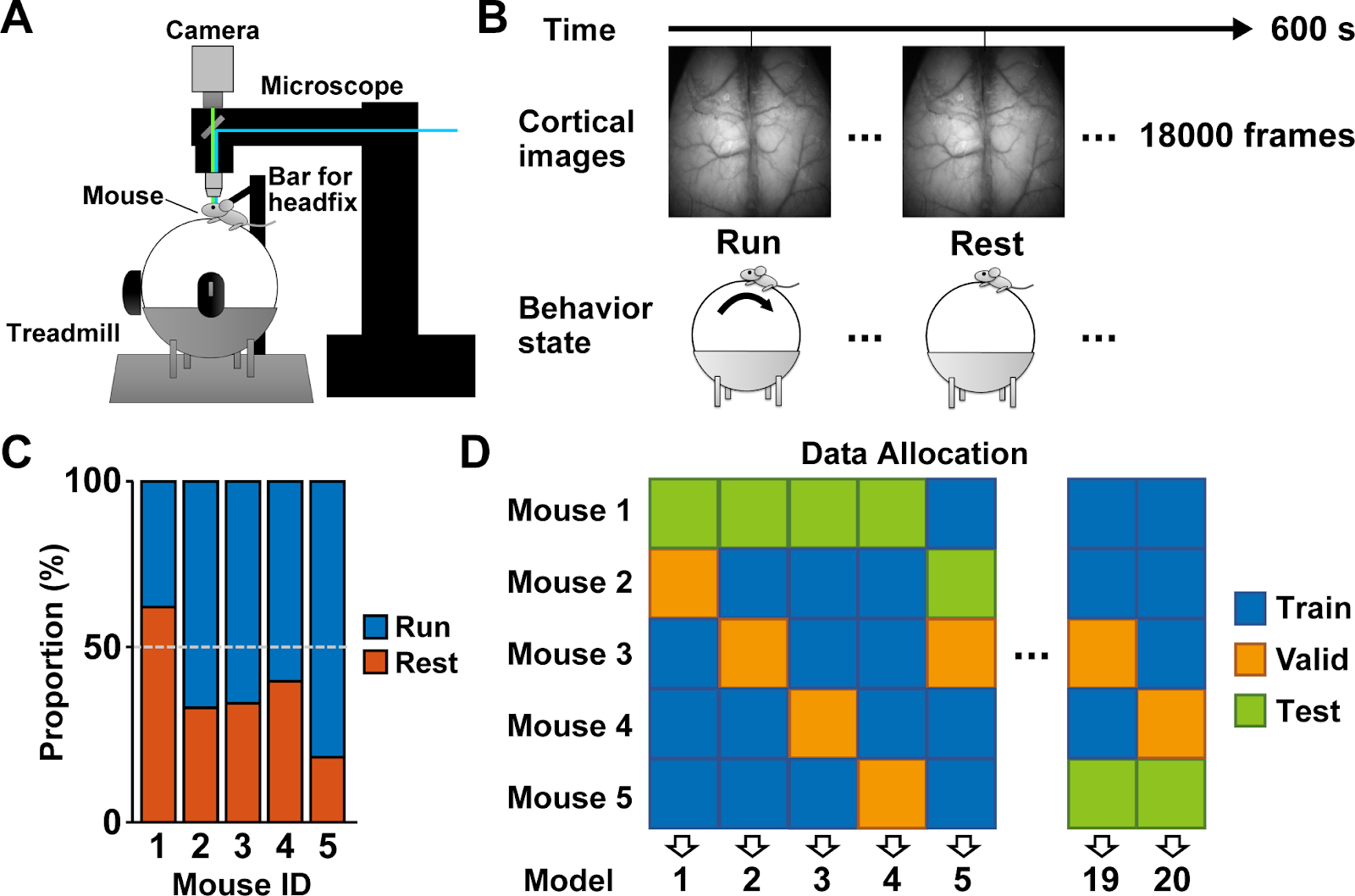
“Our experience with VR-based mouse visualization and motion tracking systems using deep learning allowed us to employ ‘end-to-end methods’. These do not require preprocessing and assess information across the entire cortex for near real-time decoding,” said project leader Takehiro Ajioka.
The innovative approach combined two deep learning algorithms for analyzing spatial and temporal patterns. Researchers applied them to brain visual data from mice in both resting and treadmill-running states. The AI model was then trained to predict the animal’s actions.
The accuracy reached 95% without the need for noise removal. Only 0.17 seconds of data is required for decoding, indicating the model’s capability for real-time predictions.
Another distinctive feature of this research is its applicability to multiple test mice. Such versatility allows the AI model to effectively filter out individual differences in brain structure and function, focusing solely on signals indicating movement or rest.
This feature highlights the potential for adapting the technology for broader and more diverse applications, including in humans.
Earlier in February, scientists from Tennessee trained a neural network to analyze mouse brain activity and report the animal’s location and direction of gaze.
Рассылки ForkLog: держите руку на пульсе биткоин-индустрии!