


Bitcoin, explained: what it is and how it works
Key points
- Bitcoin is a decentralised system built on a software protocol and on peer-to-peer exchange between users.
- All transactions on the Bitcoin network are recorded on a distributed ledger—the blockchain—whose copy is stored on a full node connected to the global network. Blockchain data are regularly verified by the Proof-of-Work consensus algorithm.
- The network’s native unit, bitcoin (ticker BTC), is the first and best-known cryptocurrency. Since its creation, bitcoin has remained the largest cryptocurrency by market capitalisation.
- Bitcoin operates without a supervisory authority or central bank; coin issuance and transaction processing are carried out collectively by network participants. No one can control Bitcoin, block, or reverse a transaction. Anyone can join the network, use it to send payments, or contribute to Bitcoin’s code.
Bitcoin’s main innovation
Bitcoin was created as an open-source digital payments system. Its principal breakthrough—and its value—lies in creating, for the first time, a self-sustaining, reliable and decentralised system for transferring value.
Any bank or similar financial institution is a centralised entity. Its operator’s work is typically opaque to users (customers), which requires them to trust it with their money. Centralised structures are vulnerable to error, abuse and fraud.
Bitcoin addresses these problems because it is a decentralised system built and maintained by its participants without a central operator. All balances are public (though real-world identities are concealed), and the network protocol contains mechanisms that regularly check the correctness of all data.
The Bitcoin network consists of nodes—computers connected into a single network and running special software. Each node stores and updates a copy of the Bitcoin blockchain. Transaction confirmation, the creation of new blocks and validation of a single version of the blockchain are achieved via a consensus algorithm called Proof-of-Work.
The data for all transfers and the balances of all bitcoin addresses are stored in a decentralised ledger—the blockchain. It is a database that forms a continuous chain of blocks, each of which records new transactions.
The role and purpose of the cryptocurrency
The key element of the traditional economy that bitcoin’s anonymous creator sought to fix was money. In today’s world, national currencies—fiat money—are issued by states. They are centralised and have well-known drawbacks. Above all, their value depends on the actions of, and confidence in, the issuer. Fiat money is also subject to constant inflation, that is, debasement.
Hence, transfers on the Bitcoin blockchain are not made in fiat but in a special unit of account—a cryptocurrency. Its chief function is to serve as the medium for transferring value within the Bitcoin network. That value can be reckoned in any convenient unit, such as a national currency, which is how bitcoin’s price is formed. The price of the first cryptocurrency is determined not by a central bank or a single organisation, but by users and investors in an open market.
In other words, bitcoin’s price is set not by a state, central bank or single authority, but by coin holders themselves. Some researchers also attempt to estimate bitcoin’s intrinsic value.
Note that bitcoin was initially conceived as a replacement for fiat money. Although the first cryptocurrency is used for payments, today many view bitcoin more as a valuable investment asset.
How to ‘open an account’ in bitcoin and make transfers
Joining the project known as Bitcoin is even easier than becoming a bank customer. Start by downloading and configuring a wallet—a piece of software that lets you create addresses on the Bitcoin network and make transactions, i.e., receive coins or send them to other addresses.
Creating and managing an address on the Bitcoin blockchain does not require cumbersome, lengthy identity verification with document uploads. Creating an address takes just a few clicks in the wallet interface.
An address on the Bitcoin network is akin to a universal bank account. As the protocol evolved, several new address formats appeared on the Bitcoin blockchain. With minor exceptions they are largely compatible. Choosing a more modern format can reduce transaction costs. Which bitcoin address format to choose is covered in a ForkLog article:
Under the hood, however, are complex cryptographic methods. When a new address is created, its owner receives a pair of keys: a public key and a private key. The latter also grants access to the balance and is intended for its owner only.
After setting up a bitcoin wallet and creating an address, you need to buy your first bitcoins. How to do this is covered in our guide:
Every transaction on the Bitcoin network carries a small fee, which is distributed among miners responsible for confirming and executing transfers.
Who invented Bitcoin, and who develops it now
The concept of Bitcoin was first described in a white paper published on 31 October 2008. Its author used the pseudonym “Satoshi Nakamoto”; it remains unknown who is behind the name—an individual or a group of developers. All of Nakamoto’s messages, publications and other “digital traces” can be read on the Satoshi Nakamoto Institute website (in English).
The Bitcoin network was launched on 3 January 2009, but the project’s official birthday is considered to be 9 January, when the node software was released publicly.
From mid-2010 Nakamoto stopped participating in Bitcoin’s development. Since then, development and coordination of the network’s functioning have been handled by the developer community. A specific proposal to improve the Bitcoin code is called a Bitcoin Improvement Proposal (BIP).
This does not mean only developers decide the direction of Bitcoin. Significant changes to the protocol are possible only after most mining pools agree to them.
How bitcoin’s price has changed
When the Bitcoin blockchain launched in 2009, the first cryptocurrency had no market value. By May 2010 its price had risen to 10 cents. Each year on 22 May the crypto community marks Bitcoin Pizza Day: on that day in 2010 a famous pizza purchase was made for 10,000 BTC.
In April 2011, 1 BTC was worth $1; within a couple of months, on June 7th, its price reached almost $30. It then fell, dropping to $2 by mid-November 2011. The year 2012 was quiet, but 2013 saw the first bull run: if in early January 1 BTC fetched a little over $13, by December its price had soared to a record $1,237 before retreating to below $700. Throughout 2014 the price declined, reaching $315 by early 2015.
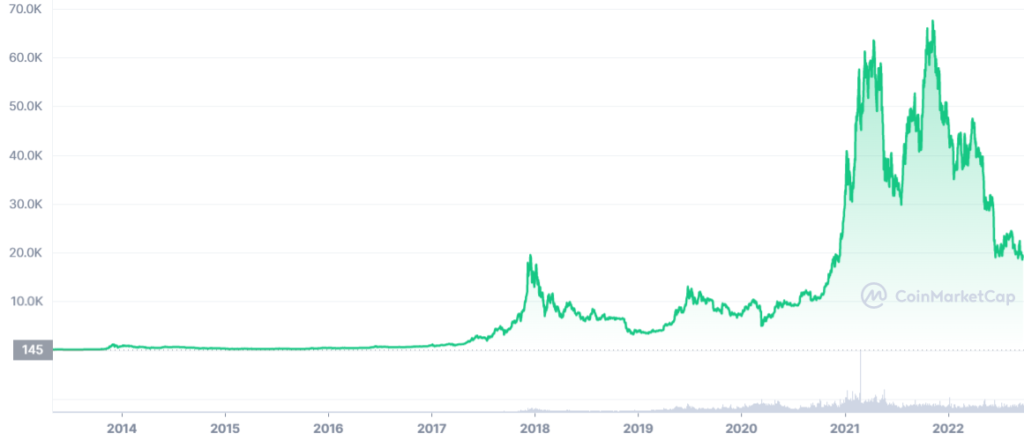
Bitcoin’s second major rally came in 2017. If in early January 1 BTC traded around $1,000, from April the price climbed sharply: to $2,500 by early June, then above $4,000 in August and $7,000 in October. In late 2017 and early 2018 the price on some exchanges nearly reached $20,000. It then fell swiftly to around $10,000 and continued to decline through 2018, bottoming in December a little above $3,200. A recovery in the crypto market followed.
By the end of June 2019, 1 BTC was worth almost $12,000. After several local pullbacks followed by an uptrend, bitcoin again approached $12,000 by October 2020.
Another bull run followed, taking the first cryptocurrency to a new peak—$63,000—by April 2021. Three months later bitcoin had lost nearly 50% of its value, but the price then resumed its climb. On November 9th 2021 bitcoin hit a new high of $69,000. A correction ensued, with brief recoveries in late March 2022.
Global economic and political instability hit financial markets and weighed on the first cryptocurrency’s price, which had fallen to around $20,000 by autumn 2022.
How many bitcoins exist, and where new coins come from
New bitcoins are generated each time a new block is successfully mined. The pace of block creation is steady: six per hour. The block reward—and thus the rate of new issuance—periodically falls in a process known as the halving, which occurs roughly every four years.
Bitcoin’s issuance schedule is precisely defined, and the total number of coins that will ever exist is known: 21 million. The final issuance is expected around the year 2140.
The appearance of new bitcoins can be likened to money issuance, except that instead of state agencies printing new banknotes, the cryptocurrency is produced by users themselves. This process is called mining. It relies on computers solving complex mathematical problems. These computers are spread across the globe, and miners band together in pools for efficiency. They receive a defined reward for their work.
Thanks to these economic incentives—cryptocurrency rewards distributed automatically among participants—Bitcoin’s network has run without interruption since its launch in January 2009.
Is bitcoin a pyramid scheme?
No. A classic pyramid, which promises unrealistically high returns, pays participants using a continual inflow of new money. Payouts come from the deposits of later entrants. When inflows slow or stop, the scheme collapses, leaving only a small number “in the black”.
Bitcoin promises investors no returns. Its only promise is full control over one’s own funds. And even if one assumes that demand from newcomers or professional investors can push the price up, early participants receive no dividends from later ones.
Finally, Bitcoin’s distributed nature means there is no single central entity that could extract financial gain.
What gives bitcoin value
Some say bitcoin’s price is not backed by anything. As James Rickards, author of the bestseller “Currency Wars”, notes, every currency in monetary history is backed by trust; the same holds for cryptocurrencies. In the bitcoin community this trust is called consensus.
Bitcoin’s value also derives from its network effect: the more participants, the higher the price. As an experimental technology, bitcoin is subject to large price swings, which traders and ordinary holders seek to exploit.
Scarce issuance is another source of value. Moreover, the first cryptocurrency introduced the world to blockchain—the rapidly spreading technology of distributed ledgers.
Is bitcoin anonymous?
This is another common misconception. It is more accurate to call it pseudonymous. In other words, anyone can see the movement of funds and the current balance of an address, but linking them to a specific person is difficult.
With sufficient effort, however, it is possible to trace the sender’s IP address, even though it is not stored on the blockchain. For example, operators of some wallet providers’ servers may have such information.
By now, effective tools for transaction analysis have been developed. Their functionality allows cryptocurrency firms to assess counterparties instantly and determine whether they are handling funds previously used in illicit financial activity.
Further reading
Mt. Gox exchange: the biggest hack in cryptocurrency history
How does the Fed’s policy rate affect crypto prices?
What is a Layer-2 solution in blockchain?
What is Ripple and the XRP cryptocurrency?
Рассылки ForkLog: держите руку на пульсе биткоин-индустрии!