



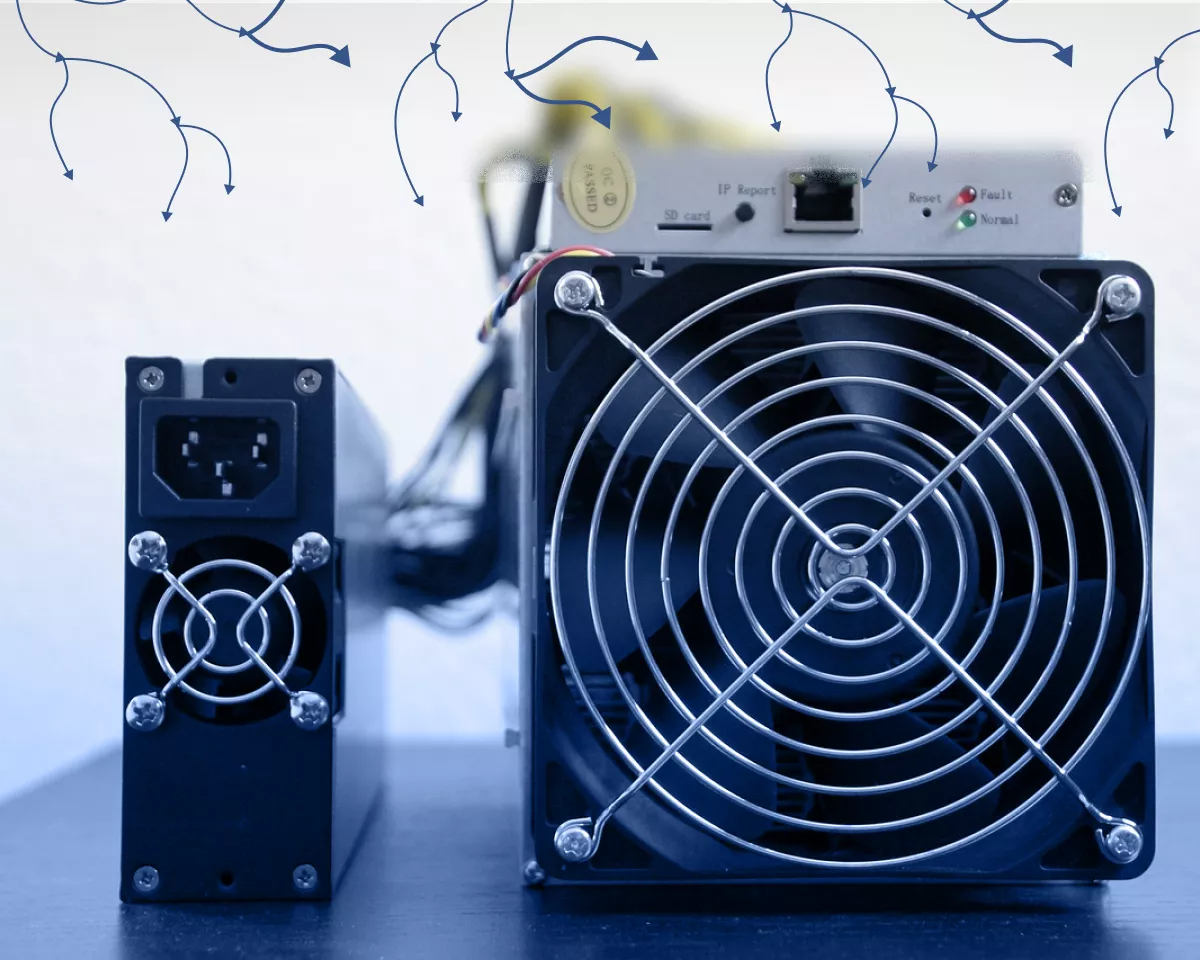
As April 9 approached, major American bitcoin miners chartered flights from Southeast Asia at a cost of $2-3.5 million, a figure 2-4 times higher than usual rates, reports Blockspace.
Cryptocurrency miners were eager to import ordered ASIC miners before the “liberating” tariffs of U.S. President Donald Trump took effect.
The information was confirmed to the publication by Synteq Digital CEO Taras Kulik and Luxor COO Ethan Vera. The rush among miners was specifically related to equipment export, with factories working overtime to fulfill orders as much as possible, the experts noted.
On April 2, Trump announced new tariffs for trade partners. A minimum of 10% for all countries took effect on April 5.
For several U.S. partners, “reciprocal tariffs” were introduced from April 9. Specifically, rates were increased for Malaysia (24%), Thailand (36%), Indonesia (32%), Taiwan (32%), and for China, it ultimately reached 104%.
The first three jurisdictions host assembly plants of major miner manufacturers: Bitmain, MicroBT, Canaan, Bitdeer, and Auradine. Taiwan’s TSMC supplies most of the chips that underpin the installations. However, semiconductors are currently exempt from the new tariffs.
In 2023, MicroBT opened miner production in the U.S. Bitmain made a similar move in January this year. However, these facilities cover only a small portion of the necessary volumes.
Impact on the U.S. Mining Industry’s Global Position
In 2024, American miners imported equipment worth over $2.3 billion. In the first quarter of this year, the figure exceeded $860 million. The country’s share in bitcoin’s hash rate is 35-40%.
Experts estimate that due to tariffs, prices for ASIC miners will rise by 22-36%.
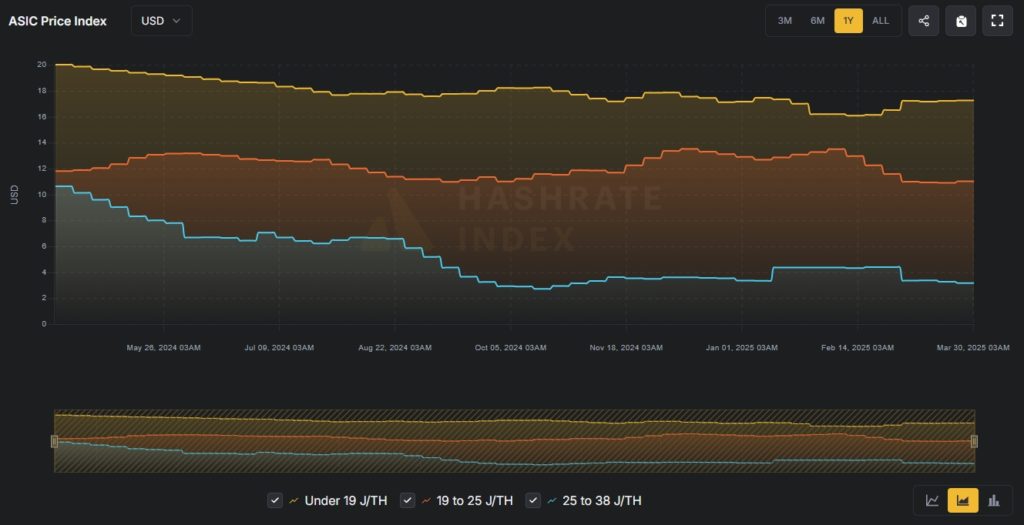
According to Hashrate Index, over the past 12 months, the cost of installations with a power consumption coefficient of up to 19 J/TH has decreased. The latest Antminer S21 series from Bitmain costs approximately $3400.


Kulik expects that new import tariffs will affect mining equipment prices by the end of this week. The price increase will also impact a significant range of electrical equipment for data centers manufactured in China.
According to Vera, in the medium term, tariffs will be a “major blow” to the bitcoin mining sector in the U.S., which “will undoubtedly lead to stagnation in industry growth.”
“If you pay 26% more for an installation than a competitor in Canada or Russia, it’s hard to compete globally,” the expert emphasized.
“Shall We Move North?”
Kulik agreed with Vera’s viewpoint, noting that moving business “north of the wall”—to Canada—could become attractive for American miners.
There, plans are underway to reduce corporate taxes and capital gains rates. The frontrunner for the premiership in the upcoming elections, Mark Carney, has expressed support for the energy industry and the expansion of the data center sector.
However, earlier, mining development in the country encountered bans on connecting new capacities in the provinces of Quebec and Ontario due to infrastructure unpreparedness. Restrictions remain in place.
Kulik believes that one of the directions for American miners’ migration could be Northern Europe. Vera thinks that “several gigawatts of opportunities” can be found in South America and Africa.
Nevertheless, in all these cases, growth will be limited if miners cannot economically deploy equipment in the U.S., the expert acknowledged. The consequences will be similar to the mining ban in China in 2021. At that time, a significant share of the hash rate moved to the United States, and now it is likely to migrate to other countries.
“International miners will benefit, as they will likely gain access to installations at much lower prices than now, as they won’t have to compete with high demand from the U.S. industry,” Vera predicted.
According to experts, as a result of the tariffs, acquiring existing enterprises may become a more accessible way to expand business in the United States. Consequently, facilities even with old “zombie equipment” will become attractive for acquisition, and their prices will soar, Kulik noted.
During his campaign, Trump called himself a “crypto president,” promised to make the U.S. the “world capital” of the digital asset industry, and globally protect the mining sector.