




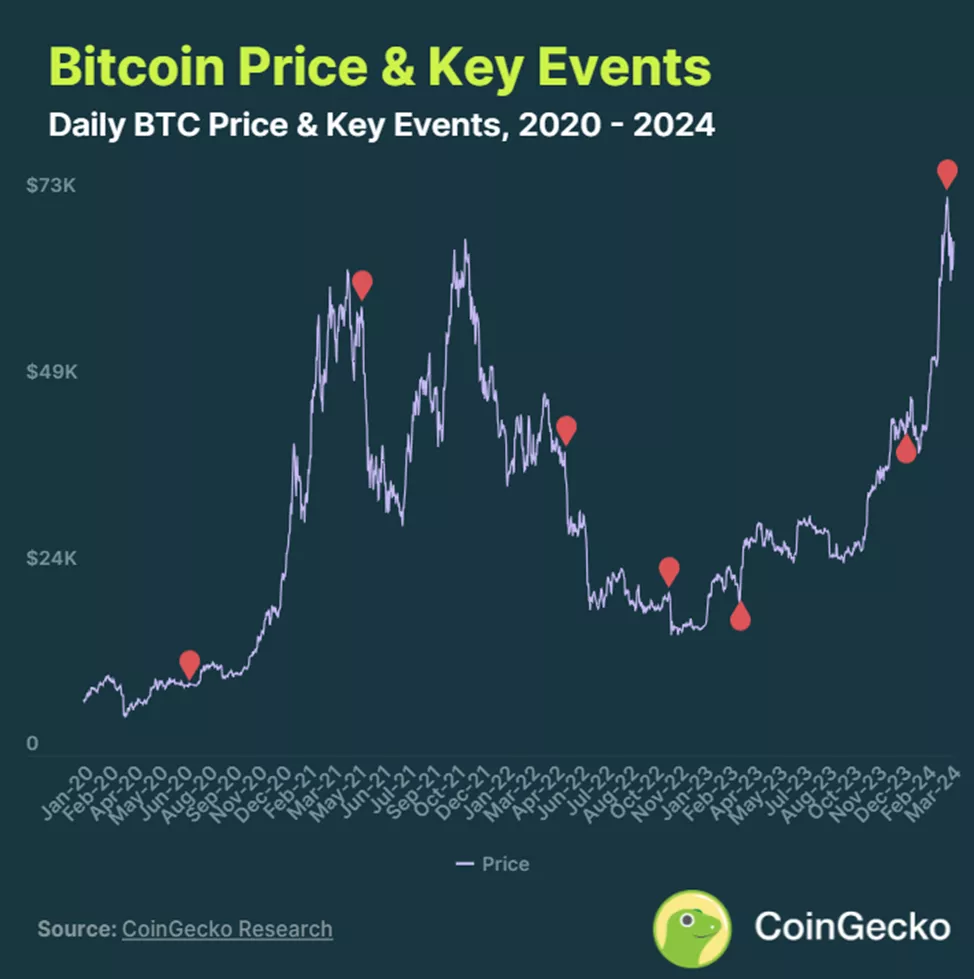
The value of the leading cryptocurrency increased by an average of 3230% in the 12 months following a halving, according to estimates from CoinGecko.
How has Bitcoin price performed after each halving?
Our latest study shows that, on average, #Bitcoin price returned 3,230% gains within one year after each halving event.
Read the full study: https://t.co/ZHcPyv3JDJ pic.twitter.com/YZP8nT7od7
— CoinGecko (@coingecko) April 2, 2024
The dynamics are as follows:
- After the first halving on November 28, 2012, the price of digital gold surged by 8858% over the next 12 months, rising from $12 to $1075. Inflation decreased from 25.75% to 12%.
- Following the second halving on July 9, 2016, prices increased from $650 to $2560, a 294% rise over the same period. Inflation rates fell from 8.7% to 4.1%.
- The third halving on May 11, 2020, led to a 540% increase in prices, from $8727 to $55,847. Inflation slowed from 3.7% to 1.8%.
Analysts noted that the calculations indicate a decline in returns with each subsequent halving of miners’ rewards. The more pronounced growth after the third halving compared to the second was attributed to a dramatic increase in the money supply due to the ultra-loose policy of the Federal Reserve.
The Impact of Halving
Experts highlighted that the halving of miners’ rewards serves as a mechanism to curb inflation.
Unlike fiat currencies, the rate of increase in the supply of digital gold is predictable, unchanging, and follows a downward trajectory with each halving.
As the influx of new coins decreases, the price of existing ones becomes more attractive. With the increasing number of bitcoins in circulation, pricing becomes more efficient.


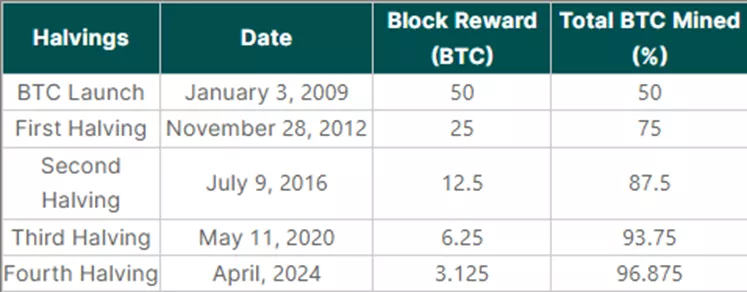
To date, miners have extracted 19.6 million BTC out of 21 million BTC (93.3%) with an inflation rate of ~1.74%. According to experts, this suggests that the price of bitcoin will rise if demand exceeds the current supply increase rate of 1.74%.
This will also hold true after the fourth halving (approximately April 20), if demand outpaces inflation, which will drop to less than 1%.
Market Dynamics
Analysts identified additional factors influencing the price of the leading cryptocurrency:
- sell order overhang;
- perception of bitcoin;
- global market liquidity;
- regulation;
- macroeconomic conditions;
- market events.
Seller Activity
Ahead of the fourth halving, bitcoin reached a new all-time high above $73,700, driven by the excitement surrounding ETFs.
Analysts provided data indicating that by March 25, ETF issuers had accumulated 4.2% of all mined coins.
Experts suggested that miners might sell bitcoins due to rising mining costs. They also noted the threat of distribution of 200,000 BTC ($13.9 billion) by Mt.Gox clients.
An additional factor to be assessed is the expected reduction of the Federal Reserve’s key rate in May or June.
“The positioning of digital gold has never been safer. ETFs will attract a new generation of investors and a new marketing impulse. Fiat currencies will continue their rapid devaluation due to the debt-based monetary regime. This makes bitcoin a unique proposition for investors, as its supply is predetermined and independent of demand,” concluded the experts.
Below are the parameters of miners’ rewards and the amount of BTC mined at each halving event.

In Bernstein, it was considered that a correction to around $63,000 was a good buying opportunity for digital gold “at the lows” before the halving. Subsequently, experts revised the bitcoin forecast from $80,000 to $90,000 by the end of the year.
Previously, Morgan Creek Capital CEO Mark Yusko predicted a “parabolic” rise in the price of the leading cryptocurrency after the event. In his view, the price will reach $150,000 by the end of the year.