


ChatGPT challenges a fine, Google unveils an AI supercomputer and other AI news
We aim to inform readers not only about events in the Bitcoin industry, but also about developments in related tech spheres — cybersecurity and the world of artificial intelligence (AI).
ForkLog AI has gathered the most important AI news from the past week.
- The Stanford Institute for Human-Centered AI published a report on AI trends.
- Google will move Bard to the PaLM language model.
- Turnitin developed a detector for AI-generated texts.
- ChatGPT helped a student dispute a fine.
- FIFA released a mobile AI-powered game.
- UMPG obtained removal of a deepfake Eminem singing about cats.
- The week’s most notable AI deals.
Researchers publish a global AI trends report
The Stanford Institute for Human-Centered AI, in a report for 2023 on AI trends, published its findings.
The 386-page document analyzes foundational models. It also contains information on the environmental impact of AI systems, training models under the K-12 system, and public opinion of the technology.
Key takeaways from the report:
- Over the past decade, industrial R&D has pulled ahead of academia by a wide margin, and there are no signs this will change;
- Testing models on traditional benchmarks has become more challenging. A new paradigm may be needed;
- AI is both helping and harming the environment;
- Since 2012, the number of incidents of misuse of the technology has risen 26-fold;
- The list of AI-related job openings is growing across nearly all U.S. industrial sectors;
- The number of laws mentioning AI in 127 countries grew from 1 in 2016 to 37 in 2022;
- Private investments in AI temporarily declined;
- 78% of respondents in China, Saudi Arabia and India believe AI brings more benefits than drawbacks. In the U.S., only 38% agreed.
Google will move Bard to the PaLM language model
In the coming days, Google will move Bard from the LaMDA language model to the more powerful PaLM algorithm.
According to Sundar Pichai, the update will give the chatbot greater capabilities, whether in logical reasoning, code writing, or solving mathematical problems. Users will soon see progress, he added.
LaMDA has 137 billion parameters, while PaLM has 540 billion. The company is upgrading Bard with a model built on a larger data set and more diverse responses.
Pichai noted that he is not worried about Google’s AI progress relative to rivals. The company deliberately launched the chatbot on the less powerful LaMDA — which requires modest compute resources — enabling more users to try it and provide feedback.
He said the company will not launch a more powerful model until it is confident it can “move quickly to take the necessary actions.”
“Wikipedia” to employ AI to generate articles
Wikipedia founder Jimmy Wales is considering using AI to write articles.
He says large language models (LLMs) like GPT can compare materials, seek contradictory viewpoints, and identify parts of pages that require authors’ rewrites. Algorithms could also draft potentially useful articles using information from the internet, the entrepreneur added.
Wales said that using AI “to triple the number of published articles” would increase Wikipedia’s current costs by less than $1,300 per year.
But he noted the tendency of algorithms to hallucinate and fabricate facts. He said the reputation of an online encyclopedia hinges on accuracy, and this is a major challenge for LLMs. It is also unclear whether AI will resolve or worsen systemic, unconscious bias among authors, he added.
Meta unveiled an image and video segmentation tool
Meta unveiled an AI model Segment Anything (SAM) for detecting objects previously unseen in images and video. A demo is available on the company’s site.
The algorithm is trained on the SA-1B dataset, containing 11 million images and 1.1 billion masks. Meta said this is the largest segmentation dataset in history.
SAM uses a variety of input prompts. Users can select specific elements by clicking on them or by using text prompts. The algorithm can also automatically segment all objects in images and generate multiple masks for ambiguous prompts.
Furthermore, the neural network can work with other models. According to the company, in the future the technology will allow recreating elements from AR/VR headset visions or reconstructing objects in 3D.
SAM and SA-1B are available for download under a non-commercial licence.
Google unveiled a supercomputer for training AI models
Google unveiled the AI supercomputer TPU v4. Google says it is 1.7 times faster and 1.9 times more energy-efficient than rivals built on Nvidia’s A100 chips.
The system comprises 4,096 fourth-generation TPU tensor processing units. The chips are integrated with custom components designed for running and training AI models. The system was launched in 2020 and used to train the PaLM language model over 50 days.
However, researchers did not compare the fourth-generation TPU with Nvidia’s flagship H100 chips. The latter arrived later and were manufactured with a newer process technology.
Google hinted that it is working on a competitor to the H100 but provided no details.
Turnitin developed a detector for AI-generated texts
Turnitin’s plagiarism-detection system was trained to identify AI-generated text in student papers.
According to the press release, the detector’s accuracy for AI-generated content, including text produced by ChatGPT, reaches 98%. Turnitin notes that the company spent more than two years developing GPT-3 detection technology.
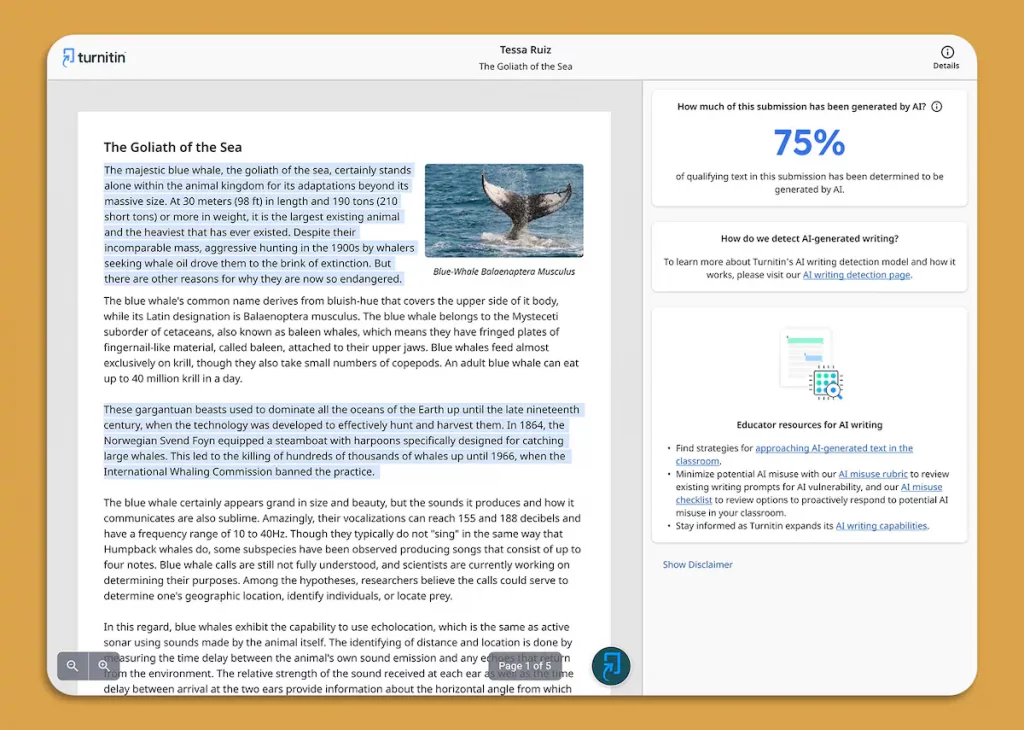
But Washington Post reporters, after testing the tool, said the system’s performance in yielding fewer than 1% false positives is still “insufficient.”
It is not clear how Turnitin verified the AI detector’s accuracy and its ability to detect text generated by different language models.
The company also launched a site for instructors. It contains guidance on academic integrity policies in the AI era and information on progress in AI tools.
ChatGPT helped a student dispute a fine
In the United Kingdom, student Millie Houlton used ChatGPT to dispute a parking fine.
She used the bot to draft a response to a York City Council notice. The student noted that she had paid for parking in the location two years ahead but did not know how to dispute the erroneous $74 fine.
Houlton fed the AI all necessary data, including the parking location and time, a link to the council notice, and reasons why the penalty was wrong. In a few minutes, ChatGPT generated an “ideally tailored personal response.”
As a result, authorities cancelled the fine.
FIFA released a mobile AI-powered game
The Fédération Internationale de Football Association (FIFA) and Altered State Machine Studios launched the mobile AI-powered game AI League. The beta is currently available on Android, with an iOS release planned soon.
AI League is a casual 4 on 4 soccer game with AI characters. Players act as coaches and team owners.
Each AI footballer is assigned unique traits that determine their strengths and weaknesses. In the future players will be able to swap characters and assemble a team with the required talent mix.
Hepburn Shire Mayor to sue OpenAI over ChatGPT defamation
The Australian politician intends to file the world’s first defamation lawsuit against ChatGPT.
Hepburn Shire Mayor Brian Hood said he will take the matter to court if OpenAI does not correct the AI’s false statements about him. The chatbot had allegedly named the head of the municipality as involved in a bribery scandal with a subsidiary of the Reserve Bank of Australia in the 2000s. It also claimed that as a result of this incident the mayor served time in prison.
Hood indeed worked for the subsidiary Note Printing Australia and notified the government about bribes paid to foreign officials to secure currency printing contracts. But, according to lawyers, he was not charged with any wrongdoing.
Lawyers said they sent OpenAI a letter on 21 March 2023 demanding that the error be corrected within 28 days or the company face a defamation suit. The AI lab has not yet responded to their request.
UMPG obtained removal of a deepfake Eminem
The Universal Music Publishing Group (UMPG) filed a complaint over a video featuring an AI-generated Eminem song about cats, voiced by a synthesized Eminem voice, for copyright infringement.
YouTuber Grandayy created a track using ChatGPT. The chatbot wrote lines including: “cats, cats, they’re always on the hunt”, “cats—kings of the house, they rule with purring” and “meow, meow, meow.”
In the complaint, UMPG stated that using Eminem’s AI voice in the video infringes its copyright. YouTube issued a warning to the creator and removed the clip. However, clips from the track can be found on other videos on the platform.
Universal Music Group just decided to copyright strike my AI Eminem Cat Rap video. Usually they just claim and monetize videos like this but they really wanted AI Eminem to be taken down for some reason. pic.twitter.com/2ky4AYOf8U
— Dr Grandayy (@grandayy) April 2, 2023
For content creators, receiving three copyright warnings means channel blockage, removal of all videos, and a ban on posting new content.
Grandayy said his videos are simply humorous parodies that do not harm the original art, and perhaps even help it. So it is “sad to see” when the recording label removes such videos, the YouTuber added.
He also added that the block is a sign that creating AI-generated video parodies has become risky.
The week’s most notable AI deals
From 2 to 8 April 2023, AI startups raised over $253 million. Here are the most interesting deals.
- Quantexa raised $129 million to expand AI-driven online fraud alerts and data governance for public and private sectors.
- Smart robotics maker Covariant raised $75 million.
- Chatbot queries dailogue Perplexity AI raised $26 million.
- Mojo Vision raised $22.4 million to commercialize the world’s smallest MicroLED displays.
- Narrato raised $1 million to develop a generative AI platform for content creation and management.
Also on ForkLog:
- In Italy blocked ChatGPT.
- Twitter published source code of its recommendation algorithm.
- European regulators took a hard line against ChatGPT.
- Bill Gates criticised the idea of pausing AI research.
- Biden called concerns about AI premature.
- Sundar Pichai: Google will add a conversational AI to search.
- Media: Samsung employees leaked secrets of ChatGPT.
- Microsoft added image generation to Edge for all users.
- Peter Schiff praised ChatGPT for choosing gold over Bitcoin.
What to read this weekend?
What is ChatGPT? How to register an account? What are the pros and cons of the chatbot? We explore these in ForkLog AI’s educational cards.
Рассылки ForkLog: держите руку на пульсе биткоин-индустрии!