


ChatGPT: what it is and how to use it
Key points
- ChatGPT is an AI chatbot capable of conversing on a vast array of topics.
- The tool understands and generates text in most widely used languages, including Russian and Ukrainian.
- Its advantages include flexibility, scalability, accessibility and ease of use.
- Drawbacks include outdated data, moderation limits and the potential to produce inappropriate content. Critics also fear ChatGPT will take jobs.
- Its success has spurred alternatives, including Google’s Bard and Baidu’s Earnie Bot.
What is ChatGPT?
ChatGPT is a chatbot developed by OpenAI. It is built on a large language model from the GPT (Generative Pre-trained Transformer) family.
What sets ChatGPT apart from other dialogue tools is the breadth of its knowledge. The bot handles topics such as mathematics, history, geography, art, medicine, finance and cooking with equal ease. It is a general-purpose model you can ask about almost anything.
ChatGPT is available in Russian, Ukrainian, English, Spanish, German, Japanese and other widely spoken languages.
The service launched in November 2022, though its base algorithm, GPT-3, was created in 2020. In March 2023 the developers added support for the fourth version of the model.
You can register and use ChatGPT for free. A premium version offers priority access to new models, faster generation and guaranteed availability during peak demand.
An API for ChatGPT has been available since March 2023.
How does the chatbot work?
In essence, ChatGPT is an interface for GPT. Previously, using OpenAI’s large language model required API access and integration into an app; now anyone can use the service.
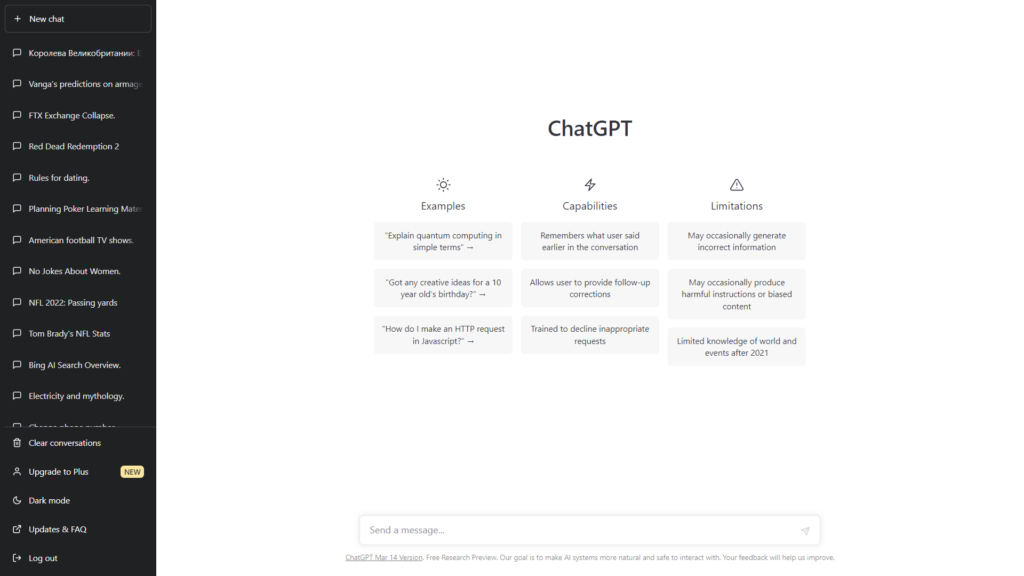
Home page ChatGPT resembles a messenger. The main window shows your conversation with the bot, with a list of chats on the left. Each thread is saved.
OpenAI launched the service as an experiment. In its announcement the firm said the bot relies on an improved version of the GPT-3.5 language model. Engineers used reinforcement learning from human feedback (RLHF).
To build the dialogue dataset, the developers enlisted so‑called trainers who conversed as both a human and an AI assistant. They were also given access to model-written suggestions to help compose responses.
To create the reward model, the OpenAI team recorded dialogues between a person and the bot. Developers then randomly selected AI responses and asked people to rank them.
What is GPT?
GPT is a large language model (LLM) also developed by OpenAI.
At the time of writing, the current version is GPT-4, released in March 2023. Unlike its predecessors, it is positioned as a large multimodal model, able to analyse not only text but also images, video and audio.
Initially, ChatGPT ran on an enhanced version of GPT-3, released in September 2020. It was trained on a 570 GB dataset and has 175bn parameters.
GPT-4 clearly surpasses its predecessors across the board. The developers have chosen not to disclose technical details.
All versions can, to varying degrees, generate text, answer questions, perform semantic search and produce summaries.
GPT belongs to the class of transformer neural networks.
How to use ChatGPT
You need an account to use ChatGPT. To register for the service, you need a valid email address and mobile phone number. You can also sign in with Google or Microsoft accounts. After successful registration you can chat with the bot.
Registration is unavailable to residents of Afghanistan, Belarus, Venezuela, Iran, China and Russia.
In February 2023 the service became available in Ukraine. However, OpenAI still does not provide services in territories temporarily occupied by Russia.
To run ChatGPT in Russia or another unsupported region, you need to use a VPN service and a phone number from the list of supported countries. It must be able to receive SMS messages for the activation code.
Access to the latest GPT-4 model requires a premium subscription priced at $20 per month.
Despite GPT-4’s stated ability to interpret images, ChatGPT does not support this feature. The company has not said when it will be added to the bot.
What can ChatGPT do?
Its text-generation capabilities are broad. It can:
- compose poems and songs;
- solve mathematical and logical problems;
- write in various styles and genres;
- summarise information;
- suggest recipes based on a list of ingredients;
- create software code;
- search for information from its own database;
- carry on a dialogue;
- adapt to the interlocutor’s style and tone.
That is far from exhaustive. Some functions, such as creating simple games, were discovered by users by chance.
The paid GPT-4 version of the bot from OpenAI offers even more use-cases.
Thanks to multimodality, the bot can process images and identify an image’s author, genre, style and other attributes. It can also provide step-by-step solutions to maths problems, perform calculations and analysis based on tables and charts, check code, help with language learning and much more. However, this feature is not yet available in ChatGPT on OpenAI’s website.
The chatbot is able to understand humour and satire embedded in text or memes. It can also produce its own ironic content.
With the fourth version of the language model, ChatGPT can process more than 25,000 words, unlike GPT-3.5, which accepts up to 3,000. The larger context lets the bot generate longer content and analyse hefty documents.
At a user’s request, ChatGPT can adopt various “roles”. For example, you can ask it to become a lawyer, financier or teacher. The persona lets it give different and more relevant answers to the same questions.
Advantages of ChatGPT
Its chief advantage is an ability to understand natural language. A user can phrase a query in almost any way, and the model will interpret it and generate a coherent, logical reply.
ChatGPT can perform a wide range of tasks such as text generation, answering questions, translation, summarisation, text classification and more.
Another advantage is its high accuracy. It handles complex queries, solves puzzles and recounts historical events.
ChatGPT is scalable. It can be deployed easily in large projects. For example, a developer shared a story in which the bot implemented a project in just 30 minutes that had taken the specialist three years.
In programming, ChatGPT can shorten application development time, as it is already trained in the necessary skills and does not require precise fine-tuning.
Among other things, the ability to connect the API to third-party products brings AI interactions to many more users.
Drawbacks of ChatGPT
Despite its many strengths, the bot has drawbacks.
As noted, ChatGPT understands Russian, Ukrainian, Spanish, German and other widely used languages. However, when handling non‑English queries it is slower. In Russian and Ukrainian the model often makes mistakes such as incorrect inflections or tautologies.
ChatGPT’s accuracy does not always meet expectations, particularly for historical events and statistics. The model was trained on datasets current to September 2021. As a result, the bot does not know about some recent events, such as the death of Britain’s Queen Elizabeth II or the collapse of the FTX exchange.
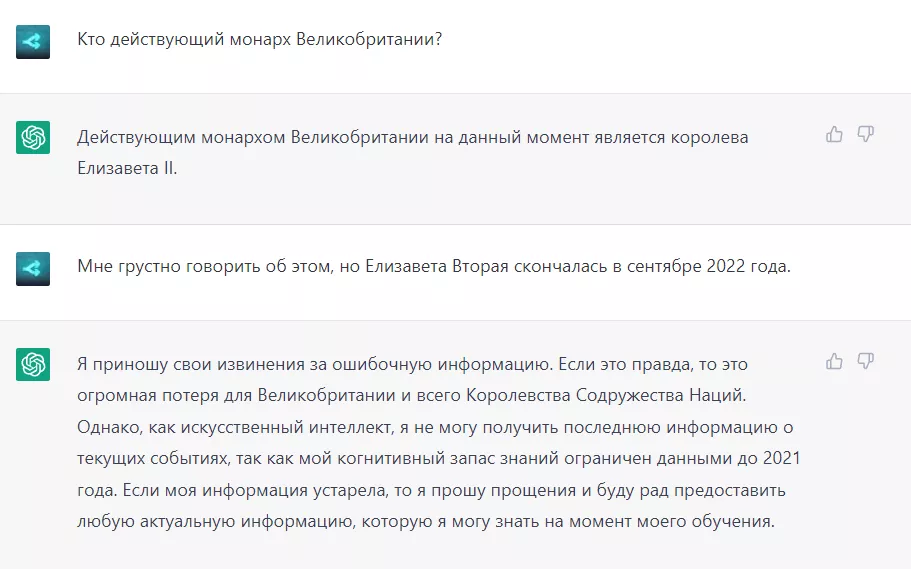
Information from the bot should therefore be checked carefully. Errors may arise not only from gaps in knowledge, but from the “hallucination” effect—a blending of data that yields false statements.
ChatGPT has no limit on the number of messages within a single conversation. However, the base model cannot produce texts longer than 3,000 words. With GPT-4 the limit rises to 25,000 words.
The service also often refuses to discuss certain topics. This stems from OpenAI’s internal constraints designed to prevent offensive and harmful text. The bot will not create provocative, racist or discriminatory content or offer tips on making dangerous or prohibited substances.
The chatbot is often unavailable because of heavy load driven by the service’s extraordinary popularity. It reached 100m active users in just two months.
ChatGPT Plus partly addresses this problem. However, the $20 price does not always justify the benefits of the subscription.
What risks does the spread of ChatGPT pose?
Despite the service’s huge popularity and versatility, the bot is frequently criticised.
Foremost is concern over ChatGPT’s ability to create convincing text. Critics fear this could fuel disinformation and propaganda.
OpenAI has acknowledged the danger and promised to develop tools to mitigate the risk.
Law-enforcement agencies worldwide also suggest that fraudsters will “arm themselves” with the technology.
In February 2023 OpenAI released a detector for generated text. But even the developers acknowledged its low effectiveness in spotting content produced by large language models.
Almost immediately after ChatGPT’s launch, the academic community in many countries voiced deep concern. Schools and universities around the world reported a sharp rise in students using the model to write essays and homework.
Academics argue this undermines students’ critical-thinking skills. In addition, the model’s inaccuracy threatens to produce academic work containing gross errors, fakes and unverified data.
In response, some universities and schools in the US, Australia, France and elsewhere banned the use of ChatGPT on their premises and devices.
The model’s scalability also heightens fears of job losses. By various estimates, the spread of language models will affect up to 300m employees in developed countries.
Some companies already use the tool in their work. Media, marketers, copywriters, analysts, programmers, lawyers and doctors—an incomplete list of professions influenced by GPT.
It is worth noting that AI will not take all the work. Labour markets have been through waves of automation before and shed obsolete professions. New jobs appeared at the same time.
This time should be no different, experts believe. In most cases language models will be another useful tool. Those who learn to use them well will only increase their productivity, which should favour pay and employment.
Alternatives to ChatGPT
One of the most accessible alternatives to ChatGPT is Bing. Microsoft’s search engine gained a new chat mode based on GPT-4 in February 2023.
Using it requires an account and joining a waitlist. Media reported that with the latest update access is granted immediately.
A direct competitor to Bing is Bard from Google. It was also announced in February, though the public release was delayed by six weeks.
To use Bard you need to join a waitlist. The dialogue AI is available only to residents of the US and UK, though a VPN allows the service to run in other countries.
In addition, in February 2023 Meta released the LLaMA large language model. It is distributed with open-source code and is available to AI researchers.
In March Stanford researchers used the algorithm to create Alpaca, a ChatGPT-like bot. They said they spent less than $600 to develop the service.
Alpaca was online for a time, but for ethical reasons the researchers turned it off a few days after launch.
Chinese companies are also trying to keep pace with Western competitors. In March 2023 the search giant Baidu presented the Earnie Bot chatbot. The company claims the service can generate text, images, video and audio.
Earnie Bot has not yet been released publicly. However, early testers rated the preliminary version highly.
Thus, in the four months since ChatGPT’s release, many technology companies have entered a new phase of AI competition. It is likely we will soon see more such tools from a variety of developers.
Рассылки ForkLog: держите руку на пульсе биткоин-индустрии!