


China Unveils Futuristic Six-Armed and Four-Legged Robots
Midea’s six-armed MIRO U and Pudu’s D5 showcase China’s robot boom.
Home-appliance maker Midea Group has developed a six-armed industrial robot, MIRO U. It is slated for deployment at a washing-machine plant in Wuxi by the end of December, reports SCMP.
Chief technology officer Wei Chang said the “super humanoid” is a potential driver of industrial productivity. It is expected to increase efficiency by 30% at the facility in the southern province of Jiangsu.
MIRO U is the third generation in the company’s humanoid robot family. It offers smooth, stable vertical lifting, can pivot 360 degrees on the spot and moves on wheels. Six bionic arms are integrated.
“The core value of MIRO U is that it goes beyond simply imitating form and enables a leap in operational efficiency in industrial scenarios,” Chang noted.
He added that the Meila series of droids, designed for commercial and household use, is undergoing final tests and will appear in the firm’s retail stores in 2026.
In recent years Midea has invested heavily in robotics. In 2017 it bought Germany’s Kuka; in 2022 it received government approval to create a State Key Laboratory for high-end heavy robots, also known as the Blue Orange Laboratory.
A four-legged bot
Chinese robot maker Pudu Robotics unveiled its four-legged D5 at an international expo in Tokyo. It walked down steps and raised its right front “paw” as if greeting onlookers.
It then rolled around the exhibition hall on wheels, skirting obstacles.
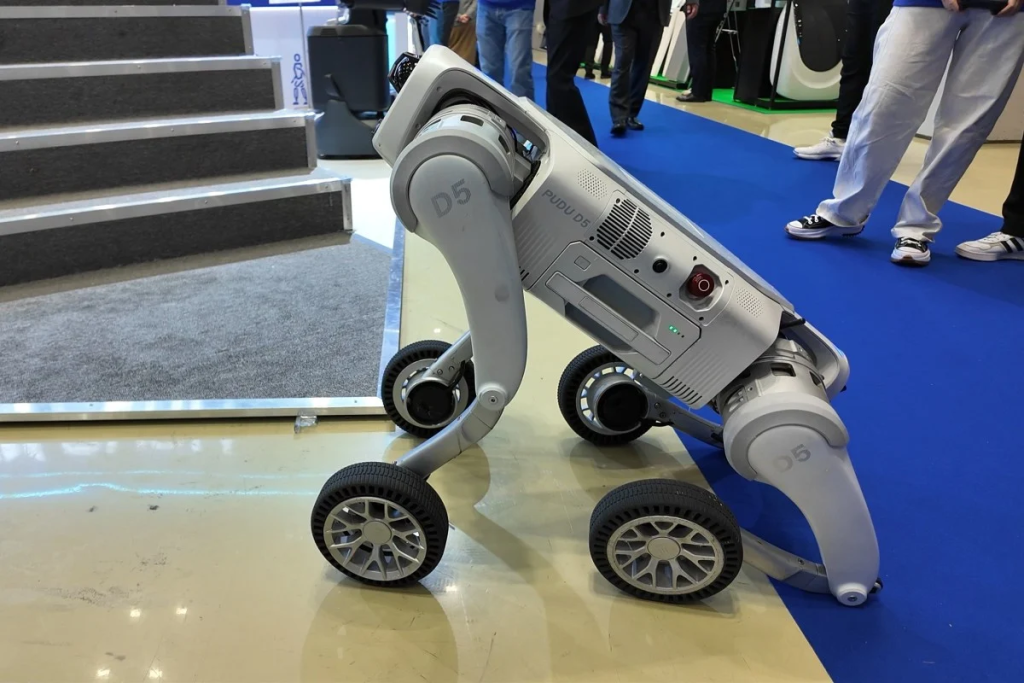
This is Pudu’s second robot-dog model after a smaller, less agile version shown in 2022. Since then, the industry has made progress in motion-control algorithms.
“Robot dogs have great application potential, from inspection and delivery to a wide range of industry functions that can be customised with high-performance computing,” said Pudu founder and CEO Felix Zhang Tao.
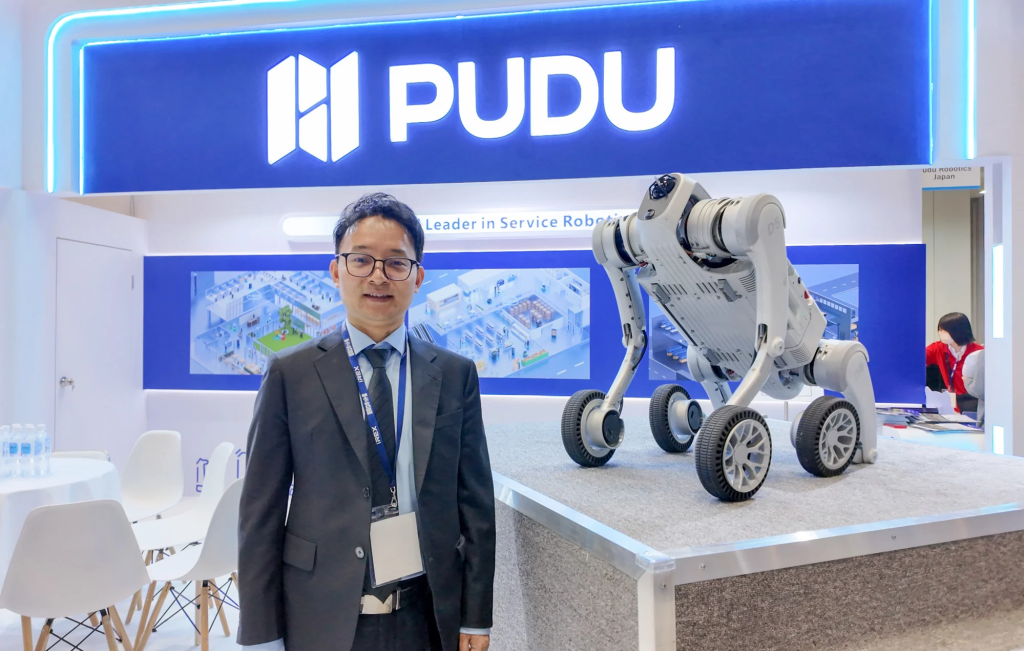
The D5 is equipped with an Nvidia Orin chip, four 120° fisheye cameras and dual front and rear LiDAR sensors. It can operate autonomously in “any conditions”.
Shenzhen-based Pudu is known for a wide range of robots that deliver food, handle cleaning or logistics. The company has sold more than 100,000 units in over 80 countries and regions.
Europe accounts for about 30% of revenue, the Americas 20%, with similar shares for the Asia-Pacific region and China.
After nearly a decade in business, the company is close to breaking even.
Robot boom
In 2025 China saw a genuine robot boom. Developers are posting eye-catching results. Bots:
In mid-March UBTech Robotics unveiled a humanoid robot priced at 299,000 yuan ($41,200).
It stands 1.7 metres tall and can move at up to 10 km/h. Tien Kung Xingzhe easily adapts to varied surfaces—from slopes and stairs to sand and snow—maintaining smooth motion and stability under collisions and external interference.
ByteDance presented a system that serves as a “brain” for bots. It enables household tasks such as hanging clothes or clearing a table.
The rapid development has worried China’s National Development and Reform Commission. It said a bubble may be forming in the robotics sector, noting a rise in similar models from more than 150 companies.
Spokesman Li Chao said the country must avoid market saturation and preserve incentives for real R&D.
Tether backs robots too
Crypto stalwart Tether is also betting on robots. It announced an investment in Generative Bionics to support the development of a new generation of intelligent humanoids.
The funds are being invested alongside other backers as part of a €70m financing round.
“Generative Bionics possesses twenty years of research in robotics. At the Italian Institute of Technology it has developed, tested and refined more than 60 advanced humanoid robot prototypes,” the Tether announcement said.
According to the USDT issuer, the “solid foundation” allows Generative Bionics “to transform Italy’s scientific excellence into real capabilities for physical artificial intelligence”.
In November, one of China’s leading robot makers, UBTech Robotics, signed a major contract to supply humanoids to border checkpoints. They will accompany travellers, conduct checks and handle logistics.
Рассылки ForkLog: держите руку на пульсе биткоин-индустрии!