


Could Solana reach $400 after Firedancer’s release?
Analysts at Bernstein forecast that Solana will lead the race to adopt on-chain payments. The view is shared by Matty Taylor, co-founder of Colosseum and former head of growth at the Solana Foundation. He believes the “parallelised” blockchain will overtake Ethereum by the number of consumer Web3 applications.
But there are snags. Amid meme fever and a surge in trading volumes on DEXs, the Solana ecosystem has often faltered, struggling to cope with an onslaught of transactions.
A new client has appeared on the horizon that could change the picture. But can it solve every problem?
- The forthcoming Firedancer client is designed to boost Solana’s throughput and reliability dramatically, which could buoy the price of its native token.
- Some experts tip SOL to reach $400 by year-end; others doubt a rapid rally and see Solana overtaking Ethereum by market capitalisation as unlikely any time soon.
- Solana still runs up against scalability limits and outages, but Firedancer may address these via parallelisation and optimised P2P communication.
Solana’s unresolved problems
Among major blockchains, Solana is the fastest—on April 6 its average daily transactions per second (TPS) hit a record 1,504 amid a meme-coin boom.
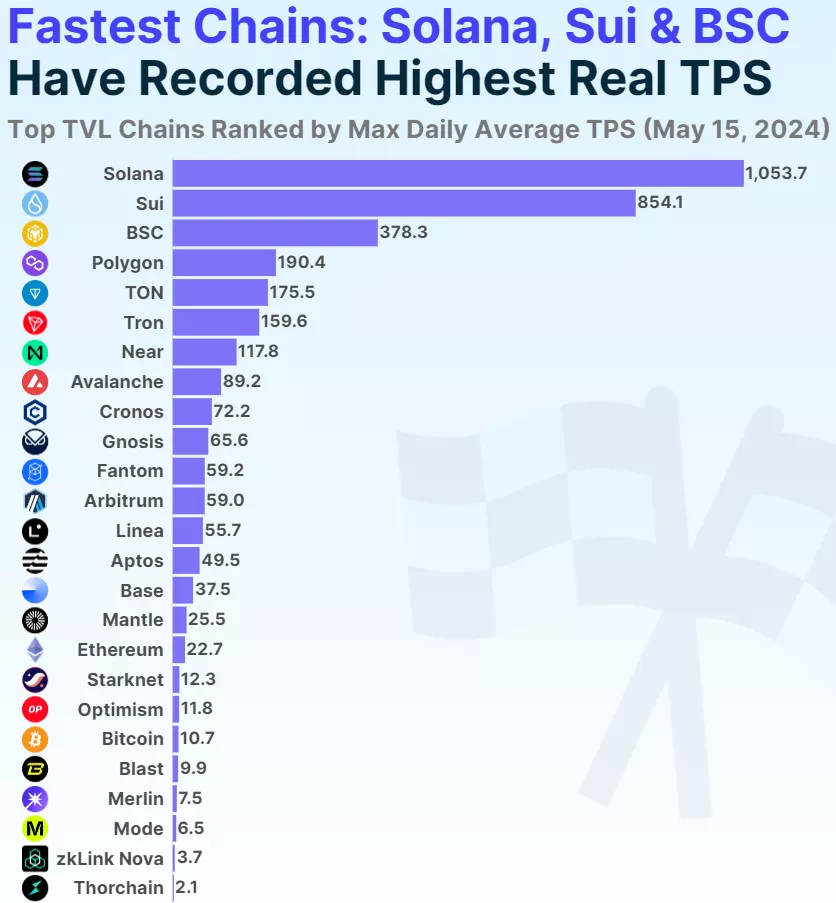
Even so, Solana has reached only 1.6% of its theoretical peak of 65,000 TPS, CoinGecko researchers noted.
Despite impressive performance metrics, the blockchain periodically stumbles under heavy load.
On 6 February, for instance, the protocol did not process blocks for almost five hours. According to Matthew Sigel, head of digital assets at VanEck, the issue was tied to the Berkeley Packet Filter mechanism, which handles application deployment and upgrades on Solana.
Experts led by journalist Colin Wu pointed out that this was far from the first outage:
- in May 2021 many transactions failed to finalise owing to unstable network performance;
- in September the network exhibited degraded performance for roughly an hour;
- in the same month, transaction volume tied to Raydium’s IDO caused memory exhaustion;
- in January 2022 activity by arbitrage bots caused a 30-hour network halt;
- soon after, the blockchain buckled under a spike in NFT transactions;
- in June a vulnerability in the nonce-signature function triggered a pause;
- in October the network failed owing to a bug in the centralised Sentry service;
- a subsequent outage was caused by a node-configuration error;
- in February 2023 the network stopped processing transactions, necessitating a restart (succeeded only on the second attempt).
“Looking back, we understand that the emergence of a large number of transactions is the main cause of the network’s historical outages, which may be related to Solana’s mechanism,” said Hu Zhiwei, president of the Boundary Intelligence Research Institute.
The diversity problem
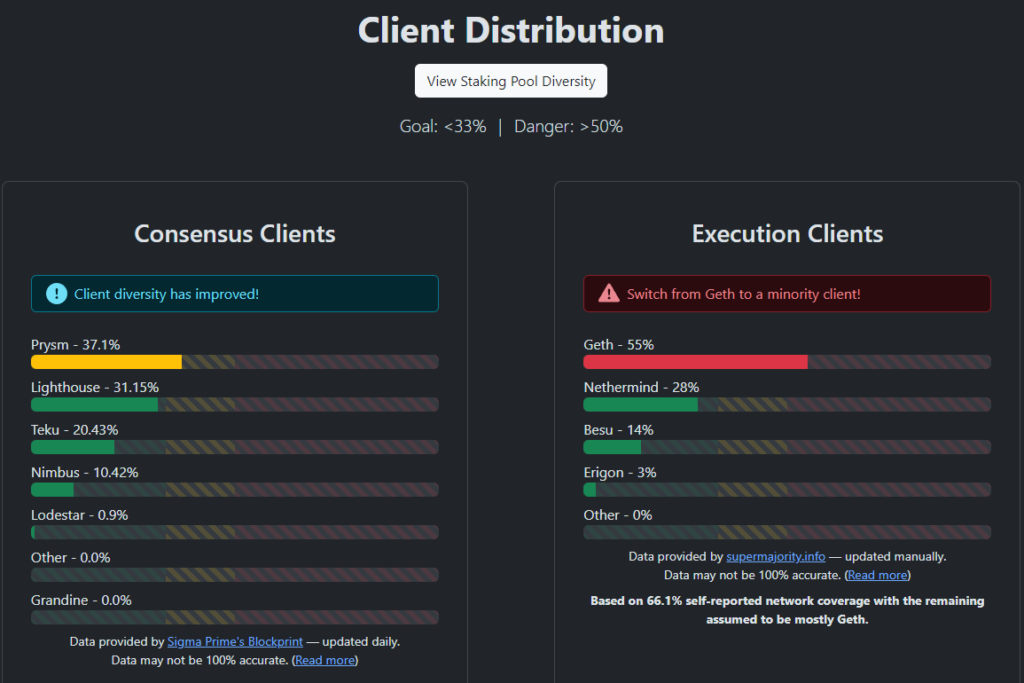
In pursuit of decentralisation and avoidance of single points of failure, projects such as Ethereum encourage third-party developers to build their own client implementations in various programming languages, so node operators have a choice.
The main advantages of this approach are:
- each client has unique code, reducing the network’s overall exposure to bugs and attacks;
- the risk of a single client manipulating transactions is lowered;
- developers can build using the language they prefer.
At present, three validator clients interact with the Solana blockchain:
- Solana Labs, written in Rust;
- Jito-Solana (a fork of the Solana Labs client, also written in Rust);
- Sig (written in Zig).
TinyDancer is also in active development. But it is a light client that does not produce blocks or participate in consensus; it simply helps users verify chain state without running a full node.
That means Solana is less resilient to attacks than its main rival, Ethereum, which is supported by a much broader mix of clients.
What is Firedancer, and how might it fix Solana?
In August 2022 the Solana Foundation and venture firm Jump Crypto joined forces to build a validator client to improve Solana’s decentralisation and performance.
Scaling is a key factor in crypto, Messari analysts argue. In their words, the Jump Crypto client is intended as an antithesis to the increasingly popular modular approach.
1/ Scalability is a key factor in the crypto space, with the modular approach gaining popularity. However, @Solana has taken a contrarian stance.@kelxyz_ explains how @jump_firedancer, a validator client developed by @jump_ aims to enhance Solana’s monolithic approach.? pic.twitter.com/zRc3Q5wSeT
— Messari (@MessariCrypto) June 6, 2023
The open-source software, called Firedancer, is built in C++ and is meant to complement the Rust-based Solana Labs client.
In tests, the new build reached 1m TPS.
2/ @jump_firedancer‘s first milestone, “fd_quic,” demonstrated impressive transaction propagation throughput of 1M transactions per second (TPS) in initial performance tests.
But there’s more work to be done to achieve the full potential of Firedancer.
— Messari (@MessariCrypto) June 6, 2023
The initiative is designed to keep the network stable if one type of client runs into trouble, and to reduce the share of staked assets tied to any single client.
Alchemy experts outlined the main drawbacks of the mainstream Solana Labs client. The “gotchas”, they said, stem from software rather than hardware limits. For example, Solana validators can process only a limited number of transactions concurrently, which can slow the system and create bottlenecks.
Evolution of Solana—or just hype?
The new Solana client targets today’s constraints and outperforms existing solutions on several fronts:
- Parallel transaction processing. Written in C and C++, Firedancer can handle more transactions concurrently, speeding the network and reducing bottlenecks. The solution rethinks the Turbine protocol, which shards data into chunks and distributes them across nodes, allowing rapid transmission and processing of large data volumes.
- Optimised P2P communication. Improved networking accelerates block and transaction propagation through compression and batching, shrinking on-chain data loads.
- Enhanced consensus. Firedancer uses a modified version of Solana’s PoS protocol that promises greater efficiency and reliability. Crucially, it complements rather than replaces the existing client.
“It [Firedancer] focuses on reducing reliance on third-party libraries and improving network communication and cryptographic functions—critical factors holding back Solana’s performance,” noted specialists at DataWallet.
Pros and cons of Firedancer
Advantages:
- performance and scalability. Supporting more transactions should markedly improve both;
- reliability. Firedancer’s optimisations make the network more stable;
- efficiency. The new client promises to lower validators’ operating costs, as suggested by the documented hardware requirements;
- open source. Openness fosters community-led development;
- fault tolerance. More clients mean fewer single points of failure and fewer network outages.
Messari’s analysts say that if successful, the Jump Crypto client could open a “blue ocean” of opportunities for the Solana ecosystem by delivering “unprecedented throughput, composability and lower costs”.
3/ If successful, @jump_firedancer could unlock blue ocean markets for the @Solana ecosystem by offering unprecedented throughput, composability, and low costs.
However, challenges in execution, timing, and competition pose risks to its adoption and success. pic.twitter.com/EYI73mZx8k
— Messari (@MessariCrypto) June 6, 2023
Experts call scalability a multi-billion-dollar question. The network that solves it will have a significant edge in winning mass adoption.
4/ Scalability is worth billions in the crypto space, as networks strive to solve scalability.
The network that cracks this challenge will have a significant advantage in achieving widespread adoption.
Validator node-to-node communications lie at the core of this problem.
— Messari (@MessariCrypto) June 6, 2023
“Node-to-node communication lies at the core of this problem,” Messari emphasised.
5/ In Web3, scalability across distributed servers and decentralized databases is a challenge.
The modular approach splits functions across chains, while the monolithic approach aims for Web2-level scalability at Layer-1.
— Messari (@MessariCrypto) June 6, 2023
According to the analysts, the modular approach splits functions across chains, whereas the monolithic approach aims for “Web2-level scalability” at layer 1.
6/ @jump_firedancer aims to achieve scalability by rewriting each component of the @Solana architecture.
It addresses transaction propagation through its QUIC implementation, fd_quic. Load balancing is achieved through hardware and software optimizations. pic.twitter.com/VjhmuKJKLI
— Messari (@MessariCrypto) June 6, 2023
“Firedancer seeks to achieve scalability by reworking every component of Solana’s architecture. It targets transaction propagation via its QUIC implementation—fd_quic. Load balancing is achieved through hardware and software optimisation,” Messari noted.
According to the company, in a performance demo TPS reached 1.08m “on just four CPU cores, surpassing Solana’s recommended 12-core setup”. Further optimisations of the consensus and execution layers are under way.
7/ @jump_firedancer‘s performance demo showcased transactions at 1.08M TPS off just four CPU cores, surpassing @Solana‘s recommended 12-core setup.
Further optimizations and scaling of consensus and execution layers are also in progress. pic.twitter.com/hnjdReyqyF
— Messari (@MessariCrypto) June 6, 2023
The firm is convinced that Firedancer will “unlock” several significant advantages.
7/ @jump_firedancer‘s performance demo showcased transactions at 1.08M TPS off just four CPU cores, surpassing @Solana‘s recommended 12-core setup.
Further optimizations and scaling of consensus and execution layers are also in progress. pic.twitter.com/hnjdReyqyF
— Messari (@MessariCrypto) June 6, 2023
First, it could make DeFi more “mature” by cutting latency, bringing it closer to centralised counterparts in speed and efficiency.
Second, the new client would benefit high-throughput financial applications and the SocialFi sector.
9/ Secondly, @jump_firedancer opens up new application possibilities by enabling Web2 applications on-chain with 1+M TPS.
This scalability would benefit high-throughput financial apps and consumer apps like social media. pic.twitter.com/iMLXQ8FgC3
— Messari (@MessariCrypto) June 6, 2023
Lastly, Firedancer will increase Solana’s reliability through client diversity, lowering the risk from bugs even if the new client hits snags.
10/ Lastly, @jump_firedancer increases @Solana‘s chain robustness by introducing client diversity.
With backup clients like @solanalabs and @jito_labs, the network can mitigate the risk of bugs and maintain performance even if Firedancer encounters issues. pic.twitter.com/giVnNIzyAE
— Messari (@MessariCrypto) June 6, 2023
Drawbacks:
- a new technology. Like any new product, Firedancer may contain bugs and rough edges;
- a learning curve. Validators will need time to master the client and adapt their processes.
Can Solana overtake Ethereum?
Ryan McMillin, chief investment officer at Merkle Tree Capital, has forecast that SOL could hit $400 by November this year. He expects a wave of US election-themed meme-coins to act as a catalyst.
He noted that assets such as Jeo Boden (BODEN) and Doland Tremp (TREMP) helped Solana overtake Ethereum by trading volume. In his view, the trend will persist over the coming months.
As of May 20, ether’s market capitalisation stood at $376.9bn, according to CoinGecko. Solana’s was $81.2bn, with SOL at $180.
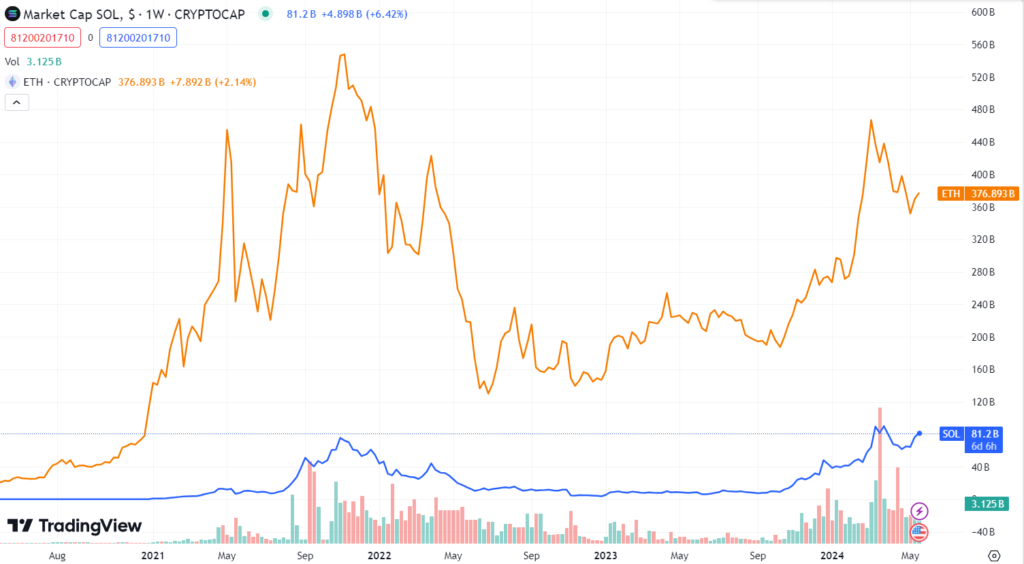
That implies that at $400 the coin’s capitalisation would top $180bn—still less than half that of its main rival and the current DeFi leader, Ethereum.
In a conversation with Cointelegraph, Austin Federa, head of strategy at the Solana Foundation, said a flippening is unlikely in the short term. But it should not be ruled out, he added, given “a potential wave of consumer-facing applications” on the L1 blockchain with Firedancer “under the hood”.
He added that he has recently seen an uptick in developers wanting to migrate from Ethereum.
“When working with Solana, everyone can write an interface in almost any programming language,” Federa emphasised, citing Rust, C and Python.
According to him, support for the Move language will appear soon.
Pranav Kanade, a portfolio manager at VanEck, stressed that Solana’s main problem, which prevents it from competing seriously with Ethereum, is insufficient client diversity. That means bugs can paralyse the blockchain—something that has happened at least ten times in recent years.
Both Kanade and Federa are pinning hopes on the upcoming upgrade.
“I see Firedancer as a key catalyst. Its successful launch will be a breakthrough for the network and could narrow the valuation gap between ETH and SOL, up to a potential flippening. If not, the modular roadmap of the second-largest cryptocurrency will catch up,” the VanEck executive said.
However, Kanade acknowledged that, thanks to ether’s longer track record and vast developer community, new projects still tend to choose it and its layer-2 ecosystem. Solana has a long way to go to catch up.
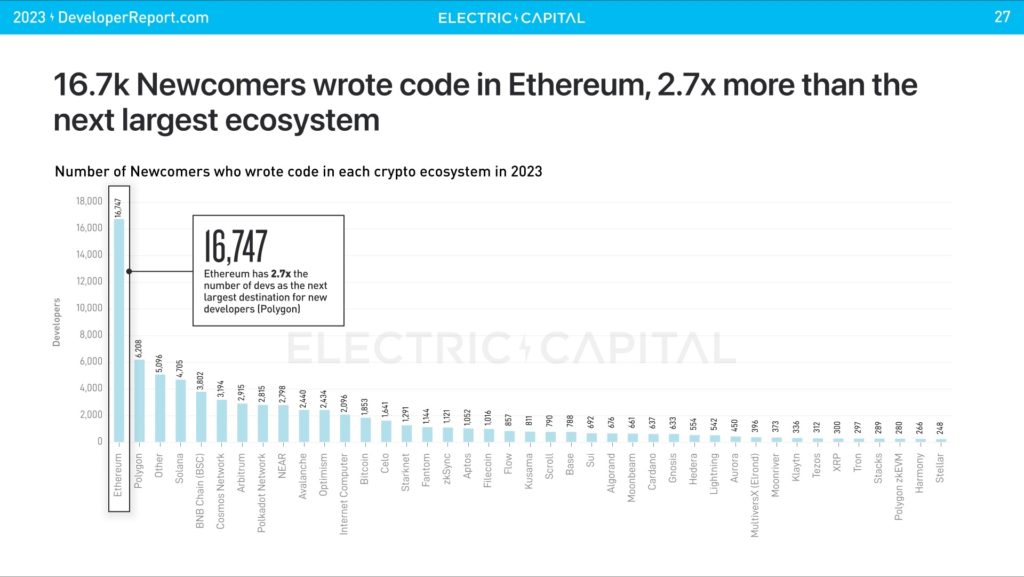
The chart below shows that in 2023 the Ethereum ecosystem attracted 16,700 new coders—around four times the number for its ambitious challenger.
Mark Smargon, founder and CEO of the Fuse Network blockchain, is also sceptical about a flippening:
“If you look at ether’s long-term goals and how a decentralised economy is built from the bottom up, you can see that many ideas reach Solana only after being tested on the second-largest cryptocurrency.”
Conclusions
Firedancer—an innovative Solana client developed by Jump Crypto—is intended to take the network’s performance to a new level. With more efficient block distribution, optimised signature verification and other improvements, it could lift throughput to over 1m TPS.
The launch of the Firedancer testnet in October 2023 marked an important milestone, opening the way to large-scale testing and optimisation in an environment close to Solana’s mainnet.
No firm date has yet been announced for a full mainnet release. Typically, after a testnet goes live, developers gather data and feedback and make adjustments before a mainnet rollout.
Firedancer could revolutionise Solana by improving both throughput and reliability. While unlikely, it is not impossible that, over the long term, the popular L1 could narrow the capitalisation gap with its main rival, Ethereum.
Update (8 July 2024, 15:49 Kyiv/MSK): this article has been amended—sections with information about sharding, taken from Messari, Alchemy and Kraken materials, have been removed. The Firedancer developer under the pseudonym Cantelope Peel заявил there are no plans to support horizontal data partitioning in Solana or in the client slated for release.
Рассылки ForkLog: держите руку на пульсе биткоин-индустрии!