


DAOs, teal management and open source: genius trio or outcasts’ trilemma?
Vladimir Menaskop explains
DAOs, open source and “teal” management grew out of a single ambition: to act effectively without a rigid hierarchy and bosses who decide everything for everyone. Yet each model, on its own, inevitably runs into crisis. Web3 researcher Vladimir Menaskop explains why the three approaches work only together.
From the author
A recent Habr article showed that many OS projects are kept afloat by one or two enthusiasts who, quite literally, work for free or for pennies.
Reading it, I immediately recalled my many years in DAOs. Back in 2025 I crossed the mark of involvement in 100 such organisations, but by 2026 it had become clear I might never get close to the next milestone of 1,000.
Why? Because the sector’s main analytics platform, DeepDAO, shut down, and many DAOs either folded or abandoned their foundational principles.
Others, though, understood where the catch lay and opted for a planned, deep restructuring. Paradoxically, these were market leaders that had been the most conservative elsewhere: Ethereum, Uniswap, Aave.
Looking back on 21 years in IT, I came to see that the three elements of self-organisation—DAO as a form, “teal” as a methodology and open source as a tool—form a single whole. But one thing at a time.
DAO
ForkLog has covered this topic at length, but a few less obvious points are worth highlighting.
What is a DAO? Literally: a decentralised autonomous organisation. Yet even this short decoding hides an inner paradox. Consider the definitions:
- Decentralised: a system whose governance and structure are created without a single centre, with control and authority distributed among many independent participants.
- Autonomous: independent, acting on its own, without external control or dependence on broader networks.
- Organisation: a group of people working together to achieve shared goals and tasks.
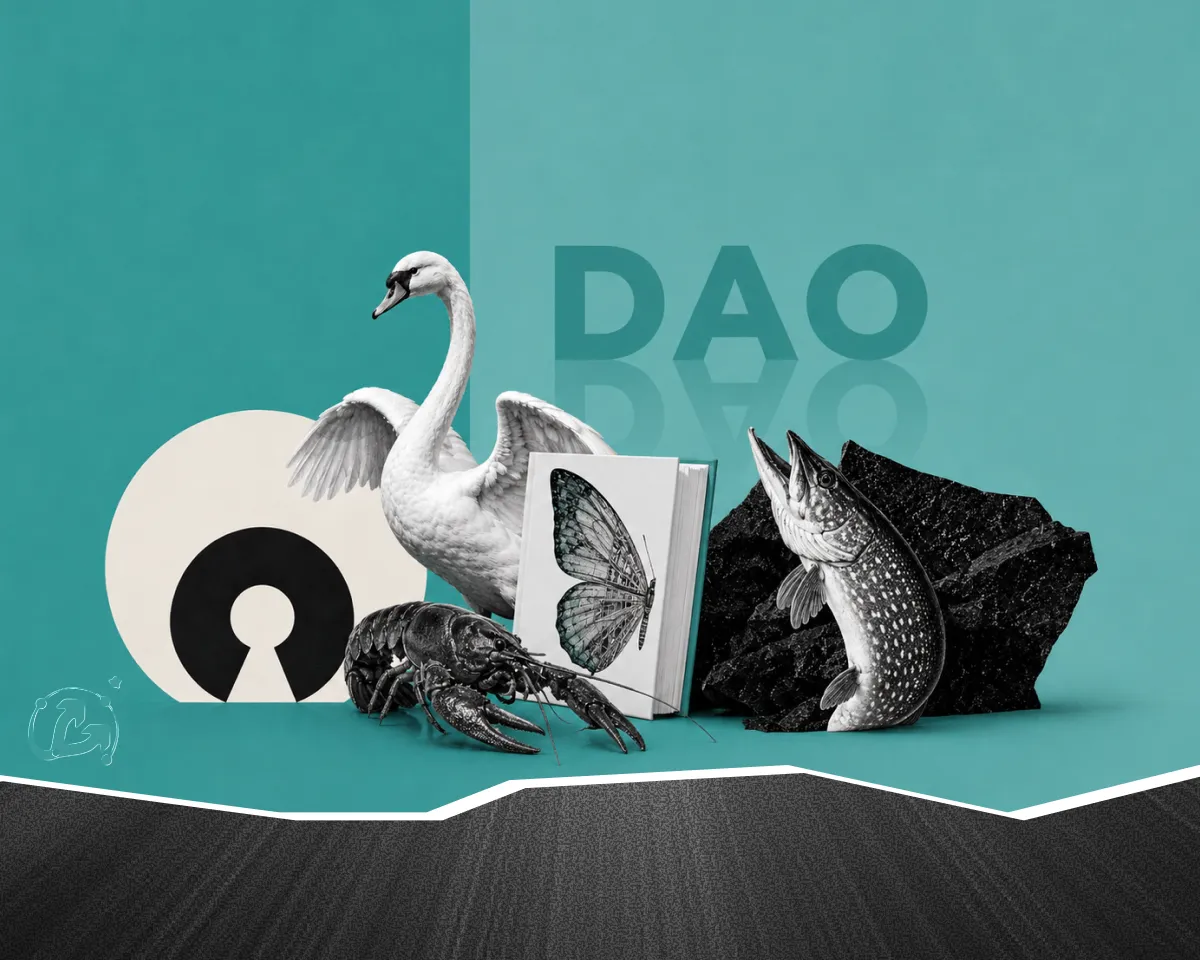
At first glance these terms sit uneasily together. The swan of decentralisation pulls skyward toward an ideology in which a centre is an unaffordable luxury. The crayfish of autonomy reinforces this stance, but focuses not on internal structure so much as non-subordination to an external system. The pike of organisation, by contrast, asserts that there is a centre after all—not in governance, but in the problems being solved and the goals set.
Hence there is no such thing as a “DAO in general”. A limited-liability company exists “in general”; an open or closed joint-stock company, too; even a simple partnership or co-operative. But a DAO cannot exist in such an abstract form.
One might object that platforms like Aragon or xDAO standardise the creation of decentralised autonomous organisations. They do, but only by providing a toolkit. They can stitch a body together, yet it may still be a corpse—formally alive, not a unified organism, and certainly not a full-fledged personality. Today the world is full of such Frankensteins, if not dominated by them.
My experience in DAOs has long suggested this is wrong: we have let form substitute for substance. For a decade I have therefore practised building micro-DAOs: aimed not at success, but at transmitting DAO principles from person to person. It works, albeit slowly. And here we need the second element—“teal” management.
“Teal”
Frederic Laloux’s book “Opening the Organisations of the Future” appeared in my life long before I read my first piece on DAOs. Decentralisation, after all, predates blockchains by a long way. In our small five-person IT firm we embraced the approach from the outset; Laloux helped formalise our experience and distil general principles.
Since then I have joined various “teal” communities, studied the experience of many companies (from offline sectors to gaming), written analytical pieces and tried to spread the word.
Seven years ago I became an administrator of a Telegram channel dedicated to “teal” management. People there spoke about DAOs without using the word, worked in DAOs without knowing it and did many other things that in essence amounted to DAOs.
I tried to bridge the two worlds, arranging several online meetings between those discussing “teal” and those already building DAOs. And… nothing much came of it. It turned out these were two largely similar but parallel universes.
Another insight followed: each element (DAO and “teal” alike) demands a dramatic internal overhaul. How is it that there is no need for a boss? How is it that there is no external control? How is it that you work only in networked entities? That overhaul consumes vast resources: time, attention, understanding and even money. Each group simply could not switch to yet another process of comparable complexity.
Even so, such a union would remain incomplete—at least without a third element.
Open source
Readers hardly need a primer on open-source software, but it is crucial to note that almost all DAOs use it by default.
Here a synthesis of science, art and, if you will, magic is born:
- DAOs help organise business within the economy of doing (more precisely, the part I call the crypto-offshore), created by the tools and mechanics of Web 3.0 and Web3.
- The profits from this business (whether network fees or gains from successful liquidations) can be distributed as grants among different teams.
- Finally, to ensure both quantitative and qualitative growth in profit generation, you need “teal” management methods (the last 18–24 months of Aave’s evolution are exactly about that).
But when open source is cut off from this triad, it does not live so much as survive: you end up hoping for donations from those for whom it is easier to fork you than to support you with hard cash.
An open secret
You might think this “discovery” is long understood. It is not.
Each element is fairly developed: behind each stands, if not a neat, then at least a well-worked theory; each has its supporters and, crucially, practice. But separately. Together they work only in exceptional cases, when enthusiasts already immersed in each sphere draw the relevant conclusions. Something similar can be found, for example, in the assertion “1 BTC = 1 BTC”: everyone seems to understand, but in fact they do not.
Hence such projects appear to have a future: uncertain, like any other, but a future nonetheless.
All the more so as each of the three elements is now in crisis:
- DAOs—because of yet another crypto winter;
- “Teal”—because of a crisis in management ideas;
- Open source—because of a lack of financial support.
In such times it is vital to focus not on fixing transient, recurring problems but on far more fundamental things. This may lead us to another trilemma, where you must back two of the three components to evolve effectively. Or perhaps there is a fourth, or even a fifth, to complete the set.
If you came to crypto for more than the next hype cycle, this approach will serve you well.
Рассылки ForkLog: держите руку на пульсе биткоин-индустрии!