



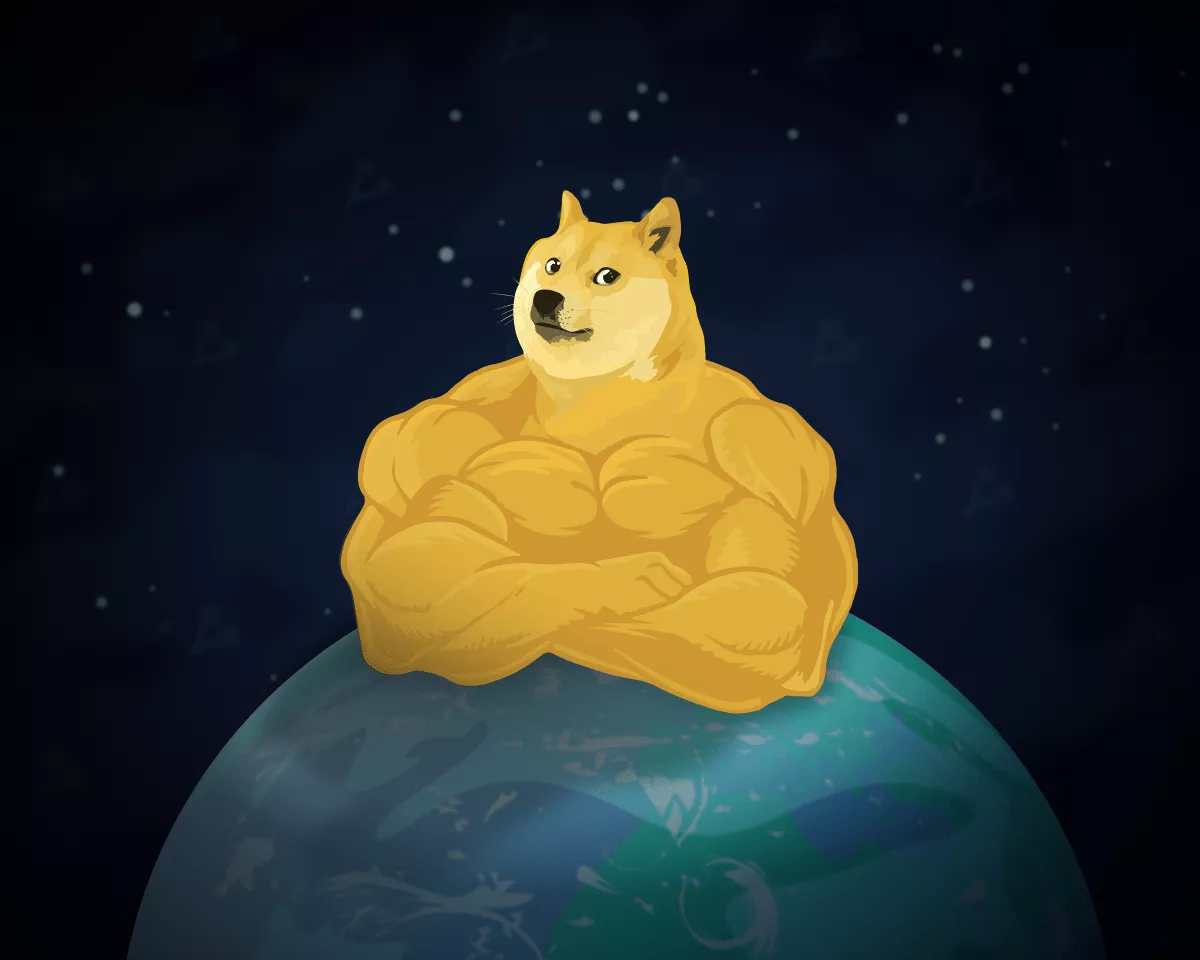
Once a half-forgotten meme coin, Dogecoin (DOGE) surged into the top five cryptocurrencies by market capitalization in 2021. Based on market dynamics, the hype around DOGE fuelled by Elon Musk’s tweets shows little sign of ending, despite the skeptics’ forecasts.
Since the start of the year the price Dogecoin has risen by more than 9,000%, outpacing the buzzy DeFi tokens Solana and Binance Coin and other top assets. From January’s sub-one-cent levels, DOGE jumped above $0.60 and continues to test new highs from time to time.


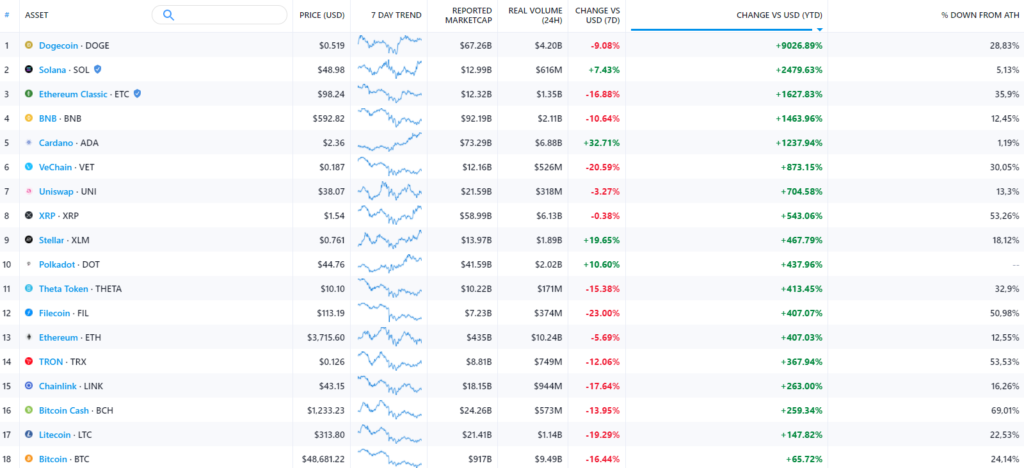
Co-founder Billy Markus admits that he left the project and sold his crypto holdings for an amount equivalent to a used Honda Civic. As of May 16, 2021, DOGE’s market capitalization stood at $67.1 billion, while Honda Motor — $52.4 billion.
Riding the hype, the cryptocurrency managed to crack CoinGecko’s ranking by market cap, overtaking the most popular stablecoin Tether (USDT). Ahead were only XRP, Cardano, Binance Coin, Ethereum and the market’s perennial leader — Bitcoin.
What explains the Dogecoin phenomenon? Beyond memes, a bull market and the crowd’s power, what drives the price to previously unattainable highs? What are DOGE’s fundamental flaws and how viable is the project? ForkLog examines these questions.
- The cryptocurrency market is truly unpredictable — a meme coin created as a joke has found new life, joining the ranks of the market’s flagship assets.
- The meme cryptocurrency landed on top exchange listings and outpaced even the hottest assets of 2021 in terms of growth.
- Dogecoin possesses a number of fundamental shortcomings: poorly developed infrastructure, low on‑chain activity metrics, uneven distribution of coin supply.
The most popular meme cryptocurrency
In 2021 the meme coin created as a joke surpassed Bitcoin in Google search queries.
The reason: an incredibly rapid price rise, driven primarily by mentions from Elon Musk and other celebrities.
Dogecoin might be my favourite cryptocurrency. It’s pretty cool.
— Elon Musk (@elonmusk) April 2, 2019
“Dogecoin might be my favourite cryptocurrency. It’s pretty cool.”
The meme coin has indeed consistently accelerated its rise after tweets from the founder of Tesla about the ‘people’s cryptocurrency’ and the ‘Doge to the Moon’. The chart below shows this.


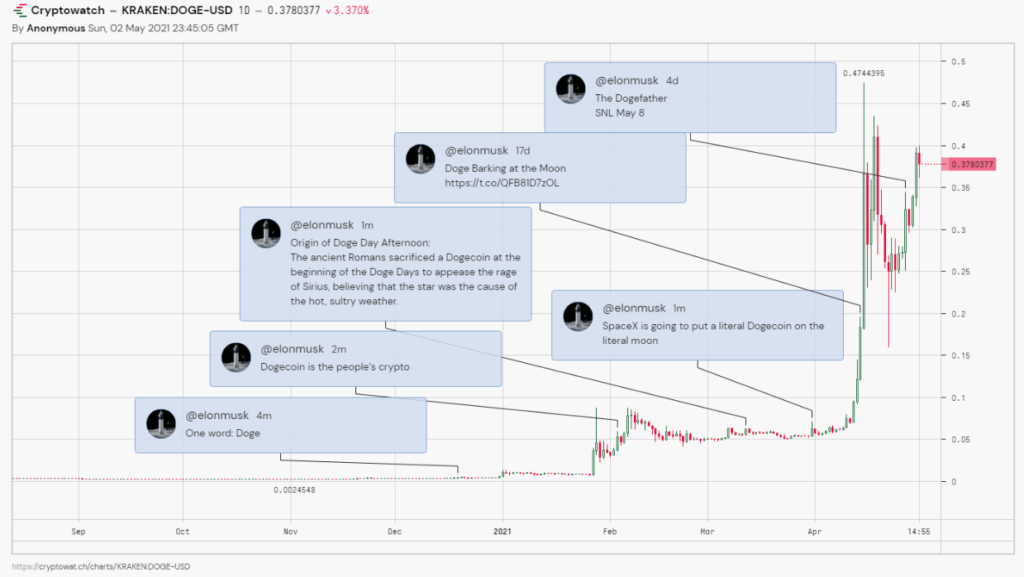
The rally in crypto markets amid the coronavirus crisis and unprecedented fiscal and monetary measures by governments and central banks also played a role.
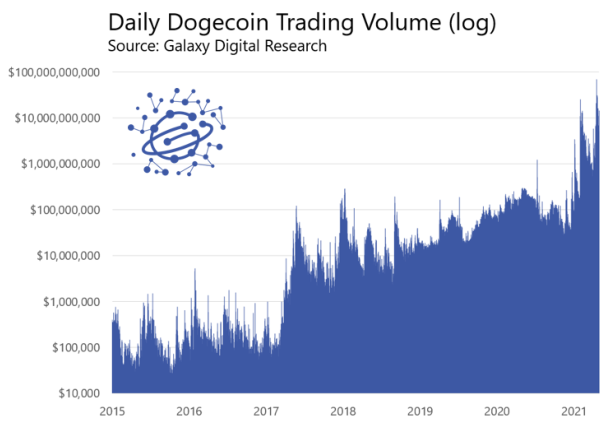
In 2021 the meme coin eclipsed Bitcoin and Ethereum in growth pace. The surge propelled DOGE onto major exchanges, including Gemini of the Winklevoss twins. Daily trading volume for the coin surpassed $20 billion.


Many shops added payment option with the hype cryptocurrency for goods and services.
Founder Elon Musk promised to launch Doge-1 satellite to the Moon. He said the mission would be paid for entirely in Dogecoin. Moreover, in a tweet Musk proposed to let users vote whether his company should accept Dogecoin payments. Nearly 80% of respondents supported the idea.
I’m looking for a shiba pup!
— Elon Musk (@elonmusk) May 7, 2021
Shortly after, Musk said he was collaborating with Dogecoin developers to “improve transaction efficiency.” The coin again rose. It later emerged that a four-developer team for the meme cryptocurrency has been collaborating with Musk since 2019.
Clones of Dogecoin appeared, such as Shiba Inu (SHIB), which also reacted positively to Musk’s tweets. SHIB quickly landed on Binance, Crypto.com and other major platforms. This boosted liquidity and accelerated the price rally of a coin whose market cap has surpassed $11 billion.
According to The Block researcher Igor Igamberdiev, a user accumulated 70 trillion SHIB, spending 37.65 ETH in August–September. By early May of the following year, his unrealized gains stood at over $2 billion.
In Uniswap’s top-10 pools on the leading Ethereum exchange, pairs with dog‑coin clones appeared. The top pool was SHIB-ETH, with a daily turnover exceeding $2 billion.
Five of the top 10 pairs on Uniswap are dog meme coins. That’s $1.55 billion in volume over the last 24 hours. Just for reference, Uniswap v2 didn’t cross daily volume like that for almost the first year of its existence. pic.twitter.com/JjJvv371Yq
— Larry Cermak (@lawmaster) May 11, 2021
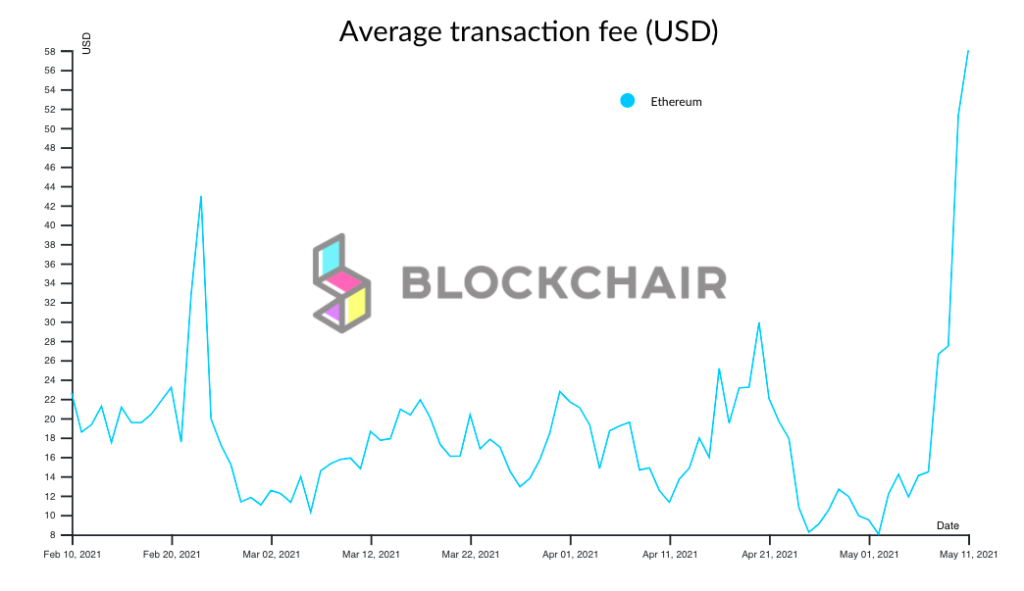
The buzz around SHIB boosted activity on the Ethereum blockchain. On Tuesday, May 11, the average Ethereum transaction fee reached an all-time high of $60.


It emerged that the largest holder of Shiba Inu is the Ethereum creator Vitalik Buterin. His public wallet initially held 505 trillion SHIB — more than 50% of the planned quadrillion coins. He later withdrew assets from Uniswap pools and donated funds to charitable organisations.
The unflagging optimism around the leading meme cryptocurrency found expression in numerous positive quotes about Dogecoin and price forecasts. For example, billionaire Mark Cuban predicted a rise to $1, arguing that unlimited issuance is an advantage. He believes a yearly issuance of 5.2 billion coins is a good thing.
SkyBridge Capital’s Anthony Scaramucci did not rule out that Dogecoin could become ‘digital silver’ relative to Bitcoin. The latter, he says, would remain the ‘super predator’ among digital assets.
Before examining the coin’s fundamentals, let us turn to its history.
How and why Dogecoin was created
Dogecoin is among the oldest altcoins, appearing about 1.5 years before Ethereum and long before many other well-known assets. It was created in 2013 by Jackson Palmer, who then worked in Adobe Systems’s marketing department, and programmer Billy Markus.
The coin was conceived as a parody of Bitcoin and other cryptocurrencies that surged in 2013–14. It was named after the popular internet meme Doge. The meme typically features a Shiba Inu named Kabosu. The image is often accompanied by text rendered in the Comic Sans MS font in various colours.



«Unlike many other crypto projects, Dogecoin does not even attempt to be anything more than the world’s most fun currency. There is no strategic concept, no statements that Dogecoin will change the world», says Galaxy Digital Research in a report.
In November 2013 Palmer tweeted: «Invest in Dogecoin. I’m sure this is a new serious thing». Soon after, he created a beginner-friendly site dogecoin.com, where one could download a wallet and learn about the meme cryptocurrency’s core features.
On 6 December, two days after the site’s launch, the genesis block of Dogecoin was mined. At the turn of 2013–2014, Dogecoin began appearing on exchanges, trading between $0.0002 and $0.0018.
Technically, Dogecoin is a fork of the Luckycoin, itself built on Junkcoin. The latter is a fork of Litecoin (LTC), which in turn is technically close to Bitcoin.
Dogecoin uses a PoW algorithm based on Scrypt. Miners can mine LTC and DOGE simultaneously via merged mining at no extra cost.
On 8 December 2013 the r/Dogecoin subreddit appeared, one member wrote:
«Post addresses here to trade for and receive Dogecoin».
Dogecoin’s launch occurred amid Bitcoin’s first rally peak, when the price of the leading cryptocurrency breached $1,000. In the year after its appearance the meme coin appeared on at least 30 exchanges. Of these, per Galaxy Digital Research analysts, only five survive to this day: Poloniex, Bittrex, Kraken, HitBTC and CEX.io.
In 2014, just months after the genesis block, the r/Dogecoin subreddit counted more than 35,000 members. Today this thread has 1.81 million users. For comparison, the Ethereum-focused subreddit has 0.89 million members, and r/Bitcoin has 2.9 million.
Over time a Reddit bot allowed users to earn DOGE for quality posts.
«Practically all Reddit users had Dogecoin», says CNET citing Palmer.
In 2014 Jamaica’s bobsled team qualified for the Winter Olympics for the first time in 10 years. The team lacked funds to compete. The Dogecoin community, including many fans of the film Cool Runnings, aimed to help by raising funds in cryptocurrency. In a few hours the #CoolRunnings2 campaign raised around $30,000 in DOGE.
Supporters funded NASCAR driver Josh Wise several times, helped residents of Kashmir (Doge4Kashmir) and Cambodia (CESHEO). In 2015 a Doge4Water campaign began to improve access to clean water.
As noted, Marcus and Palmer created Dogecoin as a joke, not for personal enrichment. They expected some hype on social media, limited miner interest and a gradual fade in interest. But something went wrong — community interest in the coin surpassed all their expectations.
As Dogecoin expanded within the crypto ecosystem, the founders grew disillusioned. Contrary to the original plan, DOGE increasingly came to be perceived as a vehicle for speculation.
Soon after, Markus left the project, saying he did not want to be ‘the leader of a cult’. In January 2021 he admitted that he made this decision ‘because of the harassment from the community’.
In a letter, Markus noted that he did not understand talk of a rally to $1 and the coin’s market capitalization approaching the size of major U.S. corporations. He called the true value of Dogecoin the community and its potential ‘to do good’.
«Pump and dump, reckless greed, fraud, unscrupulous participants, hype without research, using others for your own ends — all this is useless. […] Joy, kindness, education, empathy, fun, community, inspiration, creativity, generosity, levity, absurdity — this is what makes Dogecoin valuable to me», says the developer.
Palmer unsubscribed from the r/Dogecoin subreddit in June 2014. In 2015 he said he was taking a long break and described the crypto ecosystem as toxic. He later deleted his YouTube and Twitter accounts.
Fundamental flaws of Dogecoin
Dogecoin inherited the Script-based language and unspent transaction outputs (UTXOs) from its Bitcoin-like predecessor.
Initially, mining the meme cryptocurrency involved a random block reward, as with Luckycoin. The amount ranged from 0 to 1,000,000 DOGE.
The source of the ‘randomness’ was the hash of the previous block. Consequently, miners could calculate their potential future reward.
Some miners, including F2Pool, exploited this. This allowed them to maximise mining income, as first revealed to the community by Reddit user u/paul_miner.
Soon the Dogecoin codebase was altered — it began to be mined alongside Litecoin (merged mining), and the ‘random’ block reward was replaced with a fixed one.
In the wake of the 2021 hype, the profitability of LTC+DOGE merged mining rose significantly.
For several years the Dogecoin codebase received little attention, and development essentially stalled. An exception was the Dogethereum project, which briefly revived DOGE’s price.
It was supposed to be a bridge between the Dogecoin and Ethereum blockchains and potentially scalable to other compatible ecosystems. Judging by the dormant social-media accounts, work on the project appears to have ceased — there have been no news items in recent years.
Dogecoin is unlikely to boast a mature infrastructure comprising custodians, regulated trading and lending services, and other hallmarks of a mature market.
Dogecoin significantly lags Bitcoin on a number of fundamental metrics, including on-chain activity, distribution of assets by address, the cost of a 51% attack, and many other metrics.
The chart below compares the dynamics of the number of active addresses for Bitcoin and Dogecoin.


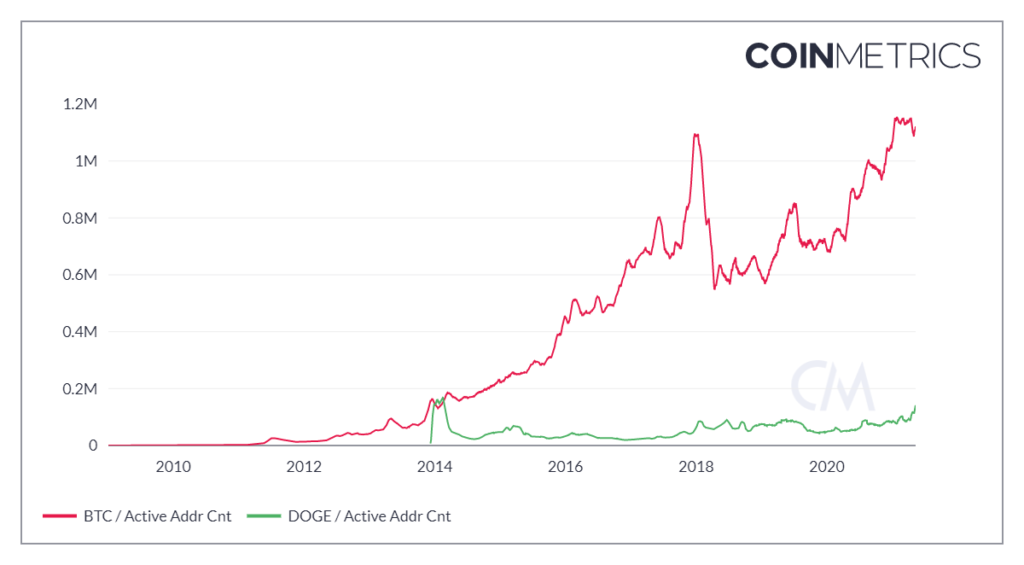
Clearly, in this respect the meme cryptocurrency lags far behind digital gold. Although in 2014 DOGE briefly topped BTC by active addresses, the metric returned to seven-year-old levels in 2021.
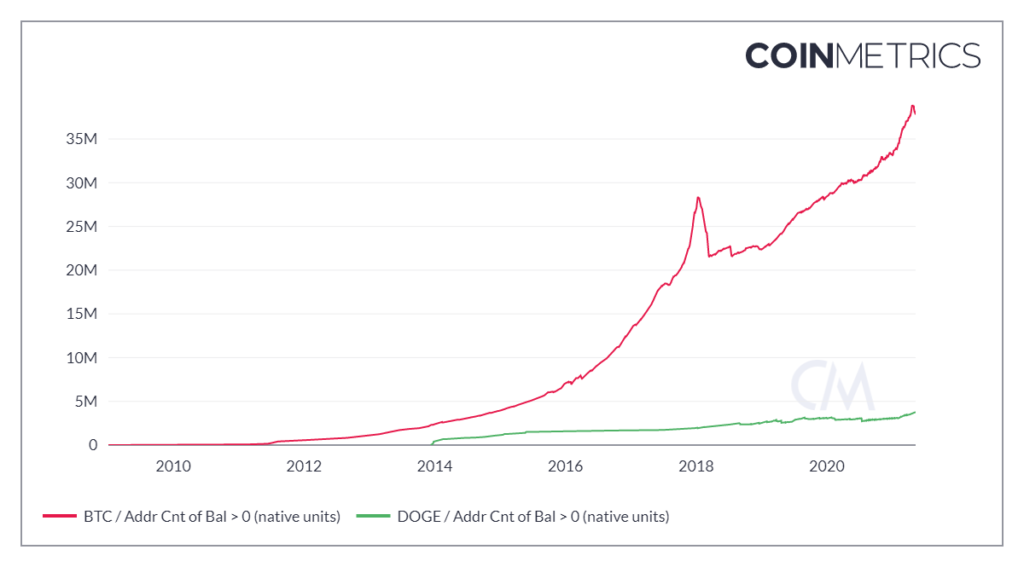
Notably, the number of addresses with non-zero balances also differs significantly. Bitcoin has more than 35 million, while Dogecoin has 3.6 million.


Unlike Bitcoin, Dogecoin’s supply is not capped. It also has a higher annual inflation rate.


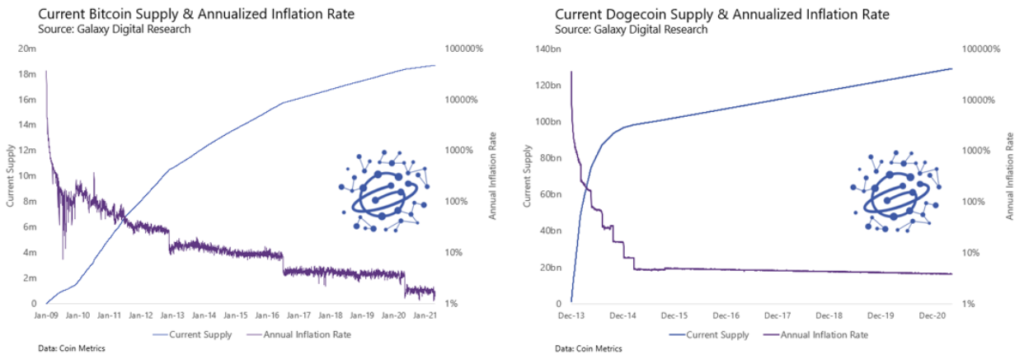
Approximately every minute, around 10,000 DOGE are distributed among miners. That means the supply of the meme cryptocurrency grows by about 14.4 million DOGE per day and roughly 5.2 billion DOGE per year.
By comparison: Bitcoin’s total supply is capped at 21 million BTC, of which around 89% has already been mined. The reward is distributed to miners roughly every 10 minutes.
The inflation rate of digital gold halves with each four-year halving. The next such event is expected around 4 May 2024 — the reward will drop from 6.25 BTC to 3.125 BTC.
Dogecoin has no halving, and no fixed supply cap. Yet its inflation rate declines as the money supply increases.
Dogecoin’s supply is distributed predominantly among large holders. Bitcoin, by contrast, has a much higher share of retail participants.


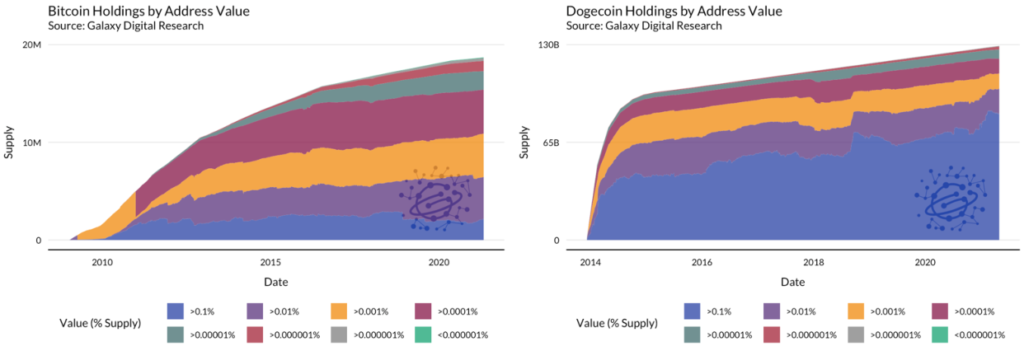
Dogecoin sits mid-pack in terms of asset distribution across address categories. Its supply is more dispersed than XRP and relatively new assets like UNI and DOT. In this context, Dogecoin sits between Ethereum and Litecoin. Litecoin’s money stock is somewhat more concentrated among large addresses.
Last year a large tranche of DOGE moved after a long dormancy — more than 60% of the supply moved. Galaxy Digital Research analysts say this indicates asset shifts from older to newer market participants.


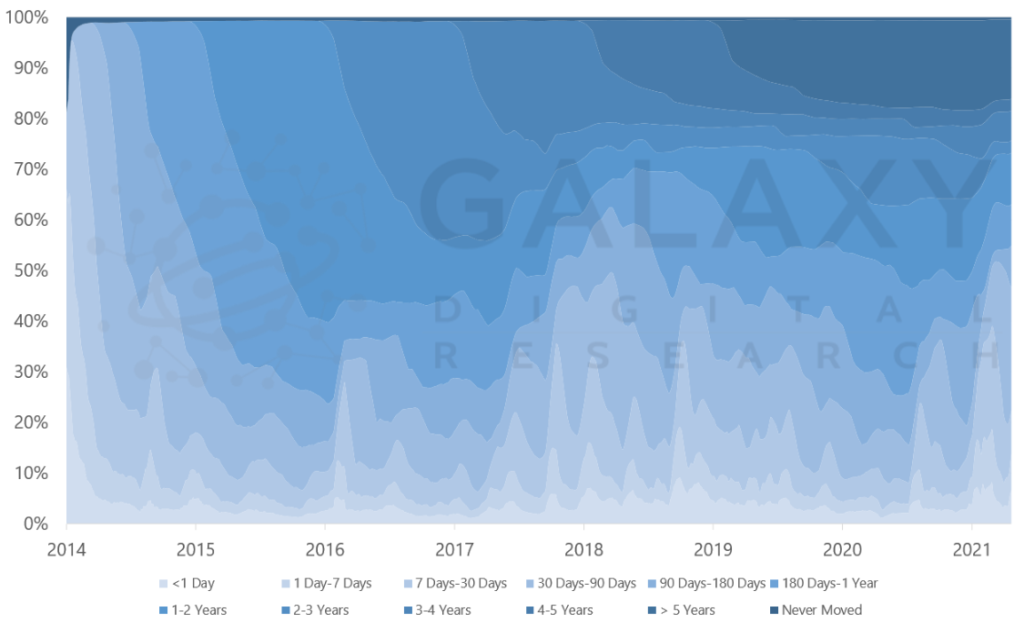
Such a pattern in relation to Bitcoin is viewed by most researchers as a bearish signal. This reflects the view of Bitcoin as a long-term store of value.
As for Dogecoin, it is hard to say what such on-chain activity signals.
«It is quite possible that new entrants have longer-term plans for the coin than those who held DOGE in previous eras», says Galaxy Digital Research.
For the meme cryptocurrency, daily transactions and the amount of value transferred remain well below those of digital gold. The main reasons are underdeveloped infrastructure and, consequently, limited use cases for the asset.
The chart below shows that in all prior years Bitcoin substantially exceeded the meme cryptocurrency in the volume of value transferred. The situation changed in early 2021 amid the Dogecoin hype.
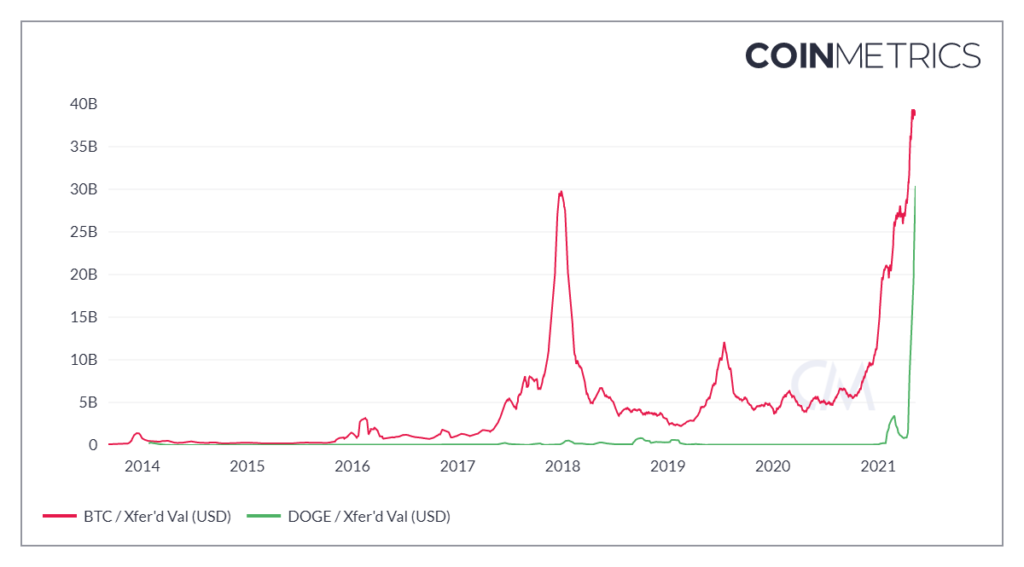
Beyond rising transaction counts and value transferred the average Dogecoin transaction fee rose.
Galaxy Digital Research experts concluded that the cost of a 51% attack on Bitcoin is 11 times higher than on Litecoin. Since Dogecoin is mined via merged mining with ‘digital silver,’ the same applies to DOGE. In their calculations, researchers used data on SHA-256 and Scrypt hash rates from NiceHash and HowManyConfs.com.
Historically, Dogecoin miners considered merged mining revenues a small additional income at marginal costs. With the recent price rally, DOGE’s share of miner revenues surpassed LTC’s.


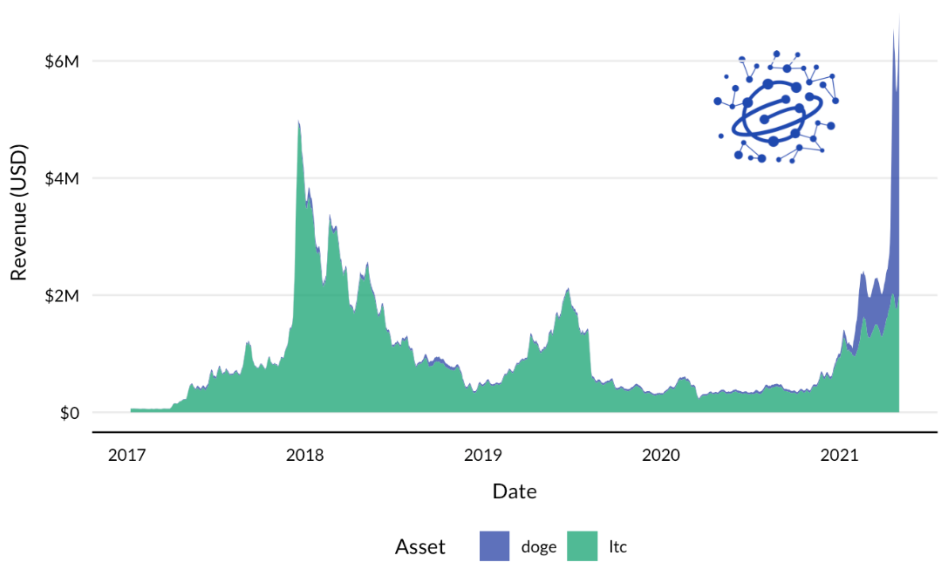
That development spurred a rise in mining hardware prices that use the Scrypt algorithm. Bitmain’s popular Antminer L3 rose from $83.26 to $547.71 since the start of the year, according to Hashrate Index.
Dogecoin has overtaken Litecoin by market capitalization — the first such case among merged-mined coins.
Conclusions
Dogecoin is among the oldest cryptocurrencies. It was conceived as a joke, not to enrich a small circle of individuals. No premine or presale preceded its creation; the project did not partake in VC rounds.
The meme cryptocurrency’s developers did not call it the ‘Bitcoin killer’, did not promise rainbow prospects, and did not seek grants. There was no marketing push or token sale. The community grew and evolved largely ‘for fun’, raising funds for various initiatives as well.
Despite the founders’ departure, a flawed monetary policy and extremely low developer activity, the project survived. Its price, market capitalization and on‑chain activity reached unprecedented levels.
Yet Dogecoin has a number of serious drawbacks:
- Supply of the meme cryptocurrency is distributed unevenly, skewed toward large holders;
- Active addresses and on‑chain activity metrics are well below those of Bitcoin;
- Historically, the volume of value transferred through the network has always been low (the metric spiked only on the 2021 hype);
- One of the least actively developed projects;
- Underdeveloped infrastructure;
- 11 times less resistant to a 51% attack than Bitcoin;
- The price is significantly susceptible to manipulation, potentially driven by a single well-known individual.
Despite these drawbacks, it remains a genuinely significant and well-known project. Perhaps, with a second wind, the Dogecoin story has only just begun.
Subscribe to ForkLog’s channel on YouTube!