




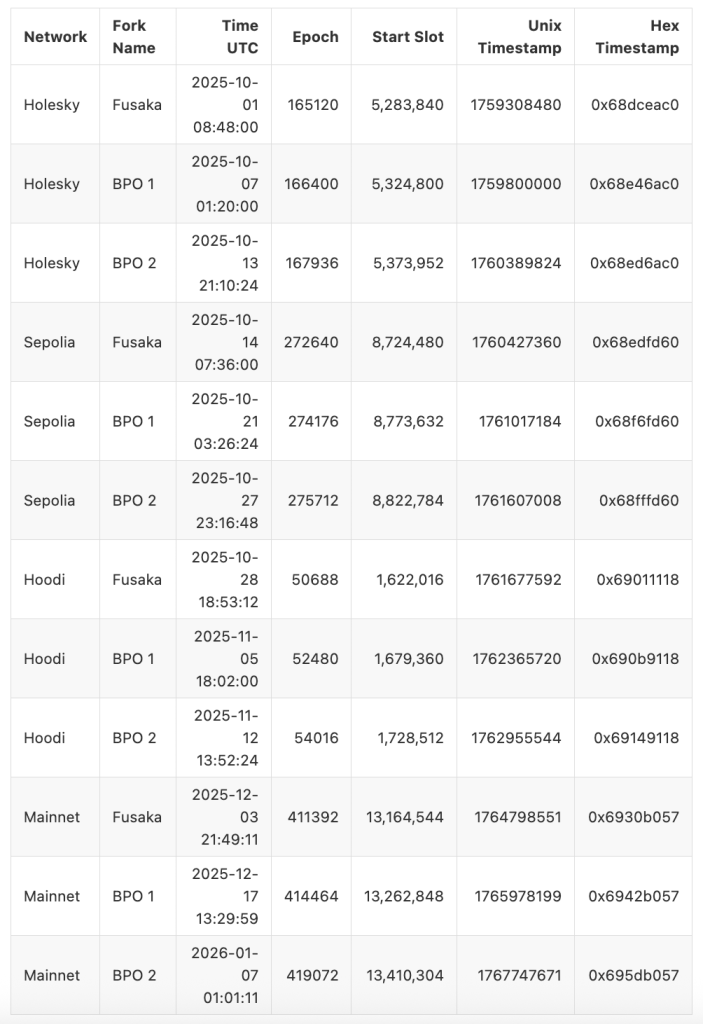
The Fusaka hard fork will be deployed on the main network of the second-largest cryptocurrency by market capitalization on December 3rd. This was announced by Ethereum’s core developers during the latest AllCoreDevs call.

Before the final launch, the team will test the comprehensive upgrade on the Holesky, Sepolia, and Hoodi networks from early October to mid-November.


The main goal of Fusaka is to enhance the scalability and efficiency of Ethereum. A key improvement will be the implementation of the PeerDAS protocol (EIP-7594), which is expected to double the network’s throughput.
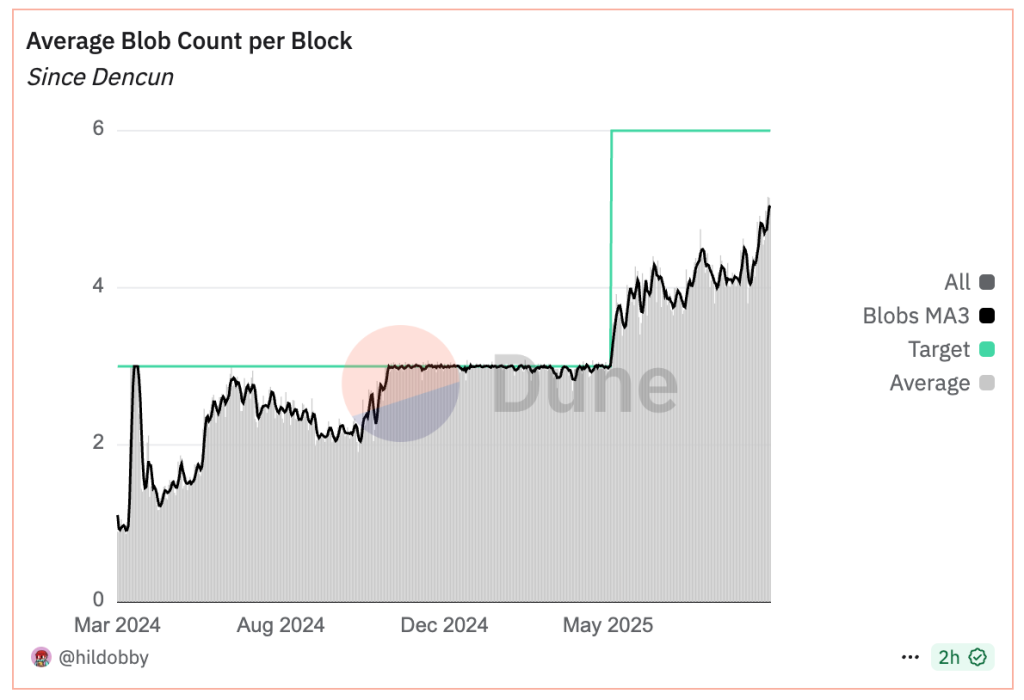
Researcher Christine Kim noted that after the update’s activation, it will take two weeks to increase the volume of data stored in BLOB objects:
- in the first week, the value will increase from 6/9 to 10/15;
- in the second week, it will rise to 14/21.
Their usage has been growing since the implementation of the Dencun hard fork in March 2024. Currently, the average number of BLOB objects per block is 5.1. For comparison, in March 2023, the figure was significantly lower at 0.9.


In total, Fusaka will implement 11 EIPs.
The non-profit organization supporting the network’s development, Ethereum Foundation, announced the launch of a four-week audit program. The initiative aims to identify vulnerabilities in Fusaka’s code before its release. The prize fund is $2 million.
The next major update for the second-largest cryptocurrency network will be Glamsterdam. Scheduled for 2026, this hard fork aims to improve scalability, security, and user experience.
On September 15, Ethereum marked three years since the upgrade The Merge, during which the network transitioned to the Proof-of-Stake (PoS) consensus mechanism.