
Key takeaways
- Bitcoin and Ethereum hit new all-time highs, Bitcoin’s market capitalization surpassed $1 trillion.
- Trading volume on spot exchanges for the first time in history exceeded $1 trillion.
- Binance Coin and Cardano vied for third place by market capitalization.
- Ethereum-based DeFi sector entered stagnation as gas fees rose; the Binance Smart Chain (BSC) ecosystem gained popularity.
- Trading activity on decentralized exchanges exceeded $60 billion, setting a new record for the previous month.
- Stablecoins’ market capitalization crossed $50 billion.
- The NFT market gained momentum, with some lots selling for millions of dollars.
- Bitcoin and Ethereum miners’ revenues in February reached parity, hitting record highs at $1.36 billion.
- Electric car maker Tesla invested $1.5 billion in bitcoin. Investments in the leading cryptocurrency were boosted by MicroStrategy and Square.
- In Russia, a draft law on taxation of cryptocurrency transactions was introduced in the first reading.
- Tether and Bitfinex settled a dispute with the New York State Attorney General, and the SEC approved Coinbase’s direct listing.
Leading assets dynamics


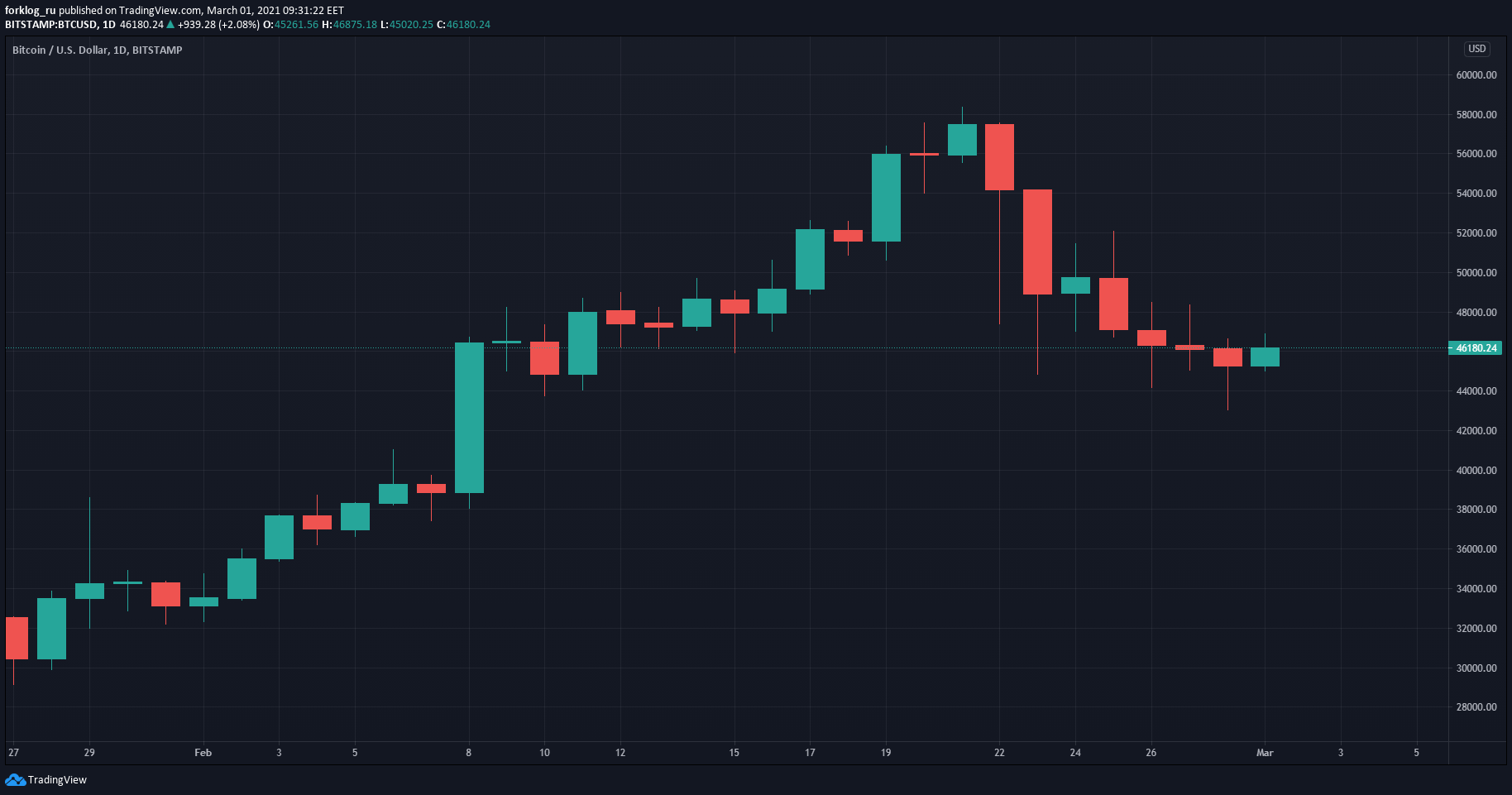
Daily BTC/USD chart from Bitstamp. Data: TradingView.
- In February, Bitcoin continued to rise, repeatedly hitting historical highs during the month. The peak price of the first cryptocurrency reached $58,354 (Bitstamp), and market capitalization for the first time surpassed $1 trillion.
- In the second half of the month the price corrected by 22%, triggering the largest cascade of liquidations.
- By the end of February, Bitcoin was up 36%.
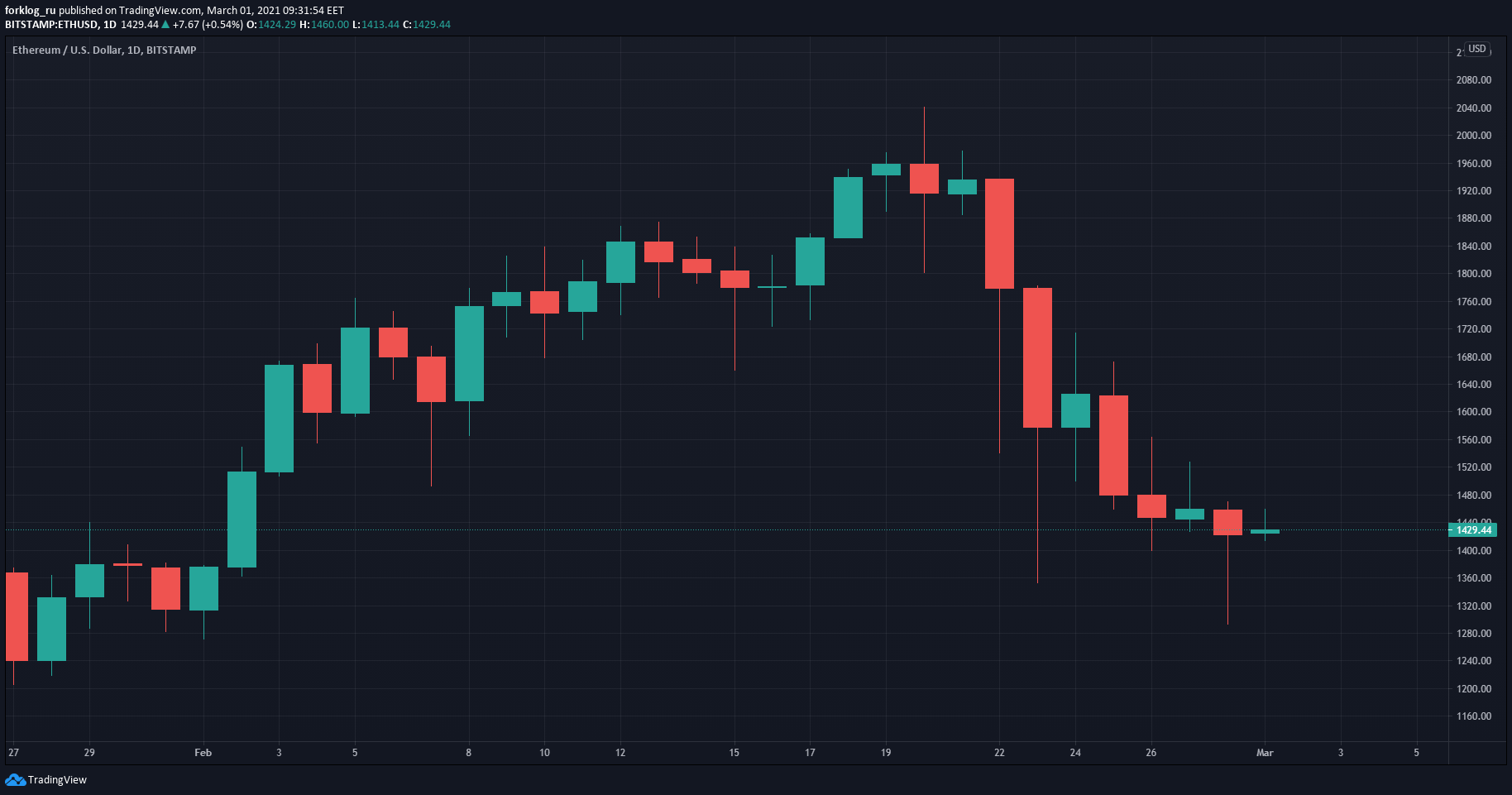
Daily ETH/USD chart from Bitstamp. Data: TradingView.
Optimistic forecasts by Ethereum proponents were confirmed in February with ETH rising to a new high near $2040. Positive price action was helped by the launch of futures trading on the Chicago Mercantile Exchange (CME).
Nevertheless, the month ended with Ethereum up only 8%. One reason for the correction was rising transaction fees, which reduced activity in the DeFi sector and decreased demand for cryptocurrency used to pay gas. Competition from Binance Smart Chain with low fees and high transaction speed may have prompted users to sell ETH to buy BNB.
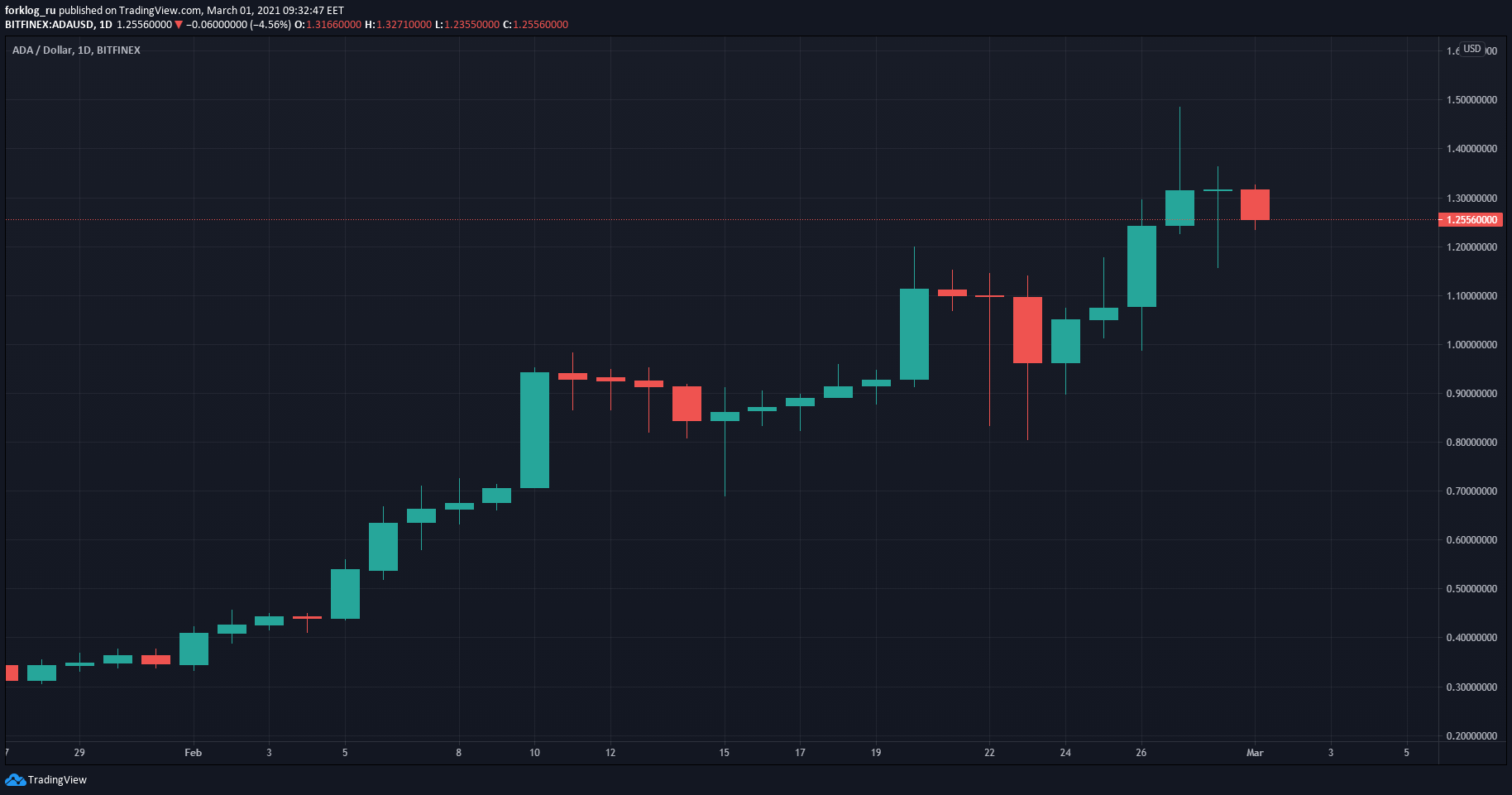
Daily ADA/USD chart from Bitfinex. Data: TradingView.
February was also marked by a struggle among projects for third place in the capitalization rankings. Initially, an undisputed contender for this spot was the Binance Coin token. Its price hit a new high of $368 as Ethereum became congested and BSC gained popularity. By the end of February the asset had risen 374%.
By month-end Binance Coin displaced the still-promising Cardano. ADA price reached an all-time high near $1.48. During February the cryptocurrency rose 295%. Developers carried out the Allegro hard fork on the path to the major Goguen upgrade and released the Glow programming language, designed to simplify writing and running smart contracts.
Market sentiment and correlations


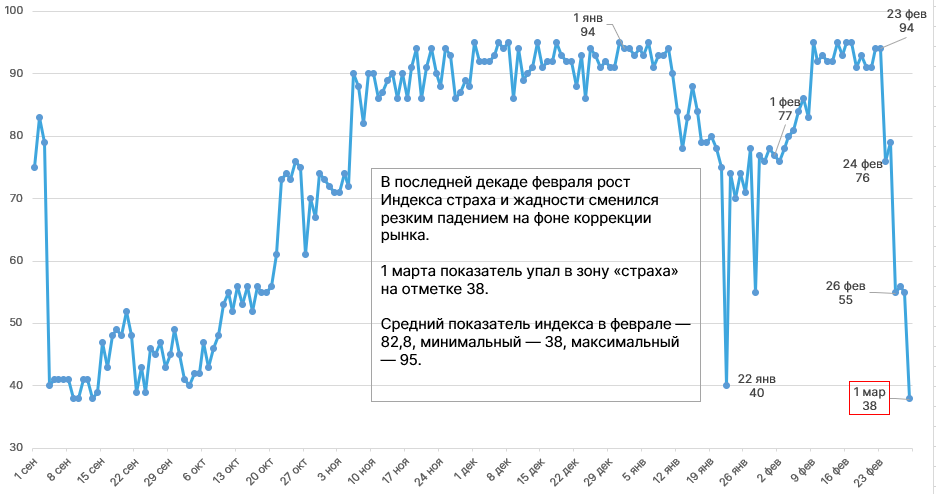
Fear and greed index dynamics. Data: alternative.me.


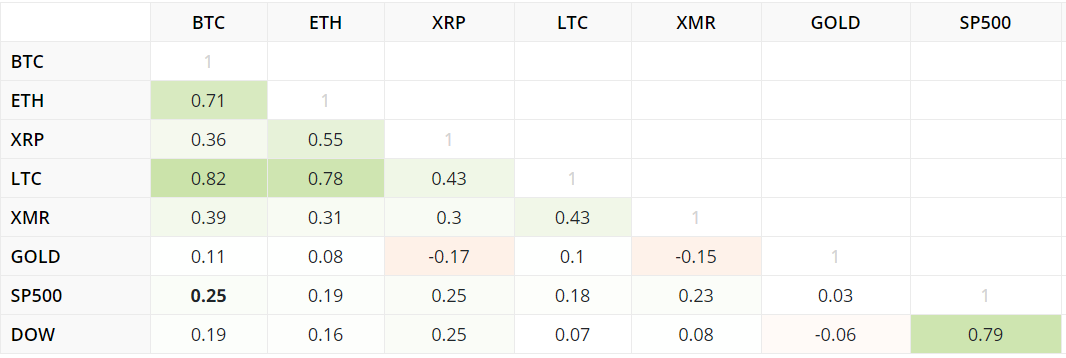
90-day asset correlation indicators. Data: BlockchainCenter.
- Against Bitcoin’s ascent to new highs and subsequent correction, the fear-and-greed index shifted to a drop. On 1 March the indicator stood at 38, in the “fear” zone.
- Bitcoin’s correlation with the S&P 500 rose significantly. At the end of the previous month the US stock index was in a correction, as was Bitcoin.
- Gold continued its downtrend, its correlation with Bitcoin weakened.
Trading volumes


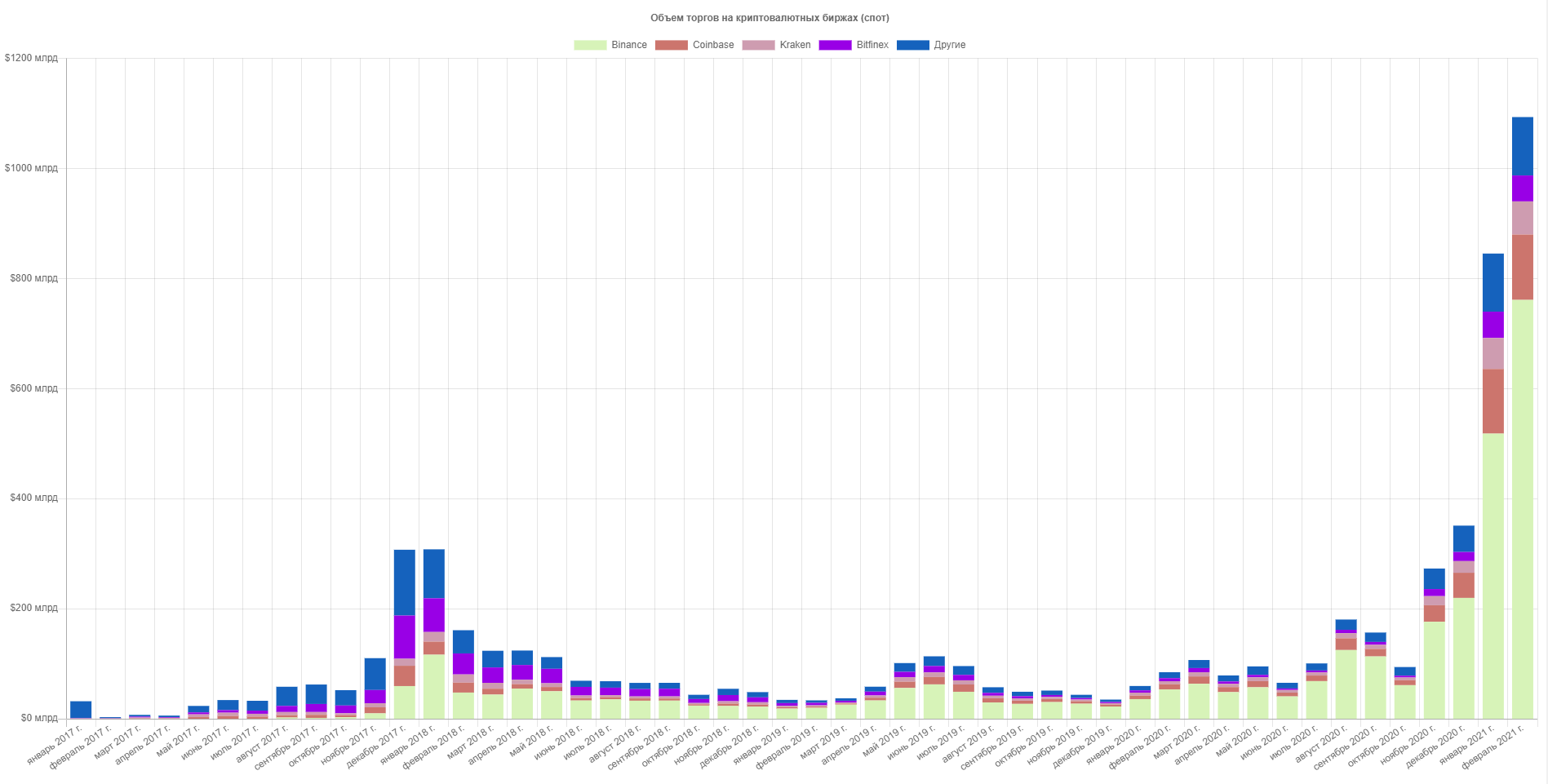
Spot exchange trading volumes, trillions $. Data: CryptoCompare.
In February, trading volume on spot exchanges exceeded $1 trillion for the first time, reaching $1.12 trillion. Binance accounted for $744 billion, Coinbase generated only $118 billion, and Kraken, another US-based platform, $60 billion.
Futures and options


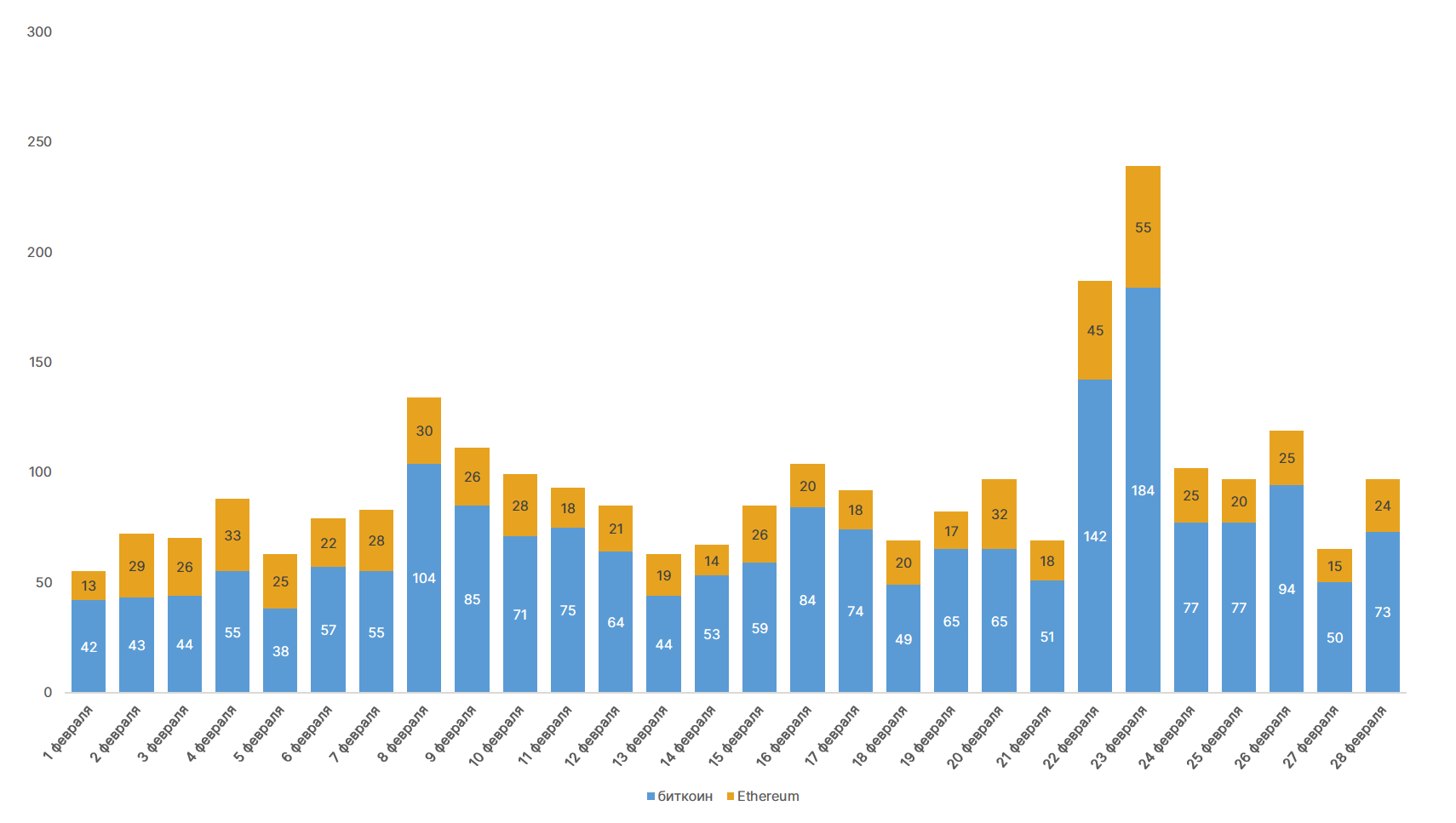
Bitcoin and Ethereum futures trading volumes, in $ billions. Data: skew.
- In February, total Bitcoin futures trading volume reached $1.9 trillion, slightly below January’s record (over $2 trillion).
- On 23 February, during the busiest session, daily turnover on platforms reached a record $184 billion, with Ethereum at $55 billion. Open interest for Bitcoin futures approached $20 billion, driving funding rates higher. By exchange, Binance remained the leader, followed by Huobi and OKEx.
- On 22 February, a price drop in Bitcoin triggered the largest the largest series of liquidations on the derivatives market — totalling $6 billion.


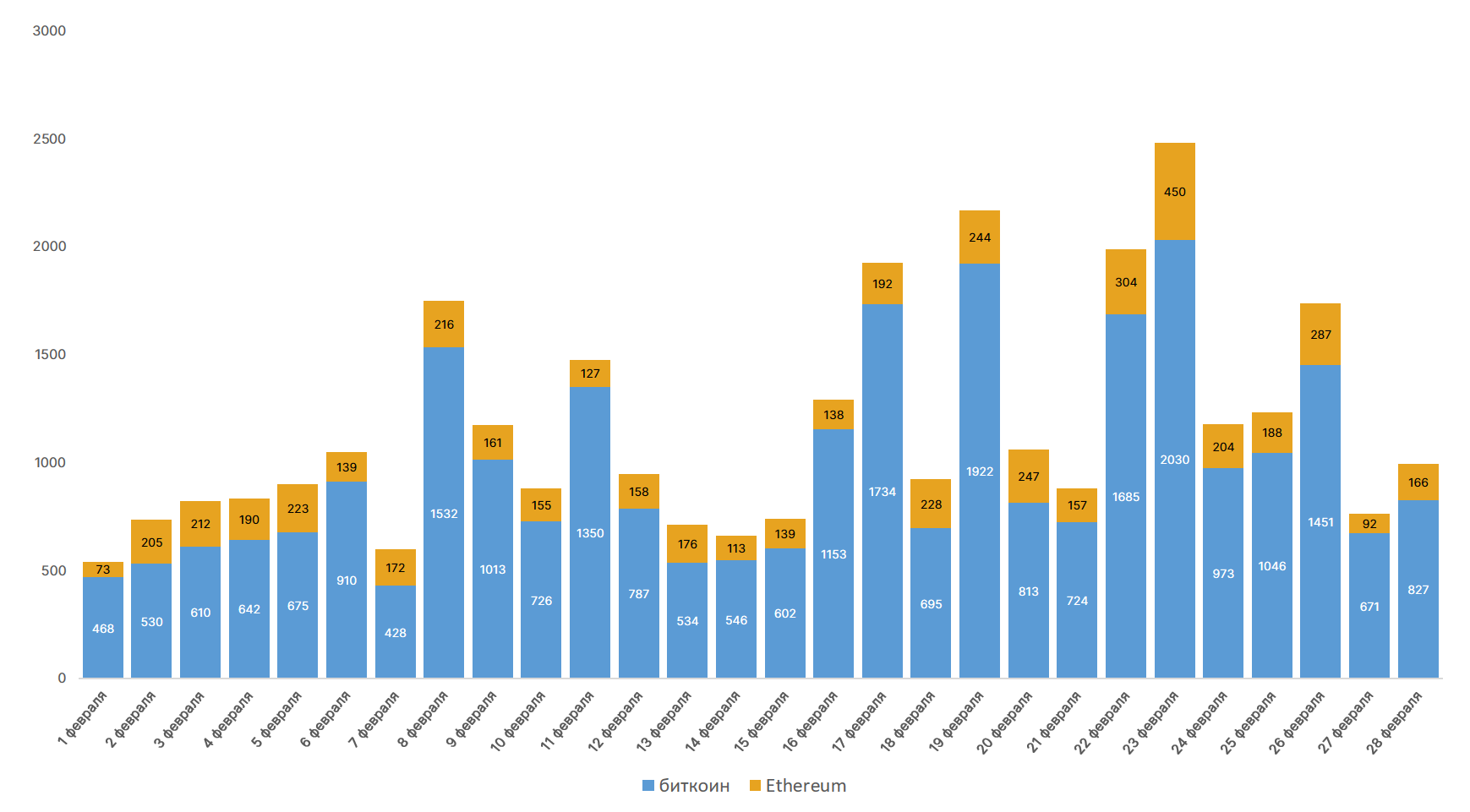
Trading volume of Bitcoin and Ethereum options, $ millions. Data: skew.
- Users actively traded Bitcoin options — total volume was $24 billion, and open interest exceeded $12 billion for the first time.
- Ethereum options volume in February reached a record $4.5 billion, and open interest neared $3 billion for the first time.
DeFi


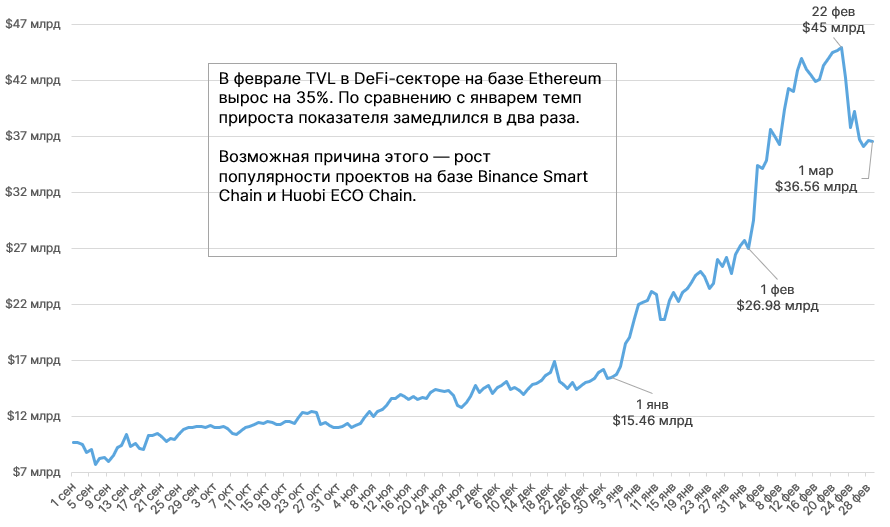
Dynamics of funds locked in the DeFi sector. Data: DeFi Pulse.


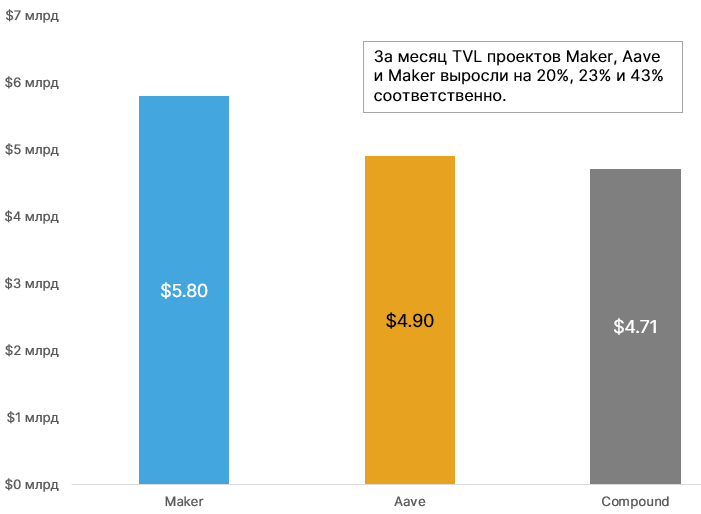
Top-3 DeFi projects by value of locked funds, bn. Data: DeFi Pulse (as of 1.03.2021).
- In February, Ethereum-based DeFi growth slowed. Total value locked (TVL) reached $45 billion, then began to decline. Likely reasons for the correction: gas price record lows and growing popularity of alternative platforms like Binance Smart Chain and Huobi ECO Chain.
- The top trio remained unchanged — lending projects Maker, Aave and Compound. TVL on March 1 stood at $5.80 billion, $4.90 billion and $4.71 billion respectively. The fastest growth was shown by DeFi platform Compound (+43% vs. the previous month).


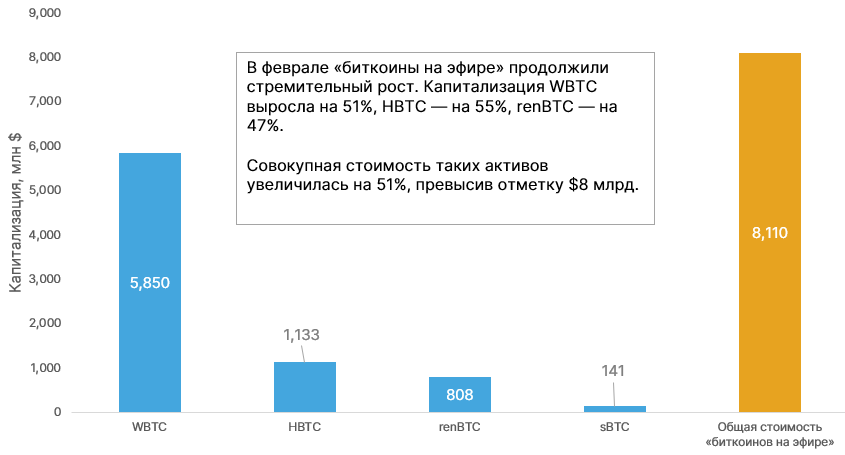
Capitalization of popular Bitcoin tokens on Ethereum, mln $. Data: DeFi Pulse.


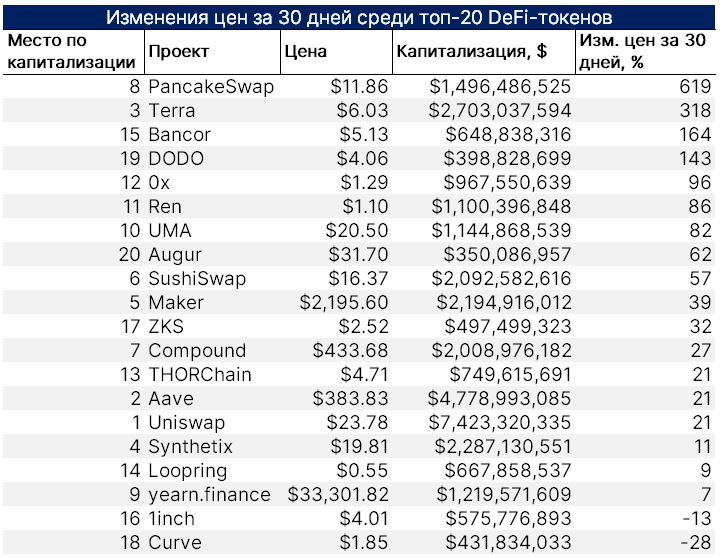
Top-20 DeFi coins by market capitalization, sorted by price growth. Data: Messari (as of 1.03.2021).
- Bitcoin on Ethereum: total value reached a record $8 billion (+51% in February). The market cap for pioneer DeFi token WBTC approached $6 billion. HBTC surpassed the $1 billion mark.
- The fastest-growing token was PancakeSwap (CAKE) on BSC — in February the token of the Uniswap rival rose by more than 600%.


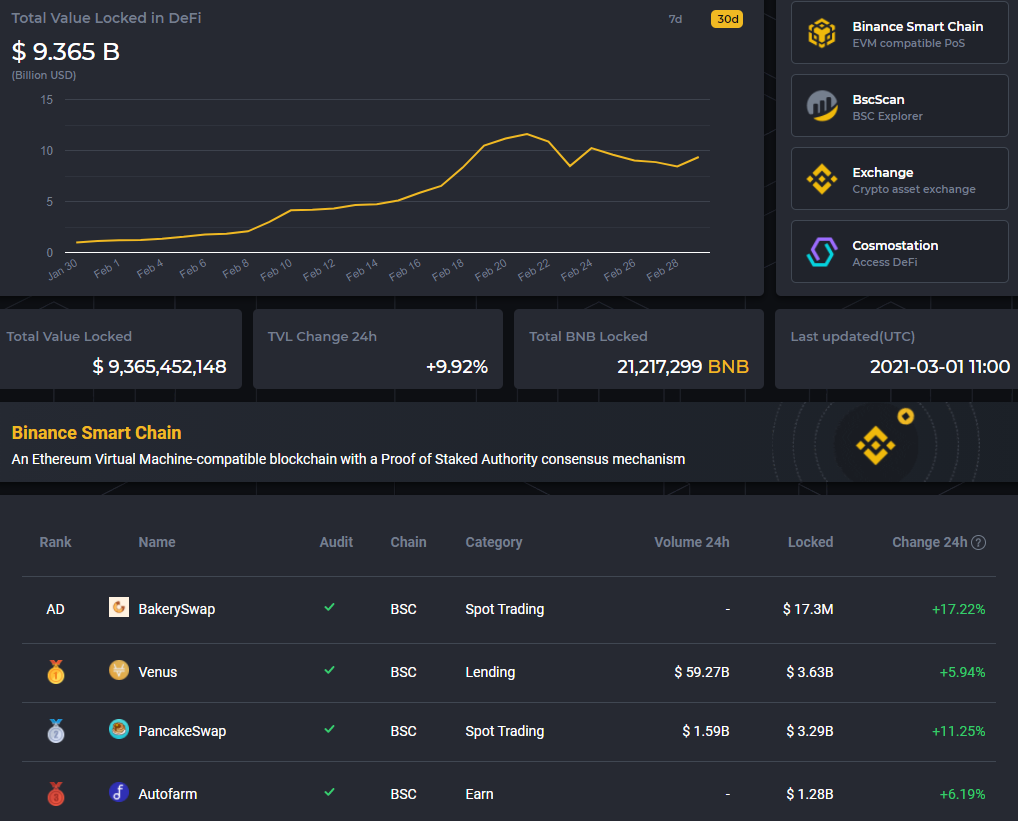
TVL and the top-3 ecosystem players in Binance Smart Chain. Data: Desistation.
- In the second half of February, TVL of the Binance Smart Chain ecosystem surpassed $10 billion. A slight decline followed later in the month, but the figure recovered again.
- The leading BSC-based projects were Venus, PancakeSwap and Autofarm. Their TVLs stand at $3.63 billion, $3.29 billion and $1.28 billion (as of 1.03.2021).
DEX


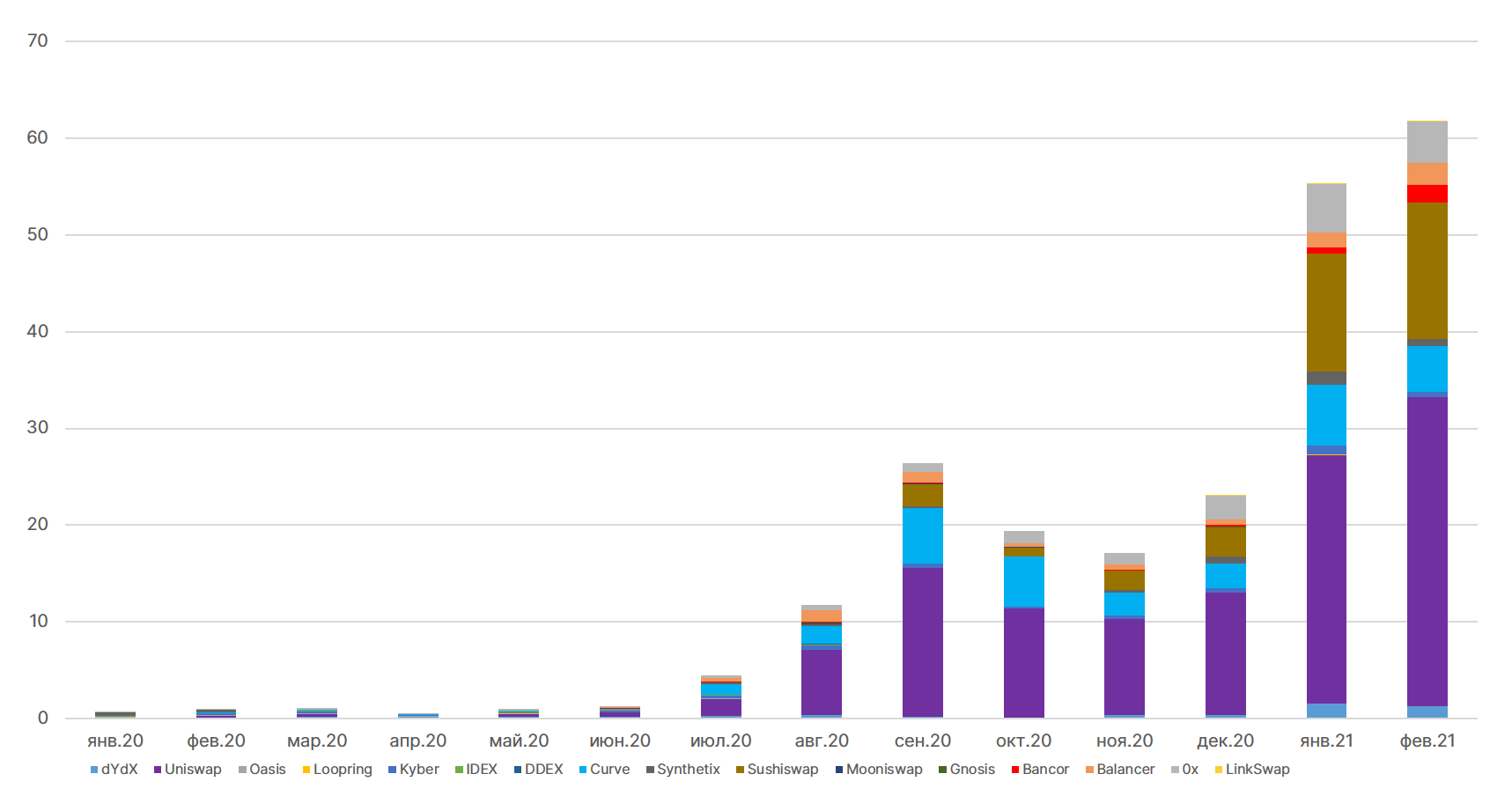
Trading volumes on decentralized exchanges, $ billions. Data: Dune Analytics.


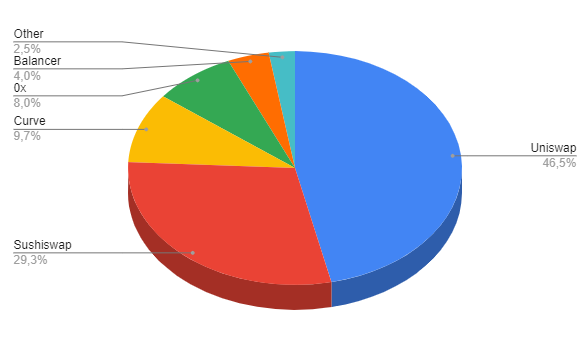
Market shares of the largest DEXs. Data: Dune Analytics as of 1.03.2021.
- In February, trading volume on decentralized platforms hit a record $61.78 billion (+27%).
- Uniswap remained the absolute leader in the Ethereum-based segment, with platform turnover at $31.8 billion in the past month.
- Top three also included SushiSwap with $14.1 billion and Curve with $4.7 billion.
NFT


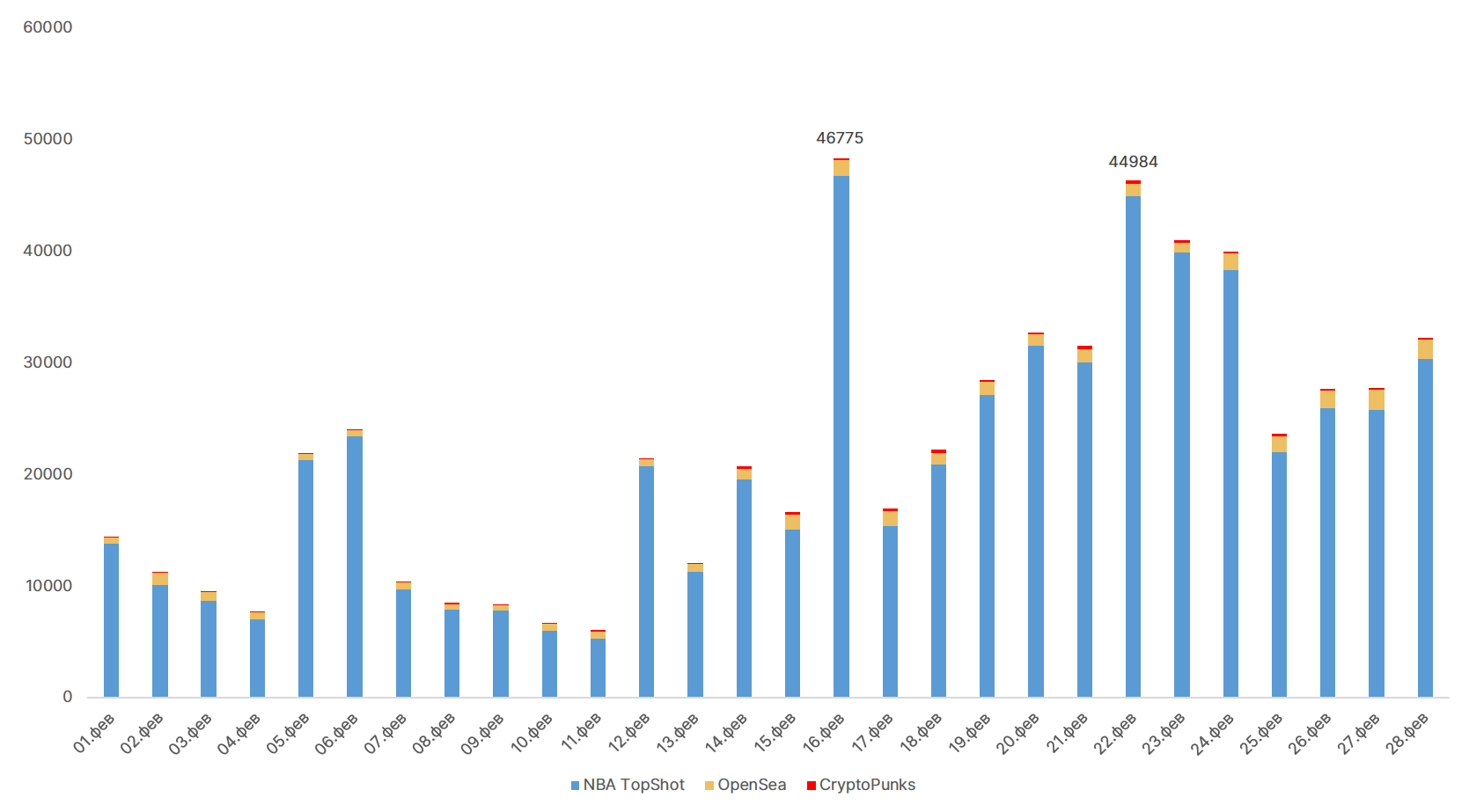
Daily users of the most popular NFT marketplaces. Data: dappradar


Daily transactions on leading NFT marketplaces. Data: dappradar
In the second half of February the NFT marketplace NBA TopShot, featuring basketball-themed cards, saw a surge in users — over 45,000 visited the platform on February 16 and 22. The second-largest marketplace OpenSea surpassed 1,000 daily users in February. In the busiest days, CryptoPunks logged 350 users.
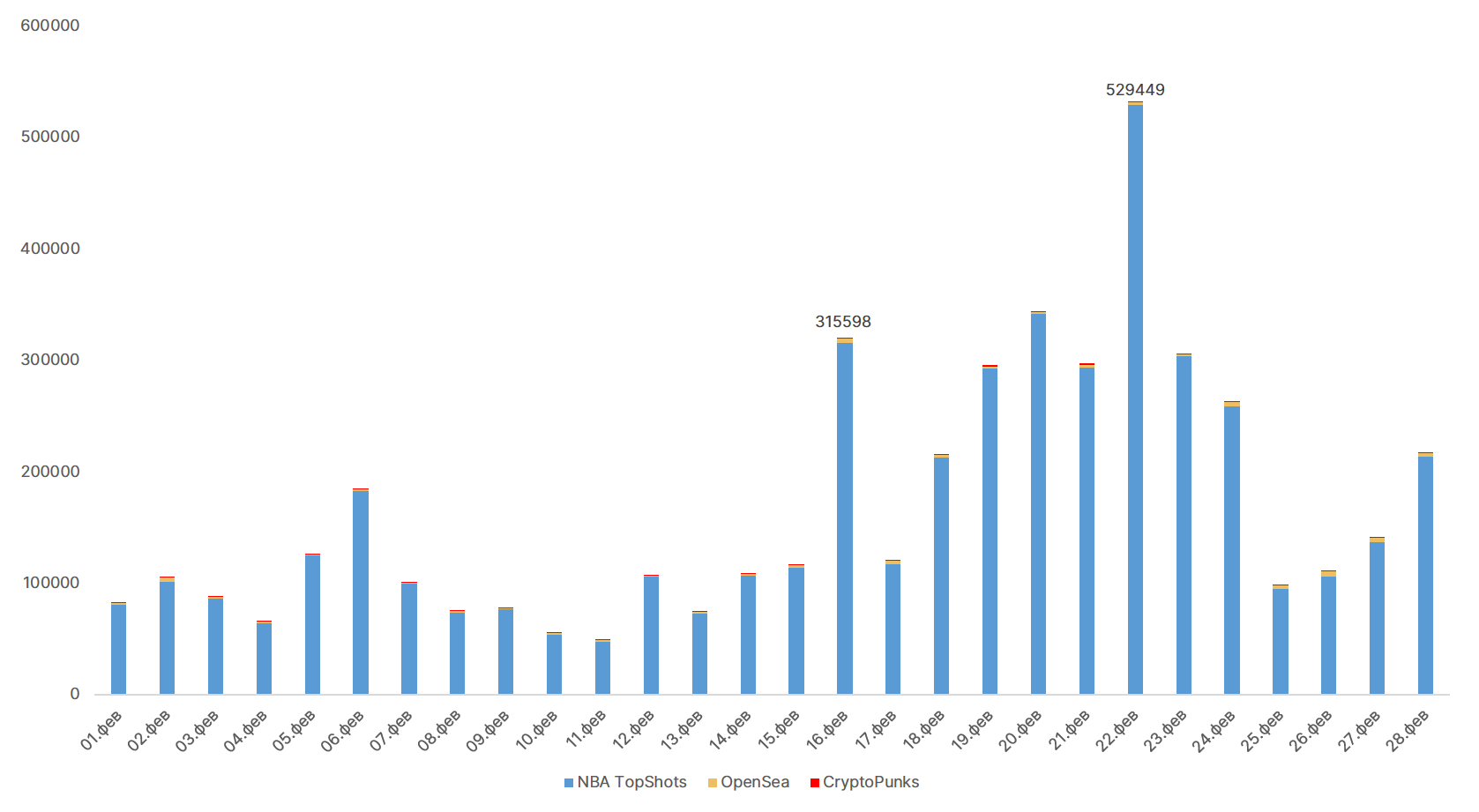
Transaction counts closely tracked the user base. On February 22 NBA TopShot processed over half a million transfers, OpenSea over 4,000, and CryptoPunks 1,400.


NFT marketplace trading volumes in February, $ millions. Data: dappradar.
- The NFT market is showing rapid growth, representatives of NonFungible reported in February. The sector’s potential in the next decade was also highlighted by billionaire Mark Cuban.
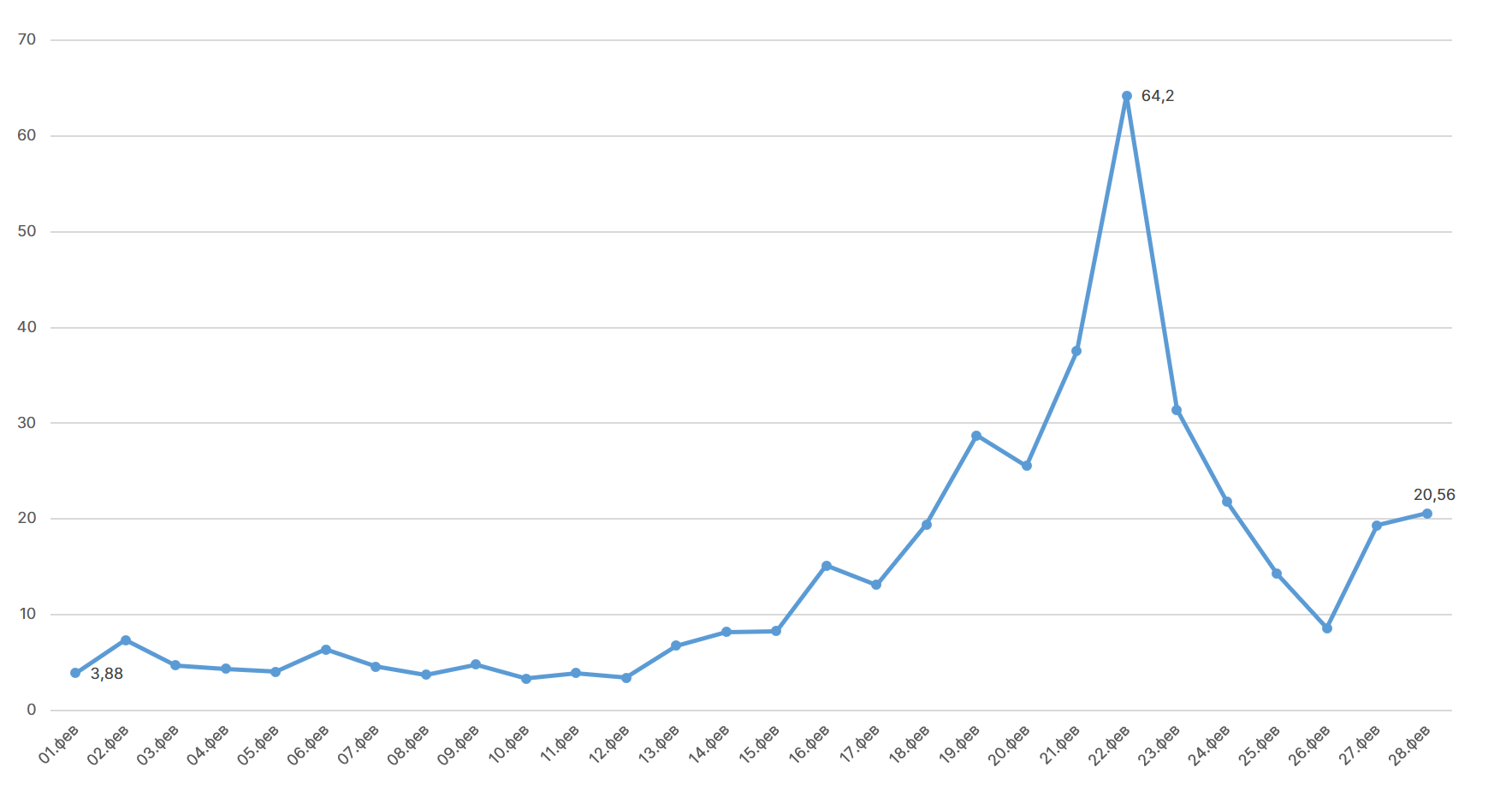
- On February 22, in the peak session, users spent more than $64 million on NFTs. Some items, such as CryptoPunks, were sold for 90-400 ETH, and the rarest piece sold for a record 605 ETH.
- Attention from high-profile figures included Lindsay Lohan, Vermont Senator Bernie Sanders, the creator of the meme animation Nyan Cat and Russian artist . But the most expensive NFT lot was Beeple’s artwork depicting former U.S. president Donald Trump — it changed hands for $6.6 million. Another Beeple piece is on display at Christie’s auction house; auctions run until March 11. As of the start of the month, the lot had 125 bids, the latest price was $3.25 million.
Stablecoins


Total market capitalization of stablecoins, bn $. Data: Messari.


Top-5 leading stablecoins by market capitalization, bn $. Data: Messari (as of 1.03.2021).
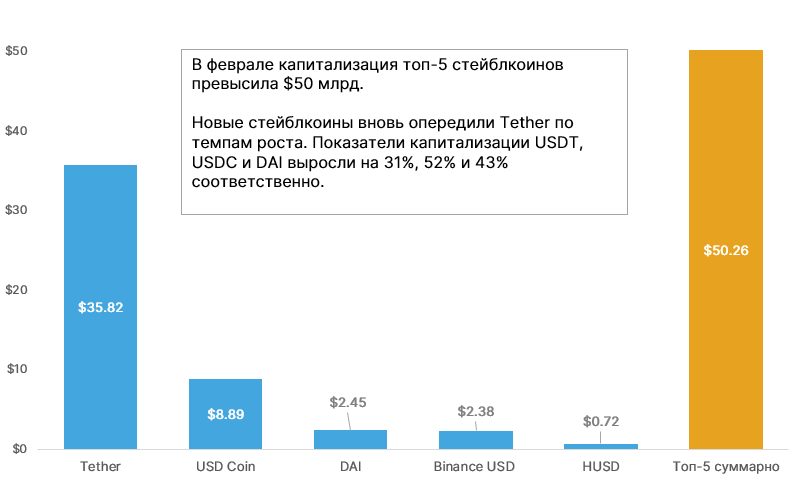
- In February, the overall market capitalization of stablecoins exceeded $50 billion for the first time.
- The leader of the segment remains USDT from Tether — $35.9 billion.
- The market capitalization of the second-largest stablecoin USDC by Circle approached $9 billion this month. Binance USD (BUSD) ranks third with $2.38 billion.
P2P trading


LocalBitcoins P2P trading volume in 2020-2021, USD millions. Data: coin.dance.


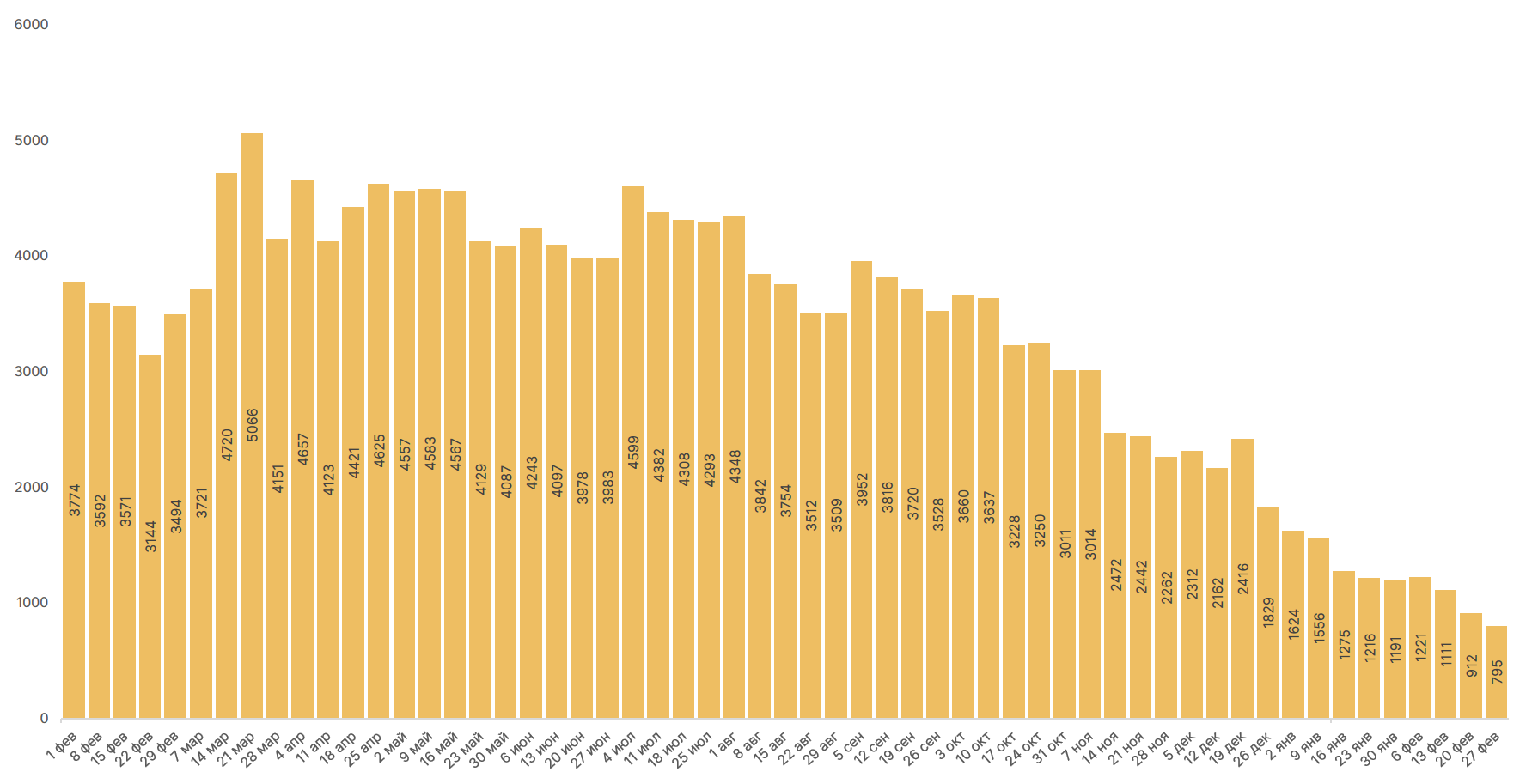
LocalBitcoins BTC trading volume on P2P.
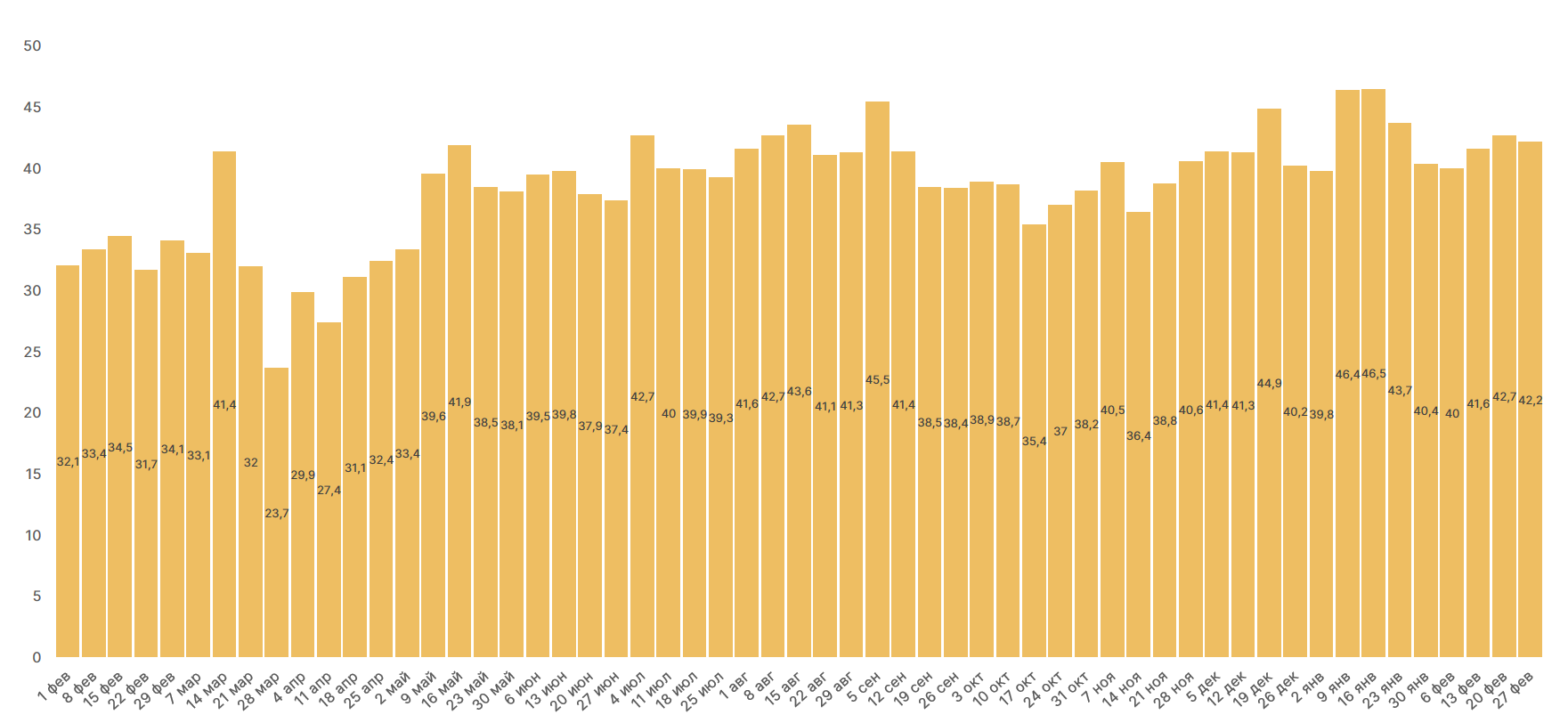
Transaction volumes on LocalBitcoins’ P2P platform remained above $40 million. However, considering the total Bitcoin-denominated trades for the month, the situation appeared to deteriorate, recording new lows.


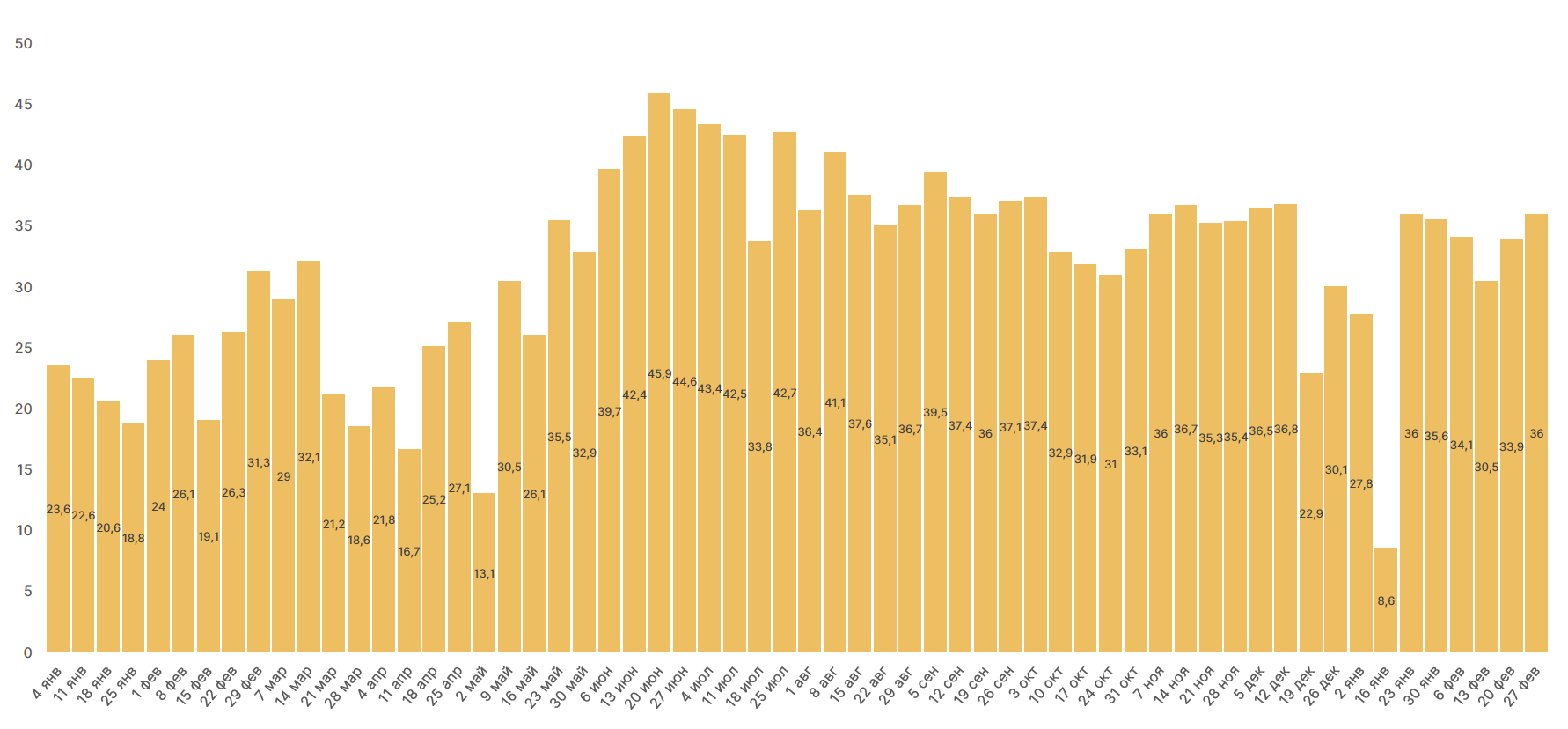
Local trading on Paxful in 2020-2021, USD millions. Data: coin.dance.


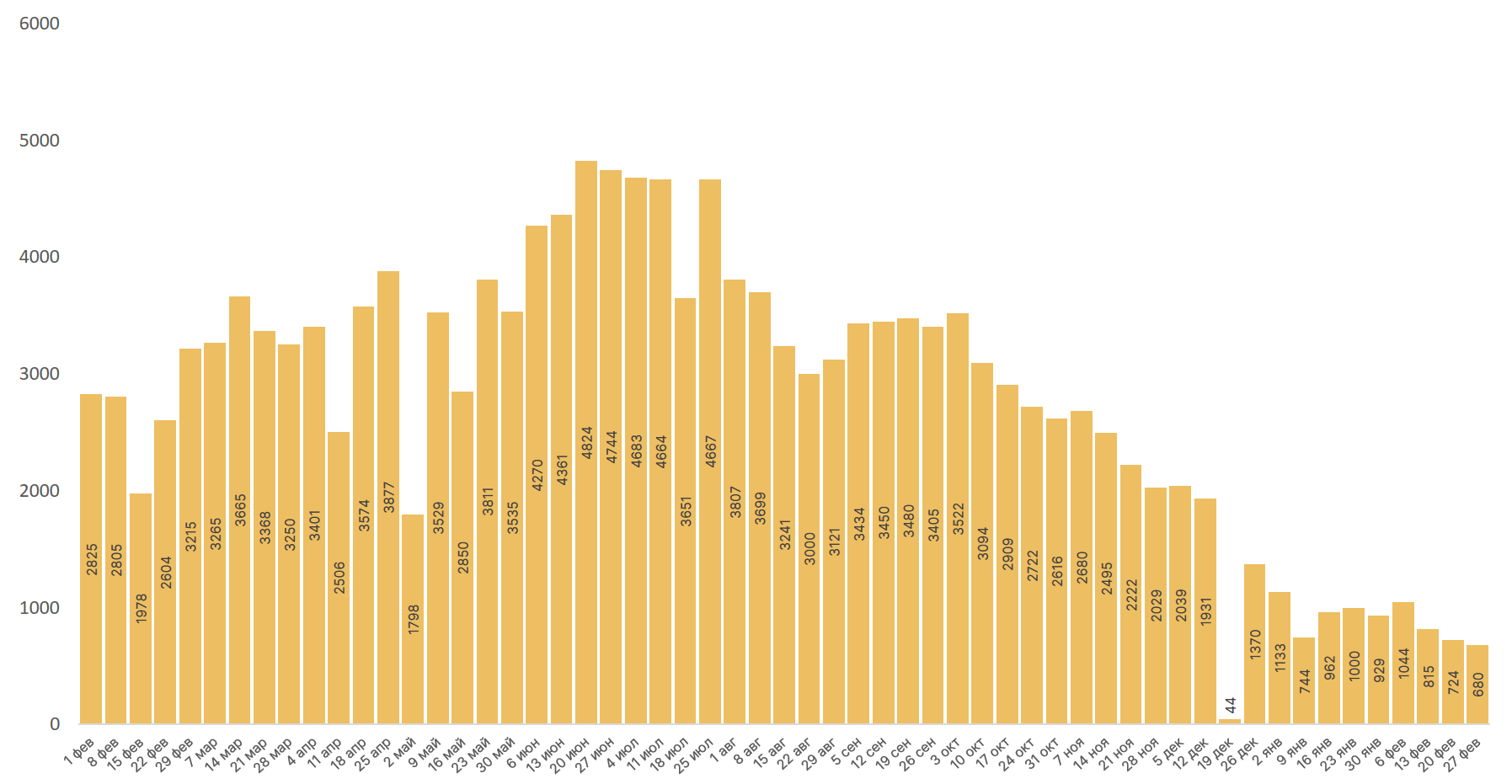
Paxful BTC trading on P2P in 2020-2021, BTC. Data: coin.dance.
A similar dynamic was observed on rival platform Paxful — towards the end of the month the USD volume rose, but the trading turnover in Bitcoin continued to decline.
Mining, hash rate, fees


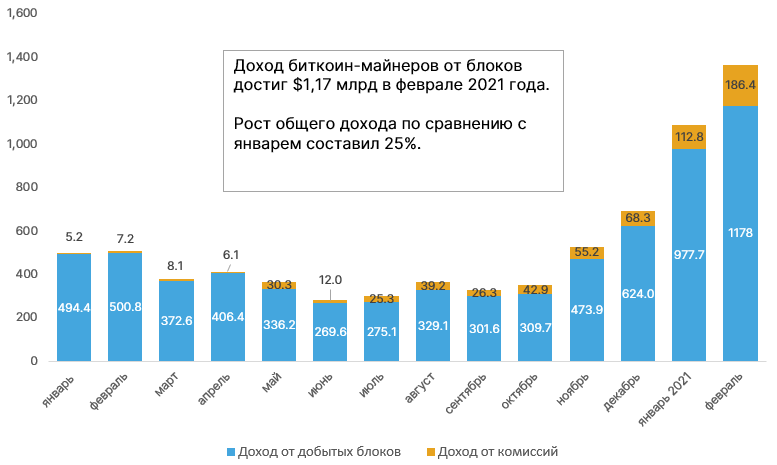
Bitcoin miners’ revenues by month, $ millions. Data: Coin Metrics.


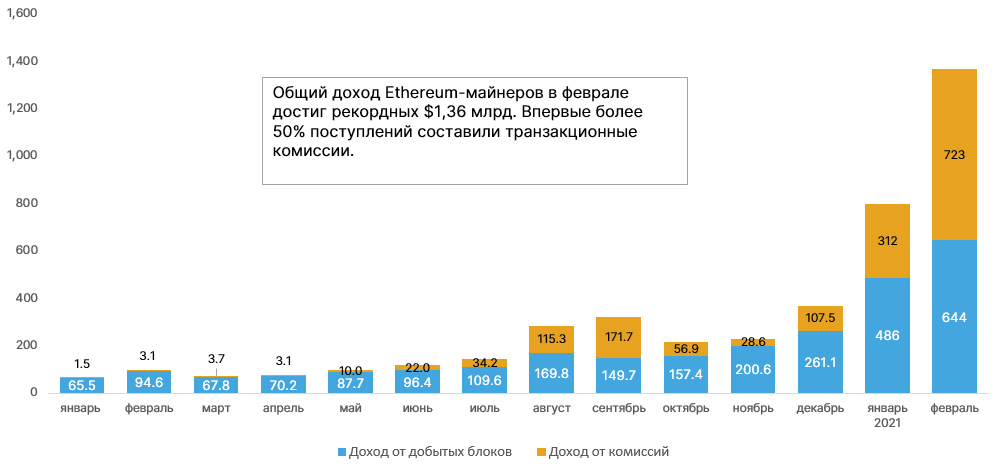
Ethereum miners’ revenues by month, $ millions. Data: Coin Metrics.
- Bitcoin and Ethereum miners’ revenues in February reached parity, hitting record highs at $1.36 billion.
- Overall miner revenues for Bitcoin rose by 25% in February.
- Against the backdrop of rapidly rising gas prices, the share of fees in Ethereum miners’ revenue for February exceeded 50% for the first time in the month.


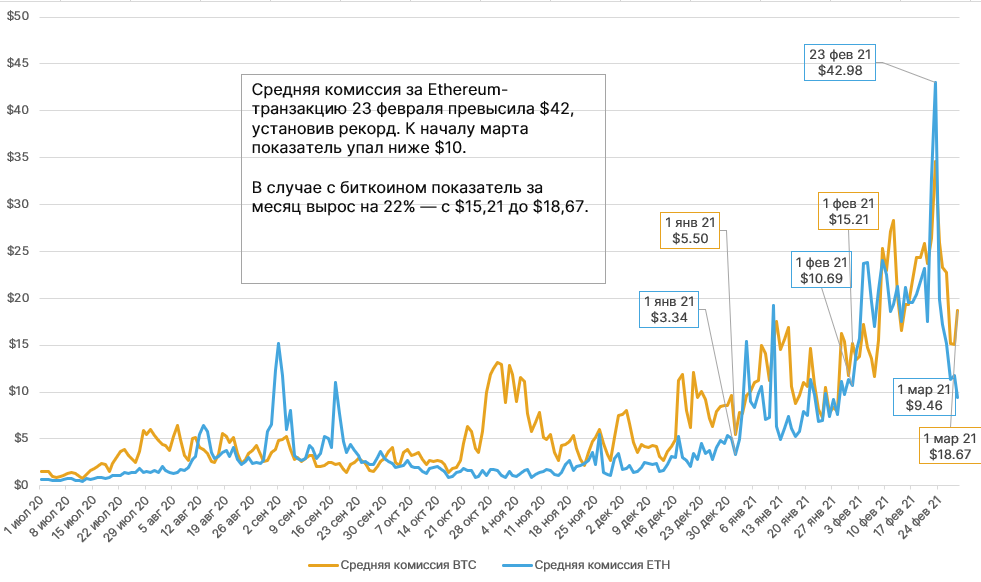
Dynamics of the average fee per BTC and ETH transaction. Data: Blockchair.


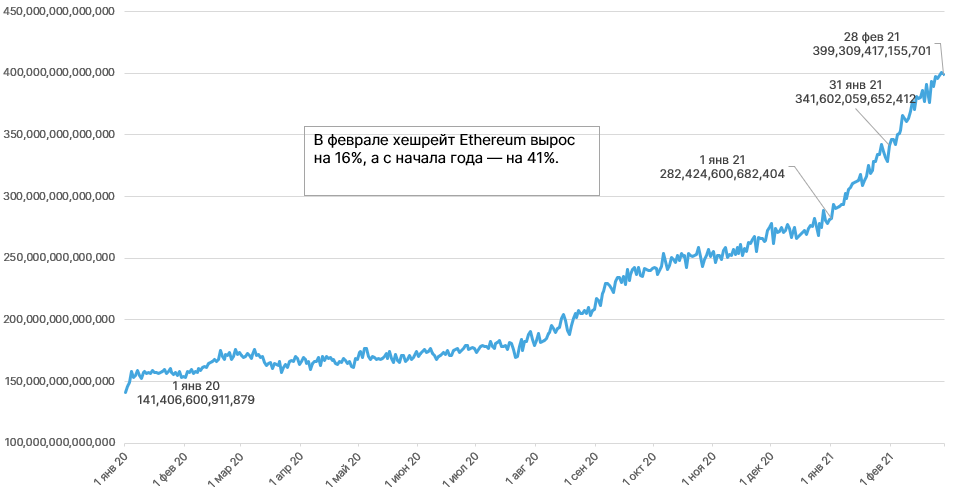
Ethereum hashrate dynamics, h/s. Data: Glassnode.
- On February 23, the average Ethereum transaction fee hit a historic maximum above $40. Bitcoin’s fees also rose significantly — from $15.21 (February 1) to $18.67 (March 1).
- In February, Ethereum hashrate rose by 16%. The rise could not be stopped by the price correction toward month-end.


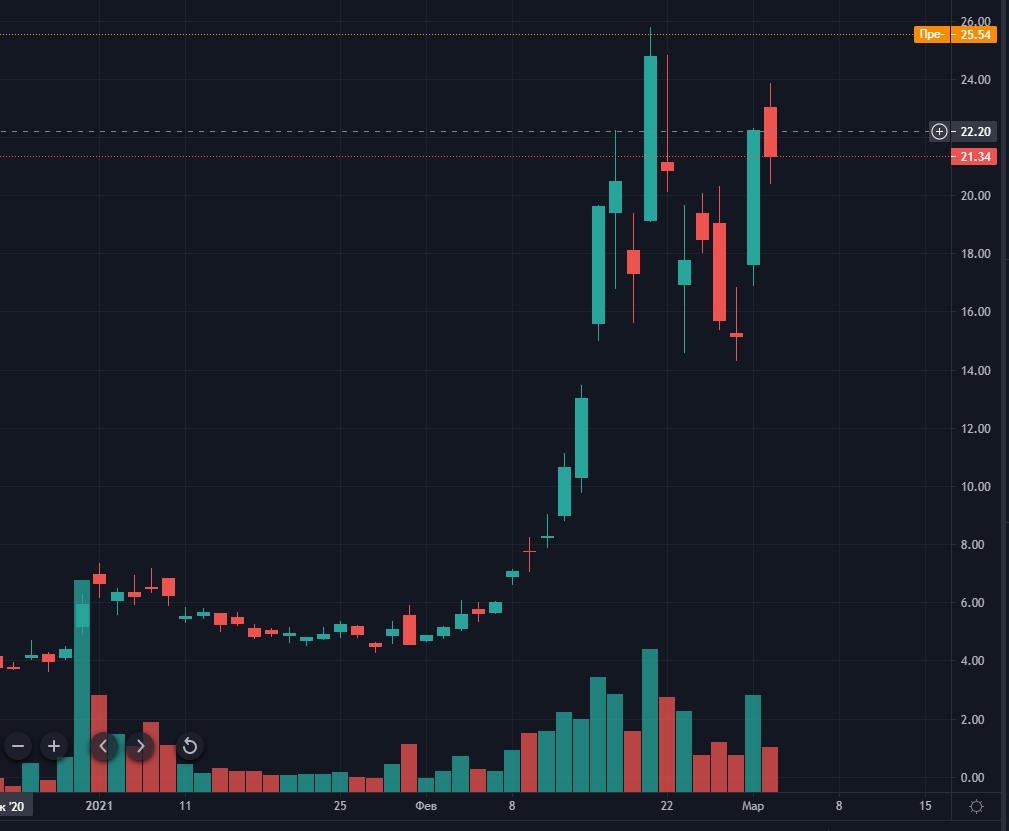
Daily chart of Canaan shares from TradingView.


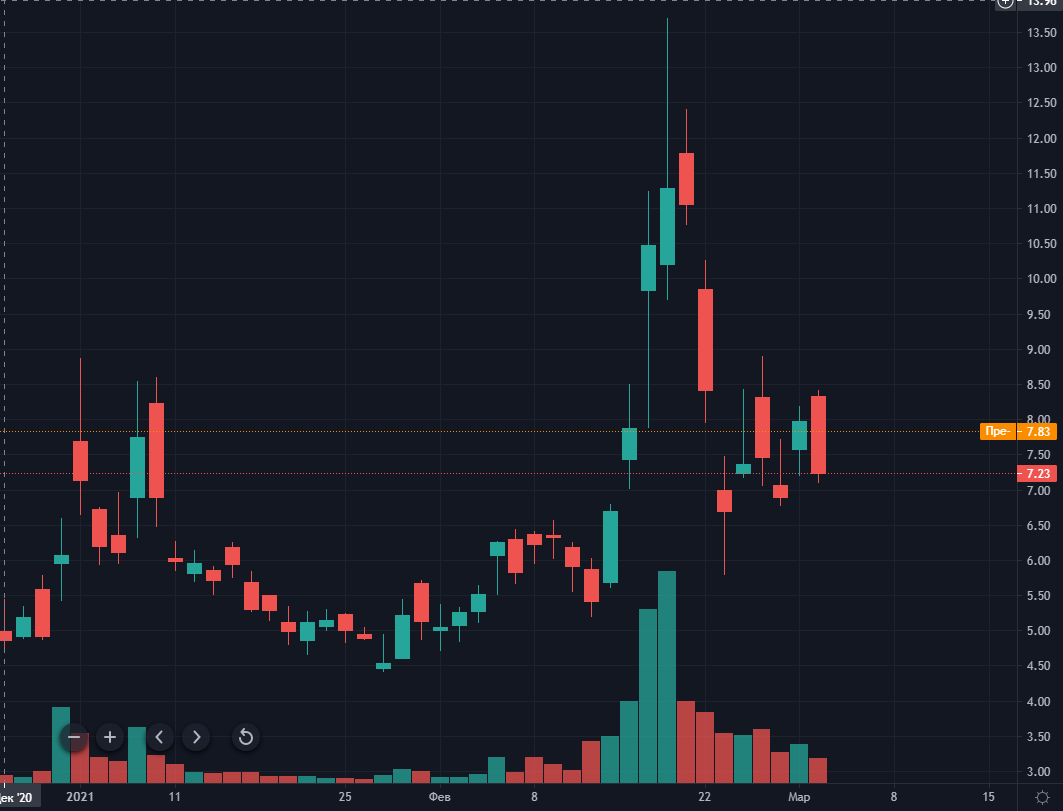
Daily stock chart of Ebang shares from TradingView.


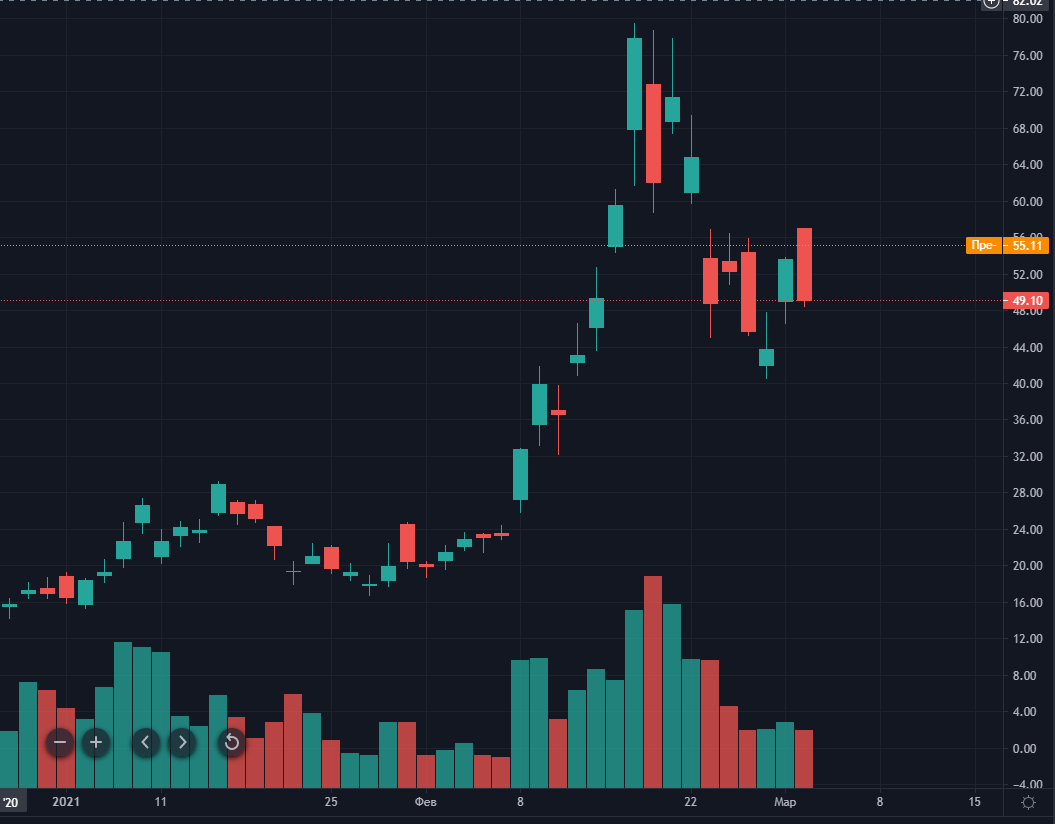
Daily chart of Riot Blockchain shares from TradingView.
Against the backdrop of Bitcoin’s price surge and crypto mining revenues, mining company equities also rose:
- Canaan Inc. — from $4.88 (Feb 1) to $22.25 (Mar 1). Monthly gain: 355%.
- Ebang International Holdings Inc. — from $5.05 to $7.98 (+58%).
- Riot Blockchain Inc. — from $19.98 to $53.60 (+168%).
On-chain data


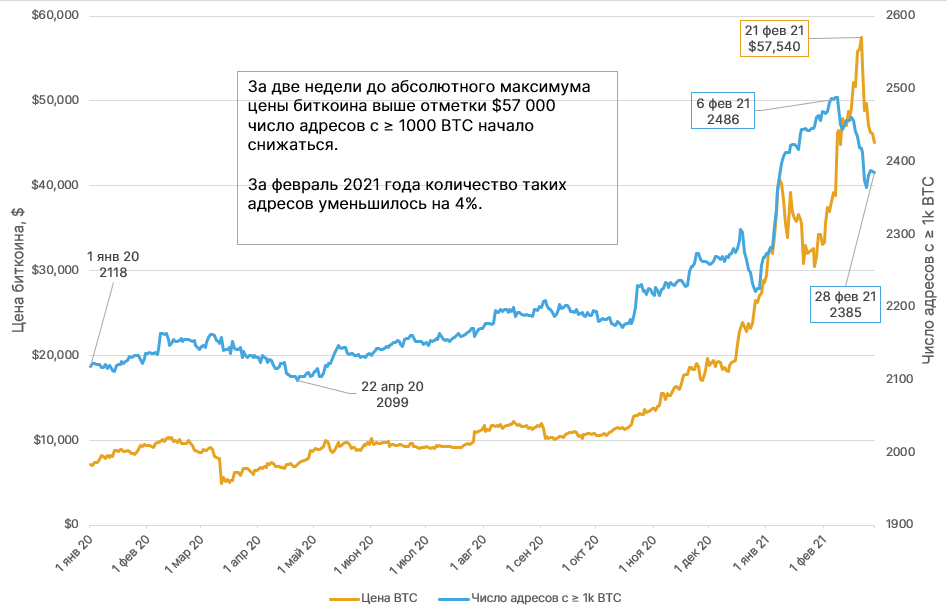
Bitcoin price and addresses with ≥ 1000 BTC. Data: Glassnode.


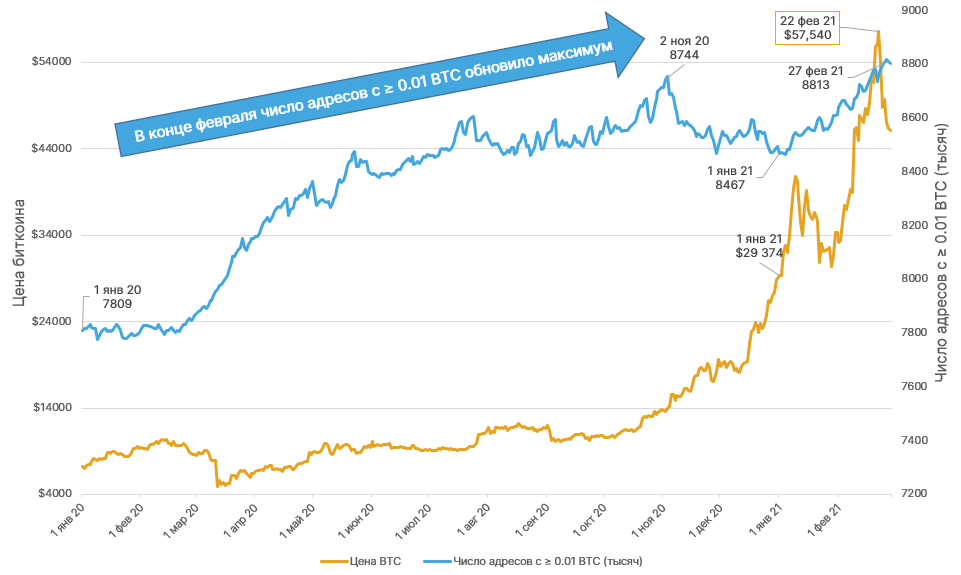
Bitcoin price and number of addresses with ≥ 0.01 BTC (thousands). Data: Glassnode.
- The number of “whale” addresses (≥ 1000 BTC) began to decline about two weeks before Bitcoin’s all-time high above $57,000. It is possible profit-taking by big players contributed to the correction and mood shift in the market.
- Despite the price pullback, the number of retail addresses (≥ 0.01 BTC) hit a new high at the end of February.


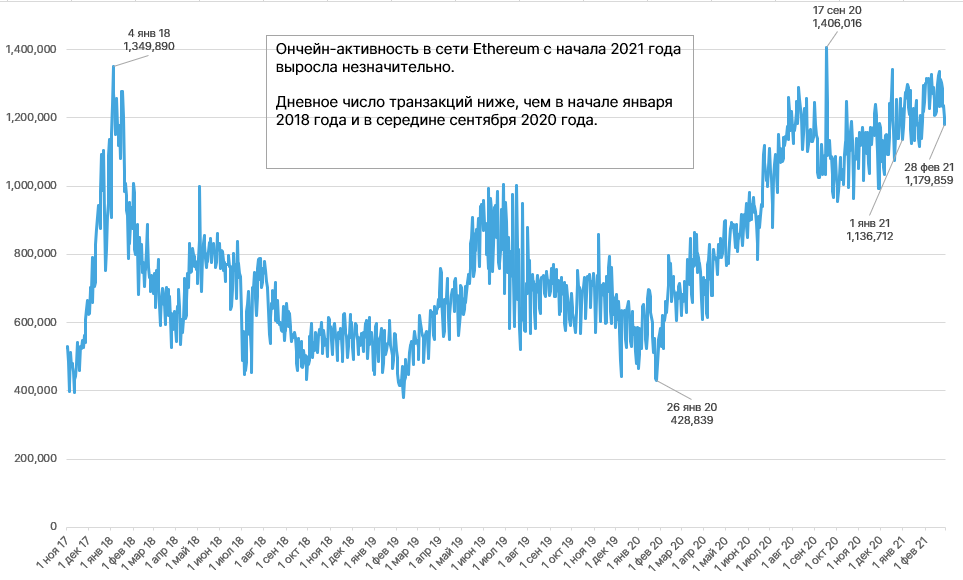
Ethereum transaction counts. Data: Etherscan.


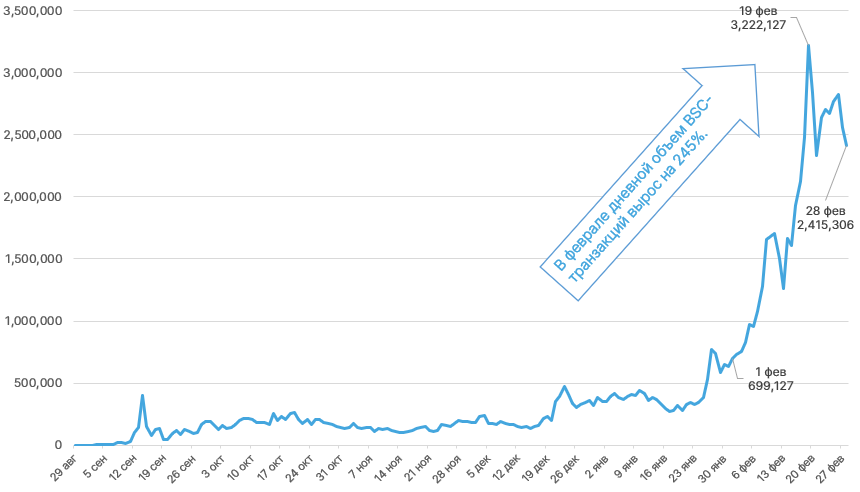
Daily transactions in the Binance Smart Chain ecosystem. Data: BscScan.


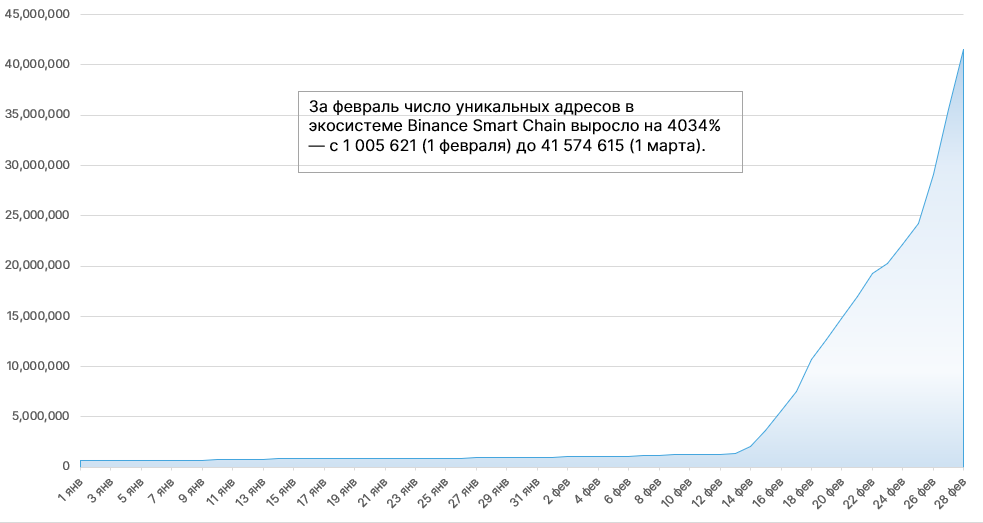
Number of unique addresses in the Binance Smart Chain ecosystem. Data: BscScan.
Against the backdrop of Bitcoin’s price surge and mining income, the stock prices of mining companies rose as well:
- Canaan Inc. — from $4.88 (Feb 1) to $22.25 (Mar 1). Monthly gain: 355%.
- Ebang International Holdings Inc. — from $5.05 to $7.98 (+58%).
- Riot Blockchain Inc. — from $19.98 to $53.60 (+168%).
On-chain data
Bitcoin price and addresses with ≥ 1000 BTC. Data: Glassnode.
Bitcoin price and number of addresses with ≥ 0.01 BTC (thousands). Data: Glassnode.
- The number of “whale” addresses (≥ 1000 BTC) began to decline about two weeks prior to Bitcoin’s all-time high above $57,000. It is possible that profit-taking by large players contributed to the correction and mood shift in the market.
- Despite the price pullback, the number of “retail” addresses (≥ 0.01 BTC) reached a new high by the end of February.
Ethereum transaction counts. Data: Etherscan.
Daily transactions in the Binance Smart Chain ecosystem. Data: BscScan.
Number of unique addresses in the Binance Smart Chain ecosystem. Data: BscScan.
Against the backdrop of Bitcoin’s price surge and mining income, the Bitcoin mining shares rose as February progressed:
- February was not the brightest month for Ethereum activity — the number of Ethereum transactions rose only slightly.
- Daily BSC transaction volume more than doubled Ethereum’s. The rapid growth of unique addresses also signaled significant activity in the new network.
- A likely reason for Ethereum’s stagnation is demand from DeFi apps on the Binance and Huobi ecosystems. Despite the relatively low decentralisation, retail investors are attracted by high transaction speeds and low fees.
Activity of large players
Tesla
The February highlight was Tesla’s Elon Musk’s bitcoin purchase of $1.5 billion. During the day the price rose from around $38,000 to a new high near $46,700, forming the largest daily candle in history.
At one point, the paper profit from Tesla’s bitcoin holdings surpassed the profits from selling cars in all of last year, according to Wedbush Securities. Yet Tesla’s stock price moved contrary to Bitcoin’s price. Wedbush Securities noted the dependence of the automaker’s shares on the price of digital gold.
According to media, the Bitcoin purchase for Tesla was executed by the cryptocurrency exchange Coinbase. Elon Musk himself called the move “quite risky”.



Investments in bitcoin by public companies as of 1 March 2021. Data: Bitcoin Treasuries.
According to Bitcoin Treasuries, Tesla holds 48,000 BTC. Tesla has not officially confirmed this.
MicroStrategy
- 2 February: MicroStrategy announced a further investment in Bitcoin of $10 million. The company acquired 295 BTC at a price of $33,808.
- Two weeks later, on 16 February, the company announced another tranche of convertible bonds for $600 million to finance further Bitcoin purchases. The next day MicroStrategy raised the target for fundraising by another $300 million with potential for additional bonds of $150 million.
- By 19 February the company reported a raise of $1.05 billion.
- 24 February MicroStrategy purchased 19,452 BTC for $1.02 billion at an average price of $52,765.
- 1 March the company announced an additional purchase of 328 BTC for $15 million.
- In total MicroStrategy owns 90,859 BTC.
Square
23 February, Jack Dorsey’s Square disclosed in its quarterly report the acquisition of 3,318 BTC for $170 million. As of 31 December, Bitcoin accounted for 5% of the company’s cash reserves — 8,027 BTC owned.
Ruffer Investment
While some companies expanded their bitcoin positions, British firm Ruffer Investment decided to partially realise gains after the price doubled. The investment firm withdrew $650 million — nearly all the amount invested in November. Duncan MacKinnon, Chief Investment Officer, said the company did not expect such rapid payoff from cryptocurrency.
Grayscale


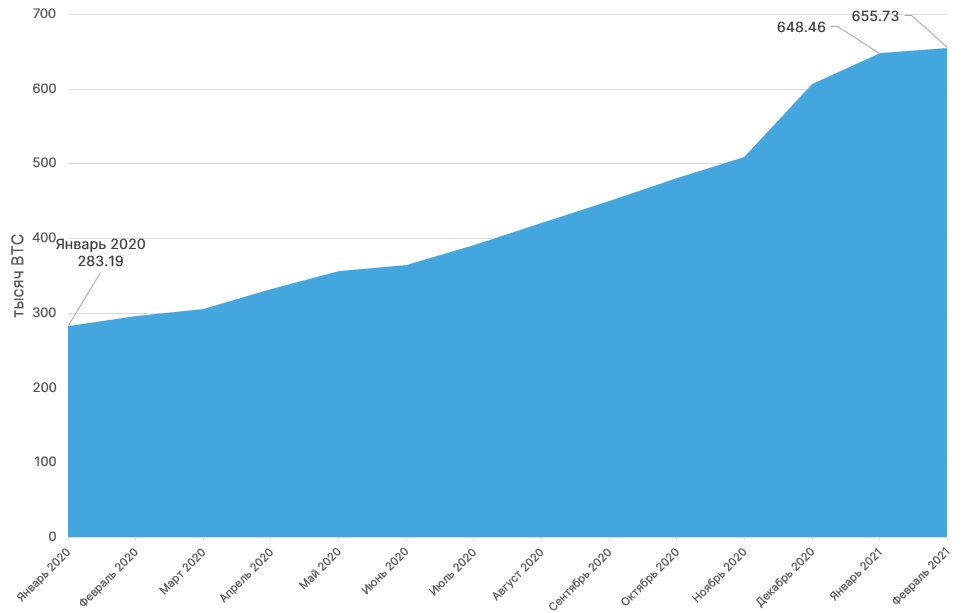
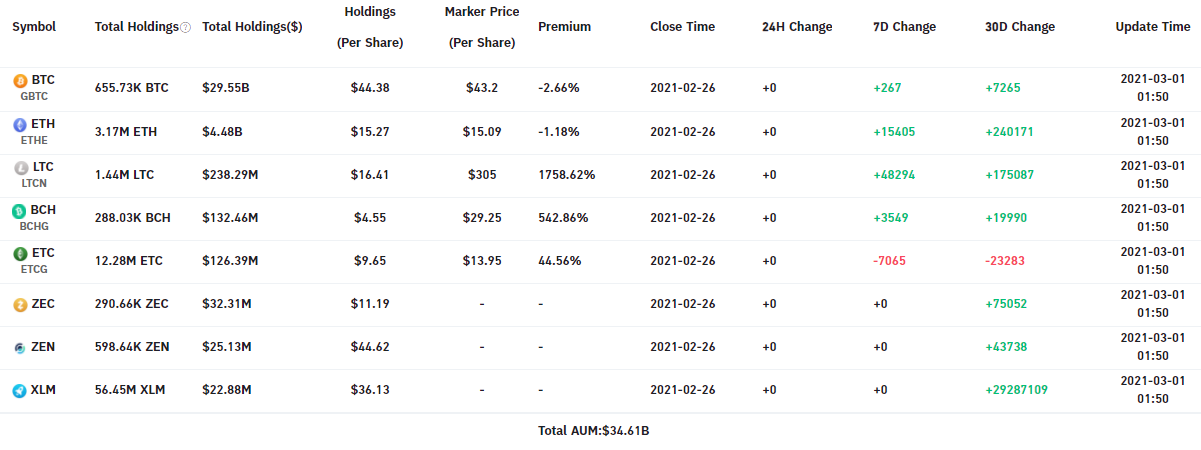
Grayscale Bitcoin Trust assets inflows. Data: bybt.


Grayscale all-trust assets inflows in February. Data: bybt.
During February, Grayscale Investments attracted 7,265 BTC, 240,171 ETH, 175,087 LTC, 19,990 BCH, 75,052 ZEC, 43,738 ZEN and 29 million XLM, bringing assets under management to $34.6 billion (as of 1 March 2021).
What about others?
- In February Bill Miller’s firm, with $2.25 billion in assets, announced plans to allocate 15% of them to a Grayscale Bitcoin Trust. The request was sent to the US Securities and Exchange Commission (SEC).
- Financial firm The Motley Fool stated intent to buy bitcoins for $5 million.
- Reports suggested Counterpoint Global (Morgan Stanley Investment Management) is considering investments in Bitcoin, with parent-company and regulators likely to grant approval.
- US oldest bank BNY Mellon will begin custody services for bitcoin. Similar plans were announced by the Deutsche Bank conglomerate.
- In JPMorgan Bitcoin was described as an “economic attraction”, with the bank noting the COVID-19 recovery would benefit the fintech sector. However, the firm recommended clients to move 1% of investment portfolios into bitcoin and other digital assets as a hedge against stocks, bonds and commodities.
- Mastercard plans in 2021 to open up merchants to accepting digital asset payments directly, without reliance on card issuers or processors. Visa is testing solutions to integrate bitcoin payments by banks.
- In Canada, a second bitcoin ETF from Evolve Funds Group was approved. In the US, New York Digital Investment Group (NYDIG) applied to launch an ETF aimed at large players.
- Uber will consider accepting bitcoin payments, says CEO Dara Hosrowshahi.
- PayPal CEO Dan Schulman said the company is actively investing in its crypto arm, which has more than justified expectations amid market growth.
Key regional events



- In Ukraine, the government included blockchain specialists in the high-skilled worker category. Foreign specialists will be able to live and work in the country for 10 years. The quota for 2021 is 50.
- Monobank announced the suspension of SEPA transfers from Binance due to ban on transfers through intermediary banks.
- On 15 February, the Ministry of Digital Transformation of Ukraine and Intelmax Management Consulting from the UAE signed a memorandum of cooperation. It envisages establishing a local office and implementing blockchain technology in government processes and services, as well as the possibility of creating a national stablecoin on the Fantom blockchain.



- The Russian Presidential Advisory Council on codification and improvement of civil law criticized the cryptocurrency taxation bill for terminology issues. The council’s press service said it needs to clarify the list of objects that could be considered digital currencies.
- On 16 February, the Russian State Duma Budget and Tax Committee recommended the lower house pass the cryptocurrency taxation bill in the first reading. The Committee said the bill would be refined before the second reading along with the “On Cryptoassets” law and amendments to the Civil Code.
- The next day, 17 February, the State Duma adopted the bill in the first reading. The document was supported by 375 deputies.
- Central Bank head Elvira Nabiullina criticised Bitcoin and commented on the next stage of work on the digital ruble.
Regulation


Regulation
Other notable February events
Elon Musk and Dogecoin
The head of Tesla and SpaceX, who has expressed affection for Dogecoin and “willingness to joke about it”, posted a series of tweets about DOGE, calling the coin a “people’s cryptocurrency.” Market reaction was immediate — DOGE rose 50%. Musk accompanied the posts with a meme that later went viral:



The trend was backed by musicians Gene Simmons, Snoop Dogg and Kevin Jonas.
On 11 February the founder of Tesla and SpaceX stated that he bought bitcoin for his younger son, and later wondered about excessive concentration of cryptocurrency and proposed to pay large holders to cancel their accounts.
Each of his posts positively influenced DOGE’s price.
Toward month’s end there were reports of an SEC investigation into the entrepreneur, but they were unconfirmed. Musk himself replied, “Hopefully that is the case. That would be great.”
SEC approved Coinbase direct listing
On 25 February the regulator approved Coinbase’s direct listing in line with its December 2020 S-1 filing. Coinbase chose Nasdaq for its stock market debut.
In the S-1 form, Coinbase disclosed risk factors for investors. These include revealing the identity of Bitcoin’s creator Satoshi Nakamoto and competition from the DeFi sector. Other risks cited include “negative sentiment toward Bitcoin or Ethereum,” as well as “unpredictable coverage on social media” and “the crypto asset trend.”
Estimates vary, but Coinbase’s market capitalization could exceed $100 billion.
The Mt. Gox rehabilitation plan cleared
The Tokyo District Court approved Mt.Gox rehabilitation plan. Creditors must vote for it by 20 October 2021. Under the plan, the exchange rate for bitcoin to creditors is $7,205, BCH — $940. In total, 137,891 BTC are held on the exchange’s cold wallet.
Bitfinex and Tether settlement with NYAG
Under the settlement with the New York Attorney General’s Office regarding the concealment of an $850 million loss, Bitfinex and the Tether stablecoin issuer USDT will pay the state $18.5 million.
Tether agreed to provide NYAG with reports on USDT collateralisation. Both companies did not admit wrongdoing. The prosecutors acknowledged the debt repayment by Bitfinex to Tether.
Jihan Wu sold BTC.com mining pool
Jihan Wu sold the BTC.com mining pool to publicly traded 500.com. It is the third-largest Bitcoin hash rate pool.
Quotes of the month