




Key points
- Filecoin is a blockchain platform focused on decentralised data storage, with built-in economic incentives for users. It is one of Web3’s core infrastructure projects.
- Filecoin was created by Protocol Labs, which also developed the IPFS protocol for distributed file storage and launched the popular token-sale platform CoinList.
- The security and verification of data stored on Filecoin are ensured by two consensus mechanisms: Proof of Spacetime (PoSt) and Proof of Replication (PoRep). Miners are responsible for storing and serving data.
- FIL, the network’s native cryptocurrency, underpins incentives for storage and other participants.
History
The foundations of Filecoin were laid in 2014 by California-based Protocol Labs with the publication of a first-version concept based on Proof-of-Work.
The next stage, from 2014 to 2017, saw Protocol Labs build and expand the InterPlanetary File System (IPFS), a decentralised network protocol. IPFS is a more capable analogue of torrent networks for file storage and distribution.
IPFS was created by Protocol Labs’ head, Juan Benet. It can be used in place of HTTP and HTTPS. All file addresses in IPFS storage start with the prefix ipfs://.
One of the first crypto projects to integrate IPFS was OpenBazaar in 2016. It grew into a decentralised marketplace but ultimately shut down in 2021.
In 2017 the Filecoin team raised $257m via an ICO. The token sale was conducted on CoinList, developed by Protocol Labs together with AngelList, and followed the SAFT legal framework.
The mainnet of the decentralised data-storage platform Filecoin was launched in October 2020.
In February 2022 it emerged that the investment firm Tiger Global Management was backing crypto projects, including Filecoin.
Architecture and features
Filecoin is a decentralised counterpart to popular cloud-storage services such as Amazon Web Services or Alibaba Cloud. It builds on IPFS and adds economic incentives.
Anyone can use Filecoin by paying to store files on the network; conversely, anyone can contribute storage hardware and earn rewards in FIL.
How Filecoin works:
- A user who needs to store data pays a fee to upload it to Filecoin’s decentralised storage.
- A suitable storage provider (miner) commits in the Filecoin blockchain to store the dataset under an service-level agreement.
- The protocol continuously verifies the integrity and parameters of the stored data.
- A dedicated retrieval provider serves data requests for a fee set on the open market.
Beyond storage payments, miners earn block rewards, which depend on the storage capacity they provide. More than 4,000 active miners operate on Filecoin today. The current reward per block is about 20 FIL.
In addition to IPFS, Filecoin uses the modular networking stack libp2p, data models based on IPLD, the Multiformats protocol suite for flexibility and interoperability, and the educational resource ProtoSchool.
Performance and total storage capacity
Blocks on Filecoin are generated roughly every 30 seconds, or about 120 per hour. Developers consider this sufficient for FIL transfers between users.
Forming a deal between a client and a storage provider takes 1–2 minutes; transferring a 32GB file takes around 90 minutes.
According to the Filfox block explorer, as of 22 September 2022 the network’s total storage capacity was 18.56 exbibytes—around 20.75m terabytes.
Consensus
A key feature of Filecoin is its use of two algorithms to reach consensus across two distinct processes in the network.
Data replication
This is governed by Proof-of-Replication (PoRep). PoRep proves that storage providers have received and properly encoded the files submitted for storage. This proof is provided at the start and end of a storage deal.
Ongoing storage
This process is secured by Proof of Spacetime (PoSt), which proves that the “keeper” of the information continues to store the data associated with the deal.
Both algorithms use zk-SNARK technology for compression and encryption of transmitted information.
Consensus in Filecoin is arranged so that the validity of both proofs is checked in every new block, ensuring the required level of data security.
Filecoin is a modular project with multiple components.
What FIL is used for
FIL, Filecoin’s native coin, is the unit of account for on-chain operations. It also incentivises storage providers and miners who produce blocks and record transactions on the Filecoin blockchain.
FIL works similarly to Ethereum, where all operations and messages are paid in gas. Inspired by Ethereum’s EIP-1559 burn mechanism, the team implemented a similar approach to compensate for network resources. When the network is congested, gas limits rise to speed up transactions; when activity falls, gas limits decline.
Filecoin has not ignored DeFi and Web3, issuing a wrapped version to extend its ecosystem to other blockchains. Such tokens have been issued on Ethereum, BNB Chain, Fantom, Polygon, Avalanche, Solana, Arbitrum and Celo.
The platform’s investment appeal has been recognised by Grayscale Investments, which included FIL among its products—FIL was included among Grayscale’s investment vehicles. Another regulated FIL-based product, Filecoin Asset Use Swap (FAUS), is managed by DARMA Capital.
Competitors
The global data-storage market is evolving rapidly. Alongside centralised cloud providers (Amazon, Google, Dropbox, DigitalOcean and others), decentralised solutions have emerged in recent years—Filecoin among them.
BitTorrent
The company behind one of the world’s most popular file-sharing and storage protocols was sold in mid-2018 to Justin Sun, founder of the Tron (TRX) blockchain. In 2019 the project held an ICO, raising $7.2m, and subsequently introduced BTT token incentives for users who seed files.
Arweave
Arweave bills itself as a collective hard drive with an immutable history, allowing users to store not only files and information but also applications. By preserving history, it prevents others from rewriting it. The Arweave blockchain has backing from major venture investors including Multicoin Capital, Coinbase Ventures and Andreessen Horowitz.
NFT Storage service
One of the most successful applications of IPFS and Filecoin has been NFTs, where the project helps solve the problem of reliably storing digital-object metadata.
In 2021 the Filecoin developers launched NFT Storage, a free decentralised storage service for NFT metadata. The solution is based on IPFS and Filecoin, with access via a regular browser. Any NFT holder can use the platform.
According to official statistics as of late September 2022, NFT Storage held about 92m NFTs, with a total dataset around 258GB. According to Pooja Shah, head of product at Protocol Labs, major users include the NFT marketplace OpenSea, applications in the Flow ecosystem and Hedera. Filecoin also stores data from other popular networks, including Ethereum, Near Protocol and Polygon.
Ecosystem development
Beyond NFTs, Filecoin is used to store and archive datasets, metaverse and blockchain-game assets, scientific research, and audio- and video-focused projects. As of late July 2021 the ecosystem included Revolut, Travala, Opera, Infura, Cloudflare, Stanford University and dozens of other organisations that use Filecoin to some extent.


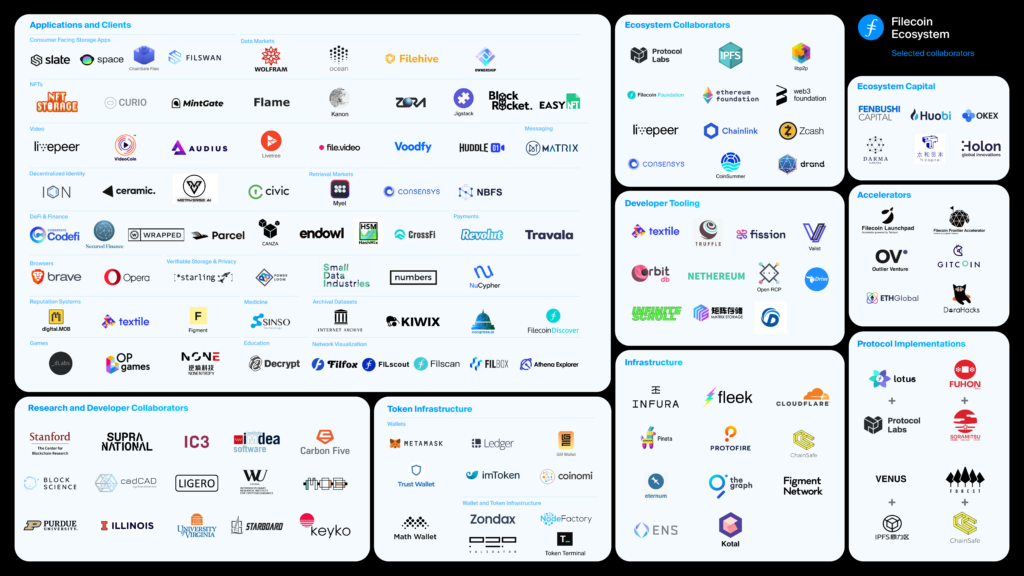
Examples include:
- Audius — a music-streaming application that uses IPFS;
- Huddle01 — a Web3 video-conferencing platform;
- Internet Archive — an archive of websites, web pages and files;
- Lighthouse — an application for fast uploads to a decentralised IPFS cloud.
Institutional interest has been accompanied by technological initiatives. In May 2022 the Filecoin Foundation and Lockheed Martin announced a programme to deploy the InterPlanetary File System (IPFS) in space.
Collaboration with other crypto projects is also noteworthy. For example, the Electric Coin Company (ECC), which develops ZCash, together with Protocol Labs, the Filecoin Foundation and the Ethereum Foundation, is working to improve scalability and privacy across their ecosystems.