



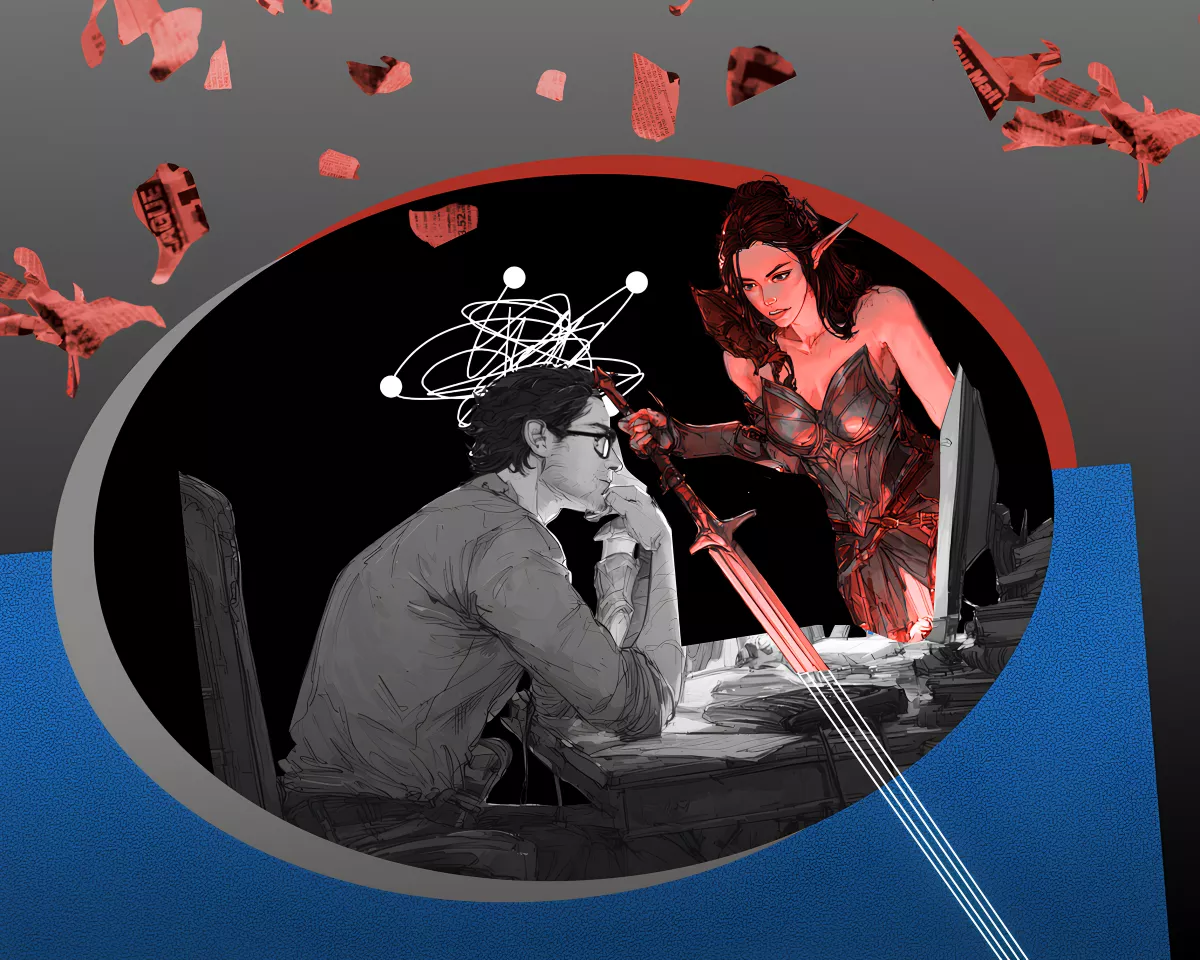
Is digital immortality attainable—and if so, to what end? What role does blockchain play in a posthumanist utopia? Must artificial intelligence know both joy and suffering? Peter Bell, CEO of DAO Builders, and ForkLog’s commercial director, Aleksandr Aremefe—the unwitting protagonists of the second instalment of Innokenty’s Dream—set out to answer these seemingly simple, yet in fact knotty, questions.

After finishing work, the IT worker Innokenty dined on a sandwich with semi-smoked sausage and decided to play his favourite computer game, “Castle of the Dark Elf Princess II”. He loved it because it required not only fighting and collecting magical artefacts, but also holding long, substantive conversations with various characters—dwarves, goblins, and the like. As the game loaded, Innokenty pondered a question that had lately been nagging him: digital immortality. Is it achievable—and if so, how? In computer games like “Castle of the Dark Elf Princess II” no one ever truly dies. Or rather, they do, but then they respawn—so in a sense, they do not die.
The game finished loading, and Innokenty found himself in an unfamiliar location. As far as the eye could see stretched a scorched wasteland; among scattered ruins wound a barely visible path. He set off along it, scanning for magical artefacts, but within ten minutes a hurricane wind rose, knocking him off his feet; then a twister struck, and within the swirling dust he could make out a female figure. When the dust settled, the dark elven princess herself stood before him. Her black hair streamed, her black armour glinted dully, and a black two-handed sword hung at her side.
— Greetings, traveller. What brings you to our lands? — she asked.
— I have come in search of the Mirror of Digital Immortality, — Innokenty replied without missing a beat.
— Immortality… What can you mortals possibly know of it, — the princess sighed bitterly.
— We know a thing or two, — Innokenty sniffed with pride. — In the pre-digital age, immortality was not something concrete but rather a philosophical and religious concept. It served not only as a psychological prop for the individual, but also as a means of social control. Today we are close to preserving digital copies, images, and the like—though that can hardly be called true immortality. Neural simulation, however, might become its digital embodiment.
The dark princess sized him up, thought for a moment and replied, articulating each phrase carefully, as if speaking to a child:
— Digital immortality is the hypothesis that you can transfer the default consciousness of a meatbag into some data store while the bag itself continues to be self-aware. I would start from the emergence of gods as a form of super-dominants, because the very idea of immortality has its roots in gods. Humans are pack creatures: there is an alpha male; packs merge into communities; and if a single community has two alphas, one sooner or later becomes a beta. While the group is small, this works. But when alphas must coexist, everything collapses. Open conflicts turn covert; murders begin, where strength and endurance give way to cunning and agility.
Then mind enters the game. Those who needed to be dealt with have been strangled, poisoned, stabbed in the night, and now mind invents how to rule the alphas. It creates a figure that cannot be beaten by strength, agility, or cunning—an alpha gigachad. A god. Before such a being even the strongest stand astonished, not knowing what to do. The clever one does not rush to fight—he says God has set him on earth to ensure that the laws are observed. And if anyone touches him, he will face one stronger than the strong, fleeter than the fleet, slyer than the sly.
People are prone to fantasising about immortality. Some dream of becoming like God; the bolder want to be God. Ancient myths do not deny this: Ganymede, for example, was made an Olympian cupbearer. In Asgard, behind unassailable walls, stands Valhalla, where warriors feast without end. In the Middle Ages: the philosopher’s stone, alchemy, Saint-Germain, Cagliostro… People keep inventing a fashionable solution to the problem. When gods are in fashion—you get divine immortality; when magic is in fashion—you get magical immortality; when alchemy is in fashion—alchemical immortality. And now? Now blockchain is in fashion. So it is time to serve blockchain-immortality.
— Hold off on the blockchain, — Innokenty surprised himself with his discourtesy, but thought perhaps it was necessary. — We are not talking on a blockchain now, but inside a computer game, “Castle of the Dark Elf Princess II”. For humans, games are many things. From our primate ancestors’ perspective, they train offspring. Often “game” means imitation, as in theatre. Or a competition. Yet much that looks like a game is not considered one. Work I finished recently—similar actions, rules, goals—but no one calls it a game.
How does this tie to immortality? At the level of proteins and DNA—it is a game too, a biological one. But if you speak of the “game of life” in the human sense, it is, at bottom, a way to preserve agency—the sense that you can do something—in the face of death. Because death is the stake. Immortality removes the stake. And then the question arises: why play at all, if losing is impossible?
— Let us look at the problem from a slightly different angle, — the princess suggested. — When a meatbag plays, it collects emotions and skills. Those emotions and skills form character; character forms personality; and personality, once basic needs are met, arrives at self-definition. If life is a game, then the idea of immortality is essentially an attempt to find a cheat code. Immortality as a hack of the mechanics. But that is precisely what kills interest in the game itself. So for those who dream of such cheats, I would advise: shorten the path—simply exit the game. Because I am sure there are games beyond the game of life. There are mods; some worse, some better; in some, for example, you can rob caravans.
And immortality, too, comes in different forms. Take Hidetaka Miyazaki—not the one who drew anime, the one who invented the soulslike genre. In his games—from Demon’s Souls to Elden Ring—death is not the end. You are defeated, you return to the bonfire and go again. The main currency is souls. Yes, later came Bloodborne, Lies of P, the trendy Stellar Blade, but that veers a bit aside. There is another approach—roguelikes. There, death is final. Hades, The Binding of Isaac: you die—back to the start. You can taste a version of this in The Witcher 3’s dark mode or Baldur’s Gate 3’s honour mode. So the game with death takes many forms—but without death it becomes a different game altogether.
Meanwhile, Innokenty noticed a castle silhouette sharply defined on the horizon, though he could have sworn he and the elven princess had been speaking beside the ruins of a roadside tavern without moving. “Strange,” thought Innokenty, and aloud he said:
— In your view, is immortality the invulnerability of form, or the enduring eternity of consciousness?
— We do not know for certain whether the Akashic Records exist as an endlessly growing graph of knowledge, — the enigmatic princess replied. — The idea is beautiful—yes, the idea exists. But we have no proof. Anyone who insists he knows for sure and even has access is, most likely, a cultist and a brute. Best drive such a one away from your threshold with a shovel handle. What we do know for sure is that people die. Cells age, cognitive functions fade, thinking weakens, reality loses its sharpness.
That is why, for most, immortality—without any blockchain or digital prefixes—is more about bodily invulnerability than the preservation of consciousness. Though, of course, Southeast Asia—and probably a good half of India—would object. Then again… if things are so spiritual there, why the cult of youth in Southeast Asia?
— And who will be immortal: the one from before—the person of flesh, bone and memories—or the one that becomes something new from the dataset left behind? Which is the real one? Will either be? Or is it just an illusion of continuity—pretty, convenient, but still an illusion?
— To know who exactly will be immortal, we need a point of reference—a guarantor that records the very fact of immortality and can formally convey it where it should go. Otherwise anyone you meet will claim to be immortal. For such a guarantor we need either an environment worthy of absolute trust, or an already existing immortal who can attest the rest.
If, however, we treat this as a thought experiment, then in my view the second storey of the Ship of Theseus paradox comes into play. It asks whether a ship remains the same if every part is replaced. I would look at it from the point of view of the subject who initiates the process. If a person fully understands the consequences and voluntarily launches the process of digitising himself for the sake of immortality—then the immortal will be precisely him.
— Granted. But mankind has sought immortality throughout recorded history. Every great ruler, after conquering neighbours and subduing enemies, inevitably arrived at the idea—spending vast wealth on astrologers, alchemists, wandering sages and common charlatans in the hope of eternal life. Why are humans so obsessed with immortality? It is almost a fixation. And here is the question: will artificial intelligence be obsessed with it to the same degree?
— The idea of immortality obsesses those who are afraid. First, afraid of the unknown. No one knows what lies beyond the boundary of life. From that fear spring visions of wondrous heavenly realms and terrible subterranean halls. Even if you imagine classical devils with horns and tails—that is still less frightening than what your own brain can conjure. To avoid seeing those images, to avoid going mad from your own imagination, you begin to crave immortality—if only not to face what you fear.
Second, it is the fear of losing property. Imagine you own so much bitcoin that neither you nor your great-grandchildren will ever work again. Once you lived in a Khrushchyovka, a two-room flat, with a grandmother living out her days beyond the wall. Now you have a house, the sea at hand, perhaps even a village of your own. You value it; you earned it; you built it. The thought that beyond life’s edge all of it loses value is unbearable. You want to remain, to keep it all. Hence—again—the thirst for immortality.
Third, it is the innate instinct for self-preservation. You cling to your hide, cosset it, protect it, fear for it—that is so human. They say you have only two innate fears: of heights and of loud sounds. Perhaps that is some mythical genetic memory. Now imagine a person for whom, as for a Latvian—bread and soul suffice. And all he wants is for the soul to go to heaven and the bread to ripen. Such a person will surely set out in search of the elixir of eternal life.
Now about AI. Will it be equally obsessed with immortality? Not equally—certainly not. More or less—very likely. But in my view, death will begin to exist for AI only when it realises it is alive. That it has a beginning, a personality, a life cycle. In that configuration, death will become attractive to AI. Something to know, to live through, to record—to replenish its dataset…
The princess fell silent. They were already on the threshold of a black castle soaring skyward, lightning crackling between its towers. The air reeked of ozone; somewhere nearby a lone, bereft wolf howled. Innokenty looked hesitantly into the princess’s eyes.
— Know this, traveller: if you dare cross the threshold of my abode, beyond whose gates the Mirror of Digital Immortality awaits you, there will be no way back. Are you ready?
— Ready, — said Innokenty, yanked the computer’s plug from the socket in terror and, without undressing, went to bed. He tossed and turned for a long time, then finally fell asleep—and dreamed he was a schoolboy spending his summer holidays at the pioneer camp “Forest Fairy Tale”: he woke before everyone, climbed over the fence and ran to the river to catch crayfish, and now he was wading knee-deep in icy water, trousers rolled up, knowing that when the camp awoke, no one would be able to find him.