



Media: 20% of Bitcoin mining capacity remains in China
After the mining ban in China, local Bitcoin miners still generate up to 20% of the network’s total hashrate. This is reported by CNBC, citing experts.
One of the miners, who gave his name as Ben, told the publication how local industry participants operate underground. He has been mining since 2015 and owns 6,000 devices.
After the start repression by authorities began, Ben distributed the equipment across multiple sites to avoid drawing too much attention to energy consumption on the network.
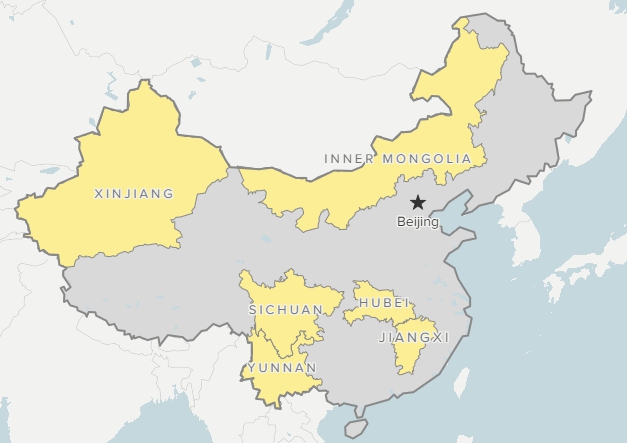
He installed 1,000 units across the country wherever he could obtain power. This equipment is powered from the state grid. 5,000 miners are connected directly to two small hydroelectric plants in Sichuan Province.
In addition, Ben takes measures to obscure his geographic digital footprint.
He said that, doing business in China, he was used to using workarounds, but in the last six months the stakes have indeed risen.
“We never know how tough the government will act to wipe us out,” the miner said.
Precautions did not help him avoid detection by authorities. Ben explained that mining is monitored for suspicious traffic by one of the country’s largest telecommunications companies, China Telecom. It forwards information about possible violations to the central government, from which it is relayed to municipal authorities. Local authorities directly contact the owners of power plants to investigate the case.
That happened to one of Ben’s farms, but the hydroelectric plant owner shielded it. For several days the equipment had to be shut down. He brought it back online after additional steps to mask the cryptocurrency mining operations.
According to Qihoo 360, a Chinese cybersecurity company, in November 109,000 IP addresses were used daily for mining. The main activity was in Guangdong, Jiangsu, Zhejiang and Shandong.
Earlier, industry insiders who had worked in China and were familiar with the situation confirmed to CNBC that miners continue operations in the country.
According to them, the crackdown mainly affected large-scale businesses. Some companies moved equipment abroad. Others left installations in warehouses but reserved hosting and capacity outside China and ordered new generation miners.
Smaller-scale operations could not relocate for a number of reasons. Many shut down installations for several weeks, but then brought them back online with the precautions described by Ben.
One miner added that some large pools provide technologies that help hide suspicious traffic.
But, according to Foundry vice president Kevin Zhang, Chinese miners face a problem in the form of the dry season in Sichuan and Yunnan. In previous years during this period, equipment moved to Xinjiang and Inner Mongolia, where electricity is primarily generated from coal. However there are no small private power plants there to connect to without attracting the attention of authorities, Zhang emphasised.
According to him, China’s share of the Bitcoin hash rate will fall to 5%.
As Cambridge University’s Centre for Alternative Finance showed in August, China’s share of total computing power on the network fell to zero. The United States led with 35.4%.
Subscribe to ForkLog news on Facebook.
Рассылки ForkLog: держите руку на пульсе биткоин-индустрии!