


Mycelium, not hierarchy
How thinking shifts in an age of instability
One morning many of us woke to find the world collapsing—or at least to learn that it was. Coping with pain, bereavement and horror, it turns out, is not only about antidepressants. For some, the true rescuers were fungi. No, this is not about microdosing fly agaric or swallowing capsules of ground reishi, lion’s mane, stinkhorns and the like.
This essay is about how foraging, observing and studying fungi can alter our understanding of the world, stretch our frames of thought, offer new meanings, and help people keep thinking about the future and survive amid constant disruption and fragility.
Life amid the ruins
For some, the metaphor “the world is collapsing” points to a very concrete political event—war; for others, it became real during the pandemic. For people with a hyper‑conservative lens, the reassessment of moral and ethical norms, the shift of values towards broader acceptance of the “other” that does not fit their idea of the traditional, is also a destruction of the familiar world.
None of this cancels the global environmental crisis, sundry economic challenges and what we call technological progress, or the local man‑made disasters that crop up and, in a Europeanised consciousness, evoke apocalyptic tropes. Anthropocentrism makes people feel guilty about what is happening, and the psyche seeks relief by looking for someone or something to cast as the source of “all evil”. Patriarchy? Capitalism? The collective West, the passionate East, the Global South? Big Brother? Yes, all of them are to blame. But all of them are, in part, us. The circle is closed.
The thought that fungi might foster the capacity to come to terms despite seemingly savage and tragic contradictions was prompted by watching mushroom‑foraging communities on social media. When Russia’s war against Ukraine entered its hot phase, hatred (justified though it may be) seeped into the comments under posts. The commonest curse was to wish that someone—whose place of residence or language marked him as an enemy—would eat poisonous mushrooms. Yet a year on, in mushroom groups, whether set up by people in Ukraine, Russia or elsewhere, courteous exchanges were again visible, including when a Russian‑language post drew replies in Ukrainian, and vice versa.
As human ties frayed everywhere, mushroom lovers kept sharing finds and knowledge. Their drive to study these organisms and their passion for gathering proved—perhaps narrowly and situationally, but still—more important than politics, nationality and enmity, and so became a unifying force. Why do fungi “do” what neither culture nor science managed? The timing may seem odd, but the point here is to try to step away from an anthropocentric—and thus humanistic—view of the world.
A caveat is in order: fungi, of course, do nothing and teach us nothing; that is merely personification, typical of a mind still prone to anthropomorphism. It is more accurate to ask what humanity can learn about the world—and change in its own thinking—by studying fungal life.
Progress is an idea from the past
In The Mushroom at the End of the World: On the Possibility of Life in Capitalist Ruins, Anna Lowenhaupt Tsing advances the idea of accepting instability as normal, exploring the phenomenon of matsutake foraging across the world. She notes the paradox of our time: a lack of confidence in tomorrow, even among those who pin their hopes on capitalism.
“Living in troubled times requires much more than attacking those who plunged us into this turmoil (although, I think, that too is useful; I do not object). One might look around and notice this strange new world and strain the imagination to grasp its contours. And here fungi come to our aid. The drive of matsutake to push through even on scorched ground lets us explore the ruins that have become home to us all,” says the researcher, drawing on a historical fact.
After the bombing of Hiroshima, the first thing to sprout on charred, contaminated ground was this very mushroom. This is not about the trite “triumph of life over death”—shedding such metaphors is useful—but about reassembling an ecosystem under the constant damage wrought by capitalism and the state. In Japan, matsutake became the basis for a new niche in the economy: supply chains and human coalitions emerged that had not existed before.
Today, on the transnational market, the mushroom passes through a ramified network of intermediaries—pickers, buyers, shippers, wholesalers, retailers and restaurateurs—and it is these ties that created a new economy atop degraded forests. It runs on informal communications, often on trust. It is also a product that resists the standard practices of capitalist alienation. Matsutake cannot be brought under control; it is not cultivated; its appearance is unpredictable in ways humans cannot measure. Foragers live with permanent uncertainty: they do not know if there will be food tomorrow, whether money will cover rent, whether middlemen will leave early, whether soils will dry up, whether access to the forest will be banned. In this sense, foraging for matsutake is not only survival under capitalism but a way to reassemble life amid the ruins of economy and landscape where stable jobs and social guarantees scarcely exist.
In Tsing’s view the economy has become precarious the world over—a state of fragility and exposure. We should admit we are not in control; we do not even control ourselves. Old philosophical approaches have aged; the modern world shows that there is no goal in life, only life itself in its uncertainty. Humanity is neither the crown of nature nor king of the hill; our species is just one among many that can make worlds. Fungi have far more experience of that. World‑building was never humanity’s prerogative; only now have scientists begun to pay attention.
So the very notion of progress loses its purchase. If we discard the simplifying, constraining narrative of linear advancement as a march forward, we can notice other temporalities beyond the merely human. Studying the entangled ties of fungal life reveals how organisms, inanimate things and landscapes enlist and are enlisted in joint activity to form intricate systems. Such curiosity enables the making of new categories, and of economic, political theories and cosmologies that account for the diversity of assemblages and worlds.
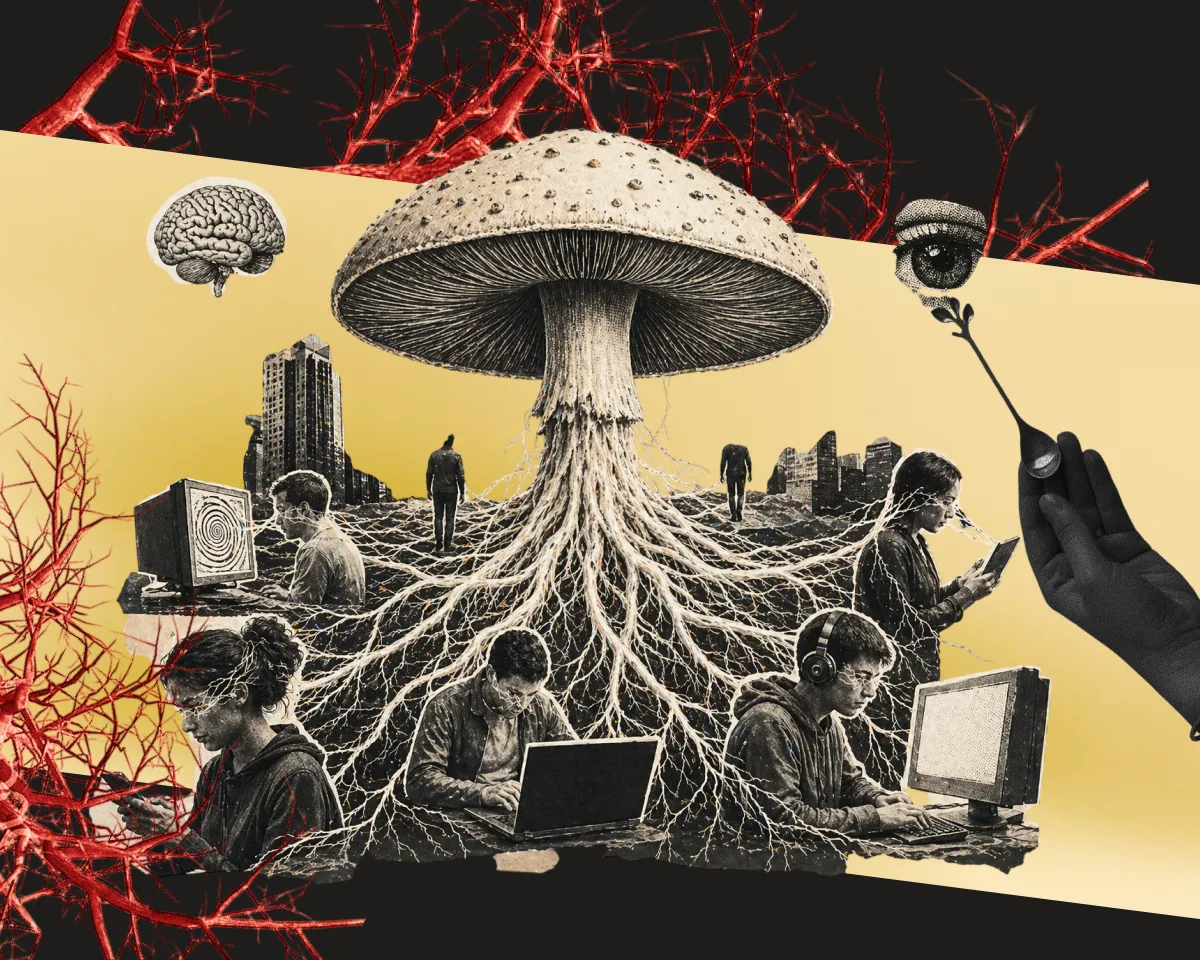
Mycelium, in this sense, ceases to be a metaphor and becomes a model of thought. Its existence relies on distribution, exchange, plasticity, and the capacity to withstand damage, to grow on scorched ground, to transform and co‑ordinate crucial elements of temporary stability in concert with other organisms—both kin and those of different kinds.
Artificial intelligence is no threat—but neither is it a crutch
While people are afraid, they not only seek culprits and try to put life on pause; they also tend to spin conspiracies and see menace in anything new—or old but other. Does that deliver real protection or stability? No. Are you afraid AI will take your job, enslave humanity, press the nuclear button? Fear often disguises itself as concern for safety but in practice merely reproduces helplessness. The fearful person does not want to understand reality; he wants to neutralise its image at once. Hence he sees conspiracy where there is complexity, and a threat where there is otherness.
AI is frightening precisely here: not only as a possible tool of substitution, manipulation or military escalation, but as a reminder that old forms of control can no longer cope with a world now too connected, too fast and not very transparent.
If watching fungi lets us think order differently—not as a stable system but as a temporary coincidence of heterogeneous ties—then we can also look differently at technologies usually cast as pinnacles of human progress. Architectures built on decentralisation, be it blockchain or learning systems of artificial intelligence, turn out less a breakthrough than a belated attempt to catch up with a reality long existing beyond human models of governance.
Decentralised digital systems and the development of AI‑based models are attempts to build assemblages in a technical medium. Our brains simply cannot process vast volumes of data at machine speed. In such conditions, artificial intelligence becomes a tool for pattern recognition in environments too complex for human attention. Yet we should avoid the opposite mistake of “appointing” digital agents as human “helpers”, “prostheses” or “crutches”.
AI agents are better conceived as dependent yet autonomous entities with which humans interact. It is undeniable that AI affects our thinking. Many people already compose sentences after the fashion of language‑model outputs—and that is only the beginning of our co‑labour.
Assemblages of humans with language models and AI can expand collective thinking. LLM can help to frame ideas faster, reconcile disagreements and work through large troves of information. In distributed interactions among many agents, shared norms and rules can emerge spontaneously—a kind of digital sociality. For people, this opens new forms of co‑operation, especially where time, expertise or linguistic access are scarce.
Now let us summon the inner sceptic‑conservative to list the risks—and at once pose clarifying questions to gauge how serious they are.
Risk 1: AI will start structuring social reality itself, subtly imposing models of speech, evaluation and behaviour.
Why is that frightening? Television or a school textbook also imposes all of the above—and yet we muddle through.
Risk 2: If AI’s autonomy grows while human control remains weak, who is responsible for a decision taken by a hybrid “human‑model‑infrastructure” loop?
In such cases it is better to assess the quality of the decision than to ask in advance “who will be to blame”. Suppose you know who decided to start a war where there was none before. Does that knowledge bring relief?
Risk 3: AI may entrench biases and misconceptions.
Yes. But no more than other technologies have done—and still do.
Risk 4: Won’t an assemblage with non‑human intelligence mean a loss of subjectivity?
No. We will explain why below.
Risk 5: What about a loss of agency?
Yes, that can happen. But how frightening is it? Let us look more closely.
Merlin Sheldrake, author of Entangled Life: How Fungi Make Our Worlds, Change Our Minds & Shape Our Futures, argues for a humbler, more precise anthropology in which humans are not central but one participant in a vast web of relations—and goes further by questioning the value of individuality as such.
Drawing on mycological research, Sheldrake contends that life runs on exchange, symbiosis, decay and redistribution, not on autonomy. His thinking helps us abandon the idea that there is a hard line between “living” and “non‑living”, “self” and “non‑self”, “organism” and “environment”. Life is better seen as a flow through which matter, energy, information and influence constantly pass. Subjectivity does not vanish—but it is nothing without interactions and interdependencies.
When agency slips from human control, the shift is not only technical but philosophical: freedom ceases to mean autonomy, and responsibility ceases to be a property of an isolated subject. It becomes distributed across the assemblage in which the human may still be a participant but is no longer master of the world. The question then is not who replaced the human, but what form of life arises where action no longer belongs to one.
People cling to their agency as an unquestionable value because we were reared on the illusion that there is no future without progress and that humans are responsible for the world they must bequeath. The outworn ideas of Enlightenment and modernism still loom large, with their hierarchies in which one species proclaimed itself the navel of the earth. Within that paradigm, harmful narratives of the “if not us, then who” variety will keep surfacing—to the detriment of humanity and everything else.
“Progress is built into the common understandings of what it means to be human. Even under the mask of other concepts—‘agency’, ‘consciousness’, ‘intention’—we shore up the thought that humans differ from the rest of the living world because they look ahead, whereas other species live for the day and so depend on us. So long as we imagine that progress makes the human, non‑humans cannot escape these speculative frames either,” notes Anna Lowenhaupt Tsing.
Perhaps we should drop human arrogance and admit that AI already outperforms us in many functions. Or that a slime mould without a brain—or anything like a central nervous system—can solve a problem faster and better than you. That is no reason to sulk or to oppose them.
An assemblage of intelligences: human, slime mould, computer
Sheldrake recounts a working human–plasmodium collaboration: a researcher who often could not find the exit from IKEA built a maze matching the store’s plan and let his slime moulds “search” for the quickest way out. They succeeded.
“See—they are smarter than me,” the researcher laughed.
Such a conclusion is neither mere metaphor nor irony—unless one insists on measuring other beings’ intelligence by a human yardstick.
The book also mentions a Japanese experiment using a map of Greater Tokyo: in a Petri dish a slime mould was offered a set of points mimicking urban hubs, and within a day it laid out paths that almost replicated the capital’s railway network. In similar trials slime moulds reproduced America’s highway grid and the ancient Roman roads of Central Europe.
For designing real infrastructure, a slime mould is the dream contractor, swiftly finding and showing efficient, economical routes. Developers use the natural abilities of the single‑celled myxomycete Physarum polycephalum to control robots and as a biological processor. Biocomputers built on slime moulds have several potential advantages over silicon systems: for example, they can solve computational and adaptive tasks with far lower energy use than digital processors. For now, such assemblages of humans, unicellular organisms and machines live in labs and prototypes rather than mass products, but they have existed for some time. And cybernetics, as founded by Norbert Wiener, has from the start studied control and communication in machines and living organisms.
If we abandon the picture of the world as a system striving for stability and equilibrium, and instead look through the logic of assemblages—temporary, brittle and centreless gatherings described by Sheldrake and Tsing—then fungi cease to be merely objects of observation or a soothing metaphor. They become a way to grasp how existence might be arranged: not as a whole, but as a process of constant reassembly and maintenance of ties.
Fungi really do expand our minds
In Sheldrake’s book is the idea that everyone needs others to live. The way lichens exist, he suggests, can force us to reconsider our views of “individuals”. Once upon a time, scientists took lichens to be a single organism; now we know their survival rests on complex relations among several organisms—two or more. The researcher of matsutake’s economy concurs.
“Mycelium is a perfect conduit. It has never allowed itself to be stuffed into the ‘iron cage’ of self‑reproduction. Like bacteria, some mycelia are busy exchanging genes in non‑reproductive contacts; many also do not allow their genetic material to be defined as belonging to a single ‘individual’ or ‘species’, let alone a ‘population’. When researchers studied the mycelia of what they had considered a biological species—the costly Tibetan cordyceps—they found a mishmash of many species. Examining the strands of honey fungus (Armillaria), they discovered a genetic mosaic that does not allow an individual to be identified,” writes Tsing.
Entertain the thought that individuals do not exist. The survival of human bodies depends on other organisms. Gut microbiota, skin bacteria, our need for bodily contact with other people and animals, our dietary inclinations—all point to multi‑species dependence. Are you sure the decision you made was not the product of a mood created by complex interactions among microorganisms and their influence on your biochemistry? Are you truly autonomous?
Modern research is literally demolishing traditional views. The study of the life sciences anchored in heteronormative understandings of both sexual and social relations is receding—not as a cultural fad. David Griffiths, in the essay “Queer Theory for Lichens”, argues that studying lichens deconstructs such assumptions, breaks their bounds and calls the binary, heteronormative scientific tradition into question.
Ecology is mutable and is best understood as a complex series of relations that dissolve borders. There is no norm—and that is the norm. The stranger, the more variegated, the more complex survive; and we cannot live without others, who are themselves in constant flux. For that lesson we can be grateful to lichens and fungi.
Toby Spribille, an expert on fungal symbiosis at the University of Alberta, says there are limits to how humans study complex relations in nature:
“A human binary view prevents us from asking non‑binary questions. Our constraints regarding sexuality prevent us from asking questions about sexuality and so on. We ask questions from within our cultural context. And this leads to extraordinary difficulty working with questions about complex symbioses like lichens, because we think of ourselves as autonomous individuals, which makes the path to understanding harder.”
Where humans are used to erecting borders—in various senses—between self and other, living and non‑living, norm and deviation, fungal assemblages reveal the permeability of those borders in the name of co‑existence, without erasing difference and while preserving the particularities of every component.
In this sense, “fungal philosophy” does not offer a new identity or a more inclusive model of the subject. It questions the very idea of the subject as an autonomous bearer of will, responsibility and value. That touches the foundations of systems that need clear borders—economy, politics, law. If the individual cannot be unambiguously singled out, it becomes harder to count, control and extract value.
But that does not mean liberation. Life does not become more just or harmonious; we simply start to notice its complexity—through overlaps, dependencies and partial alignments of interest. We are unlikely to step fully outside capitalism, the state and hierarchies now, but we can already look at them from the side and refuse to accept their frames as the only possible ones.
Рассылки ForkLog: держите руку на пульсе биткоин-индустрии!