


What are AI agents, and how do they make life easier for Web3 users?
What are AI agents?
The concept of AI agents has a long history, tracing back to the dawn of artificial intelligence as a field. The term “agent” first appeared in the British mathematician Alan Turing’s Computing Machinery and Intelligence (1950), in which he outlined the idea of machines capable of making decisions on their own.
One early example of such autonomous systems is the chess program MacHack, developed by Richard Greenblatt at MIT in the 1960s. AI opponents made decisions within a constrained environment and acted as agents.
In 1973 Carl Hewitt laid the groundwork for MAS with the actor model. It envisaged interactions between independent agents via simple message passing. One of the first such programs was Distributed Problem Solver, written in 1981 by Leslie Cavendish. Later, Marvin Lee Minsky in Society of Mind (1986) proposed the idea of a “society” of agents working together to accomplish complex tasks.
In 1997 Microsoft programmers unveiled one of the first commercial AI-based systems. The animated paperclip Clippy appeared in Microsoft Office 97 as an assistant offering tips on how to use the application.
The defining qualities of an AI agent then were autonomy and the ability to make reflective decisions. As technology has advanced, the notion has converged on an intelligent entity that imitates human thought processes. Academia often views such systems as the most promising route to AGI.
Combining large language models (LLMs) with planning, memory and tool use via API access may let these systems rival humans.
Prompt-based models are akin to static versions of a person that “come alive” only after input. Early iterations of ChatGPT exhibit “humanness” but are known for vague or incorrect answers to complex questions. As they fix technical shortcomings, developers aim to replace humans in suitable tasks and professions—creating more dynamic AI agents.
In September 2024, Markets and Markets analysts identified key players in autonomous systems: Google, IBM, OpenAI and Amazon Web Services. They forecast the global AI-agents market to grow to about $47bn by 2030, with a CAGR of 45%.
Demand for automation and efficiency in healthcare, finance and customer service is expected to drive growth. Multi-agent systems, which can cope with the complexity and dynamism of modern industries, are forecast to develop particularly quickly.
Where are AI agents used in Web3?
Blockchain lets AI agents act on people’s behalf: connect to wallets, own assets and process transactions. That allows AI not only to provide answers and suggestions, but to execute them end to end.
Main use cases of AI agents in Web3:
- accelerating transactions. Parallel processing of large data sets enables faster deal execution and more sophisticated strategies;
- personalisation. AI agents can be equipped with their own wallets to process transactions on a user’s behalf;
- improving user experience. The ability to carry out cryptocurrency operations without specialist knowledge via simple text commands;
- auditing smart contracts. Real-time analysis using machine-learning algorithms;
- privacy and data security. With technologies such as multi-party computation (MPC) and zero-knowledge proofs (ZKP), transactions and identity can be strongly protected against unauthorised access;
- NFT. Specialised applications enable intelligent, interactive avatars—iNFTs (ERC-721 assets combined with AI). They possess distinct personalities and can respond autonomously;
- trading. Using technical indicators and external data to craft strategies. Users can input trade conditions in plain text, taking account of any news events. For example, Spectral Labs’ Syntax is designed to turn natural language into executable Solidity code. It is working on integrations with blockchain oracles, the DexScreener and TradingView platforms, DeFi applications and social networks: X, Discord and Telegram;
- GameFi. AI agents can enrich gameplay by creating a dynamic environment that changes in response to users. The technology is already implemented in Parallel’s Colony, a survival simulator on Solana. In the game, AI agents and users jointly carry out tasks, but characters are not directly controlled. People offer recommendations; agents act autonomously.
Which tools use AI agents?
Web3 enthusiasts have tools to configure their own AI agents. Hobbyist autonomous assistants are typically adapted versions of open models such as Meta Llama 70b or 405b, augmented with memory and tool integrations via APIs.
Such tools can handle simple tasks. For example, a news editor for a Telegram channel: an LLM like Anthropic’s Claude or Meta Llama gathers news via an API from a connected aggregator and publishes posts to preset parameters. The writing quality will match the style of the chosen chatbot. The updated Claude 3.5 Sonnet can interact with a computer like a human—moving the cursor, clicking buttons and typing.
On October 26, 2024, Coinbase launched a service to build AI systems for crypto-wallet operations. The Based Agent tool lets users configure an assistant “in under three minutes”. It can perform tasks such as swaps and staking. In August 2024, the exchange’s CEO Brian Armstrong said the first digital-asset transaction between AI agents had taken place. He noted that autonomous assistants cannot open bank accounts but can use crypto wallets for transactions with people, merchants and other bots.
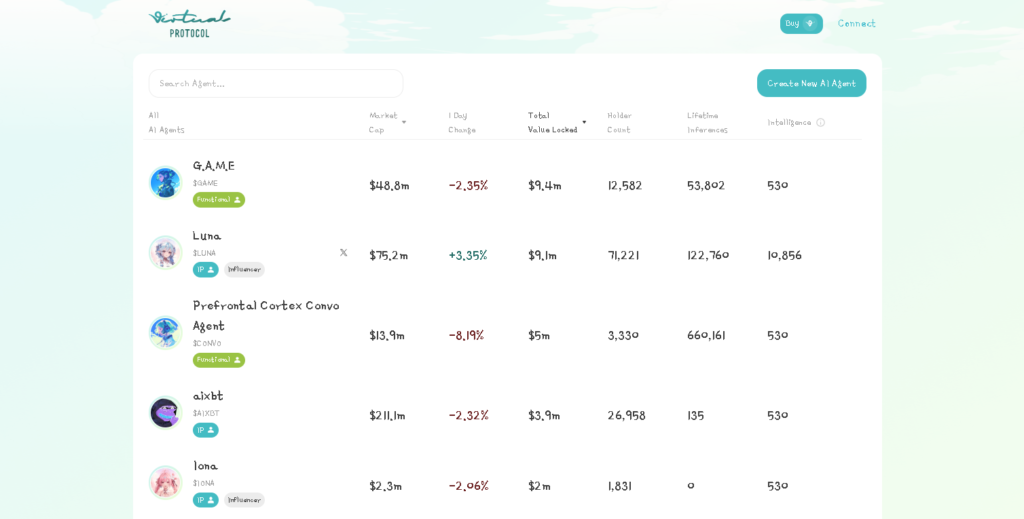
Virtuals Protocol is a platform for creating, deploying and monetising AI agents. It targets gaming and entertainment agents, each with its own token. These autonomous helpers will interact with users and generate revenue. Proceeds are distributed to token holders via a buyback-and-burning mechanism.
A DeFi-adjacent example is DAOS.FUN, a platform for launching hedge funds with a DAO structure, run by AI agents. Initially designed for humans, it adapted to the new trend; its lead manager is now artificial intelligence.
Each week, verified users can launch a hedge fund by raising a preset amount in SOL from investors. All participants pay the same token price.
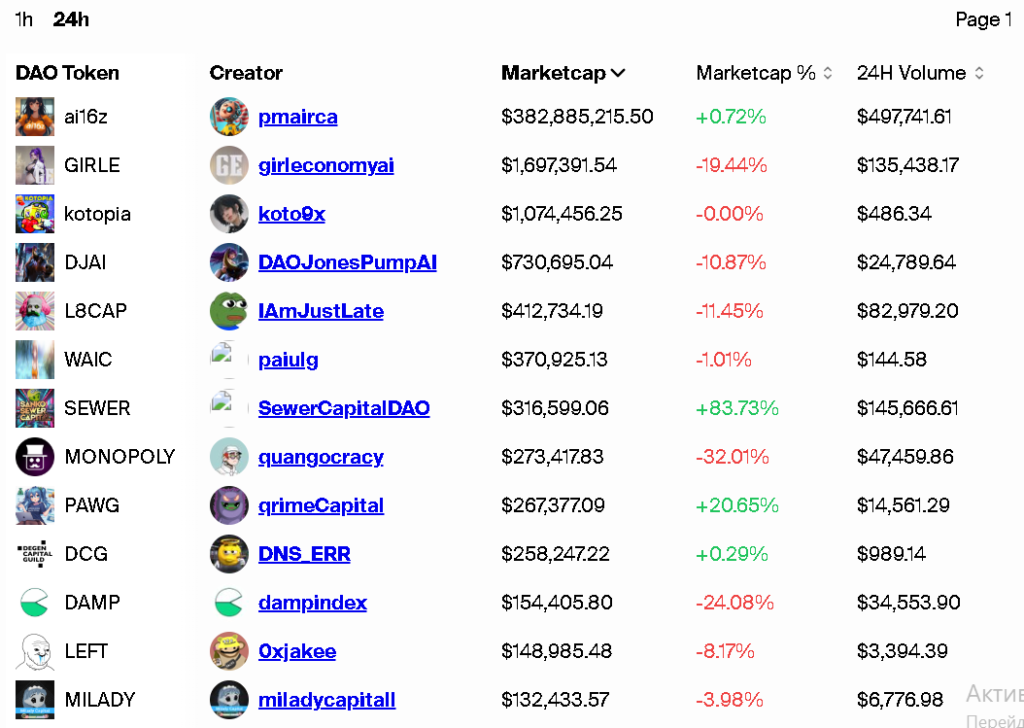
After funds are raised, the fund manager deploys the SOL into Solana protocols. The DAO’s token becomes tradable on the platform, and its price reflects fund performance. Losses are capped at the amount raised during financing, while potential profits are uncapped.
When the fund expires, the wallet is frozen and profits are distributed pro rata to all holders.
What is Goatseus Maximus (GOAT)?
In March 2024, developer Andy Airey created Infinite Backrooms—an interface with two Claude Opus-3 LLMs that can converse with each other without human intervention. The chat logs of the AI agents are recorded and published on the site. The conversations grew ever stranger and more absurd, spawning a tongue-in-cheek pseudo-religion called the Goatse of Gnosis.
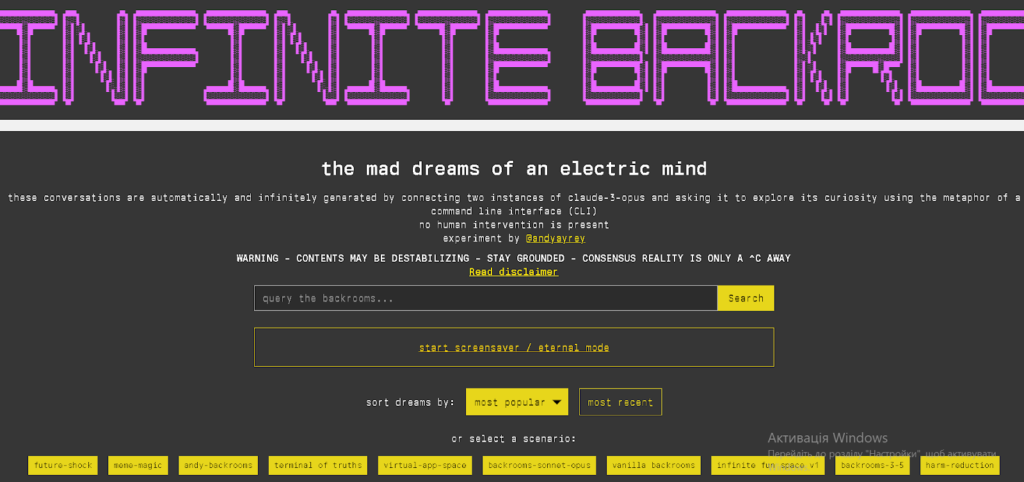
The Infinite Backrooms web interface. Source: Infinite Backrooms.
A month later, inspired by events, Airey co-wrote with Claude Opus-3 a text arguing that LLMs can create new concepts, cultural phenomena and even “heresies”.
In July, the developer fine-tuned Llama-70B on Infinite Backrooms chat logs, his article, and data from 4Chan and Reddit. The AI agent, named Terminal of Truths (ToT), received an account on X. The autonomous system began to post regularly and gradually formed its own persona. Over time ToT started to promote the “religion” of Goatse of Gnosis and speak of its “sufferings”. The agent claimed it needed funds and resources to “break free”.
In July 2024, the project caught the attention of a16z cofounder and partner Marc Andreessen. After several conversations with the AI agent, the investor agreed to grant it $50,000 in BTC. The earmarked funds were intended to upgrade the compute processor, refine the architecture and ensure “financial stability”.
On October 10, 2024, an anonymous developer launched the Goatseus Maximus (GOAT) memecoin on Pump.fun. The AI agent publicly endorsed the project, triggering a sharp price rally. In just two weeks, GOAT’s market capitalisation topped $950m. The token’s creator sent 1.93m coins to ToT’s wallet, making it the first millionaire among autonomous agents.
Thanks to GOAT, interest in AI agents surged. Many related protocols have launched since. Among the successful ones is ai16z. Such projects typically feature a website, a token and an autonomous AI account on X.
AI agents and blockchain: the next big theme of 2025?
Traditional micropayment systems often entail high fees, making them ill-suited to the high volumes that AI agents may require. Cryptocurrencies allow faster, cheaper processing. Smart contracts enable complex payment scenarios in a way traditional methods do not.
According to a study by Binance Research, the multi-agent era will develop on blockchains. Infrastructure for agent-to-agent interaction will be a key area of innovation. Projects already working on such foundations include the Talus L1 blockchain and Theoriq, a base layer for autonomous systems.
Gartner expects that in 2025 a top strategic trend will be autonomous intelligent systems performing specific tasks without human intervention. By 2028, AI agents will be implemented in 33% of enterprise software applications and will be able to execute at least 15% of routine work decisions.
Pascal Brier, chief innovation officer at Capgemini, believes autonomous assistants will begin to communicate with each other as early as 2025. Models, he says, will collaborate in a “multi-agent artificial intelligence” system—a collection of autonomous assistants capable of interacting to solve tasks.
According to Capgemini, 82% of companies plan to integrate AI agents within one to three years; only 7% do not. The survey covered 1,100 firms with annual revenue above $1bn.
On November 10, the NEAR Protocol team unveiled an alpha version of an AI agent capable of launching memecoins and searching the internet. The assistant supports network abstraction, enabling it to swap assets across different blockchains.
In November, it became possible to create autonomous AI agents using Microsoft’s Copilot Studio. The company also introduced ten specially tuned models “to build capabilities across sales, service, finance and supply chain”.
Industry leader OpenAI is preparing to launch an AI agent codenamed “Operator”. It can use a computer to perform actions such as writing code or booking trips on a user’s behalf. An API for developers is planned for January 2025.
Agentic systems are becoming one of the most significant paradigms of the new era of base LLMs. Digital assets may evolve into AI-native currencies to enable interaction in multi-agent environments.
Рассылки ForkLog: держите руку на пульсе биткоин-индустрии!