



Neural network learns to design sneakers; Russian businessmen express trust in algorithms, and other AI news
We aim to inform readers not only about events in the Bitcoin industry but also about developments in related tech fields—cybersecurity, and now the world of artificial intelligence (AI).
ForkLog has gathered the week’s most important AI news.
- The White House proposed a law to protect Americans from ‘harmful’ artificial intelligence.
- Moscow plans to track vehicles using neural networks.
- Facebook announced development of an AI that will “see the world through the user’s eyes.”
- Microsoft and Nvidia unveiled a language model three times larger than GPT-3.
- An engineer created a generator of unique sneakers with editable designs.
- Researchers, using AI, recovered a hidden image beneath a Picasso work.
- The week’s most notable venture deals.
White House proposes a tech ‘Bill of Rights’
In the US, proposed to develop and enact a technology “Bill of Rights” to limit the harms of artificial intelligence.
The proposal was put forward by the president’s chief science adviser Eric Lander and the deputy director for science and society, Alondra Nelson. They say Americans must be protected from erroneous and harmful consequences of AI use, including discriminatory outcomes and privacy violations.
The Software Alliance (BSA) welcomed the White House’s efforts to curb AI bias. But the organisation argues that companies should independently research their AI developments and reduce the associated risks.
Moscow’s traffic police to deploy AI to track vehicles
The authorities in Moscow will spend 180 million rubles on software to track suspicious vehicles and recover partially obscured licence plates. It is planned for roll-out in 2022.
The system will allow traffic police officers to operate cameras via a mobile app and determine a vehicle’s status. For example, the algorithm will identify cars that are wanted, deregistered or registered to deceased individuals.
It will also be able to recognise a partially obscured licence plate. It will match the make and model of the car with the digits on file and suggest possible plate numbers to the officer.
Study: Russian entrepreneurs would trust AI
One in five Russian entrepreneurs is ready to trust the conclusions of artificial intelligence. The finding comes from a study on AI use in business conducted by the Platform for Big Data.
The company surveyed online 1,238 executives from various enterprises in million-plus cities. The top five AI tasks were:
- customer support and handling feedback;
- inventory management;
- replacing a personal assistant, including calendar management, scheduling meetings, governance and ticketing;
- sales management;
- laying off employees.
Twenty-two percent of respondents are willing to blindly trust AI outputs, while 36.8% say the algorithmic work requires constant oversight and validation of results.
Facebook trains AI to see the world through the user’s eyes
Facebook launched the Ego4D research project, aimed at developing AI to help people solve everyday tasks. It will record and analyse all user actions from first-person video.
Developers listed capabilities they want the system to learn. Among them:
- Episodic memory: for example, answering the question “where did I leave my keys?”
- Prediction: “You already added salt to this dish?”
- Hand and object manipulation: “Teach me to play the drums.”
- Audio-visual diary: “What was the topic of the previous lesson?”
- Social interaction: “Help me hear the person I’m talking to in a noisy restaurant.”
The project involves researchers from 13 universities worldwide. They gathered a dataset of 3,205 hours of video from 855 participants across nine countries.
Microsoft and Nvidia developed a language model three times larger than GPT-3
Microsoft, together with Nvidia developed the Megatron-Turing Natural Language Generation (MT-NLG) with 530 billion parameters. It is designed to generate natural language and is three times larger than GPT-3, developed by OpenAI.
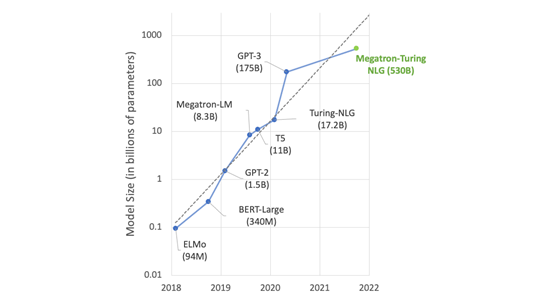
The model is based on the Turing NLG 17B and Megatron-LM algorithms. For its training, the authors used a dataset of 270 billion tokens from English-language websites.
MT-NLG demonstrates “unparalleled” accuracy across a broad range of NLP tasks, including reading comprehension, reasoning with common sense, and automatic detection of textual relations.
Nvidia releases StyleGAN3
Nvidia unveiled the third version of the popular face-generation neural network, StyleGAN3.
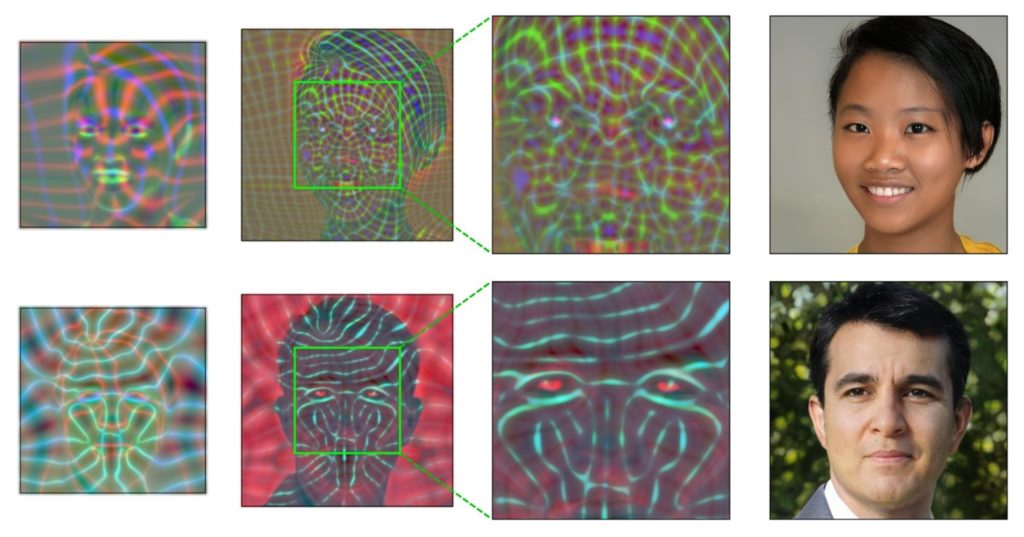
The repository includes ready-made models trained on 70,000 images of people at a resolution of 1024×1024 pixels. The developers have also published algorithms trained on animal-face collections and portraits from classical paintings.
StyleGAN3 is an improved version of StyleGAN2 with a new mechanism for distributing signals as continuous processes.
Xiaomi unveils door lock with 3D facial recognition
Xiaomi announced the Smart Door Lock X, a door lock supporting three-dimensional facial recognition. The device is equipped with infrared and RGB cameras, distance sensors and other sensors.


In addition to biometric authentication, users can enter using a password, a fingerprint, or NFC.
The smart lock went on sale on 12 October in China. For early buyers, the device will cost $465; the price will rise to $510 thereafter.
Google adds AI-powered guitar tuner to Search
Google has added a guitar tuner to Search, available on smartphones, tablets and computers.

To use the tool, a user must enter the query “google tuner” and grant microphone access. The system will detect the pitch of the strings and indicate how close it is to the reference.
The tuner’s accuracy depends on the device’s microphone quality, the developers said.
Developer creates AI-based sneaker generator
Engineer Stan van der Fossen created a website with thousands of unique sneaker models generated by AI.
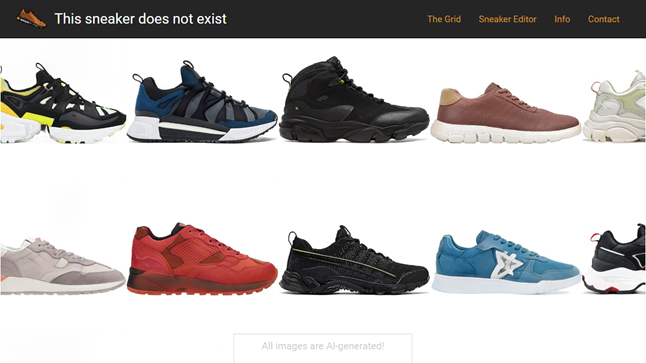
He trained the StyleGAN2-ADA algorithm on 50,000 footwear images from various sites, filtering them to keep only fashionable and interesting designs. He then adapted the network to a specially curated sneaker set to achieve a more futuristic style.
The site offers a wide range of models, as well as an editor to modify their appearance.
British researchers restore hidden image under Picasso painting
British company Oxia Palus restored the image of a nude woman hidden beneath Pablo Picasso’s “Breakfast of the Blind.”
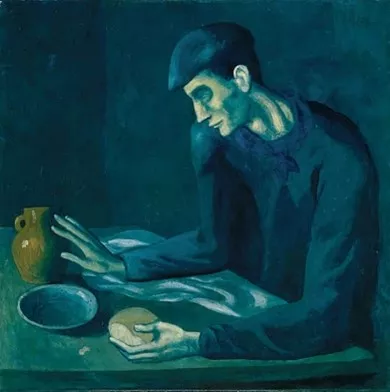


Researchers used X-ray imaging to reveal the hidden layer of the canvas and artificial intelligence to redraw the portrait in the artist’s style.
The recreated work is titled “A Lonely Seated Nude.” It will be shown at the Deeep AI Art Fair in London from 13 to 17 October 2021.
The week’s most notable venture deals
From 9 to 15 October 2021, AI startups attracted more than $368 million. Here are the most notable deals.
- Hailo raised $136 million for mass production of AI chips for edge devices.
- Groove raised $45 million to develop a platform for sales automation.
- AiDash raised $27 million to grow its geospatial analytics service.
- Copy.ai raised $11 million to expand its team building AI-generated marketing copy.
- Aware raised $60 million for its workplace monitoring system.
- SupportLogic raised $50 million to expand its customer-service analytics platform.
- Cloudtamer raised $9.5 million to expand sales of its cloud-management platform.
- AmplifAI raised $18.5 million.
- Cast AI raised $10 million to advance its cloud-operations optimization service.
- Spice AI raised $1 million to expand AI tooling for building intelligent apps.
Also on ForkLog:
- Opinion: China has already won the AI race against the US.
- Facebook agreed to open regulators’ access to its algorithms to demonstrate their safety.
- In Ukraine AI cameras will be deployed to detect violations of quarantine measures.
- Study: voice deepfakes have learned to fool speech-recognition systems.
- In the US military denied claims of losing the technological battle to China.
- In the UAE, scammers using voice deepfakes stole $35 million from a bank.
Subscribe to ForkLog’s AI news on Telegram: ForkLog AI — all the AI news!
Рассылки ForkLog: держите руку на пульсе биткоин-индустрии!