


Bitcoin Core developer Luke Dashjr, the younger, criticised Ordinals for network spam
- Bitcoin Core developer Luke Dashjr, the younger, criticised Ordinals for spreading spam.
- The community accused him of censoring the protocol.
- “Inscriptions” remain popular, as do their counterparts on other blockchains.
Bitcoin Core developer Luke Dashjr, the younger, said that “Inscriptions”, which underpin the Ordinals protocol, contribute to spam in the network and predicted their imminent end.
PSA: “Inscriptions” are exploiting a vulnerability in #Bitcoin Core to spam the blockchain. Bitcoin Core has, since 2013, allowed users to set a limit on the size of extra data in transactions they relay or mine (`-datacarriersize`). By obfuscating their data as program code,…
— Luke Dashjr (@LukeDashjr) December 6, 2023
“Inscriptions exploit a vulnerability in Bitcoin Core to spam the blockchain. The software, since 2013, allows setting a limit on the size of extra data in transactions they relay or mine, but ‘inscriptions’ bypass that limit with code,” he explained.
According to the developer, his team began addressing the bug in Bitcoin Knots v25.1, and plans to fully fix it by v27.
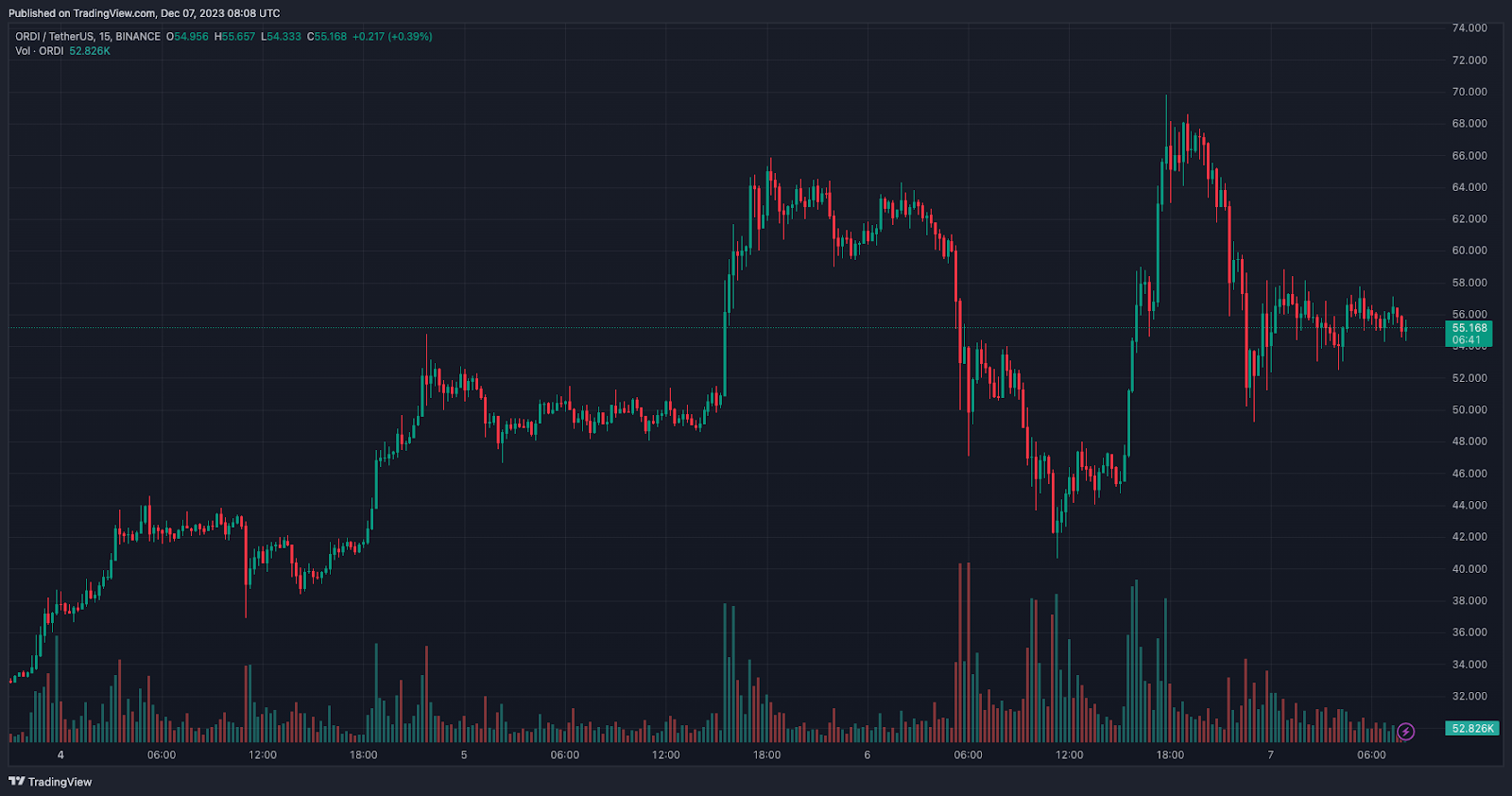
Dash’s post was a likely driver of ORDI’s plunge of almost 50%—from $65 to $42. But later the asset’s quotes recovered to around $55.
The developer’s remarks drew criticism and questions from the community about the usefulness of such censorship methods for the blockchain. One user noted that most miners would prefer to mine transactions with “Inscriptions”, as they make more economic sense.
If #Bitcoin network can’t withstand a puny spam from “inscriptions” how can we feel safe from a nation attack on its network?
You people call yourselves BTC promoters but spend your time with these llame examples.
Bitcoin is 4 everyone, you are dismissed.
— MisterSpread (@MisterSpread) December 6, 2023
“If the Bitcoin network cannot withstand a trivial Inscriptions spam, how can we feel safe from a coordinated attack? You people call yourselves BTC promoters, but you spend your time on these dull examples. Bitcoin is for everyone; you are fired,”
When the discussion subsided, Samourai Wallet representatives noted that Ocean, the mining pool owned by Dash and former Twitter CEO Jack Dorsey, had adopted a policy censoring Whirlpool coinjoin transactions and BIP47 notification transactions, which are part of the CoinJoin anonymity solution.
We can confirm that @ocean_mining has enacted a policy of censoring Whirlpool coinjoin transactions and BIP47 notification transactions as of Dec 6, 2023
This is a regrettable action by the operators @jack and @LukeDashjr and far surpasses any hostile action we have seen before
— Samourai Wallet (@SamouraiWallet) December 7, 2023
According to Dash, Whirlpool transactions contain errors and create non-standard transactions due to the 46-byte OP_RETURN function present in Whirlpool. However Samourai Wallet says he is deliberately deceiving users.
“People have had no problems creating and relaying standard Bitcoin transactions since Whirlpool was released in late 2018. Miners also pass on and mine these transactions with ease,” the wallet’s representatives said.
They acknowledge the legitimacy of Dash’s actions, but do not share his desire to censor transactions that do not align with his values, another example of “weakening the cypherpunk roots of the project”.
Bitcoin developer and Nostr founder Damus William Kazarin, in response to the lively discussion stated, that “‘inscriptions’ mask data as a Bitcoin Script cache, which is technically an exploit, since the network is not used to store such information.
“I will participate in the Inscriptions commission as one of those who oppose the claim that they are good for Bitcoin. I decided to refresh my memory of how inscriptions work. I am beginning to understand Dash’s point of view on why he uses a loophole in the protocol mechanisms to defend against spam,” he added.
Spread of “Inscriptions”
Ordinals have again gained popularity after a downturn in autumn, but the early days of December have not been productive for Bitcoin NFTs either.
According to the Dune dashboard, the number of daily inscriptions created in the last week did not exceed 70,000.
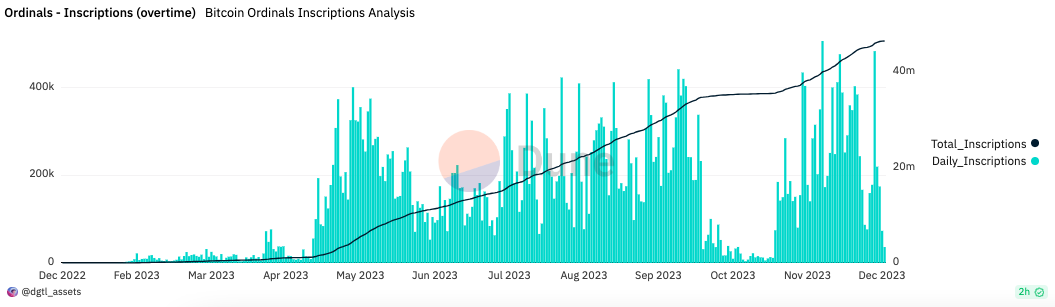
The decline in activity on the Bitcoin network may be linked to the emergence of Ethscriptions on Ethereum, Doginals on Dogecoin and Solana Inscriptions on Solana.
The Polygon network has more than 109 million “Inscriptions”. On blockchains Celo, Avalanche and Fantom together more than 20 million such assets.
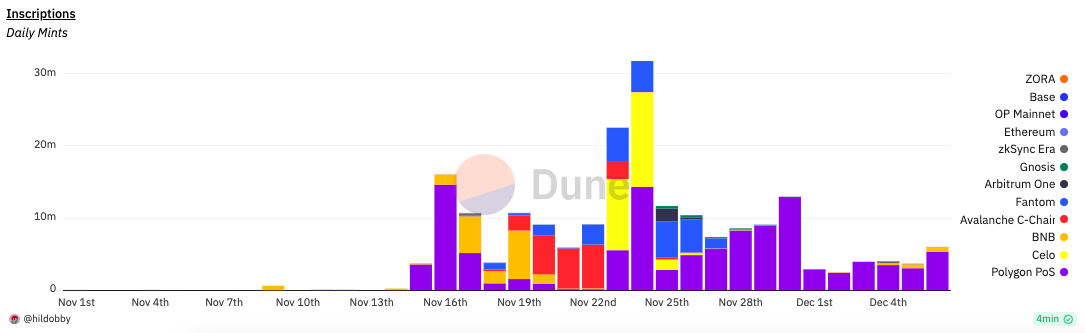
This activity also contributes to higher numbers of transactions in the protocols and, as a result, higher fees.
On the hype around Ordinals, Tron co-founder Justin Sun drew attention. He asked the community for opinions on integrating Tron with BRC-20 and creating its own inscriptions format.
I’d like to hear your thoughts on four key initiatives: firstly, enhancing the inscription support for Tron; secondly, integrating Tron with BRC20; thirdly, launching a $100 million Tron developer fund; and fourthly, reducing energy costs to attract more developers and users to…
— H.E. Justin Sun 孙宇晨 (@justinsuntron) December 6, 2023
Earlier, the Luminex представила the BRC-69 standard, which simplifies and lowers the cost of issuing NFT collections on the Bitcoin blockchain.
As reported in November, the daily transaction volume on the Fantom network reached record levels, presumably due to the growing popularity of the Ordinals analogue in the form of FRC-20 tokens.
In the same month, for a similar reason, резко вырос the transaction volume on Avalanche’s C-Chain jumped sharply. 22 November the metric surpassed 6.3 million.
Рассылки ForkLog: держите руку на пульсе биткоин-индустрии!