




Over the past year, the total debt of bitcoin miners has increased sixfold, from $2.1 billion to $12.7 billion. Analysts at VanEck attributed this to the simultaneous need to invest in mining equipment and fulfill orders in the AI sector.


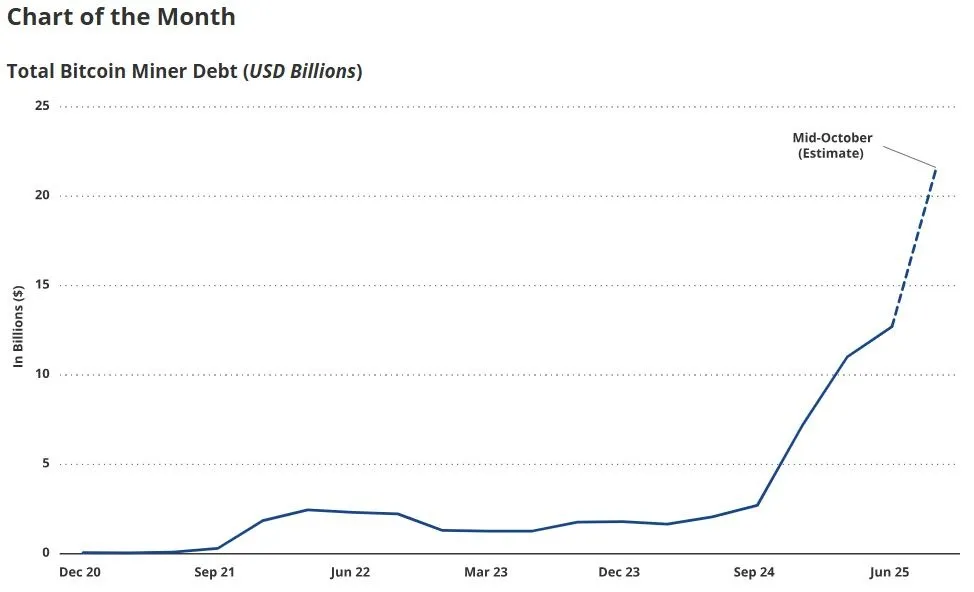
Nathan Frankovitz and Matthew Sigel explained that without constant investment in modern cryptocurrency mining devices, miners’ share in the global hashrate declines, leading to reduced rewards.
Historically, they financed capital expenditures through equity issuance, but are now actively using debt instruments.
According to The Miner Mag, the total liabilities of 25 public mining companies amounted to $4.6 billion in the fourth quarter of 2024, $200 million at the start of 2025, and $1.5 billion in the second quarter.
Shift to the AI Segment
The latest halving occurred in April 2024, reducing the reward for a mined block in the Bitcoin network to 3.125 BTC.
In September this year, the profitability of mining the leading cryptocurrency dropped by more than 7%. Against this backdrop, miners began diversifying their businesses.
Primarily, companies have redirected energy capacities to artificial intelligence and high-performance computing. One of the largest deals was the acquisition in July by AI hyperscaler CoreWeave of mining center operator Core Scientific for $9 billion.
In August, Google increased its stake in TeraWulf to 14% by expanding financial guarantees to $3.2 billion. In September, a miner announced raising $3 billion for data center construction.
Previously, the firm IREN also invested in AI computing, with the deal amounting to $193 million.
A Threat to the Bitcoin Network?
Nevertheless, VanEck is confident that miners’ shift to the AI sector does not threaten the security of the largest cryptocurrency’s blockchain. According to Frankovitz and Sigel, “the prioritization of electricity consumption for artificial intelligence ultimately benefits Bitcoin.”
“Mining digital gold remains a straightforward way to quickly monetize excess electricity in remote or developing markets, effectively subsidizing the development of data centers initially designed with the capability to convert for AI and HPC needs,” they added.
Demand for AI computing also has a cyclical nature throughout the day and depends on human activity. This creates a natural balance between the two directions, the experts concluded.
Previously, ASIC miner manufacturer Canaan introduced an eco-friendly solution for Bitcoin mining.