



Bitcoin’s Brief Dip to $65,700 Amidst Macroeconomic Factors
On March 9, Bitcoin briefly dipped to $65,700 amid macroeconomic uncertainty.
On March 9, the price of the leading cryptocurrency briefly fell to around $65,700. Experts are divided on the market’s future trajectory: some anticipate growth, while others warn of potential declines due to macroeconomic uncertainty.
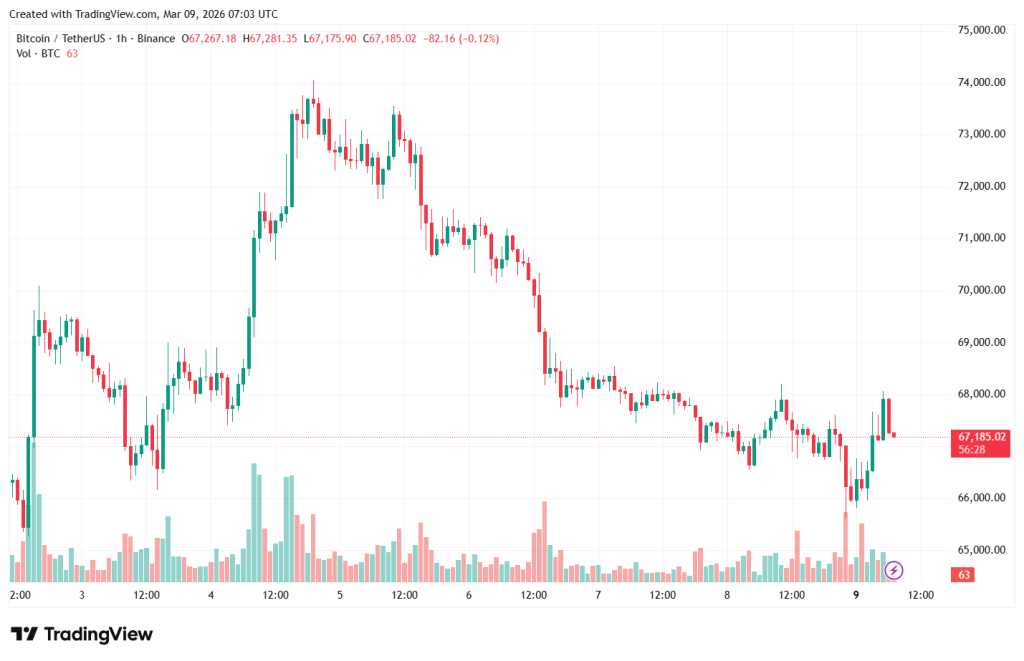
At the time of writing, the asset is trading around $67,185 (+0.1% over the day).
Bloomberg Intelligence Senior Strategist Mike McGlone suggested that Bitcoin could drop to $50,000, with silver potentially falling to $50 per ounce.
Iran War May Enhance Bitcoin Bear, Fuel Silver Peak —
Bear markets are notable for sharp bounces, and Bitcoin has done so. A top reason the crypto may have rebounded roughly 12% to March 4, almost matching crude oil’s gain since the start of the Iran war, is highlighted by the… pic.twitter.com/wV5Qf8cvCl— Mike McGlone (@mikemcglone11) March 7, 2026
Swan Bitcoin Managing Director John Haar noted that during periods of market instability, the leading cryptocurrency behaves like a high-risk asset. In the long term, its price is determined by adoption expansion and monetary properties.
The market dynamics heavily depend on institutional investors. Citrea co-founder Orkun Mahir Kılıç identified spot ETFs as the main gateway for traditional capital.
MyDoge founder Jordan Jefferson emphasized that locally, macro shocks pressure Bitcoin’s price. Globally, independent financial infrastructure benefits from the weakness of TradFi. Bank failures and fiat currency devaluation drive users to digital assets for wealth preservation.
US Stock Market Plunge
Ed Yardeni of Yardeni Research believes that the likelihood of a market crash by year-end has increased from 20% to 35%. The chances of speculative growth driven solely by investor enthusiasm have decreased from 20% to 5%.
The main reason for the revision is rising oil prices. On March 9, prices exceeded $100 per barrel for the first time since 2022. The energy shock hits household incomes, reduces corporate profits, and complicates the task of the Fed.
“The US economy and stock market are caught between a rock and a hard place. So is the Fed. If high oil prices persist, the regulator will face a tough choice between rising inflation and increasing unemployment,” Yardeni stated.
Amidst this, the dollar has become the main beneficiary. Over the week, the US currency has risen against almost all major competitors. Traditional safe-haven assets like Treasury bonds, the Japanese yen, the Swiss franc, and gold are depreciating.
Futures on the S&P 500 index fell by 1.6%. Hedge funds are actively increasing short positions on US stocks.
Despite short-term risks, the strategist’s base scenario remains positive:
- 60% — probability of the “Roaring Twenties” by year-end. This scenario envisions confident US economic growth driven by productivity gains. Over the next decade, the probability of this scenario reaches 85%.
- 15% — chance of a repeat of 1970s stagflation within a decade.
Yardeni emphasized: if investors believe in the reality of stagflation, the onset of a full-scale bear market will become the most likely outcome.
Bitcoin’s Correlation with the IT Sector
The recent synchronous movement of digital gold and US software developer stocks is linked to macroeconomics, not structural market merging. This was stated by NYDIG’s Head of Research Greg Cipolaro.
Last week, the leading cryptocurrency rose alongside the IT sector. In light of this, market participants began to perceive Bitcoin as a proxy tool for evaluating developer companies.
According to Cipolaro, price charts look similar, but the assets do not share common trends like AI development. Their simultaneous rise is merely a reaction of liquidity-sensitive risk instruments to current economic conditions.
Over the past 90 days, Bitcoin’s correlation has increased not only with software developer stocks but also with the S&P 500 and Nasdaq indices.
Meanwhile, the stock market explains only a quarter of cryptocurrency price movements. The remaining 75% of price changes depend on factors not directly related to traditional exchanges.
The analyst noted that investors are not currently using Bitcoin as a hedge against macroeconomic shocks. As a result, the asset has yet to justify its status as “digital gold.” Traders buy cryptocurrency simply as one of the risk assets.
However, Bitcoin retains its own economic drivers: network activity, adoption rates, and regulatory features.
“This uniqueness maintains Bitcoin’s status as a portfolio diversification tool. Correlation with stocks is high now, but it does not determine cryptocurrency returns,” the expert concluded.
Earlier in March, VanEck’s Jan van Eck stated that the price of digital gold had approached a local bottom.
Рассылки ForkLog: держите руку на пульсе биткоин-индустрии!