



The decentralized finance (DeFi) sector continues to attract heightened attention from crypto investors and traders. ForkLog has pulled together the most important events and news from the past three weeks in one piece.
Value of Locked Assets, Market Capitalization and DEX Volumes
On November 14, the amount of assets frozen in DeFi protocols reached an all-time high at $13.96 million (DeFi Pulse).

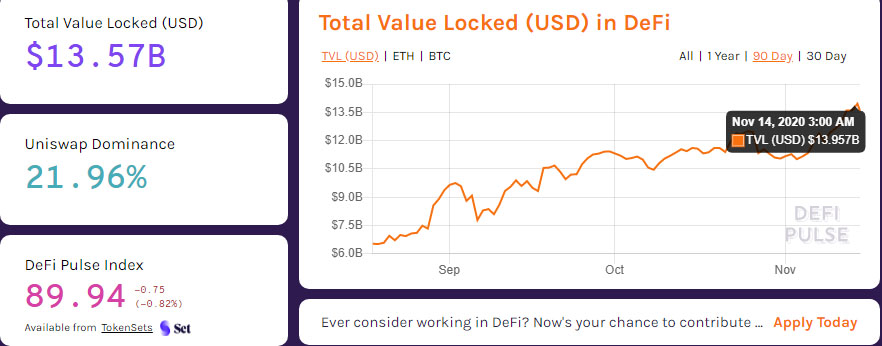

At the time of writing, the figure had adjusted to $13.57 billion. Uniswap remains the leader — its dominance index approached 22%.
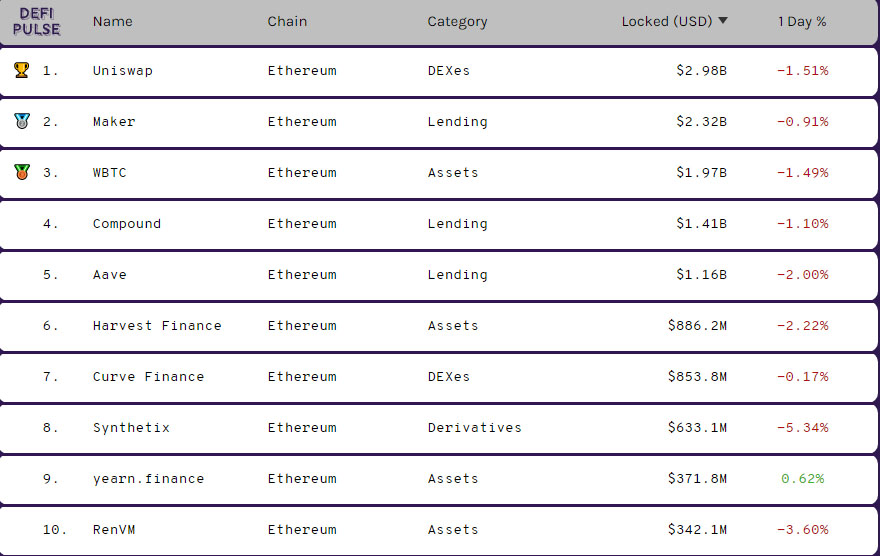
Uniswap accounts for $2.98 billion of all assets in DeFi protocols. The composition of the top five over the past three weeks did not change; only Aave ceded the fourth place to Compound.


The market capitalization of DeFi tokens also reached a record figure of $16.855 billion (DeFiMarketCap).

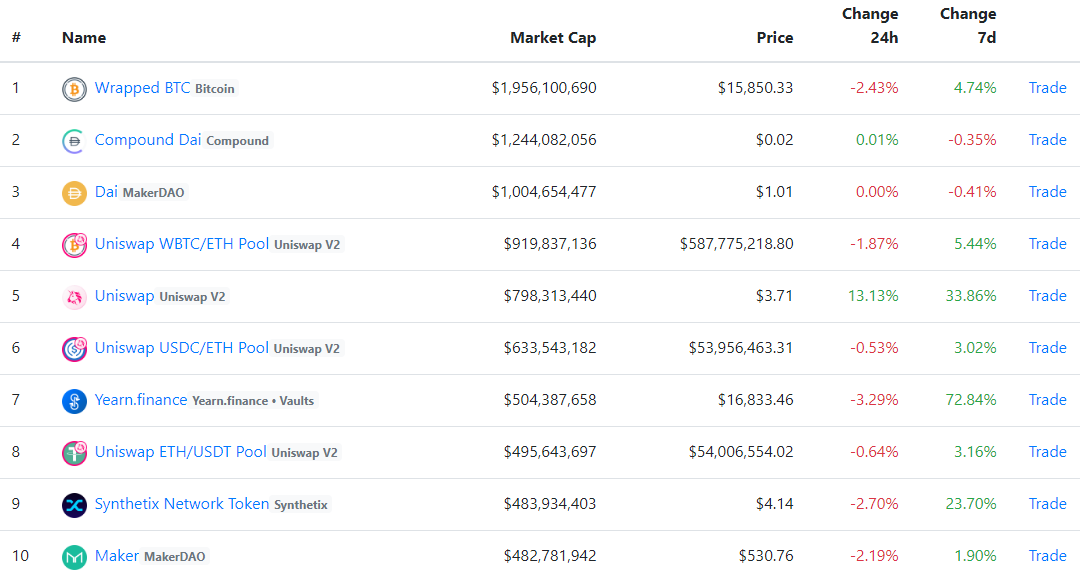

Wrapped Bitcoin (WBTC), backed by Bitcoin, remains the leader with a value exceeding $1.9 billion. The top three remained unchanged, while the capitalization of the trailing DAI surpassed $1 billion.
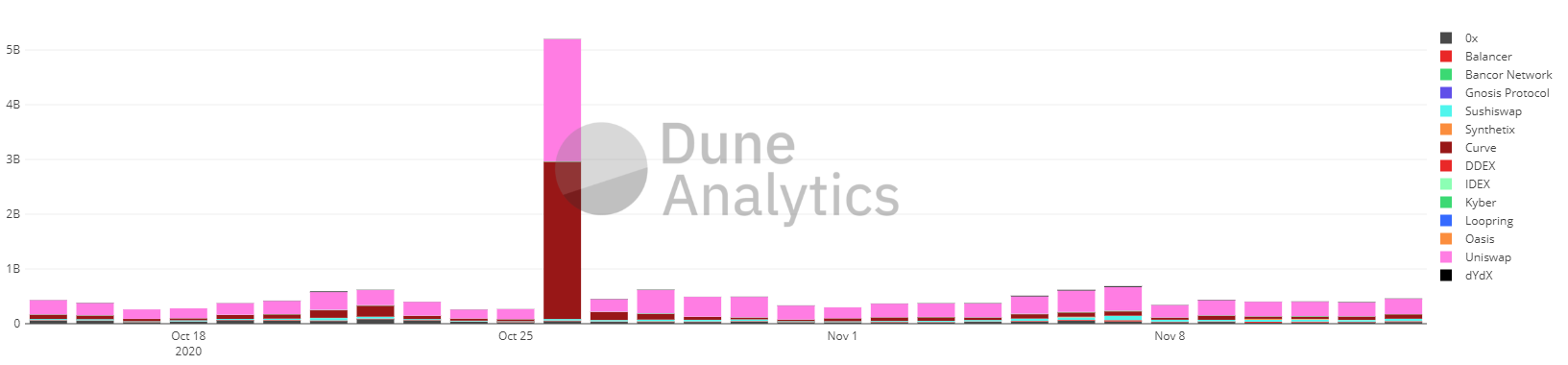
Trading volumes on decentralized exchanges over the last 30 days amounted to $17.57 billion, according to Dune Analytics. Compared with the previous similar period, the figure fell by 9%.
Over the last 24 hours trading volumes reached $481 million. An anomalous spike was recorded on October 26, when on Curve it approached $2.9 billion and on Uniswap exceeded $2.2 billion. This occurred in the wake of Harvest Finance’s platform hack.


Source: Dune Analytics
Hacker Withdraws $19.8 Million from Harvest Finance Platform
An unknown attacker used $24 million in stablecoins from Harvest Finance DeFi protocol pools to withdraw $19.8 million in renBTC. The project’s native FARM token reacted by dropping more than 50%.
According to the developers, the hacker manipulated the prices of stablecoins on the Curve DeFi protocol with which Harvest Finance interacts. It took seven minutes to withdraw funds from the platform. Part of the assets was routed through the Tornado Cash mixer.
The team said it had moved “100% of the stablecoins and BTC from Curve’s vaults” into storage. Together with Ren Protocol they identified attacker addresses — project representatives appealed to major exchanges to block them.
Harvest Finance representatives also said that the attacker returned $2.47 million. They will distribute it among affected investors.
Later, the project’s developers said they not only know the attacker’s addresses but also have personal information about him. The hacker is “well known in the Bitcoin community.” The project has set a bounty of $100,000 for the first to contact them and help recover the funds.
Later the project team increased the reward to $1 million.
According to analysts, the attacker used Uniswap for instant swaps — a feature introduced in the second version of the decentralized platform.
On Curve, the hacker manipulated the price of stablecoins. He swapped large amounts of USDC for USDT to push the second coin higher, transferring the obtained amount to Harvest Finance. He then repeated the pattern in the reverse direction — USDT to USDC to depress the price of the Tether stablecoin.
As a result, the attacker drained more USDT from the vault than he deposited. The process could be repeated indefinitely.
Harvest Finance’s developers took responsibility for the “engineering error” that allowed the hacker to carry out the attack.
As possible measures to prevent incidents, Harvest Finance representatives named banning deposits and withdrawals in a single transaction. In their view, such a move would render instant swaps meaningless.
Balancer Protocol Attracted Seven-Figure Funding via Token Sale
Balancer Labs attracted investments from Pantera Capital and Alameda Research through a direct sale of BAL tokens.
The amount raised was not disclosed.
Sam Bankman-Fried, CEO of Alameda Research and the FTX exchange, said the sum was “seven figures.”
The funds will be used to develop the protocol’s second version.
It is expected that Balancer v2 will allow users to significantly reduce transaction costs and improve interaction with the protocol. Developers can look forward to easier integration with DEXs.
Aave and Balancer Joined Open DeFi Alliance
The Open DeFi Association launched a Western division, comprising eight leading DeFi organizations.
New members of the alliance are Aave, Balancer, BlockScience, DyDx, Ocean Ventures, Outlier Ventures, Quantstamp and SuperRare. Together with them, Open DeFi brings together 16 organizations.
Open DeFi head Stani Kulechov assessed that the alliance’s support reflects the sector’s ideals. He said he looked forward to working together on tools and infrastructure within Open DeFi.
Initiated the creation of an association aimed at bridging eastern and western DeFi markets, the blockchain startup Conflux Network. The project was supported by the Shanghai Committee on Science and Technology, and among the first participants were the DeFi protocol dForce, venture capital Sequoia Capital and others.
Opium Protocol Raised $3.25 Million from Alameda Research and Galaxy Digital
The Opium Protocol platform attracted $3.25 million in a funding round with Galaxy Digital, Alameda Research, HashKey Group and CMS Holdings.
Representatives said the funds would help implement new derivatives on the DeFi market.
According to them, as an advisor to the startup joined Stani Kulechov, the head of Aave.
“Derivatives not only enable efficient risk trading but also boost capital efficiency. These features are key to a mature financial system, and they will also be widely used in DeFi,” said Andrey Belyakov, founder of Opium Protocol.
Token Percent Finance Crashed After $1 Million User Funds Block
On November 4, the Percent Finance DeFi project, a Compound fork, reported to users about a serious issue on the platform.
During the update of the interest-rate model due to a bug, markets for USDC, WBTC and ETH were frozen, the developers explained. They noted that the issue could lead to permanent locking of user funds.
The amount of funds locked in contracts was estimated at $966,000 (446 000 USDC, 28 WBTC and 313 ETH). The Percent Finance team asked USDC issuers (Circle and Coinbase) and WBTC (BitGo) for help in unfreezing funds.
The developers warned that restoring about $125 000 worth of Ethereum would likely be impossible.
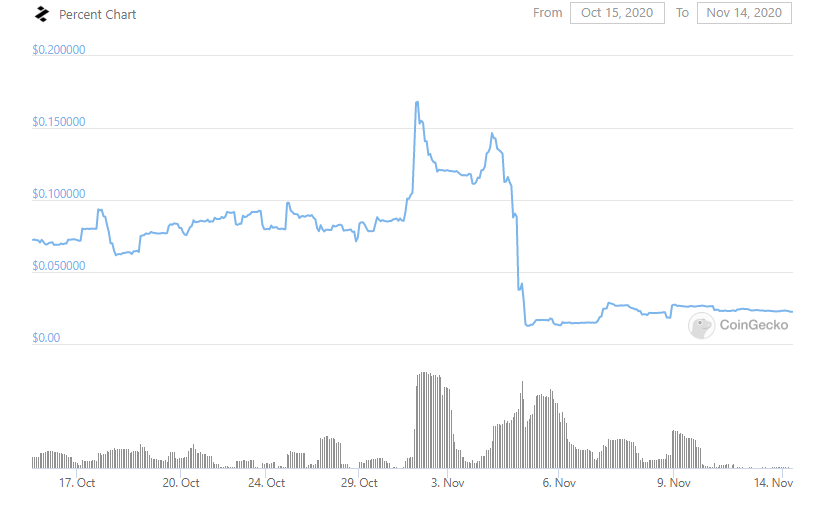
After the project’s statement, the PCT token price collapsed from $0.15 to $0.01. As of writing, the asset was trading at just over $0.02 (CoinGecko).


Source: CoinGecko.
Hacker Drained $2 Million from Akropolis DeFi Protocol
An unknown attacker drained the Akropolis project’s YCURVE and sUSD liquidity pools in DAI stablecoins for $2 million, having bypassed two audits of the smart contracts.
Analyst Stephen Chen observed that the hacker withdrew assets in 50,000 DAI tranches over seven hours until liquidity was exhausted in the pools.
DeFi project Akropolis enables borrowing and generating yield on crypto deposits.
According to the project, the pools were audited by two independent audit firms. They did not find a vulnerability in the savings part of the service that uses Curve. The hacker carried out a series of attacks with flash loans. Such loans are repaid within a single block, allowing no collateral.
The project is studying ways to reimburse users for losses and will present its proposal soon.
What is yield farming?
ForkLog also wrote:
- The number of DeFi sector users grew by 55% in six weeks.
- CipherTrace: DeFi protocol losses from hacks year-to-date surpassed $99 million.
- Kyber Network launched a platform for on-network market making.
- Coinfirm integrated Chainlink oracles to combat money laundering in the DeFi sector.
- MyEtherWallet added support for the 1inch DEX aggregator.
Subscribe to Forklog’s channel on YouTube!