




Airdrop is the distribution of project tokens among the community. Assets are awarded to early users or to those who completed tasks set by the developers.
Such distributions are practised by numerous teams. Regardless of the model chosen, they pursue fairly concrete goals: increasing brand recognition and audience loyalty, accelerating token adoption, collecting user data or decentralising project governance.
Recipients of “free” tokens may hold them for a long time or sell them shortly after the airdrop.
ForkLog examined the most notable airdrops of 2021. We identified which tokens delivered the greatest profits to their holders, and considered whether to adhere to a HODL strategy after receiving the airdrop. HODL
- Since the airdrop by 1 January 2022, more than 40% of the ForkLog tokens examined rose in price. The strongest performers were Lido (LDO) and OpenDAO (SOS) — 148% and 150% respectively. However the latter only launched in December.
- Over 80% of the tokens examined reached price peaks within the first month after distribution. Subsequently, they traded lower.
- The price trend is downward as most participants are not inclined to hold tokens. A contributing factor was also the protracted market correction.
Not all tokens are equally valuable
We examined airdrops of a number of projects, including liquidity aggregators, DeFi platforms, cross-chain bridge and domain-name services.
If developers do not set strict participation targets, all airdrops are profitable to some degree. Users receive “free” assets that can be sold—regardless of the exchange rate this will still bring money.
However, some prefer to hold tokens in the hope of a rise in value.
With such an approach there is a significant risk of missing out on profits. Of the 18 tokens considered, only 8 proved profitable — the price of the rest has fallen since the airdrop.


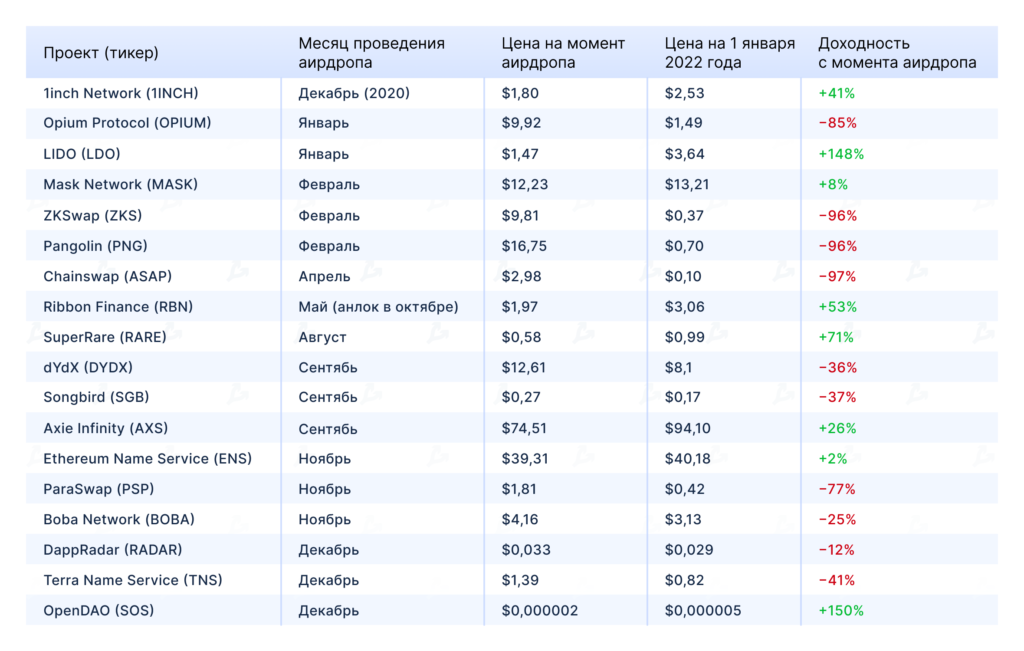
Negative price dynamics for most coins are explained by tokens typically falling into “weak hands”. Undoubtedly, a significant factor was also the market correction.
1inch Network (1INCH)
The liquidity aggregator from decentralized exchanges (DEX) 1inch released a governance token in December 2020. That same period saw the first 1INCH airdrop — assets were distributed among participants in two liquidity mining programs, as well as wallets that interacted with the platform before 24 December and met one of the following criteria:
- at least one trade before 15 September;
- transactions totaling at least $20;
- no fewer than four trades.
In February 2021 the project conducted an additional governance token airdrop. The participation conditions were the same as for the December distribution. During the event the 1inch Foundation sent:
- 3.57 million 1INCH — 1,308 participants of the second liquidity mining program;
- 4.8 million tokens — 9,094 Mooniswap users;
- 375,000 tokens to smart wallets Argent, Authereum, Gnosis and Polp;
- 310,000 1INCH — to people using limit orders.
The aggregator also distributed 6 million 1INCH among Uniswap traders who had never traded tokens on 1inch or Mooniswap. From the addresses listed as participants, trading bots were excluded.
In mid-November 1inch announced a full transition to a DAO.



Opium Protocol (OPIUM)
DeFi derivatives platform Opium Protocol launched the OPIUM governance token and conducted an airdrop in January 2021. Assets were distributed among users who had at least once traded on the platform or provided liquidity in the USDT Insurance pool.
Payouts ranged from 8 to 100,000 OPIUM.
The distinctive feature of the airdrop was the drOpium liquidity mining model, which rewards long-term holding. The earlier a user withdraws the tokens, the smaller the reward. For instance, the first person to withdraw received only 40% of the initial reward — the remaining coins were distributed among the other addresses in the pool.


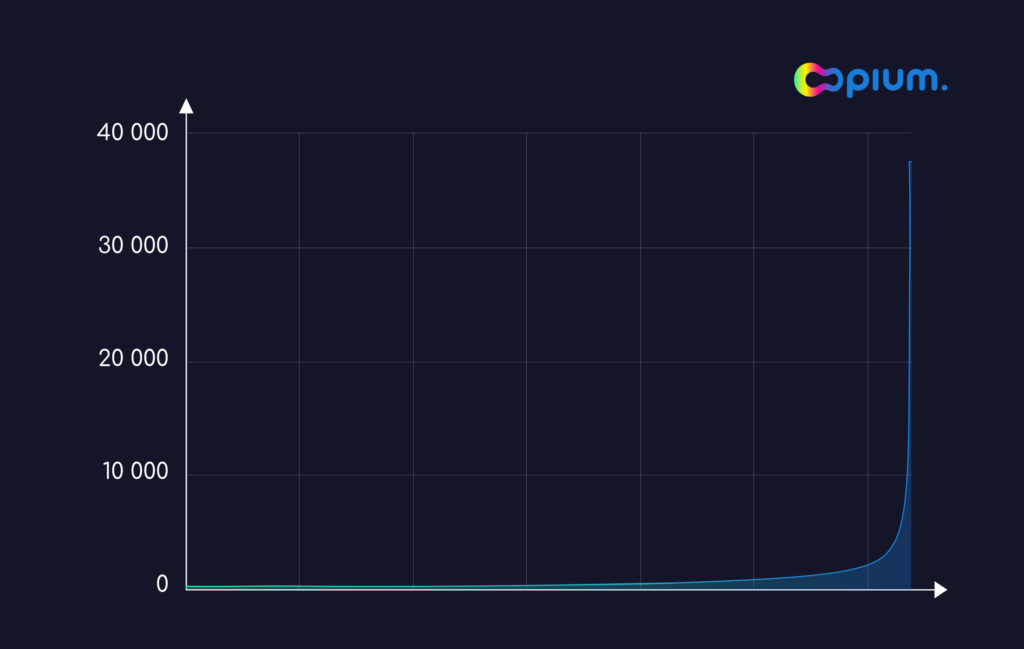
The mechanism is designed to reward users who hold tokens longer in storage. In theory even those who withdraw as little as 8 OPIUM will be able to withdraw up to 200,000 coins if they exit last.
As of writing, OPIUM tokens are held by 2,747 holders. In November the protocol’s derivatives trading volume exceeded $31 million, and in December the figure reached $67.2 million, according to opium.research.

LIDO (LDO)
The platform for liquid staking of Ethereum 2.0 for liquid staking held its airdrop in late January 2021. Among participants who interacted with the project by December 28, 4 million LDO were distributed.
In April, 100 million LDO (10% of total supply) was bought back by the hedge fund Paradigm and its strategic partners. Those tokens are locked for a year, with the lockup being released gradually.



Mask Network (MASK)
The Mask Network project, offering a browser extension with data-encryption features, conducted an airdrop in February. During the event users were allocated 1.86 million MASK tokens.
Shortly before this, Mask Network distributed 1.06 million MASK as part of an Initial Twitter Offering (ITO). Its participants also received tokens in the first round of the airdrop.
Recipients had to claim the tokens within 24 hours. After that, the initial amount decreased by 20% each day until it hit zero.
After the ITO, MASK traded above $40, but by the airdrop price had fallen to $12.

ZKSwap (ZKS)
In February, the ZK-Rollups-based DEX ZKSwap distributed 80 million ZKS among users who held tokens on the first-layer network (exchanges or standalone addresses), on the second-layer ZKSwap network, and on the ZKSwap Proof-of-Staking contract.
The balance snapshot was taken on February 25. At the time of the snapshot ZKS traded above $11, but later the price fell sharply and never returned to those levels.
Throughout the year developers announced several liquidity mining programs, distributing more than 10 million ZKS.



Pangolin (PNG)
After the February 2021 launch of the Avalanche-based DEX Pangolin, an airdrop of governance tokens was conducted. PNG could be claimed by users who held Uniswap (UNI) or SushiSwap (SUSHI) as of December 7, 2020.
Rewards could be claimed within a month of the platform launch. In the airdrop 5% of the total PNG supply was distributed; the remaining tokens were allocated to the liquidity mining program.
The launch generated a frenzy among users — the load on the Avalanche network was so high that transactions nearly halted.
In the first few days PNG traded above $16, but the token price subsequently declined and, like ZKS, failed to return to those levels.



ChainSwap (ASAP)
The cross-chain bridge ChainSwap launched its own token at the end of April. The project conducted an ASAP airdrop among AntiMatter (MATTER) holders — 1% of the total supply was set aside for this purpose.
During the airdrop, ASAP options were distributed, which could then be exchanged for tokens on the Binance Smart Chain. Also eligible were liquidity providers for the MATTER/ETH pool and ChainSwap users.
In July, hackers carried out two attacks on the protocol and withdrew nearly $5 million. To address the consequences of the second breach, the developers issued a new version of the ASAP token.



Ribbon Finance (RBN)
DeFi protocol Ribbon Finance conducted an airdrop in May, but assets were unlocked only in October. For the airdrop 3% of the total supply (30 million RBN) were allocated.
In the event, participants could engage with Ethereum-based options protocols — AntiMatter, Hegic, Opyn, Charm and Primitive. Tokens were distributed among liquidity providers and option sellers.
Each address could claim 5,772 RBN.
After the unlock, a community scandal erupted. The developers arranged the distribution so that “smaller contributors” would benefit more from the airdrop.
Analyst Bridget Harris of Divergence Ventures took advantage of this, registering many wallets and sending tiny transfers to the project address, ultimately receiving over $2.4 million in RBN.

SuperRare (RARE)
NFT marketplace SuperRare launched the governance token in August and began the airdrop. A total of 150 million RARE — or 15% of the market supply — was allocated. Early users of the platform participated in the event.
Within 24 hours of launch, RARE surged 900%. In November, following listing on Binance, the price rose 176%, but it could not reach the earlier highs.

dYdX (DYDX)
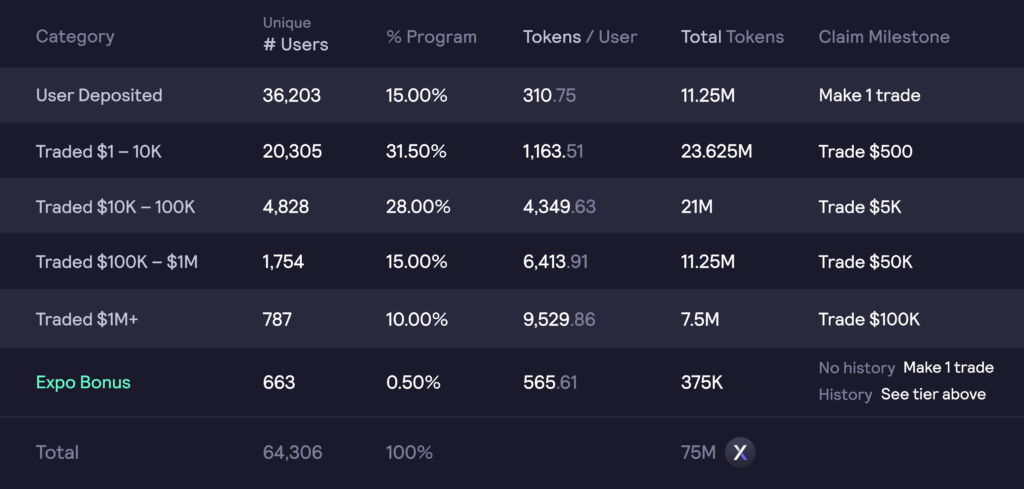
In September, the decentralised exchange dYdX launched a governance token and distributed a portion of the supply among users who had used the platform before 26 July.
75 million DYDX (7.5% of the total supply) were allocated for participation. To participate one had to make at least one trade on the platform. Rewards increased for meeting certain trading-volume targets. Traders from the United States and some other jurisdictions were excluded from the distribution.


Soon after launch, the DYDX developers discovered that an error occurred during the deployment of the safe staking pool. The service was blocked.



Songbird (SGB)
In late September, Flare Network’s experimental network Songbird conducted an airdrop of SGB tokens for XRP holders. The XRP Ledger snapshot was taken with a timestamp of December 12, 2020.
Many platforms supporting the airdrop did not distribute SGB in a timely manner, citing infrastructural problems. For example, Bitstamp distributed only on December 8, while Binance did so only on December 21.
Nevertheless, some participants managed to receive the reward in September.
The Songbird $SGB distribution has been completed! You can check to see how much you got in your assets center. (Be sure to scroll down to find it) @FlareNetworks
Trading for SGB/ $USDT and SGB/ $XRP starts TOMORROW at 10:00 UTC. We hope you’re as excited as we are! pic.twitter.com/O6G1dKJtSf
— Bitrue (@BitrueOfficial) September 26, 2021
For each XRP on balance, participants received 0.1511 SGB.
Earlier, Flare Network also conducted a preliminary airdrop of native SPARK (FLR) tokens. Participants will receive the assets when the project team launches the mainnet.



Axie Infinity (AXS)
In late September, Axie Infinity operator Sky Mavis conducted an airdrop of AXS tokens worth more than $60 million. The assets went to early platform users. Late adopters included players who joined the project before 26 October 2020.
Alongside the distribution, users gained the option to stake AXS. As of writing, more than 20.5 million AXS (~$2.8 billion at the current price) have been staked.

Ethereum Name Service (ENS)
In November, Ethereum Name Service announced a move to a decentralised governance model with community delegates and the ENS governance token governance token for ENS.
For the airdrop, 25% of the total ENS supply was allocated. The tokens went to addresses that, as of 31 October 2021, had registered .ETH domain names. The amount received depended on the number of days the domain was held. Those who set ENS name as their primary address Primary ENS Name received double rewards.



ParaSwap (PSP)
In mid-November the DEX aggregator ParaSwap launched the PSP governance token and ran an airdrop distributing 150 million coins among 20,000 wallets. However, tokens were issued to only 0.015% of participating addresses.
The project team aimed to cultivate a community. The distribution rewarded engagement, screening users step by step:
- First to receive were addresses that used the aggregator regularly since its 2019 inception;
- Then PSP was distributed to wallets with a ParaSwap transaction history, on-chain activity with other projects/blockchains, and a non-zero balance. The route from origin address → ParaSwap → origin address was excluded;
- Finally, assets went to participants of swaps with partner projects that integrated ParaSwap.



Boba Network (BOBA)
The developers of the Ethereum layer-2 solution Boba Network conducted an airdrop of native BOBA tokens in November. The assets went to holders of the OMG Network token OMG.
The Enya team, behind Boba Network, is a major participant in the OMG Foundation.
The balance snapshot was taken on 12 November. In November TVL in the Boba Network ecosystem exceeded $1.39 billion. After peaking, the figure began to fall. By January 2022 TVL had dropped to $0.48 billion.

DappRadar (RADAR)
In December, analytics service DappRadar launched the RADAR token on the Ethereum blockchain and announced the start of the airdrop. Tokens could be claimed by:
- Users who had a DappRadar account with a connected wallet and interacted with at least one dApp on Ethereum in the last six months. These addresses received 8,697 RADAR;
- Any users who interacted with at least one dapp on Ethereum in the last six months and had activity in at least 10 applications over the wallet’s lifetime. These addresses received 5,798 RADAR.
The chain snapshot was taken on 19 October 2021. Claims had to be made by 14 March 2022.



Terra Name Service (TNS)
Terra Name Service, linked to the Terra protocol, introduced the TNS token and conducted an airdrop for users on 24 December.
Over two years, the team will distribute 25% of the total token supply. The first snapshot for the airdrop was taken on 17 December.
10,198 addresses were eligible, each of which conducted at least 15 transactions and spent more than $16 on domain registrations. Depending on the volume of operations, participants received 538 TNS, 1,077 TNS or 1,940 TNS.



OpenDAO (SOS)
In the same month the OpenDAO project conducted an airdrop of SOS tokens among OpenSea NFT marketplace users. All addresses that made purchases on the platform in ETH were eligible.
The Ethereum snapshot was taken on 23 December 2021. It was initially planned that claims would run until 30 June, but the community later shortened this to 12 January.
The amount of the reward depends on the total number of transactions and their volume. The average allocation per address was 27 million SOS.
The airdrop generated fanfare in the community, but OpenSea emphasised that it has no involvement with the project and advised users to study the contract before claiming tokens.



“Golden” Apes
The airdrops are not limited to DeFi projects and trading platforms. In 2021, the NFT segment also embraced the trend.
At the end of August, Yuga Labs, the team behind the Bored Ape Yacht Club (BAYC), carried out an airdrop of “Mutant Ape” mutations that allow a free new Mutant Ape item to be minted (Mutant Ape Yacht Club, MAYC).
The distribution proved highly profitable for participants. In August 28 the BYAC tokens were sold at 3 ETH. At the time of writing, the average price of MAYC tokens exceeds $60,000 (more than 19 ETH at the current rate).
The example was followed by Degenerate Ape Academy developers on Solana. Holders of those NFTs received Degenerate Trash Pandas tokens. The price of the latter may reach a few thousand dollars.
Introducing: Degenerate Trash Pandas: https://t.co/LaTXJYg4ux
Fair Launch: Nov 14th.
Snapshot for Ape holders: Nov 7th. Delist or NGMI. pic.twitter.com/J0pkNujKjf— Degenerate Ape Academy 🎓 (@DegenApeAcademy) November 1, 2021
Conclusion
Airdrops are generally profitable by default. The exception is when the costs of meeting participation requirements exceed potential gains. This is plausible given Ethereum’s transaction fees.
A case in point is the Instrumental Finance (STRM) airdrop, which took place on 14 December. Since these are ERC-20 tokens, many users’ network fees exceeded the rewards.
Airdrop is live 🤑🤑🤑
Team give me 13,5 $STRM = 10$ but claim cost 40$ 😆😆😆
Nice start gays , and good bye 😎😎😎— Adriano Stampony (@AdrianoStampony) December 14, 2021
In recent times, developers seek to raise engagement by introducing liquidity mining models that incentivise HODL and exclude “reward hunters.”
However, market data show that, in most cases, those who are not actively involved in the target project are better off selling their assets soon after distribution ends. Of the tokens reviewed, 15 reached their price peak within the first month after distribution; thereafter, their price trended lower.
When deciding on strategy for these assets, one should consider the roadmap, team reputation, venture investor interest, and the product’s practical value.
Read ForkLog crypto news in our Telegram — crypto news, rates and analysis.