



On March 22, Ethereum’s daily fee volume fell to a historic low, resulting in the removal of a minimal 53.07 ETH (~$106,000) from circulation.


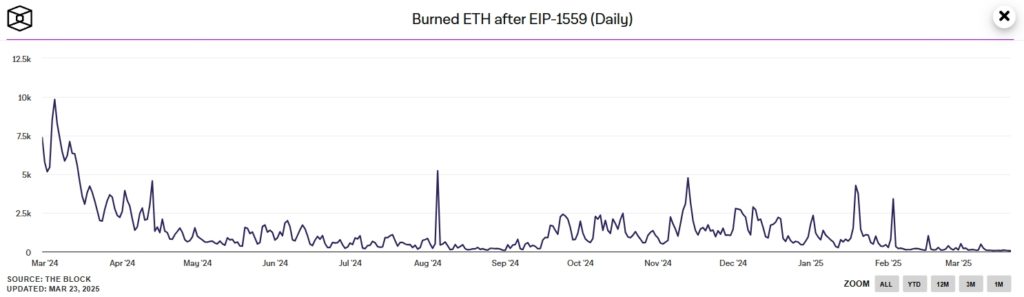
In August 2021, the London hard fork implemented the EIP-1559 improvement proposal. It introduced a mechanism for burning a portion of transaction fees based on network load and reducing gas price volatility.
The cryptocurrency shifted to a deflationary model, with the market supply of the asset gradually decreasing.
In March 2024, developers deployed the Dencun update on the mainnet. A key component of the upgrade was EIP-4844, which implemented the Proto-Danksharding option, aimed at scaling the network by creating a new type of transaction for large binary data arrays (BLOB).
This allowed a significant reduction in fees in the ecosystem’s L2 networks, especially those based on rollup technology.
The burn rate in Ethereum slowed, and around early April, the market supply of ether began to rise. By early 2025, the amount of ETH in circulation returned to levels seen before The Merge hard fork in September 2022.


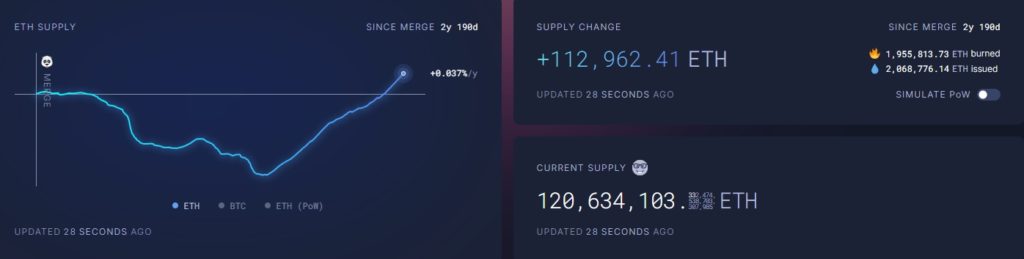
Over the past 30 days, the annual inflation of the cryptocurrency has risen to 0.73%.
The slowdown in network activity negatively impacts the ETH burn rate. The number of active Ethereum addresses (7 DMA) dropped to its lowest since September 2024. Transaction counts and daily volumes of transferred value have also declined in recent weeks.
Some experts believe the upcoming Pectra hard fork, which will increase the target volume of BLOB objects and their maximum limit, will boost inflation. Ethereum developers plan to activate the update no earlier than the end of April.
Analysts at Standard Chartered revised down their 2025 ether price forecast from $10,000 to $4,000, citing the growing influence of L2 solutions, particularly the Base platform.