




The crypto community is eagerly awaiting Ethereum’s next major upgrade—Cancun-Deneb (Dencun). It is the first large-scale update to the second-largest cryptocurrency since Shapella, activated in April 2023.
Dencun spans several areas: scalability, lower gas fees, improved security, better cross-network communication and optimized data storage.
This ForkLog article explains in plain terms the significance of EIP-4844—the most anticipated change in the forthcoming hard fork.
- Dencun is a preparatory step towards Ethereum’s full data sharding.
- EIP-4844 introduces Proto-Danksharding, designed to scale the network by creating a new transaction type for large binary data blobs (BLOBs).
- Experts are confident that Dencun will cut L2 costs by an order of magnitude and substantially boost Ethereum’s throughput.
What are L1, L2 and the data-availability layer?
To understand EIP-4844’s purpose and significance for Ethereum, it helps to clarify what L1, L2 and the data-availability layer are.
What is L1?
The term L1 typically refers to blockchains that do not depend on external networks and can perform all the functions expected of distributed systems on their own. Examples include Bitcoin, Litecoin, Solana and BNB Chain. These are base networks able to validate and finalize transactions without outside help.
Other systems can use first-layer networks as service providers for certain functions. Networks built atop L1 are called second-layer (L2) solutions.
What is L2?
L2s are systems “layered” on top of L1. Second-layer solutions perform only part of the functions needed for a decentralized network to operate, delegating some tasks to the first “floor”.
Such networks are meant to improve the scalability of base systems. They can at least partially address low throughput and high transaction fees without altering the base chain’s code.
As a rule, L2s focus on computation (notably smart-contract execution) while delegating security to L1. In this context, the “first floor” is often called the data-availability layer for L2.
What is the data-availability layer?
Distributed systems are expected to provide the following functions:
- execution. All nodes check transactions for compliance with the consensus rules. In account-based blockchains (which typically support smart contracts) nodes execute transactions to compute the network’s new state;
- consensus. Nodes “agree” with one another on which transactions will be processed and in what order;
- settlement or dispute resolution (settlement). This function guarantees the irreversibility of confirmed transactions and provides arbitration if their validity is challenged.
- data availability. Every node holds a copy of the entire blockchain, storing every transaction. A peer can request data from another node.
Data availability is the most important function L1 performs for L2. It is also critical to the security of any blockchain, ensuring that validators publish and store transactions, states and other information required for the network to operate. It also implies that any participant can audit the distributed ledger of transactions and verify it.
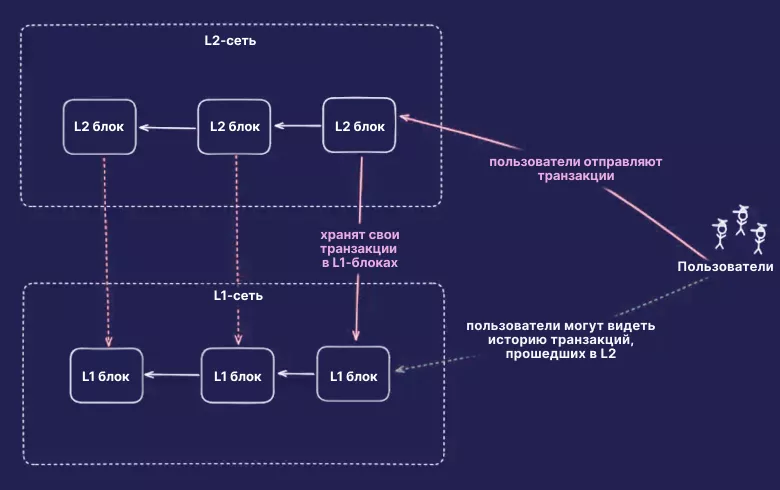
For simplicity, think of the L1–L2 stack as a computer:
- the “first floor” is akin to a hard drive. Here the computer stores transactions that took place on the second layer—in case anyone wants to inspect their details;
- L2 is the processor that performs all computations. You can also see the results of transactional activity at this layer. But the picture changes dynamically as users constantly perform many actions—transfers, token swaps, NFT minting and so on.


How do L2s work?
Many popular decentralized-finance (DeFi) projects run on Ethereum. Scalability is therefore an especially acute problem for the second-largest cryptocurrency.
Rollups are the key technology powering Ethereum-based L2 solutions. They enable high privacy and scale the main Ethereum network by bundling many transactions into a single batch that is confirmed on the first-layer blockchain.
There are two main types of rollups:
- Optimistic rollups. With this approach, transactions are executed on the L2 network and then grouped into compact batches that validators include in the main Ethereum network. Such rollups are used by Arbitrum and Optimism.
- ZK-rollups. Transactions on the second layer are likewise batched and sent to Ethereum, but their verification is performed using special verifiers that serve as cryptographic proofs of validity. Polygon is built on ZK-rollups. Ethereum co-founder Vitalik Buterin considers this the main scaling technology for Ethereum.
Put simply, optimistic rollups follow a “trust me, bro” approach:
- they “optimistically” execute L2 transactions;
- they publish the results to L1 (providing all the data needed to verify correctness);
- they allow anyone to challenge the result within a set period. For example, someone finds that the Arbitrum network processed a token transfer incorrectly. The user can report the issue and receive a reward, and the network will adjust to reflect the correct outcome.
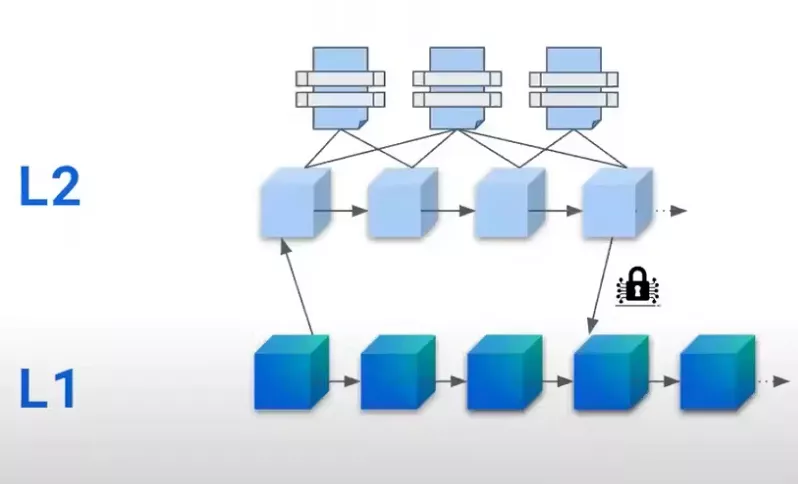
ZK-rollups operate on the principle “here is the result, and here is the proof”:
- they submit transactions while generating proofs of their correct execution;
- they publish transactions and proofs to L1;
- anyone can then confirm that the L2 correctly executed the operations by verifying the proofs provided.

Zero-knowledge proofs were initially used in privacy-focused cryptocurrencies, but in recent years they have found broad application as Ethereum scaling solutions.
ZK-rollups allow user data to be processed without revealing private information. For instance, the algorithm can verify that funds exist without showing a user’s balance. These properties matter for companies that must protect clients’ personal data.
Using ZK-rollup-based solutions also significantly reduces transaction fees. Many transfers are combined into one batch in which data are compressed—for example, an index can stand in for an address. This lets the first-layer blockchain store less information. Costs are shared across all senders, so each user pays less.
ZK-rollups provide low latency for withdrawals to the main network, because the smart contract verifies data correctness before the batch is included on-chain.
In broad strokes, an L2 works as follows:
- Users submit various transactions: they wrap ETH, swap coins on Uniswap and other DEXs, lend on AAVE, buy USDT, and so on.
- The second-layer network processes transactions as they arrive.
- The L2 periodically creates transaction batches and publishes them to L1.
Today, all EVM-compatible blockchains have calldata—a special space where parameters and data sent with a transaction are stored. These can, for example, serve as a kind of “instruction” for a smart contract.
Thanks to calldata, second-layer solutions can record transactions, proofs and execution results to the highly decentralized and secure Ethereum network.
There are pitfalls, however—notably a single fee market in which all transactions compete. If Ethereum gas spikes because of an airdrop or a new NFT collection, the price an L2 protocol must pay to publish its data also rises. Conversely, if a second-layer solution pushes lots of data to the “first floor”, that affects costs for all users of the second-largest cryptocurrency’s network.
“At present, L2s publish their data to L1 using calldata. And this is, without question, the most expensive component of L2 transaction costs,” — noted CoinShares analysts.
What will EIP-4844 change?
With this problem in mind, the Ethereum community devised a solution—EIP-4844. It is the most anticipated Ethereum change in the upcoming Dencun (Cancun-Deneb) upgrade.
The basic idea, put simply, is: “Let L2s do their job without bothering Ethereum users.” To that end, a new transaction type for large binary data blobs (BLOBs) is introduced, allowing second-layer networks to publish all the data they need there.
In addition, EIP-4844 creates a separate fee market. This means Ethereum and L2 users will not “bother” one another by pushing up gas prices—each will “drive in their own lane, safely and without hindrance”.
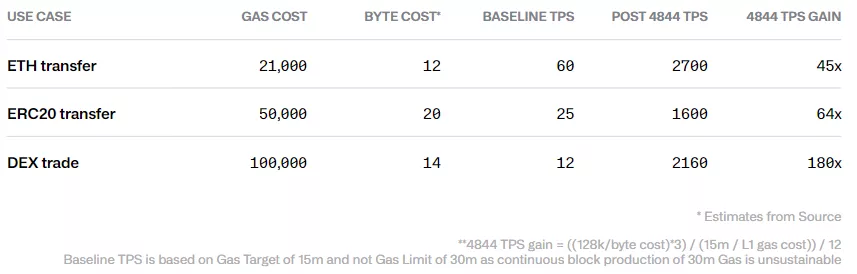
CoinShares analysts expect this feature (Proto-Danksharding) to reduce L2 costs by at least 10x and to significantly increase system throughput.
“Substantially optimized characteristics of the BLOB space will also allow L2s to include more transactions in each block. This is an important step towards increasing the network’s transactions per second (TPS),” the CoinShares experts noted.

According to OP Labs researchers, EIP-4844 will “unlock” other approaches to further scale Ethereum, including sharding and data-availability sampling.
And this is also prepares go-ethereum for full danksharding: forward-compatibility to unblock future eth2 scaling work like shards and data-availability-sampling!
Which brings us to the consensus layer changes, with two teams ??
— proto.eth (@protolambda) February 20, 2022
“It is abundantly clear that at least in the short to medium term, Ethereum is focused on improving the efficiency and throughput of second-layer solutions rather than introducing any fundamental changes that would increase first-layer scalability and TPS,” CoinShares said.
In the experts’ view, decentralization will decrease to some extent (in particular, the cost of running a full node will rise). But the trade-off looks acceptable compared with the alternative of L1 scaling with far higher validation costs—risking an even greater drop in decentralization and “uncharted territory in terms of security”.
Conclusions
There is not long to go before Dencun’s activation—the new Ethereum version already runs on the Goerli testnet, with Holesky slated for early February.
CoinShares researcher Luke Nolan expects a mainnet hard fork in March. He allows for a change in ether’s issuance dynamics due to a potential reduction in gas usage and, consequently, a smaller volume of coins being burned.
According to Nolan, gas prices will stabilize at lower levels soon after the hard fork. That is what ordinary users have been waiting for for years—many simply cannot afford roughly $10 DEX swaps.
Because of high transaction costs, on-chain activity on Ethereum has stagnated for a long time. After Dencun, a revival of DeFi is likely, supported by the market’s cyclical upswing, as well as improved competitiveness for the second-largest cryptocurrency.
The coming upgrade will lay the foundation for future updates aimed at the long term—to make Ethereum a modular system and address the perennial scaling trilemma.