




There is no doubt that a significant portion of the crypto community is awaiting approval of the first spot Bitcoin-ETF in the United States — SEC has been inundated by a wave of registration filings from major investment firms, and the number of related Google searches is breaking records.
A fake Cointelegraph post about a ‘green light’ for launching the new product significantly revived the market, lifting the price of digital gold to the psychological level of $30,000. The CEO of the applicant company BlackRock explained such a market reaction as ‘unmet demand for digital assets’.
Many people are likely wondering what exactly is so special about this ETF and how the launch of exchange-traded funds would affect the price of digital gold.
ForkLog has examined the significance of the new product for the cryptocurrency market and collected the most interesting forecasts from experts.
- Analysts forecast a strong inflow of funds into the spot Bitcoin-ETF should the SEC approve the instrument, as well as a substantial rise in the price of Bitcoin.
- Some believe that the U.S. regulator will give the ‘green light’ to all applications to launch the new product to avoid giving an advantage to any single company as a pioneer.
- BlackRock’s Steven Schoenfeld suggested the SEC would register the first spot Bitcoin-ETF within three to six months. However, QCP Capital’s analysts doubt regulator readiness to approve new financial instruments before year-end.
Why is a spot Bitcoin ETF so important?
Galaxy analysts named the main advantages of a spot exchange-traded fund based on digital gold over current alternatives such as ETP and closed-end funds:
- increased efficiency through lower fees, liquidity and price tracking;
- convenience — accessible through a wider range of channels and platforms;
- regulatory compliance, which could lead to lower volatility.
According to Galaxy’s analysts, a spot Bitcoin ETF could accelerate the asset’s mainstream adoption by:
- increased accessibility for individuals across all wealth brackets;
- official recognition by regulators and key players in the financial services industry.
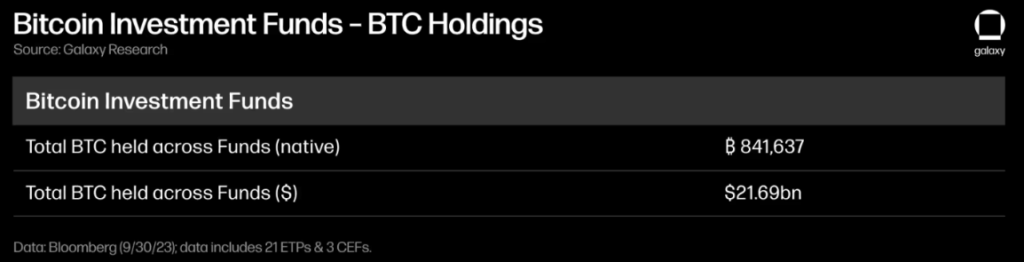
According to Galaxy’s analysts’ calculations, as of September 30, there were 841,637 BTC in ETPs and closed-end funds (~$21.69 billion).


To understand the potential significance of a spot Bitcoin ETF, one should draw a parallel with similar gold-based products, argues trader Gordon Grant. In his observations, volumes traded in ‘gold’ financial instruments have consistently risen, as have the corresponding derivatives.
According to the World Gold Council WGC, as of September 30 AUM of gold ETFs stood at ~3282 tonnes (~$197.8 billion) or ~1.7% of the gold supply. On the same date, Bitcoin products held 841,637 BTC (~$21.7 billion) or 4.3% of the total supply of issued coins.


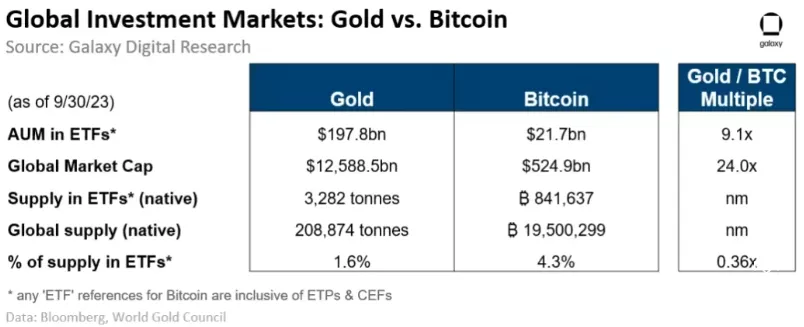
Given that gold’s market cap is about 24 times higher, and the supply of investment instruments is about 36% smaller than that of Bitcoin, analysts have allowed that dollar inflows would have 8.8 times greater impact on the digital-gold market than on the precious metals market.
Galaxy’s analysts stressed that demand for Bitcoin would be driven more by second-order effects of the product’s approval. In particular, one can expect the registration of similar ETFs in other jurisdictions and the inclusion of digital gold in various asset-management strategies.
In the long run, TAM TAM may expand to all assets managed by third parties (~$126 trillion, per McKinsey), and even more so to global wealth (~$454 trillion, per UBS).
CoinShares researcher Luke Nolan expressed confidence that spot ETFs will ease access for institutional investors to Bitcoin.
“There will be no need to worry about storing keys or seed phrases,” said the expert.
In his view, the need for bespoke crypto-security solutions will also disappear.
Nolan also noted that a spot Bitcoin ETF would affect the “distribution channels for institutional capital inflows,” easing the work of financial institutions with 401(k) retirement plans and “fund management by companies looking to include cryptocurrency in their portfolios”.
Impact on Bitcoin’s price
Many experts are building optimistic forecasts. Galaxy analysts believe that Bitcoin’s price could rise by more than 70% in the first year after the approval of a spot Bitcoin ETF in the United States.
Galaxy’s researcher Charles Yu assessed the TAM for new products at $14.4 trillion in the near term. The forecast for the future value of digital gold is based on potential inflows into exchange-traded funds, drawing parallels with similar ETFs based on precious metals.
According to Galaxy’s model, only in the first month Bitcoin’s price would rise by 6.2%.


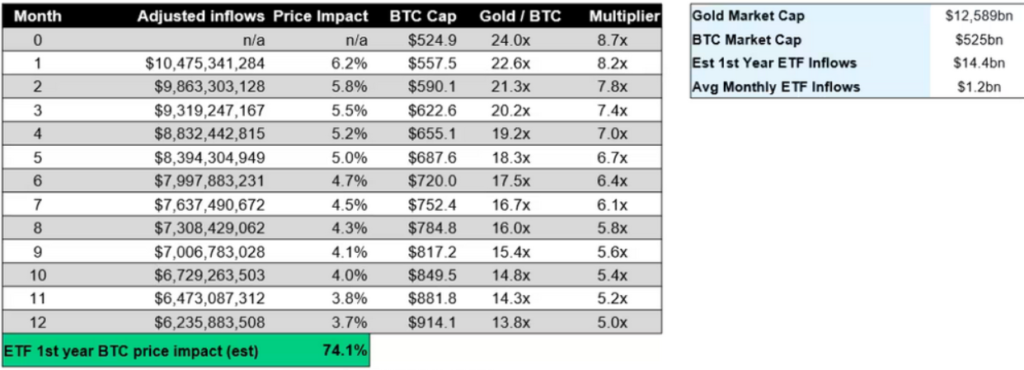
The study provides the Bitcoin price as of September 30. A 74.1% rise implies a price of $59,200 by the end of the 12th month after the launch of the first spot Bitcoin ETF. Inflows into the new product in the first year alone would amount to $14.4 billion.
As justification for his forecast, specialists cited likely inflows of $24–$50 billion from US-regulated investment advisers (RIA). This industry counts about 15,000 specialists, whose clients have entrusted about $5 trillion in capital, the report says.
The Matrixport figure of $50 billion corresponds to 1% of their AUM.
Drawing a parallel with precious-metal ETFs, whose market cap is around $120 billion, analysts suggested that at least 10% to 20% of that group would consider a digital-gold-based product to diversify inflation-growth risks. This implies inflows into the crypto market of $12–24 billion.
The appearance of such an amount in stablecoins after fiat conversion would support Bitcoin reaching $42,000. If 1% of AUM ($50 billion) is allocated — up to $56,000.
CryptoQuant analysts allow for a rise in the crypto market’s capitalization of $1 trillion if a spot Bitcoin ETF is approved in the United States.
Experts noted that the event would trigger the next wave of institutional adoption of the asset class.
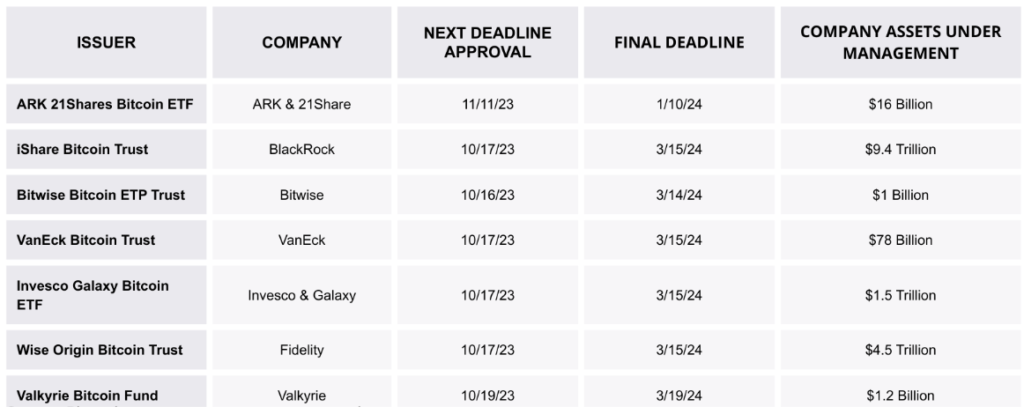
In their view, after the Ripple and Grayscale victories over the SEC the chances of such an outcome rose significantly by March 2024, when the decision deadlines arrive.


Approval of the product would bring inflows of $155 billion (about 1% of asset-managers’ AUM) into the Bitcoin market, which could lift the digital gold’s market cap by $450–$900 billion. In terms of price, that implies an increase of 82–165%, to $50,000–$73,000.
Former BitMEX CEO Arthur Hayes told Tom Bilu that by 2026 Bitcoin’s price would reach between $750,000 and $1 million.
He partly based his forecast on the prospect of spot Bitcoin ETFs being approved. Other drivers include limited issuance of digital gold and geopolitical uncertainty.
In his view, next year digital-gold prices could reach $70,000.
When will the launch?
In October, BlackRock managing director Steven Schoenfeld expressed hope that the SEC would register the first spot Bitcoin ETF within three to six months.
His colleague — former director at the investment giant Martin Brandell — suggested that the Commission would likely green-light all spot ETF applications for the first cryptocurrency at once.
“I don’t think they want to give anyone an advantage as a first mover,” said the expert.
According to Brandell, approval of spot ETFs in the United States could lead to inflows of $150–200 billion into Bitcoin products over three years.
BlackRock filed an application for a digital-gold-based investment product with the SEC on June 15. Following the giant, similar requests came from Valkyrie, Fidelity Investments, WisdomTree and Invesco.
Galaxy Digital CEO Mike Novogratz expressed confidence that the SEC would approve a spot Bitcoin ETF by the end of 2023.
The entrepreneur cited the court ruling at the end of August, which granted Grayscale Investments’ petition against the SEC for its refusal to convert GBTC into a Bitcoin ETF.
“The SEC lost in court […]. The judge said: ‘What are you talking about, SEC? You have a futures ETF [on Bitcoin], and you say there can’t be a spot one. That makes no sense.’ This puts the SEC at a disadvantage,” explained the founder of Galaxy Digital.
In October, the U.S. Court of Appeals upheld the decision that the Commission must reconsider Grayscale Investments’ application to convert GBTC into a spot ETF on Bitcoin.
The firm will list GBTC on the NYSE Arca. After the S-3 form and the separate 19b-4 filing are approved, the company will begin to issue the product on a continuing basis.
JPMorgan analysts also believe in the approval of spot Bitcoin ETFs ‘in coming months.’
“The timing of approvals … remains unclear, but this is probably set to happen … by January 10, 2024 — the final deadline for the ARK Invest and 21 Co applications. This is the earliest of the various deadlines the SEC must meet,” the document states.
Experts stressed that the Commission could approve all proposals at once to ensure fair competition.
JPMorgan also believes that the SEC faces lawsuits if it denies new products.
SEC Commissioner Hester Peirce, in a CNBC interview, emphasised that Bitcoin ETFs should have been approved five years ago.
“The logic of why we have not done this until now has always troubled me,” the official said.
The SEC official acknowledged that her views on digital assets differ significantly from the agency’s stance. According to Peirce, she “cannot predict how colleagues will approach this topic”.
A sour note
Despite a flood of optimistic forecasts, the regulator has so far only rejected or pushed back consideration of spot Bitcoin ETF applications. In September the SEC postponed decisions on filings from BlackRock, Invesco, Bitwise and Valkyrie. The new date is set for mid-January 2024.
Bloomberg equity analyst James Seiffart said he expects decisions on Fidelity, VanEck and WisdomTree to follow suit. The SEC has previously delayed review of ARK Invest and 21Shares’ spot-Bitcoin ETFs filings.
Former SEC lawyer John Reed Stark concluded that the agency will not approve a spot gold-based ETF for a number of compelling reasons. He cited Better Markets’ well-argued arguments on this matter.
In August a non-profit urged the SEC to reject all Bitcoin ETF applications, citing “potential investor risks.”
“Multiple coercive actions, bankruptcies, criminal prosecutions. Dozens of lawsuits for lies, fraud and theft. Meanwhile, the main beneficiaries of the crypto frenzy are criminals who use it to spread ransomware, launder money and engage in various other illicit activities. It is in this context that the SEC should assess the latest wave of Bitcoin-ETF applications,” said Steven Hall, the Legal Director of Better Markets.
According to the organization’s two letters, the Commission should continue to follow a cautious approach.
QCP Capital doubted the SEC’s readiness to approve a spot Bitcoin-ETF by year-end, which would leave digital gold at the mercy of macroeconomic factors. The latest discussions point to downside risks.
A former employee of the NSA and CIA Edward Snowden said that there are potential risks associated with traditional financial institutions entering the crypto market, including via Bitcoin-based exchange-traded funds.
In his view, capital inflows from traditional financial institutions could affect Bitcoin’s price. Yet large volumes would give institutions “too much power” over the asset, and ordinary users would no longer be able to influence decisions and actions concerning the coin, the former agent said.
Snowden noted that crypto ETFs, which are becoming popular among financial firms, are in fact “taming” the market for digital assets.
Conclusions
Bitcoin ETF applications have been under regulator review for years. Despite the SEC’s stubbornness, the crypto industry is developing apace, and its market capitalization exceeds $1 trillion.
Bitcoin has come a long way, becoming a powerful financial instrument. It is being invested in by public companies and even governments. Some members of the community consider the asset as a hedge against upheavals.
Prominent experts remain optimistic about the prospects for approval of a spot Bitcoin ETF in the near term. They believe the new instrument will spur institutional adoption, reduce regulatory uncertainty, and drive the price of digital gold higher.
Yet there are also many skeptics who doubt the friendliness of the SEC under hard-nosed crypto critic Gary Gensler. Some even see risks in a sizable influx of capital from traditional financial institutions.
Whether a spot ETF will appear in the United States soon or not — time will tell. One thing is certain: in 2023’s remainder and in 2024 there will be many events with meaningful implications for the crypto industry.