



Hyperliquid co-founder says CEX liquidation totals may be underreported by up to 100x
Hyperliquid’s Jeff Yan says CEX liquidation totals may be underreported by up to 100x.
Centralised exchanges (CEXs) may be materially underreporting liquidation data, warned Hyperliquid co-founder Jeff Yan. In bouts of volatility, he said, actual volumes can be up to 100 times the reported figures.
Hyperliquid’s fully onchain liquidations cannot be compared with underreported CEX liquidations
Hyperliquid is a blockchain where every order, trade, and liquidation happens onchain. Anyone can permissionlessly verify the chain’s execution, including all liquidations and their… pic.twitter.com/K5sv74LJgO
— jeff.hl (@chameleon_jeff) October 13, 2025
Yan noted that some CEXs, including Binance, disclose only one order per second even when thousands occur in that interval, citing the exchange’s public documentation. Because liquidations tend to arrive in bursts, this can severely skew the statistics.
According to CoinGlass, on 11 October positions of more than 1.6m traders worth $19.1bn were liquidated in total. However, the firm’s analysts noted the true sum was “likely much higher”, because Binance limits reporting.
By comparison, in the past 24 hours 210,930 positions worth $693.49m were forcibly closed.
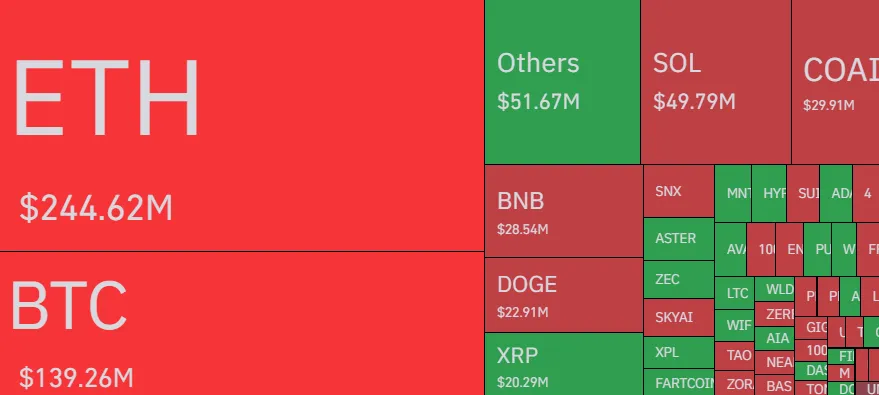
CEX troubles
During the market rout, centralised platforms ran into difficulties. Binance, in particular, faced criticism amid numerous outage reports. Co-founder of the leading CEX Yi He said the exchange’s core systems operated stably.
市场有第一类FUD:币安宕机,事实:在事件期间,币安核心合约和现货撮合引擎及API交易均保持稳定运行。经数据统计,币安平台处理的强制平仓金额占总交易量比例处于正常低位,表明本次波动主要由市场整体行情推动。… https://t.co/6zDA27B80S
— Yi He (@heyibinance) October 12, 2025
She acknowledged brief delays in “some functional modules” and price decoupling in certain products. She said the exchange paid users more than $280m in compensation.
Hyperliquid said its blockchain suffered no outages or latency despite record traffic.
During the recent market volatility, the Hyperliquid blockchain had zero downtime or latency issues despite record traffic and volumes. HyperBFT consensus and execution handled the spike in throughput gracefully.
This was an important stress test proving that Hyperliquid’s…
— Hyperliquid (@HyperliquidX) October 11, 2025
The company called it an “important stress test” that proved the reliability and scalability of its decentralised financial system.
Three causes of the sell-off
Former BitForex CEO Garrett Jin blamed the crypto-market slump on three factors: an escalating US–China trade war, overheated markets and irresponsible behaviour by crypto exchanges.
7/ But on Oct 11, the market saw extreme volatility, with many major altcoins dropping by 80%.
Some traders using just 0.2x or 0.3x leverage still got liquidated.
Can every trader sit in front of the screen 24/7 and manually close positions during chaos? Obviously not.
If…— Garrett (@GarrettBullish) October 13, 2025
Jin noted that even before the crash, technical indicators—including MACD—were flashing overbought for tech stocks and major cryptocurrencies.
The worsening US–China trade conflict darkened sentiment, prompting investors to pull capital from risk.
Crypto prices and US tech stocks have historically moved in tandem, he said, allowing stress to spill from one to the other ahead of the plunge.
The rout was driven not only by macro forces but by internal fragility. Equity and crypto markets were crowded with leveraged longs, creating conditions for a crisis reminiscent of the US stock-market crash in March 2020.
According to Jin, unlike equities, most cryptocurrencies lack intrinsic value and depend on investor sentiment. Exchanges offering 5x–100x leverage on such volatile assets foment liquidity crises.
He recalled that during the 11 October panic many altcoins fell by 80%. Liquidations hit even traders with minimal 0.2x–0.3x leverage. Not everyone can sit in front of a screen around the clock to close positions manually, he stressed.
In Jin’s view, the problem is that exchanges dangle high leverage to boost profits while shirking responsibility.
To restore trust and foster healthier growth, exchanges should set up stabilisation funds, he argued, akin to stock‑market mechanisms in the United States that can supply liquidity during crises.
The “insider whale”
Jin is allegedly the mysterious whale on Hyperliquid, according to an investigation by on-chain sleuth Eye.
1/ An investigation into the alleged identity of the mysterious Hyperliquid/Hyperunit whale, who holds over 100,000 BTC. Recently, he sold over $4.23B in BTC to acquire ETH and is the same person behind the $735M BTC short order placed on the same platform. pic.twitter.com/WeNvmiYP8v
— Eye (@eyeonchains) October 11, 2025
The trader opened a 10x‑levered perpetual short on bitcoin on the DEX. The position will be liquidated if bitcoin reaches $125,500.
Attention focused on the user after prior trades. He made $192m by opening a short 30 minutes before Donald Trump’s tariff announcement, which sent markets tumbling. The community dubbed him the “insider whale”.
Eye presented a transaction analysis. The whale’s wallet received fee funds from an address linked to the ENS ereignis.eth. That name, in turn, is associated with garrettjin.eth, which points to Jin’s X account.
The former BitForex CEO denied the claims. Binance founder Changpeng Zhao reposted the investigation. In response, Jin said he had no connection with the Trump family and that this was not insider trading.
Hi @cz_binance, thanks for sharing my personal and private information. To clarify, I have no connection with the Trump family or @DonaldJTrumpJr — this isn’t insider trading.
— Garrett (@GarrettBullish) October 13, 2025
On 13 October, bitcoin rebounded above $115,000, and Ethereum rose to $4,190.
Рассылки ForkLog: держите руку на пульсе биткоин-индустрии!