




Layer-2 scaling solutions (L2) are rapidly evolving, and competition between projects is heating up.
L2 technologies significantly speed up and reduce the cost of transactions, without sacrificing decentralisation. This is particularly relevant amid high Ethereum fees, which are pushing more users to alternative DeFi platforms such as Fantom, Avalanche and Binance Smart Chain.
ForkLog has examined the features of Layer-2 solution Optimistic Rollups, weighed the advantages and drawbacks of the technology, and assessed the prospects for Ethereum’s scalability.
- Projects built on Optimistic Rollups hold strong positions in the L2 solutions segment, but competition is growing.
- Metis Andromeda and Boba Network have demonstrated impressive growth in TVL in a short period.
- With the launch of Ethereum 2.0, Layer-2 solutions will not lose relevance, but will dramatically increase the efficiency of the new blockchain system.
State of Play in the L2 Segment
According to data from L2BEAT, the aggregate liquidity in L2 protocols exceeds $5 billion. This is not a large figure compared with the total DeFi TVL (~$190 billion). However, there is a clear growth trend as second‑layer solutions mature and Ethereum’s scaling dilemma remains pressing.


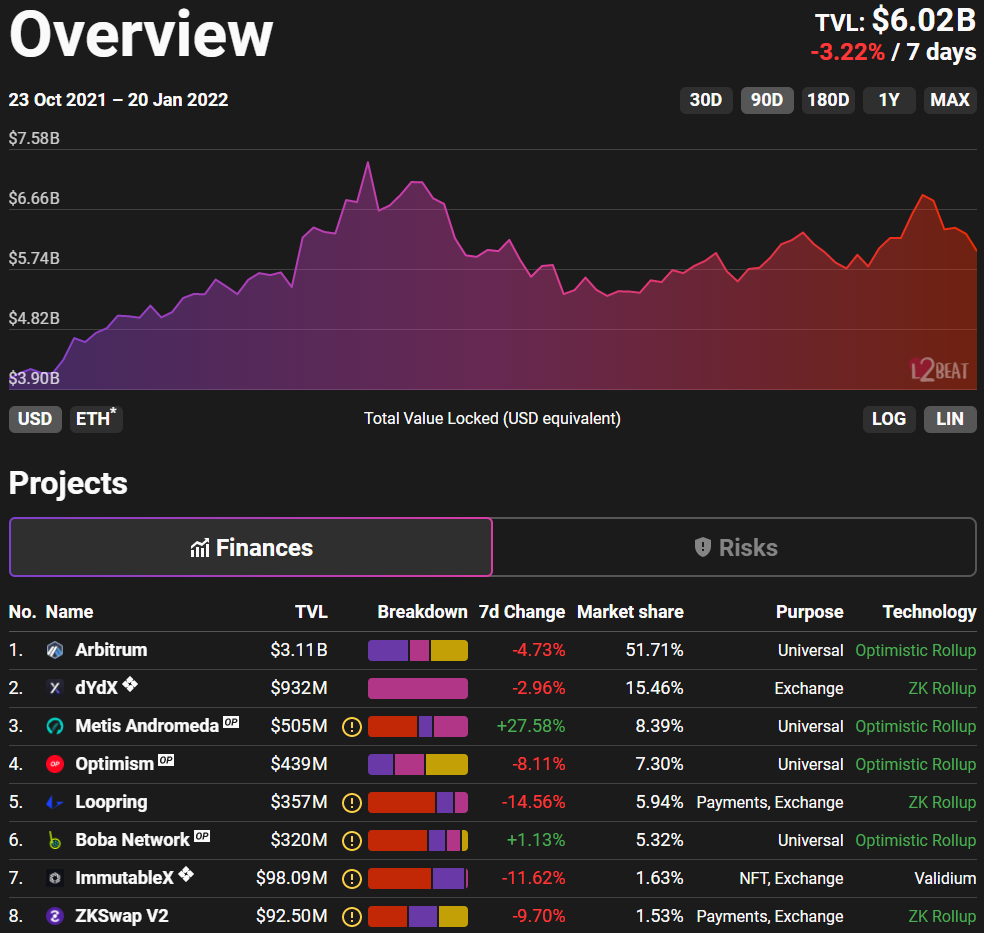
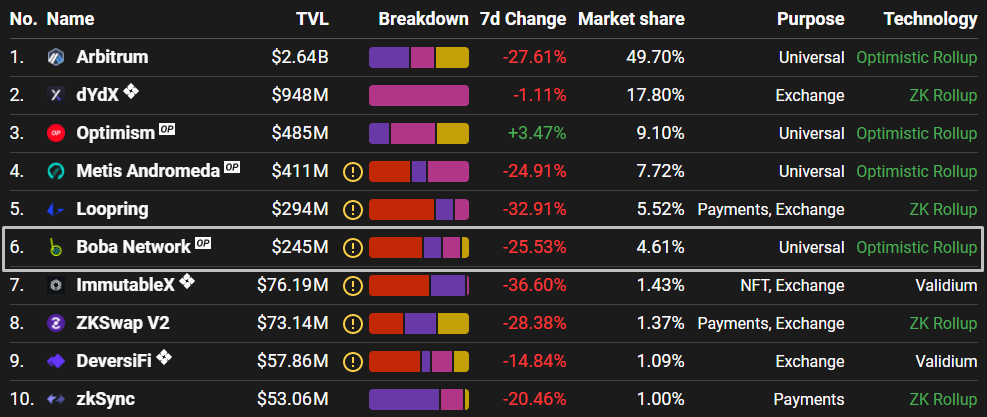
In the L2 segment, Arbitrum leads by a wide margin, though technically similar platforms — Metis Andromeda, Optimism and Boba Network — are gaining momentum.
Upright position is also held by ZK-Rollups-based solutions — technology on which Vitalik Buterin places his hopes.
Below is a screenshot showing the difference in transaction costs between Ethereum and various Layer-2 solutions.


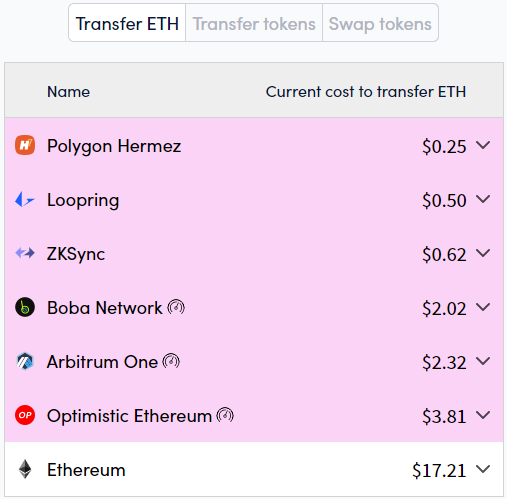
Polygon Hermez, Loopring and ZKSync on ZK-Rollups offer users the lowest transaction costs.
Early pioneers of the L2 space — Optimistic Ethereum and Arbitrum One — are not the cheapest options, despite higher TVL. Costs are substantially lower on Boba Network.
Earlier we discussed the features of Arbitrum and outlined two main approaches to solving Ethereum’s scaling problem. In this article we take a closer look at other Optimistic Rollup projects and try to uncover the secret of their popularity.
Optimism
The Optimism team was the first to develop an EVM-compatible solution based on Optimistic Rollups. The system runs atop Ethereum and can efficiently process transactions, inheriting the high degree of security and decentralisation of the second-largest cryptocurrency by market cap.
Rollups reduce network load by grouping transactions and moving part of the computation off-chain. There are two main types of Rollups: ZK-Rollups and Optimistic Rollups (OR). In the former, cryptographic proofs (SNARKs) are generated and used to commit transactions to the blockchain and reconcile states of the base chain and the Layer-2 chain.
Optimistic rollups rely on fraud proofs. Without performing any computations by default, they “optimistically” assume the data published on-chain is valid unless proven otherwise.
“Because computations are the slow and costly part of using Ethereum, Optimistic rollups can offer scalability improvements of about 10–100x, depending on transaction types. That figure could rise even further with the introduction of shards, since more data will be available if a transaction is challenged,” as explained on the Ethereum.org site.
Optimism employs two types of nodes — sequencers and verifiers.Transactions sent by users to the Layer-2 network are collected by sequencers. The latter cryptographically sign the commitment to execute the received transaction exactly as written.
Verifiers can dispute the validity of the transaction proposals submitted by sequencers. After that, the Rollup conducts the corresponding checks and computations using available state data.
If it turns out that a proposal is fraudulent, the verifier receives a reward, and the sequencer is punished — slashed.
“Anyone who can take actions that will need proving to protect their funds should stake. You basically take some ETH, lock it up and say: ‘Hey, I promise to tell the truth… If I don’t tell the truth and fraud is proven, this money will be slashed,’ — explained Optimism co‑founder Ben Jones.
According to him, part of these funds will go to paying the gas that ecosystem participants spent on proving fraud.
Thus, the incentives are as follows: participants face penalties for misconduct and rewards for fraud proofs.
To optimise the operation of the system and further cut gas costs, transactional data are written to the main Ethereum network as calldata.
In 2021 the Optimism team donated $1 million to support open-source projects on Ethereum.
Advantages and Disadvantages of Optimism
Among Optimism’s main advantages are:
- EVM compatibility;
- a high degree of data security;
- fast and inexpensive transactions.


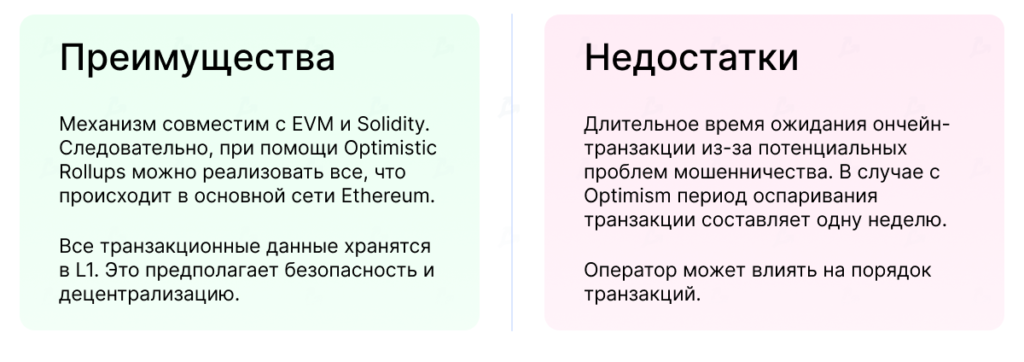
EVM compatibility means seamless integration — developers can deploy any Ethereum-based dApp to Optimism without significant changes to its architecture.
In October Optimism announced a shift toward the concept of “EVM equivalence”.
“EVM equivalence — full alignment with the Ethereum Virtual Machine specifications — will become the new universal standard in the L2 space,” the developers emphasised.
Unlike sidechains like Ronin, which operate independently and rely on their own security approaches, Optimism and similar solutions rely on Ethereum. Transactions are processed on L2, but their data are recorded and stored on the main chain.
As noted, Optimism helps users cut gas costs significantly. Transactions are processed almost instantly.
One major drawback of Optimism: due to how fraud proofs operate, withdrawing funds via the official bridge Optimism bridge can take a week.
Once a withdrawal transaction is issued, it cannot be cancelled — users must wait seven days for their ETH to arrive. In addition, withdrawal costs can reach $100 or more, depending on gas costs on Ethereum.
Fortunately, there are cross-chain bridges from external projects like Hop Exchange and cBridge, enabling quick transfers between networks at modest cost.
The Optimism network relies on the incentives of verifiers to dispute fraudulent proposals and on the proper functioning of sequencers.
“If the number of fraudulent proposals is small or non-existent, verifiers earn less, or even nothing, for maintaining the node,” explained the analytics firm Nansen.
According to them, such a situation reduces verifiers’ motivation to participate actively in the ecosystem.
If there are no verifiers, sequencers could, at their discretion, push fraudulent transactions, risking a network failure. However, Nansen believes such a scenario is unlikely.
Additionally, a sequencer could attempt to bribe Ethereum miners to allow fraudulent proposals to pass computational checks at very low cost.
“Such a situation could lead to a complete loss of trust in the network and its eventual breakdown,” the analytics firm warned.
Differences Between Optimism and Arbitrum
The Optimism team was the first to create an EVM‑compatible protocol on Optimistic Rollups, but launching the mainnet was delayed several times. Arbitrum took advantage of that early-mover gap.
For example, the Uniswap team planned to launch on Optimism soon after Uniswap v3 release.
While waiting for Uniswap on Optimism, the exchange community “>endorsed integrating Arbitrum.
Optimism and Arbitrum are similar in many respects. Their key difference lies in the logic of “fraud proofs.”
Optimism uses a non‑interactive approach to fraud proofs, where verification requires re‑executing the entire transaction and corresponding computations on Layer 1. Arbitrum uses an interactive approach in the context of fraud proofs, where the verification checks are performed only for a specific step.
The non‑interactive approach offers simplicity of implementation and faster execution by avoiding the need to coordinate actions among ecosystem participants.
In terms of EVM, Optimism places more reliance on EVM than Arbitrum. When a fraud proof is offered, the entire transaction passes through the Ethereum Virtual Machine. For Arbitrum, the dispute resolution happens off‑chain, after which a one‑step assertion is posted to the EVM for final verification.
As part of the push toward EVM equivalence, developers at Optimism plan to move to an interactive fraud‑proof model and to push for greater decentralisation.
“The difference between EVM equivalence and EVM compatibility is that, in the former, processing occurs on the EVM, while in the latter it occurs on a compatible VM like Arbitrum Virtual Machine, much as is happening today with Arbitrum,” explained a Nansen blog post.
There is even talk that Optimism may, in the future, be supported on centralised exchanges such as Binance and Huobi. The ability to move funds from a CEX directly into the ecosystem, without bridges, could further lift its TVL.
According to DeFi Llama, Arbitrum supports 53 dapps (as of 23.01.2022), while Optimism supports only 19 applications. Moreover, more than 40% of the ecosystem’s total TVL is attributed to Synthetics, which was among the first to integrate Optimistic Ethereum.
Notably, the difference between the projects extends beyond TVL and supported platforms — the daily transaction count on Arbitrum is roughly 17 times higher than on Optimism.


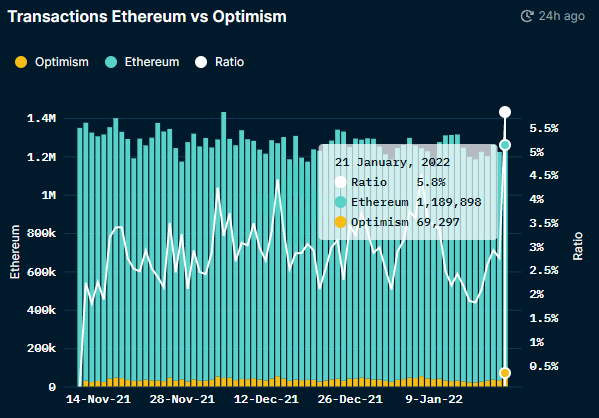
In the future one might expect the gap to close as more protocols plan to support Optimism. In addition, the project team recently dropped the concept of a “white list” and opened access to all developers.
Previously, interaction with Optimism was limited to authorised projects such as Uniswap and Synthetix. The developers said the restriction was necessary for testing, as a small number of teams made planning and deployment easier. Representatives of authorised projects, in turn, were always in touch and promptly reported bugs.
As with Arbitrum, Optimism has not yet announced plans to release a native token.
Metis Andromeda
For a long time, Arbitrum and Optimism competed mainly with each other for leadership among Optimistic Rollup projects. Then a new player appeared on the horizon — Metis Andromeda.
The TVL of this project grew more than 200x in less than a month — from $1.6 million (28.12.2021) to $335.6 million (21.01.2022).


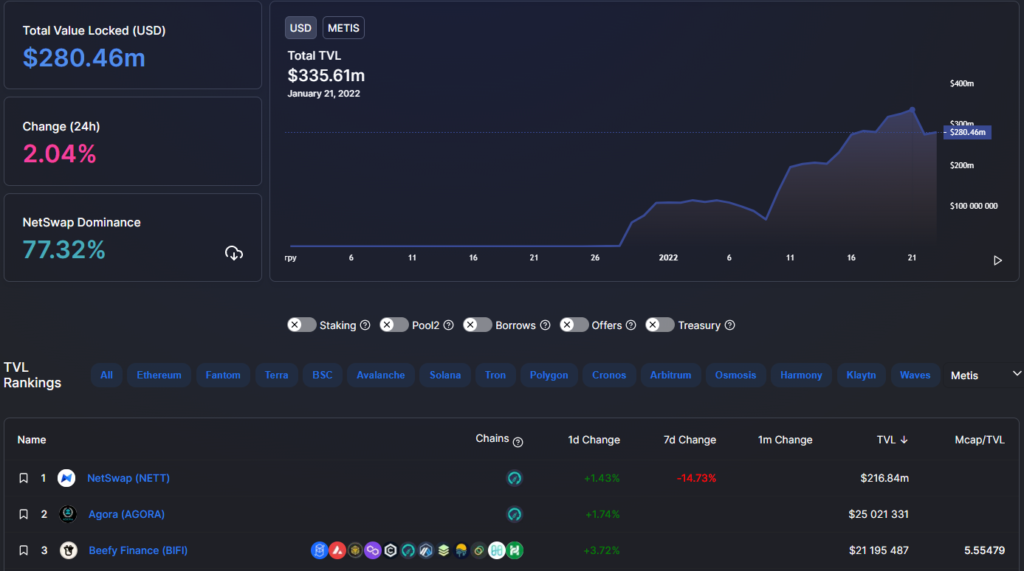
The growth was driven by the rise of the native METIS token and numerous integrations. Recently, Beefy Finance and Pickle added support for the new network.
Above, the lion’s share of TVL is held by NetSwap, a Uniswap fork. It’s likely that the popularity of this DEX owes much to the NETT token airdrop for early adopters.
Launched in 2018, Metis positions itself as a faster, more efficient version of Optimism. Its founders are Elena Sinelnikova, also known for CryptoChicks, Kevin Liu and Yuan Su. The METIS token was released in 2020.
Metis Andromeda is an EVM‑compatible platform. It is built on a fork of the Optimism Virtual Machine named Metis Virtual Machine (MVM).
As with other Optimistic Rollup solutions, Metis uses sequencers to order and “pack” transactions before sending final state changes to the main Ethereum network.
A notable feature of Metis Andromeda is that many sequencers are grouped into on‑chain structures called Decentralized Autonomous Companies (DACs). In each block the protocol randomly selects a new sequencer from a DAC to submit a state change to the mainnet.
DACs are in essence similar to DAOs. Metis positions them as on‑chain organisations that enable users to collaborate and take certain actions in the ecosystem (for example, to launch a sequencer pool or a new application on the MVM). To validate transaction packages, sequencers must stake METIS.
Users can also act as “Rangers” who monitor sequencer activity. If fraud proofs are verified, Rangers receive rewards in METIS, and sequencers are slashed.
Key features of Metis include:
- IPFS integration for cheap and confidential data storage;
- fast verification during state changes thanks to the use of “Rangers”;
- Polis Middleware — software to simplify launching and porting apps from Web 2.0 to Web 3.0;
- the ability to launch new execution layers for DACs, aimed at scaling;
- configurable access levels to the MVM.
In addition to the near-instant and low-cost transactions typical of OR solutions, Metis Andromeda offers faster withdrawals to Ethereum thanks to a redesigned fraud‑detection system using “Rangers,” reducing state-change confirmation times from days to hours.
TVL of Metis Andromeda is comparable to Optimism — $411 million and $485 million respectively (data from L2BEAT as of 24.01.2022).
Boba Network
This is another Optimistic Rollups protocol, whose popularity is boosted by a token airdrop of BOBA for OMG Network holders.
The mainnet for Boba Network launched on 20 September 2021. The platform is developed by Enya, a participant in OMG Foundation.
The protocol runs on Optimism. However, as its founder Alan Chiou noted, withdrawals to Ethereum occur within minutes.
“We have a feature called Hybrid Compute that lets developers build advanced algorithms that would be too expensive to run on-chain,” Chiou said.
He added that Solidity, Ethereum’s native language, significantly constrains DeFi developers, many of whom “had to simplify their algorithms.”
Chiou noted that the protocol is also oriented toward NFT use cases.
TVL of the Boba Network stands at $245 million (as of 24.01.2022).


Advantages of Modular Architectures
Blockchains face a challenge known as the “scalability trilemma.” It is hard to build a system that is simultaneously fast, decentralised and secure. Developers often have to pick and optimise at most two of the three.


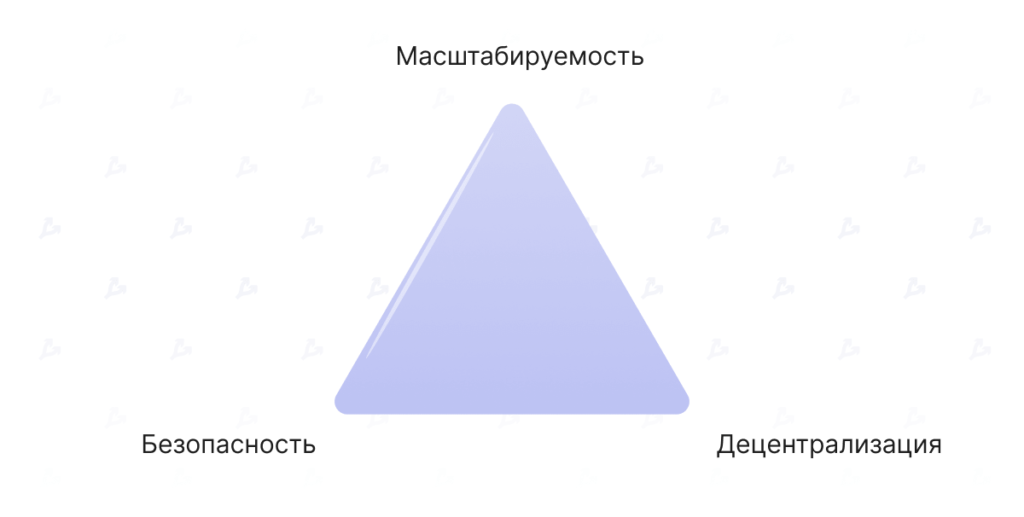
Analysts at Nansen believe that the ETH 2.0 rollout and the transition from Proof-of-Work to Proof-of-Stake is just the “tip of the iceberg” in resolving the above trilemma.
“The real end goal is to create a completely new framework for scaling that moves from monolithic blockchains to modular ones,” the experts emphasised.
In monolithic systems all computations are performed in a single network. Following a recent Solana outage, some in the community questioned the viability of monolithic structures.
Solana being down for 48 hours multiple times now makes me question the viability of a monolithic structure.
It’s clear the winning blockchain of the future will likely be one with a modular architecture.
Bullish $ETH 2.0 🚀 & Cosmos Ecosystem.
— Daniel Cheung (@HighCoinviction) January 22, 2022
“The leading blockchain of the future is likely to be modular in architecture. Bullish on ETH 2.0 and the Cosmos ecosystem,” wrote investor Daniel Chun.
Modular blockchains split systems into layers for execution, security and data availability. Each layer sits atop another, performing a dedicated role.
In Ethereum, L1 handles security and data availability, while L2 built on top handles transaction execution.


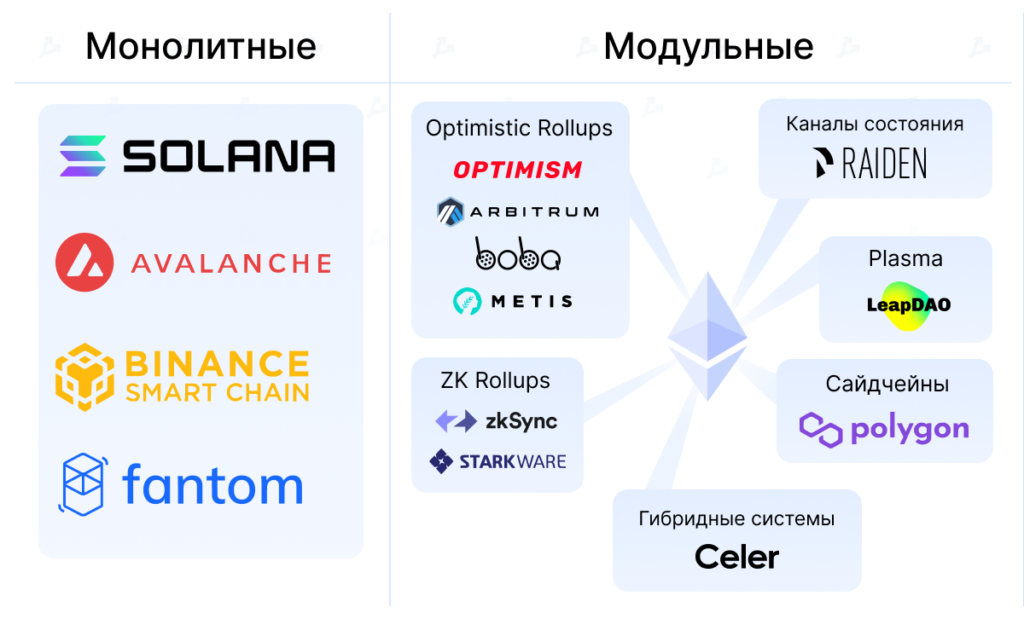
The base Ethereum layer can currently process roughly 15 TPS. Layer-2s can significantly raise this figure — up to 2,000–4,000 TPS.
Layer-2 solutions could indeed coexist with sharding in Ethereum 2.0, potentially enabling thousands or even millions of transactions per second in the future.
“When Phase 1 arrives and Rollups move into the Eth2 ecosystem with data sharding, we will reach a theoretical maximum of around 100,000 TPS,” reads Vitalik Buterin’s statement in “Rollup‑centric Ethereum Roadmap”.
Buterin is convinced that Rollups are the key to Ethereum’s scalability not only in the near and medium term but also in the long term. Cross‑chain bridges should facilitate seamless interaction between different blockchain ecosystems and L2 solutions.
Conclusions
Optimistic Rollup solutions are developing rapidly, offering users fast and inexpensive transactions and providing developers with easy integration and a wide range of use cases thanks to EVM compatibility.
Arbitrum and Optimism remain leaders, continuing to develop toward higher throughput and greater decentralisation.
New protocols — Metis Andromeda and Boba Network — are gaining traction with faster withdrawals enabled by revised fraud-proof approaches. Both projects have native tokens whose prices have closely tracked TVL growth.
With Ethereum 2.0, Rollups will not lose their relevance but will be able to expand significantly thanks to sharding. Given DeFi’s pace and related NFT, DAO, GameFi and metaverse activity, L2 solutions will play a crucial role for many projects and the crypto industry at large.
Market participants can be confident that competition between monolithic and modular systems will only benefit the sector.
Subscribe to ForkLog on YouTube channel at YouTube!