



By the close on 29 October, spot exchange-traded funds based on Solana drew $47.9 million. Cumulative inflows since launch have exceeded $117 million.


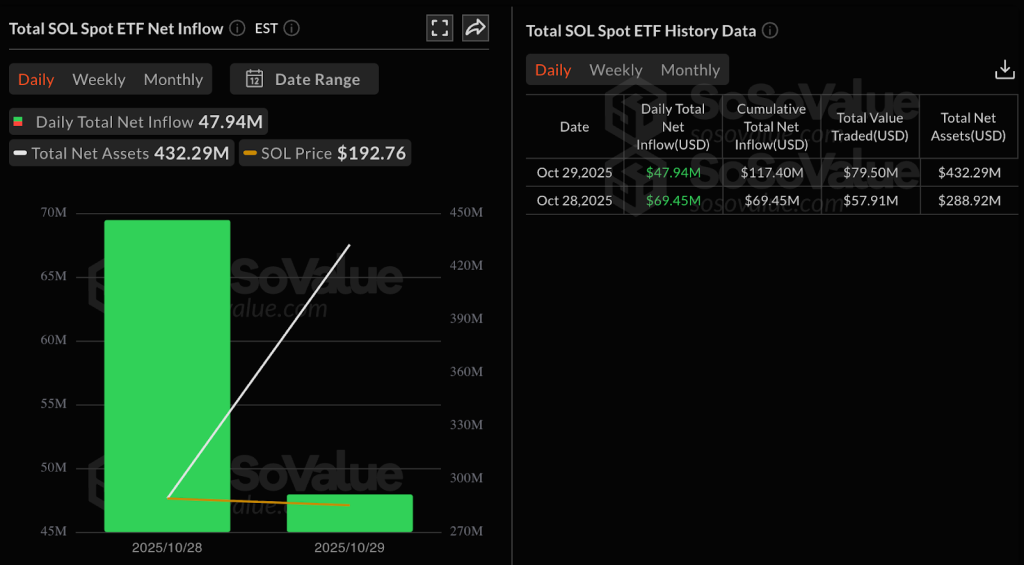
Most of the intake went to Bitwise’s SOL ETF (BSOL) — $116 million. The product launched a little earlier than the rival from Grayscale (GSOL), whose AUM is currently just $1.4 million.
According to Bloomberg ETF analyst Eric Balchunas, BSOL’s day-two trading volume reached $72 million. He called the result “a huge number” and “a good sign.”
$BSOL did more volume on Day Two.. $72m is a huge number. Good sign. pic.twitter.com/KpTbiQxZnv
— Eric Balchunas (@EricBalchunas) October 29, 2025
GSOL’s figure was $4 million, he added.
The two funds’ combined assets amount to $432 million.
When could Solana hit a new ATH?
Ahead of the launch of spot Solana ETFs, many analysts expected SOL to rally. In August, Matt Hougan of Bitwise predicted the debut would propel the token to a new all-time high.
MEXC Research’s chief analyst Shawn Yang noted the cryptocurrency would reach $250 by year-end. Among additional drivers, he highlighted the Alpenglow upgrade.
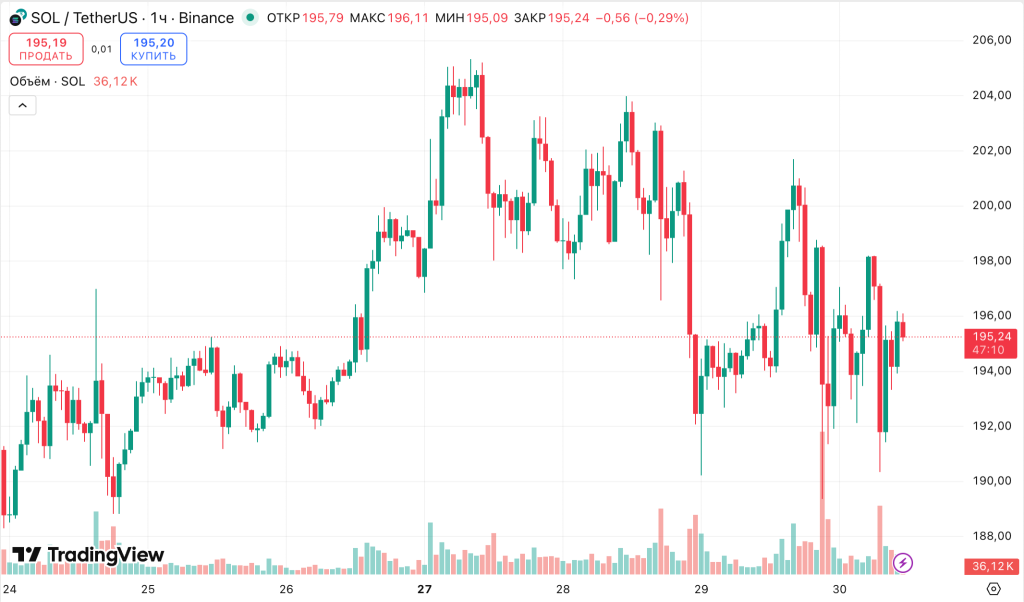
So far, Solana has shown little price reaction. Over the past week the coin has risen 4.4%, and 0.1% in the past day. At the time of writing, SOL trades around $195.


Analysts at Hyblock told Cointelegraph they see a parallel with bitcoin’s behaviour after spot BTC ETFs launched in January 2024:
“A similar pattern was observed then. Despite rising inflows, the price of the first cryptocurrency stayed in a sideways range and fell by about 5%. A breakout followed, however — inflows surged, which became the turning point for the price of digital gold.”
The experts suggested Solana is going through the same phase, with the initial hype fading. They do not see the situation as alarming: “this is quite expected when such significant financial instruments launch,” they added.
Market participants remain optimistic about SOL’s prospects. An analyst going by NekoZ called the altcoin’s current chart “incredibly bullish.”
SOLANA (SOL) BULL RUN INCOMING ?$SOL chart looking incredibly bullish right now.
We’ve broken out of the down trend line and seem to be confirming the start of a massive Elliott Wave 5-step impulse move!
If we hold $194 (Support), the path to the $295 Resistance and… pic.twitter.com/ooPBVGiUXQ
— NekoZ (@NekozTek) October 29, 2025
“We broke through the downward trendline and appear to be confirming the start of a major impulse move. If $194 support holds, the path opens to resistance at $295 and, in time, to levels above $400,” he forecast.
According to bitcoin trader HODL GENTLEMAN, the nearest resistance sits at the psychological $200 level. A close above would open the way toward $210.
Otherwise, a retest of $190 support is possible, he stressed.
An analyst under the pseudonym EtherNasyonaL noted that “Solana is caught between two key levels: resistance at the 2021 all-time high and an uptrend that has been forming in recent years.”
$SOL 🔃
Solana is sandwiched between the nearly 4-year resistance level of 2021’s ATH and the approaching 3-year uptrend.
A squeeze lasting this long typically ends not with a minor breakout but with a major blowout. pic.twitter.com/SRV16y8dXW
— EᴛʜᴇʀNᴀꜱʏᴏɴᴀL 💹🧲 (@EtherNasyonaL) October 29, 2025
“A squeeze lasting this long typically ends not with a minor breakout but with a major blowout,” he commented.
Other ETFs
Bitcoin-based ETFs recorded $470 million of outflows.
The largest came from Fidelity’s FBTC, which saw $164 million withdrawn. It was followed by ARK Invest’s ARKB (-$143 million) and BlackRock’s IBIT (-$88 million).


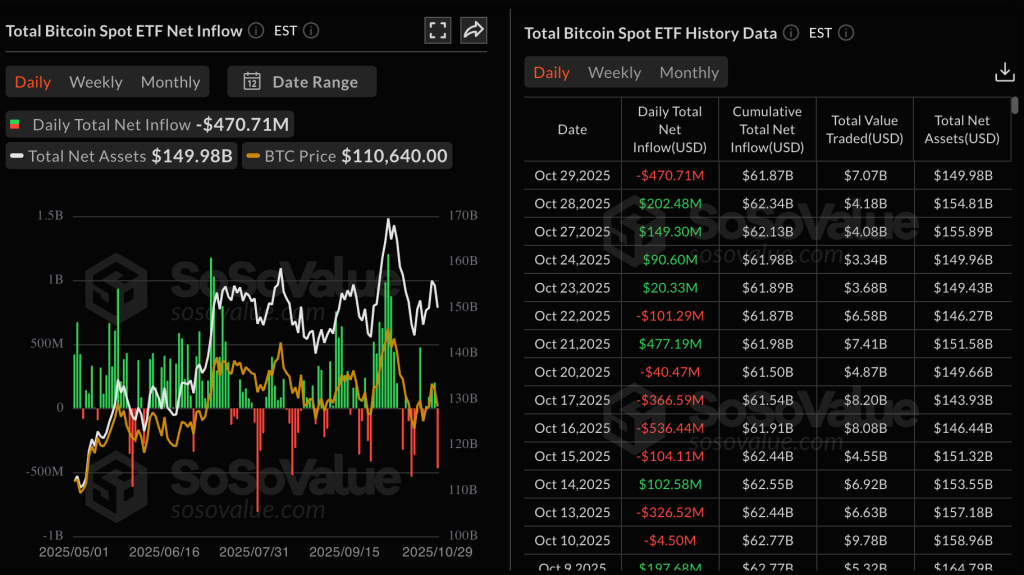
Total net inflows declined to $61 billion, with assets under management down to $149 billion.
Ethereum ETFs saw $81 million of outflows. The biggest losses were recorded by Fidelity’s FETH (-$69 million), Grayscale’s ETH (-$16 million) and VanEck’s ETHV (-$4 million).


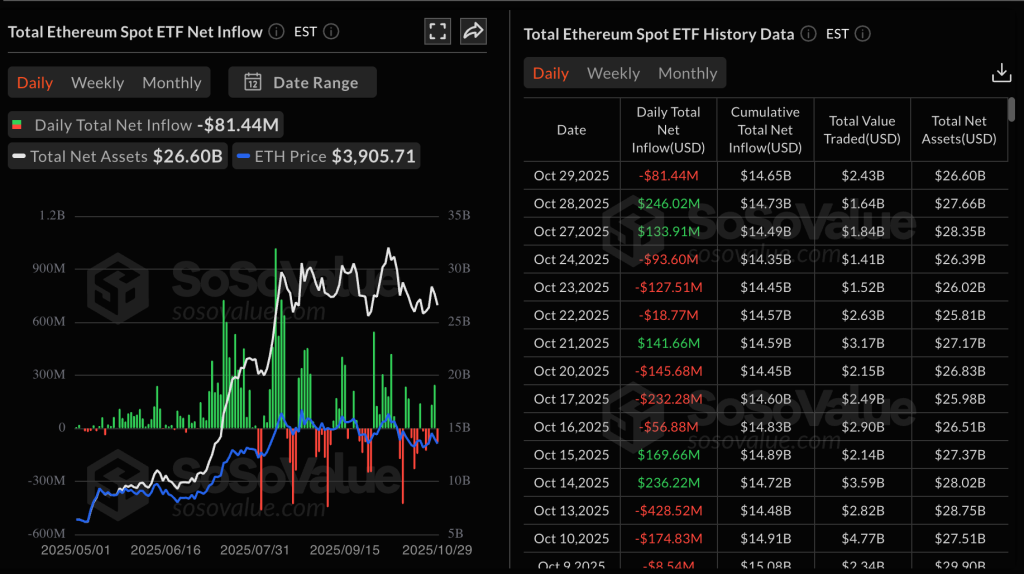
Net inflows since launch stand at $14.6 billion. Issuers manage $26 billion in assets.
At the time of writing, bitcoin and Ethereum trade around $110,000 and $3,900, respectively, according to CoinGecko.
Earlier, Martin Hiesboeck, head of blockchain research at Uphold, said the era of self-custodying digital gold was ending. In his words, large players are increasingly opting for ETFs.