




After the exodus of miners from China, the Bitcoin network’s carbon emissions rose by 17%, rather than decreasing as some experts claimed. The data come from a study published in Joule.
According to CCAF, in May 2021 China’s share of the hash rate of the leading cryptocurrency stood at 44%. In August the figure fell to zero, and the United States moved into the lead. Kazakhstan, Canada and Russia notably boosted their shares.
Many experts argued that the migration of miners from the PRC made the Bitcoin network more decentralised and environmentally friendly. In June, the founder of the BTC.TOP pool, Jiang Zhuoer, said that more than half of the hash rate is generated from renewable energy.
According to Bitcoin Mining Council, the share of green energy in global mining of digital gold reached 56%. However, the crypto community questioned the organization’s findings.
Authors of the study “Rethinking Bitcoin’s Carbon Footprint” confirmed the scepticism — the share of renewable energy fell from 41.6% in 2020 to 25.1% in August 2021.


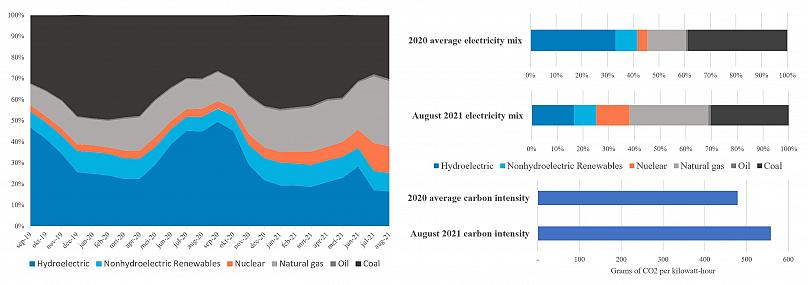
The researchers concluded that miners in China were more oriented toward green electricity than most leading industry participants today.
“Many miners had access to hydroelectric power; now it has been replaced by natural gas (in the United States). Moreover, coal-fired electricity in Kazakhstan is dirtier than in China. Overall, this has made mining more carbon-intensive than before,” explained one of the report’s authors, Alex de Vries of Vrije Universiteit Amsterdam.
As of August 2021, Bitcoin’s annual CO2 emissions stood at 65.4 megatonnes, roughly on a par with Greece’s footprint. The largest contributions came from miners in Kazakhstan and the United States.

In de Vries’s view, even a ban on mining across all countries is not a solution. The decentralised nature of cryptocurrencies would lead people to install equipment at home, the researcher noted.
A possible way out would be to subsidise the use of renewable energy. However, he believes this would be difficult to implement.
Swedish regulators have called for an EU-wide ban on Bitcoin mining and other Proof-of-Work-based cryptocurrencies.
Similar proposals also surfaced at the regulatory level of the EU itself, from the head of Hungary’s central bank, and in the United States—from the candidate for governor of New York state.