



Bitcoin mining in 2021: China’s ban reshaped the balance of power
The Chinese ban on mining propelled the United States to the forefront of Bitcoin’s hashrate; miners’ revenues hit new records, though the industry was also grappling with a semiconductor shortage. We look back at what 2021 meant for the mining sector.
Key takeaways
- China banned mining and yielded leadership to the United States.
- Manufacturers of mining equipment posted record revenues, but global chip shortages affected their operations.
- A new player on the map — El Salvador began mining digital gold, but geothermal-energy usage found less than universal support.
China bans mining
In late May stated the authorities’ intention to take measures regarding mining cryptocurrencies and Bitcoin trading. He urged regulators to support the real economy and impose tougher oversight of the crypto industry.
Almost unprecedentedly for someone of such high rank, a direct proposal to ban mining operations was made. Environmental considerations — Beijing aims for carbon neutrality by 2060 — could be decisive for China.
According to one of the studies from April, mining farms located in China could over a three-year horizon surpass the Philippines in greenhouse-gas emissions. The researchers argued the industry would rise to 10th place in energy consumption and CO2 emissions, leaving behind the largest Chinese cities and a number of leading industrial regions, including electronics manufacturing.
“Mining is not counted anywhere as a separate source of carbon dioxide, which complicates the assessment of its impact on the carbon budget of the PRC. Policymakers should address this problem as soon as possible,” — noted the researchers at the time.
They proposed restricting Bitcoin mining at least in regions where coal-fired TES plants are the main source of electricity.
Following Liu He’s statement, the official government news agency Xinhua released a piece criticizing Bitcoin and mining. There was a first industry reaction — according to media, the BTC.TOP pool and HashCow decided to halt operations in China.
There were signs of hashrate migrating outside the country as well.
In early June authorities in the provinces Xinjiang and Qinghai ordered local mining companies to halt operations. Restrictions were also imposed in Yunnan.
In the autonomous region of Inner Mongolia the crackdown on mining began even before the deputy premier’s statement.
In Sichuan miners were ordered to stop by 20 June and local energy companies were prohibited from supplying them electricity.
Chinese miners traditionally migrated to Sichuan during the “high-water” period, which usually lasts from May to October. At the start of the month officials organized a seminar with Bitcoin miners to discuss the scale of mining and the use of surplus electricity in the event of a crypto ban. According to participants, the meeting went positively. After it, authorities told miners they would be allowed to operate until September, but the decision was later reversed.
By mid-July 90% of mining capacity in China had been shut down. The main relocation destinations were the United States, Canada and Kazakhstan.
The United States leads Bitcoin hashrate share
According to the Cambridge Centre for Alternative Finance (CCAF), in August the United States displaced China from the top position in the amount of computational power in the Bitcoin network. Since May the US share in total hashrate has grown from 17.8% to 35.4%.

During the same period other countries also expanded their shares notably. Kazakhstan’s share rose from 7.4% to 18.1%, and Canada’s from 4.7% to 9.6%.
Russia’s relative share rose less, from 7.2% to 11.2%, but the country retained third place in the ranking.
CCAF researchers noted that China’s dominance ended even before the open crackdown on mining began. By March its hashrate had fallen to less than half of the total for the first time.
Kazakhstan, amid a flood of miners, began experiencing electricity shortages, and by year-end players started leaving the country .
In Russia, applications were received to host 1.08 million ASIC miners .
In November the Foundry USA pool briefly topped the hashrate chart. At one point its share reached 21%.
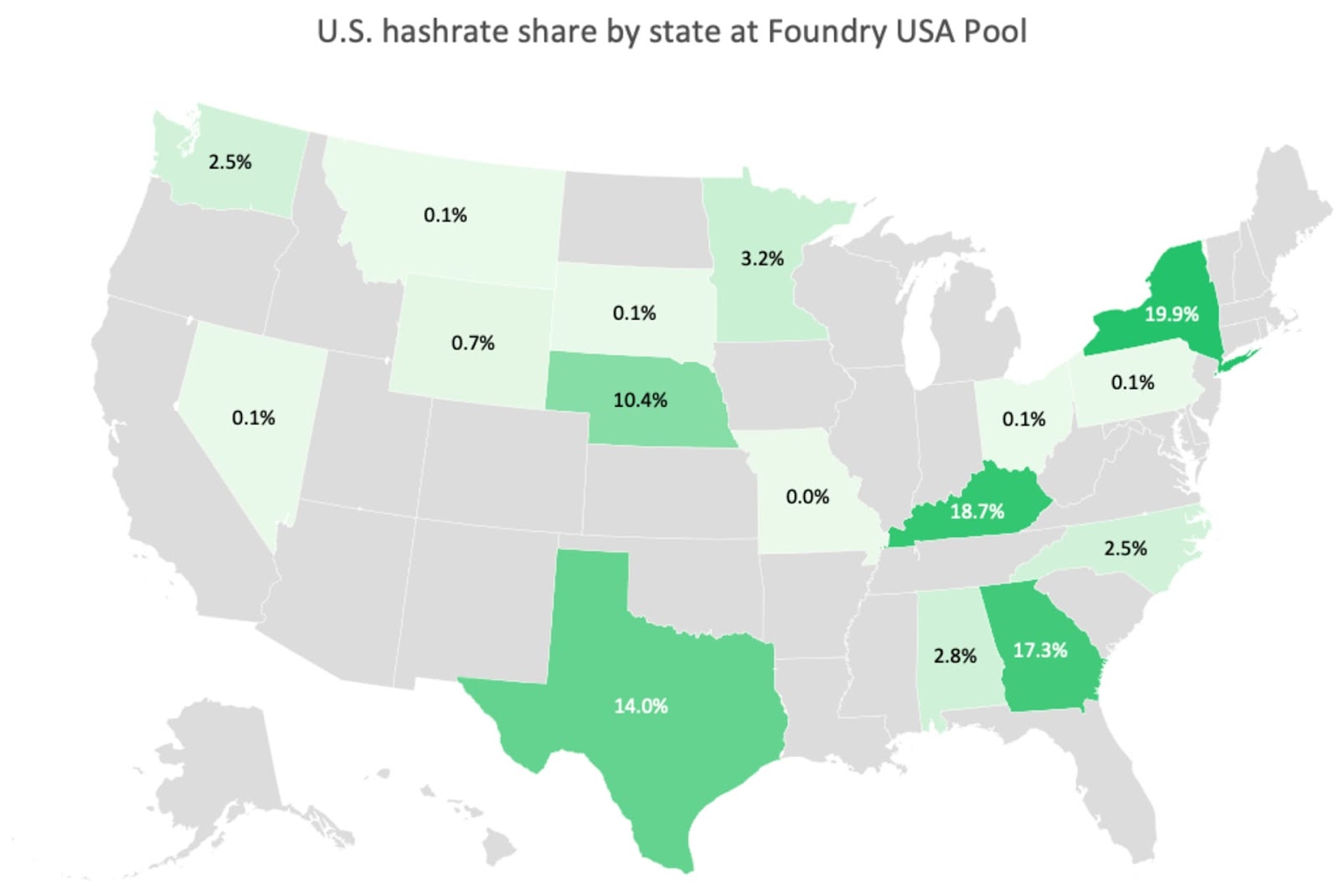
According to data from CNBC on Foundry USA, 19.9% of the pool’s computing power is in New York, 18.7% in Kentucky, 17.3% in Georgia and 14% in Texas. A co-author of the 연구 for the firm — Nick Carter of Castle Island Ventures — noted that this is not a complete picture of the US landscape. For instance, in Texas one of the largest publicly traded miners, Riot Blockchain, operates, but it is not a Foundry client and thus not reflected in the figures.
The emergence of a large number of publicly traded or SPAC-listed miners became one of the consequences of increased mining activity in North America.
Some chose an IPO path, including Northern Data, Stronghold Digital Mining or Rhodium Enterprises; others chose SPAC deals. Among the latter: Cipher Mining Technologies, Gryphon Digital Mining, Core Scientific, Greenidge Generation, Prime Blockchain (PrimeBlock), GRIID and TeraWulf. And Iris Energy preferred a direct listing.
The status of a public company eases access to financing, including from institutional investors. For example, the Nasdaq-listed Marathon Digital Holdings raised $250 million at the start of the year via an equity offering. In November the firm placed convertible bonds worth $500 million. Portfolios in the company are owned by investment giants such as Fidelity Investments, Vanguard Group and BlackRock.
Investments were actively attracting private miners as well. In July Genesis Digital Assets raised $125 million in equity, and in September attracted another $431 million. GRIID secured a renewable credit of $525 million from Blockchain.com.
Some experts believe that the migration to the United States has made mining more environmentally friendly.
Elon Musk revives the environmental debate around mining
At the start of the year, researchers from CCAF reported that annual energy consumption of Bitcoin mining reached 121.36 TWh, surpassing Argentina. Since the end of 2015 the figure had grown 66-fold.
Critics of Bitcoin point out that energy used for mining and transactions increases greenhouse-gas emissions, contributing to global warming. Proponents argue the network relies heavily on renewable energy, and its environmental impact is overstated.
In May, Elon Musk’s Tesla halted car sales paid for in Bitcoin, citing the cryptocurrency’s negative impact on the environment.
“We are concerned about the rapid growth in use of fossil fuels for Bitcoin mining and transactions, particularly coal, which has the worst emissions of any fuel source,” the company said.
The decision drew criticism within the community, some directed at Musk himself, who posted Tesla’s statement on his Twitter account. That contributed to a renewed energy debate around the crypto network, in which he himself participated .
Following the meeting with Musk, a group of American miners formed the Bitcoin Mining Council (BMC) with the aim of reducing greenhouse-gas emissions from Bitcoin mining. It included 23 companies — at the time with a combined share of 32% of the network’s hashrate.
In its first July report, the BMC noted that its members’ share of renewable energy in consumption stood at 67.6%, and they assessed the industry-wide figure at 56%. The latter figure was met with skepticism.
Nevertheless, the share of North American miners in the hashrate has risen significantly since then. Local firms continue to stress their commitment to green mining.
Most Foundry USA pool clients are located in states with substantial renewable-energy generation. For example, in New York green electricity accounts for more than 60% of the energy balance.
Hashrate recovers to highs after the Chinese ban
According to Bitfury Group analysts, after the de facto ban on cryptocurrency mining in China, minersshut down equipment with a total hashrate of 90 EH/s. Of that, 22 EH/s is unlikely to return to the network due to the unprofitability of transporting devices abroad, the company noted.
By the end of July the network’s total had fallen below 60 EH/s — a level last seen in July 2019. The mining difficulty, correlated with hashrate, also demonstrated a record decline.
Signs of recovery in computing power emerged closer to August, as equipment moved out of China began returning to the network.
The hashrate continued to rise, and in early December the daily figure reached 190 EH/s, versus an April peak of 198 EH/s (Glassnode). The figure, smoothed with a 7-day moving average to filter out short-term volatility, even surpassed the record — 182 EH/s vs 180 EH/s in April.

According to the US National Bureau of Economic Research, the top 10% of miners control 90% of mining capacity, and around 0.1% (roughly 50 companies) account for 50% of the hashrate. Such consolidation poses systemic risks, since it could enable a 51% attack; if the price of Bitcoin falls, the concentration of power tends to rise, experts warned.
Mining equipment makers report record sales
For the third quarter, Canaan reported record revenue of $204.5 million. Year‑on‑year, the growth was 708.2%, and quarter‑over‑quarter it rose 21.8%.
For 2020 the maker of mining hardware posted a loss of $33 million. But in the first three months of 2021 it earned a profit of $72.5 million.
The firm also reported cash reserves of $263.2 million — up more than threefold since the start of the year, largely due to upfront customer payments.
Ebang, in the first six months of its fiscal year, posted revenue of $18.3 million — up 65.7% year on year. The period’s loss narrowed from $6.96 million to $4.26 million.
MicroBT and Bitmain did not disclose financial results. Among the notable large sales by the latter:
- 26 007 and 24 000 units of Antminer S19j — The9 Ltd;
- 42 000 Antminer S19j — Riot Blockchain;
- 112 800 devices of the S19j line — Core Scientific;
- 30 000 Antminer S19j Pro — Marathon Digital Holdings;
- 22 500 Antminer S19j Pro — Greenidge Generation;
- an order worth $650 million (~55 000 S19j Pro, based on spot price) — Phoenix Technology Consultants.
Bitfarms bought 48,000 miners from MicroBT with delivery schedules from January to December 2022, and Core Scientific added 6,000 devices from Canaan.
In September Bitmain ceased selling equipment to Chinese clients, while Canaan had earlier said that overseas sales account for more than 78% of revenue.
Among major manufacturers, only Bitmain introduced a new Bitcoin miner model during the year.
Antminer S19XP is built on 5‑nm chips, delivering 140 TH/s with 21.5 J/TH efficiency. The current flagship S19j Pro delivers 110 TH/s at 29.5 J/TH. Deliveries of the S19XP are expected to begin between July and September 2022.
The pandemic spurred a logistics crisis and a chip shortage
In the autumn, US companies awaiting large batches of equipment reported supply-chain disruptions amid the global logistics crisis. Riot Blockchain called the problems “minor,” but Marathon Digital said they had resorted to air freight to ship devices.
Experts also highlighted the chip shortage, which arose from reduced production volumes and shifted delivery schedules during the pandemic. The semiconductor shortage affected mining equipment makers as well.
Analysts expect the shortage to persist into 2022, affecting equipment deliveries and prices.
Meanwhile, non-core firms announced plans to start producing mining devices, such as the payments company Square by Jack Dorsey and the maritime logistics operator Sino-Global Shipping America.
Amid mining’s rising popularity, more companies from other sectors entered the field. In January the Nasdaq-listed Chinese firm The9 saw its shares surge by 140% after an announcement. Subsequently, public companies Urban Tea and Powerbridge Technologies disclosed plans to mine cryptocurrencies, and Japanese financial conglomerate SBI Holdings announced a mining pool.
Governments in some countries expressed interest. The government of the Khyber Pakhtunkhwa province in Pakistan decided to establish two ventures to mine Bitcoin.
El Salvador starts volcano-powered mining
After legalising Bitcoin in October, El Salvadorian authorities launched a mining farm on a geothermal plant near the Tecka‑pa volcano. The facility houses 300 devices.
Beginning Bitcoin mining on clean volcanic energy was proposed by President Nayib Bukele as early as June 10, and he announced plans to attract miners with cheap electricity.
El Salvador imports between a quarter and a third of its electricity, and tariffs for households and businesses are higher than the world average. Miners also tend to prefer cooler climates, and El Salvador is tropical.
Experts agreed geothermal energy holds promise, but its development will take years and millions of investments. The environmental credibility of volcanic energy was questioned — drilling wells to access subterranean heat could damage aquifers, of which El Salvador has a shortage.
Conclusions
The inflow of miners to the United States is likely to continue — with ample capacity at relatively low tariffs and favourable climate zones. Market players are actively building infrastructure, and the institutionalisation of the sector supports investment and regulator‑friendly attitudes.
For Western firms, compliance with ESG principles is important, and has already improved the environmental profile of mining. This trend will endure given the carbon‑neutrality goals of many countries.
Bitmain has surged to the fore in the technology race among manufacturers, but chip shortages and a potential continuation of the logistics crisis affect delivery timelines. Competitors suffer as well, and must catch up to the leader in device energy efficiency.
With strong demand from North American firms, new manufacturers are on the way, especially in the United States.
Рассылки ForkLog: держите руку на пульсе биткоин-индустрии!