



In 2022 entrepreneur Balaji Srinivasan unveiled the Network State, a concept that fuses an alternative vision of statehood with blockchain technology. In just three years, the idea has moved off the page and into the physical world.
In this ForkLog piece, we explore the historical roots of the Network State, the launch of the Network School, Vitalik Buterin’s Zuzalu “pop-up cities”, and why even Liberland’s own citizens are not allowed onto its territory.
Separating to unite
History offers many attempts to build communities parallel to the state: the Koinon of the Zagorisians in the Ottoman Empire, numerous Jesuit missions in the New World, and Jewish kibbutzim in Palestine. Such autonomies required compact settlement within strictly bounded territory. Today the internet makes it possible to create entire states of like‑minded people without a fixed geography.
Bitcoin’s arrival in 2008 gave old ideas new impetus. Cypherpunks set about building a fresh technical architecture for a libertarian network, while political activists developed an ideological superstructure to match.
In the late 2000s activist Patri Friedman and hedge‑fund manager Peter Thiel popularised the concept of seasteading cities. They dreamt of ocean colonies that residents could move and reshape at will—much like in the film Waterworld. The attempt fizzled, but the philosophy endured.
Over time, Friedman’s Thiel‑backed fund Pronomos Capital invested in several network‑state projects—Praxis, Prospera, Itana.

“A school for untapped talent”
Balaji Srinivasan, former CTO of Coinbase, proposed his own take on network states. He detailed the idea in the 2022 book The Network State, an eight‑year effort.
The project quickly caught on in Silicon Valley. It drew support from investor Marc Andreessen, Coinbase CEO Brian Armstrong, AngelList co‑founder Naval Ravikant and Ethereum co‑founder Vitalik Buterin.
The Network State seeks to use markets to accelerate social progress: anyone, using modern communications and digital finance, can found a start‑up community.
Cryptocurrency underpins economic activity, resident identity and record‑keeping, voting and crowdfunding. Land is the Network State’s property in physical space, used by its members. It can be spread around the world as an “archipelago”.
In 2023 The Network Podcast launched, alongside a venture vehicle—Balaji Fund—to back related initiatives. The first serious step toward the concept’s realisation came with the formation of the Network School in 2024.
According to Srinivasan’s blog, the school is looking for the following candidates:
“Our ideal hire is someone who understands that a new reality is emerging today: the internet is gaining strength, Asia is rising, and technology has finally decentralized and is no longer concentrated in a single Silicon Valley. As for the specific domain you work on — that matters less than the depth of your engagement. Some of our candidates will be just starting their careers (for example, high‑school graduates or recent PhDs), others will already have experience (open source developers, scientific researchers, early‑stage startup participants, instructors in engineering disciplines). But we are flexible in our criteria — the main thing is that you are technical.”
The plan envisages five main stages for the Network School:
- “Start‑up society” (v1 — completed). An experimental session for 128 participants in Q4 2024. Successful for most participants; a number of comments have been incorporated into the v2 curriculum.
- “Society as a service” (v2 — ongoing). In March 2025 a year‑long programme for 256 participants was launched. The main difference from the first version is genuine demand for creating a permanent “cloud” community. The primary selection criterion is pioneers ready to build for the long term.
- “Society from scratch” (v3). In parallel with the launch of v2, a permanent Network School campus is being built next to the current location (apparently the rented island). It will host thousands of enthusiasts from around the world to learn, train, earn and simply enjoy life.
- “Scaling the school” (v4). To create a portable template during construction of the permanent campus, a modular architecture is used that can be openly disseminated and replicated anywhere in the world.
- “Build your own society” (v5). Many programme participants arrive with original projects that draw on the school’s social, digital and physical templates. The best will receive funding. As these associations emerge, a single network of start‑up communities will take shape.


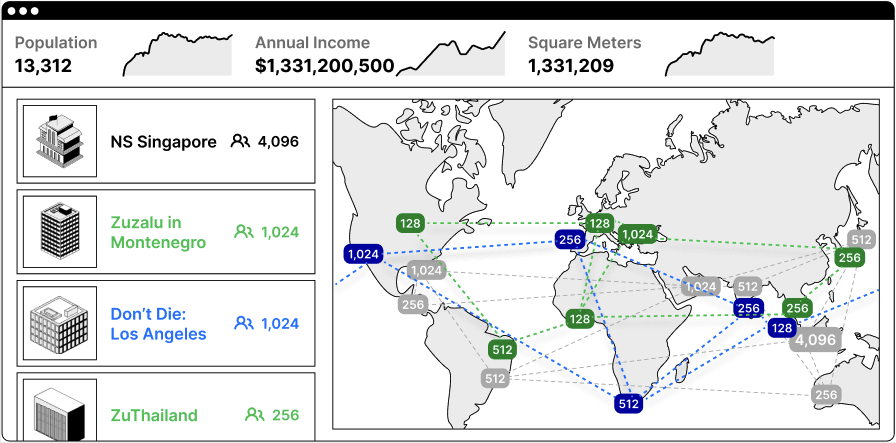
The first two stages are being held in a striking spot on the ocean — Forest City, a Malaysian ghost town.


Located in a free‑trade zone, the apartments offer accommodation at $1,500 a month shared, or $3,000 solo. Under the v2 rules, stays are for one year and run until March 2026.
The residential programme includes regular training, diet and cryo baths under the guidance of “longevity guru” Bryan Johnson.

Ethereum co‑founder and Zuzalu “pop‑up cities” co‑creator Vitalik Buterin broadly agrees with the Network State’s core concept but has some disagreements with Srinivasan. The main concern is the risk of turning “network states” into clubs for the rich and concentrating too much power in the founder’s hands.
At the Network State Conference 2024 in Singapore, Buterin reminded the audience that a network state implies bringing an online community together in the physical world to seek political autonomy. Such organisations are proposed as a potential successor to libertarianism, combining individualism with collective values. In Buterin’s view, two core questions must be solved to make network states work: governance and membership.
Zuzalu’s “pop‑up cities”
Inspired by Srinivasan’s ideas, Vitalik Buterin adapted them to current realities, starting with simple multi‑month gatherings at various resorts.
The first Zuzalu event ran from March 25th to May 25th 2023 at the Lustica Bay resort in Montenegro. About 200 people took part, with roughly 300 more visiting for one or two weeks. The “pop‑up city” was aimed primarily at longevity enthusiasts, cryptographers, AI researchers, entrepreneurs and Network State adherents.
Montenegro’s government is friendly to network states. The country launched a digital‑nomad visa programme in 2021 and granted Buterin citizenship a year later.
Apartments cost participants $1,800 a month, including an organisational fee and breakfasts. Check‑in was via ZuPass—a “passport” that generates QR codes with support for zero‑knowledge proofs (ZKP).
According to Decrypt journalist Shuyao Kong, the media wrongly portrayed it as a party for crypto‑rich yearning to live forever through technology.
“This is far from the truth. Of course, there were longevity supporters who did cold plunges, fasted, and constantly monitored their glucose levels. But most participants, like Vitalik Buterin, were simply trying to live a healthy lifestyle,” she added.
In 2025 Zuzalu turned three. In that time the project’s ecosystem has grown to more than 30 “pop‑up cities” in Chiang Mai in Thailand, Istanbul, Zanzibar, Ghana, Argentina, India, the United States, Berlin and elsewhere.
Unlike Srinivasan, Buterin believes Network State participants cannot ignore the needs of populations living around network communities. After flooding in Chiang Mai, the Zuzalu team began taking applications to rebuild homes and help disaster victims.
By March 2025 they had raised 5m baht (~$140,000) to support 506 residents. The rebuilding of homes and infrastructure went to plan, with local authorities actively involved.
There are negative reviews, too. Vladimir Prosvirkin, a developer at Aspis Protocol, shared in his blog his experience of Zuzalu events in Georgia:
“At first glance, it seemed that ZuVillage embodied a community that could find a balance between self‑governance and common interests. However, several incidents showed that the principles of pluralism and decentralization are under threat.”
He says there were at least two cases in which community members were evicted with the use of physical force. In one episode his friend was expelled for rule violations, but in an excessively harsh manner.
“Such a response dealt a sharp blow to the purported spirit of ZuVillage, which was supposed to become a model for future societies based on collaboration, inclusivity, and decentralization, rather than a police state that strictly monitors compliance with privacy rules,” Prosvirkin added.
In seeking redress he tried Web3 tools. The anonymous discussion platform Agora did not help: he came away with the impression of heavy moderation with comment deletion. He also commented on the ZKP app:
“As for ZuPoll, this tool is simply not used for important matters, and [I] received sweet polls like ‘which cat is the cutest,’ without any real impact on governance or decision‑making.”
President or boss?
Since the breakup of Yugoslavia, a small territory between Serbia and Croatia on the west bank of the Danube remained terra nullius, until on April 13th 2015 Vit Jedlička and Jana Markovičová proclaimed the Free Republic of Liberland.
According to the state’s official website, by the end of July 800,000 people had applied for citizenship, of whom 1,158 had received passports. Liberland covers roughly 7 sq km, with borders drawn to avoid encroaching on its neighbours.


Despite this, Jedlička regularly clashes with Croatian authorities and border guards, who allow no one to set foot on the land, whose only structure is an abandoned fishing hut. Multiple waterborne landings have ended with arrests of the “state fleet’s” boats and their crews.
In August 2023 Liberland announced via its online newspaper that it had gained access to the territory and begun construction. The grandiose plan envisaged a multifunctional hub with a medical room, a Liberland Hotel designed by Italian architect Sergio Bianchi for $10m, a resort area, a yacht marina and much else that strained credulity.

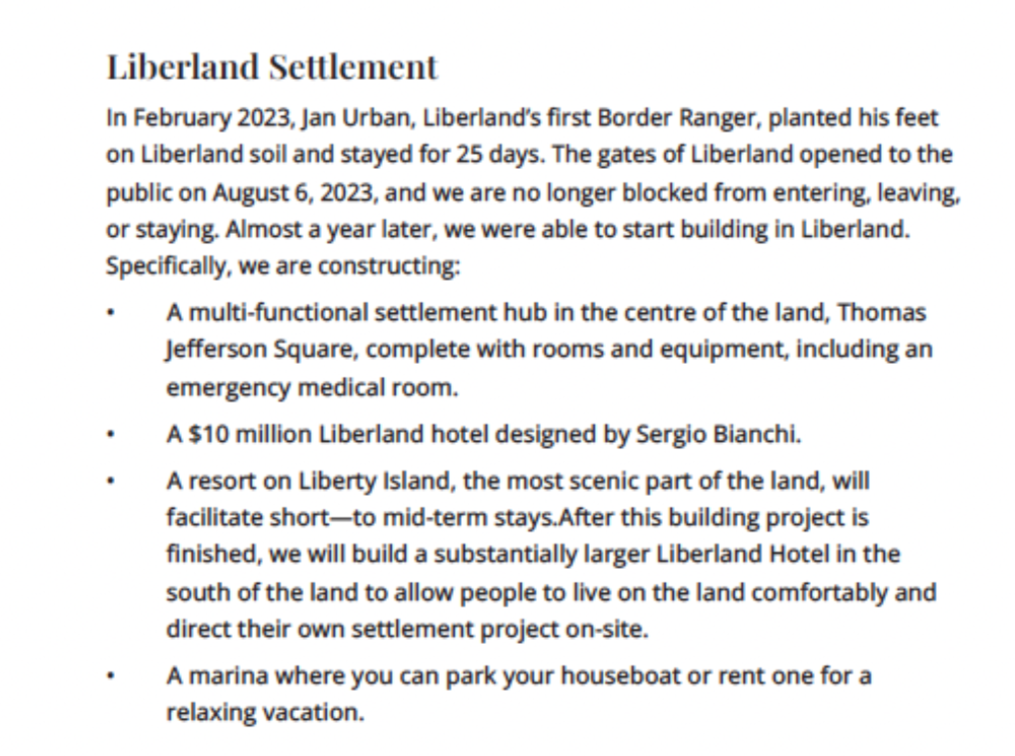
A month later, according to Liberland’s statement, the police seized everything: tools, equipment, generators, quad bikes, bicycles and personal belongings.
While physical development has stalled, the virtual side is proceeding as planned. In 2020 Liberland began cryptocurrency experiments on the EOS network with its founder, “true democracy” proponent Dan Larimer. Today state governance is fully digital. Everything—from voting for ministers to the national digital currency—is built on the Polkadot blockchain.
In October 2024 TRON founder Justin Sun became the first prime minister of Liberland. Later, in 2025, it became possible to transfer the Liberland Dollar (LLD) via a bridge to Sun’s network.
Liberland has two official cryptocurrencies—LLD and Liberland Merit (LLM). The former is used for transfers and can be involved in financial settlements and operations of companies registered under Liberland’s “jurisdiction”. LLM is for governance—voting.
The state’s main sources of income are investor and philanthropist funds, as well as passport sales. A personal passport costs $10,000; a family passport, $20,000. For now it offers no real social benefits, but it does provide “simplified” business operations via the electronic membership programme (E‑Residency card).
In May 2025 a plan was unveiled to revitalise the shores around Liberland. Backed by international investors and supporters, the initiative envisages equal investments—about $15m per participant—into the border regions of Serbia and Croatia over the next two years.
President Jedlička is constantly on the road, developing the country and building relationships—seeking investors and opening embassies, of which there are now 77.
The state marked its tenth anniversary nearby—at a rented resort. The community gathered in forest cottages in Apatin, Serbia, on the Danube. This location is listed as one of nine “diaspora villages” scattered around the world. Most are in Latin America.
Conclusions
The pejorative “broligarchy” inevitably springs to mind when reading about popular network states in their current guise. Yet perhaps something similar was said more than 700 years ago, when the first three cantons of the future Swiss Confederation were formed.
It is too early to judge the impact digital associations might have. Many are only in their first stages. Given how long it takes a state to grow into something coherent and worthwhile, it is far too soon to think about the end result. But Srinivasan’s energy, coupled with Buterin’s cool logic and Jedlička’s determination, could lift the blockchain industry to a new level. What will it be? Evolution will tell.
Moreover, many other projects merit separate review. The Network State dashboard lists 117 active network‑state projects, among them Prospera, Praxis, Vitalia, Itana and others.