




The stablecoin USDC lost its peg to the U.S. dollar, the New York attorney-general’s office filed a lawsuit against KuCoin, Bitcoin briefly traded below $20,000, and other developments this week.
Bitcoin tests the $20,000 level
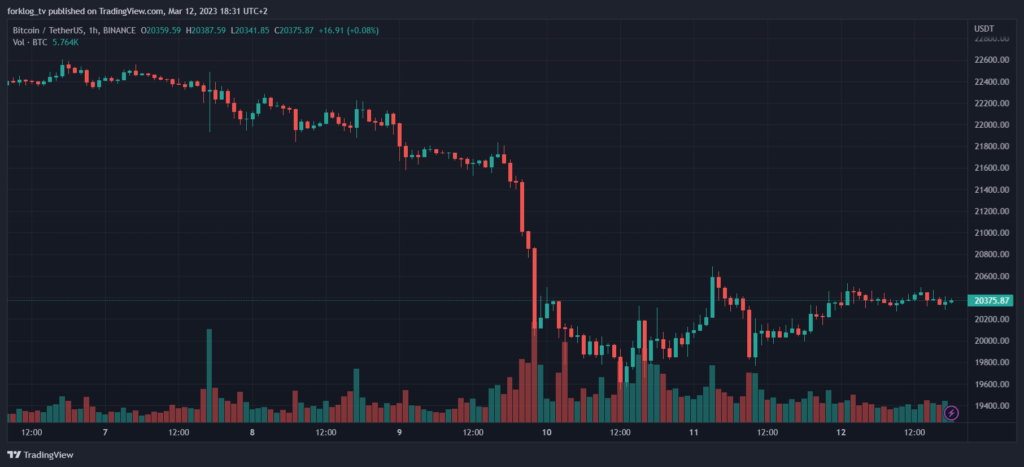
On March 7, the chair of the U.S. Federal Reserve, Jerome Powell, in his testimony before Congress stated a high likelihood of further tightening of monetary policy. Bitcoin initially retreated slightly, but prices recovered subsequently.
However, by March 10, Bitcoin tested levels below $20,000. The move was attributed to problems at Silicon Valley Bank, the liquidation of Silvergate Bank, and the U.S. Treasury’s proposal for a 30% tax on mining.
As of writing, the price had recovered somewhat — Bitcoin was trading near $20,375.


The above events also affected other cryptocurrencies. By week’s end, all top-10 assets by market capitalization were in the red. Dogecoin posted the worst performance — the price of DOGE fell by almost 12%. In turn, the stablecoin USDC lost its peg to the U.S. dollar.


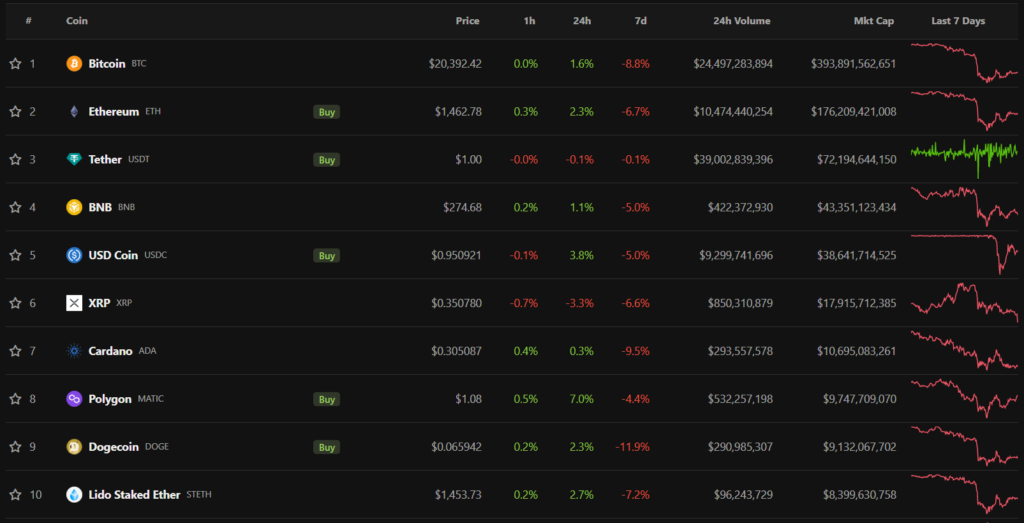
Total market capitalization of the cryptocurrency market stood at $976 billion. Bitcoin’s dominance rose to 40.4%.
The USDC stablecoin lost parity with the U.S. dollar
On Friday, March 10, the California Department of Financial Protection and Innovation shut down Silicon Valley Bank (SVB) and appointed the FDIC as receiver. The regulator cited “insufficient liquidity and insolvency”. It noted that depositors would have full access to their insured deposits no later than the morning of Monday, March 13.
SVB’s troubles created difficulties for its clients, including Circle. Circle, together with Coinbase, is part of the Centre consortium behind the USD Coin (USDC).
On March 11 Circle announced that it holds a portion of the asset’s reserves at SVB ($3.3 billion). In this context, USDC lost parity with the U.S. dollar — its price touched an all-time low near $0.88.
Subsequently, the company promised to cover “any shortfall” in the reserves. If it cannot timely and fully return the assets trapped in the bank, Circle will use corporate funds and “external capital” to back USDC.
Because of the USD Coin depeg, algorithmic stablecoins that used it as collateral for issuance lost their pegs. In particular, the peg for DAI and FRAX collapsed.
To limit the impact of USDC issues on its project, the MakerDAO community decided to adjust the protocol parameters. The move envisages reducing the maximum number of DAI that can be borrowed against particular collateral.
The parameter changes will also cap the stablecoin’s daily issuance at $250 million (the current limit is $950 million) and raise the minting fee against USD Coin from 0% to 1%.
New York Attorney General Files Suit Against KuCoin
The Office of the New York State Attorney General (OAG), led by Letitia James, filed a lawsuit against KuCoin. The cryptocurrency exchange was accused of securities-law violations by offering tokens without a license.
According to the release, the platform lacked broker-dealer registration and “misrepresented itself as an exchange.” The regulator’s claims also concern the KuCoin Earn product.
In the list of assets the OAG counted as securities, Ethereum is named. This marks the regulator’s first public assertion of such in court.
US Proposes 30% Tax on Miners’ Electricity Usage
The U.S. Treasury advocated for a 30% excise tax on electricity consumed by mining firms.
The tax is planned to be phased in over the next three years, rising by 10% each year. Miners would also be required to report how much electricity and capacity they use.
The new excise is expected to reduce the total number of mining devices in the United States.
Additionally, the Treasury proposed expanding securities-lending rules to include cryptocurrencies.
Silvergate to Liquidate the Bank
Silvergate Capital Corporation, the holding company for Silvergate Bank, announced its intention to wind down operations and liquidate the bank.
The plan calls for full repayment of deposits. The firm is also exploring ways to settle claims and preserve residual asset value, including its own technologies.
Binance Bans Russians from P2P USD and EUR
The cryptocurrency exchange Binance introduced a series of restrictions for P2P service users under the EU’s tenth sanctions package against Russia.
Russian citizens and any individuals resident in the country are barred from buying or selling dollars and euros on the P2P platform. EU citizens are barred from ruble operations using the service.
Media also reported on a Treasury bill that would criminalise failing to declare digital assets.
Hedera Hashgraph reported an unauthorized withdrawal of assets from the Hedera Token Service following a hack of the mainnet’s smart-contracts service. To prevent further damage, developers halted mainnet proxy servers.
What to Discuss with Friends?
- Snoop Dogg became a co-founder of the streaming Web3 platform Shiller.
- Vitalik Buterin dumped a number of sale tokens for $700,000.
- An illicit exchange with turnover of $34 million was blocked on Binance.
- Elon Musk considered the purchase of Silicon Valley Bank.
FTX Files Suit Against Grayscale Investments and Reveals Bitcoin Shortfall
The collapsed exchange FTX filed a lawsuit against Grayscale Investments, accusing the firm of mismanaging funds and violating the trust agreement.
Also named as defendants are Grayscale’s CEO Michael Sonnenshein and the founder of the parent company Digital Currency Group — Barry Silbert. The complaint, on behalf of Alameda Research, alleges Grayscale improperly received more than $1.3 billion in the form of “excessive management fees” over the past two years.
This week the exchange also said that the total asset shortfall to cover client claims stands at $8.7 billion, with $1.6 billion in Bitcoin. To raise funds, FTX will sell a stake in Sequoia Capital for $45 million.
A federal judge approved an agreement between FTX and Voyager Digital, under which the crypto broker will reserve $445 million for Alameda-related claims.
The new FTX CEO John Ray presented to the bankruptcy court a plan to raise salaries for employees by 17% to 94%, aiming to deter key staff—from those versed in coding to those skilled in accounting—from leaving.
Bloomberg: Mt. Gox Top Creditor Plans to Hold Returned Bitcoins
The largest creditor of the defunct exchange Mt. Gox is set to hold onto the Bitcoins that are due to be returned in autumn 2023. Mt Gox Investment Fund would receive about 90% of the recovered funds, in an approximate split of 70% Bitcoin and 30% fiat.
The exact amount of restitution remains unspecified. Journalist Colin Wu estimates it could reach up to 30,000 BTC.
Meanwhile, the platform’s liquidator said it extended the deadline to file compensation claims to April 6.
Rollkit Project Unveils Infrastructure for Bitcoin Rollups
Rollkit created a modular framework to support sovereign rollups on the Bitcoin blockchain. The technology aims to optimise block space and reduce fees, and opens the path for DeFi solutions on the Bitcoin network.
Tether Calls WSJ Article on Shadow Schemes Misleading
On March 3 WSJ published a report alleging that in 2018 Tether and Bitfinex provided access to the banking system via shell companies. The publication also claims the firms forged documents and “used various means” to bypass restrictions in dealing with financial institutions.
The issuer of USDT called the article’s conclusions “outdated allegations” that are “inaccurate and misleading.” According to the statement, both entities maintain world-class compliance programs and adhere to applicable legal requirements for AML, KYC and CFT.
The company-commissioned study showed that the WSJ frequently published discrediting information about Tether, praising FTX.
Court Approves Binance.US Acquisition of Voyager Digital Assets
Following four days of hearings the court allowed Binance.US to acquire the assets of the bankrupt crypto lender Voyager Digital. Plaintiffs were the SEC and the New York Department of Financial Services.
During the proceedings, a SEC representative accused Binance.US of operating an unregistered securities exchange and of Voyager’s alleged missteps in selling VGX, while noting a lack of supporting evidence.
After the verdict in Binance’s favour, the DOJ intervened by filing an appeal.
Also on ForkLog:
- Trustee Plus will give away 5,000 virtual crypto cards.
- L2 protocol Scroll for Ethereum scaling raised $50 million at a $1.8 billion valuation.
- Jack Dorsey announced a “Bitcoin mining developer kit.”
- Binance conducted trainings for the SBU and Ukraine’s cyberpolice.
What Else to Read?
In collaboration with ForkLog analysts we examined which Bitzlato-linked companies could face new investigations and how that might affect their users.
ForkLog AI’s editorial team spoke with Yuri Fitzgerald, the founder of a digital human cloning startup. They discussed whether ChatGPT demonstrates intelligence, whether the technology will replace human labour, and the ethics of using AI in war.
Our traditional digests gathered the week’s main cybersecurity and AI news.
The decentralized finance sector continues to draw heightened attention from crypto investors. ForkLog has gathered its most important events and news in a weekly digest.