


What are Starknet’s blockchain and cryptocurrency?
Key points
- Starknet is a decentralised Layer-2 scaling solution for Ethereum built on the ZK-STARK cryptographic mechanism.
- The protocol’s lead developer is the Israeli firm StarkWare.
- As of October 2022, an alpha version of Starknet’s mainnet with limited functionality is live. Even so, the ecosystem already counts more than 120 projects, and the mainnet processes 3–6 million transactions a week.
- StarkWare’s developers have issued the Starknet governance token (STRK), an ERC-20, for investors, employees and the foundation. Free circulation and trading of STRK could start in early 2023.
Who built Starknet?
The L2 network Starknet is being developed by the Israeli company StarkWare Industries, founded in 2018. Among the founders is noted cryptographer Eli Ben-Sasson, a Technion professor and co-author of the STARK technology, who earlier took part in creating the privacy coin Zcash. Co-founders Mikhail Riabzev (co-author of ZK-STARK), Uri Kolodny and Alessandro Chiesa (a Zcash co-founder) are also well known in the crypto community.
From January 2018 to May 2022, several funding rounds raised a total of $273 million.
The first commercial application of ZK-STARKs was the launch of StarkEx in June 2020. This is an application-specific scaling solution for Ethereum already used by dYdX, Rhino, Sorare and Immutable.
The next step was the alpha launch of the Starknet mainnet at the end of 2022.
In time, StarkEx is expected to become a “third layer” deployed atop Starknet for specific DeFi protocols, to simplify use and cut costs.
How does Starknet work?
Starknet is a permissionless zk-rollup whose smart contracts are written in Cairo, its native programming language.
As with other rollup-based L2s, Starknet batches hundreds or thousands of transactions and cryptographically attests to their validity. Unlike other L2s, Starknet relies on ZK-STARK technology.
Starknet’s architecture has three core off-chain components:
- Sequencer — a server that receives transactions, validates them and combines them into blocks. For now there is a single sequencer controlled by StarkWare, but as decentralisation progresses, network participants will be able to run their own.
- Prover — produces cryptographic proofs attesting to the integrity of the sequencer’s computations. At present there is a single prover for both Starknet and StarkEx.
- Full node — servers running the Pathfinder application to index all transactions and track the system’s global state.
There are also two on-chain components:
- Verifier — an Ethereum smart contract that receives newly generated proofs from the prover and verifies them. The result is sent to the core.
- Starknet Core — a smart contract that updates Starknet’s global state each time L2 produces a new block and its proof is successfully verified.
StarkWare says this architecture can cut gas costs by 100–200 times versus Ethereum. The developers set a goal of reaching 700 transactions per second in 2022, and argue the network’s theoretical throughput is far higher.
One of the technology’s creators, Professor Eli Ben-Sasson, believes that recursive proofs used in ZK-STARKs could in theory aggregate up to 60 million transactions into a single Ethereum block (today the number is under 1,000).
How does Starknet compare with other L2s for Ethereum?
By total value locked (TVL) and the number of deployed DeFi protocols, the most-used L2s are Arbitrum and Optimism, which use Optimistic Rollups.
The chief difference lies in transaction processing. In Optimistic Rollups, for speed, all transactions are assumed valid unless challenged. If a node behaves maliciously and includes invalid transactions, there is a seven-day window during which a transaction may be disputed and reverted by verifiers.
On Starknet, ZK-STARKs allow each batch to carry a validity proof, so there is no challenge window. That boosts throughput and lowers gas costs.
Another contender, zkSync, uses a different proving system called ZK-SNARK.
As some cryptographers argue, ZK-STARKs are:
- more secure across setup and operation;
- potentially up to ten times more scalable than ZK-SNARKs;
- resistant to attacks by quantum computers.
Will Starknet have its own cryptocurrency?
In July 2022, the StarkWare team confirmed plans to issue a governance token for decentralised stewardship of the ecosystem and its maintenance.
The total issuance is not yet known. StarkWare will mint the first 10 billion ERC-20 tokens on Ethereum. They will be allocated as follows:
- 17% — investors;
- 32.9% — key community participants (StarkWare employees, advisers and external developers);
- 50.1% — the Starknet Foundation. Under the plan, only 10% will remain with the foundation; the rest will fund community rewards, grants, donations and other purposes.
All tokens allocated to investors and the team are locked for one year, then vest linearly over the following four years.
The STRK token will serve three core purposes:
- governance of the network;
- payment of transaction fees on Starknet;
- participation in consensus and transaction processing.
The cryptoasset is planned for release in October 2022. Starknet Foundation is expected to conduct an airdrop in early 2023. To reduce the chances of retrodrop hunters participating, the snapshot date will not be announced.
What does the Starknet ecosystem look like?
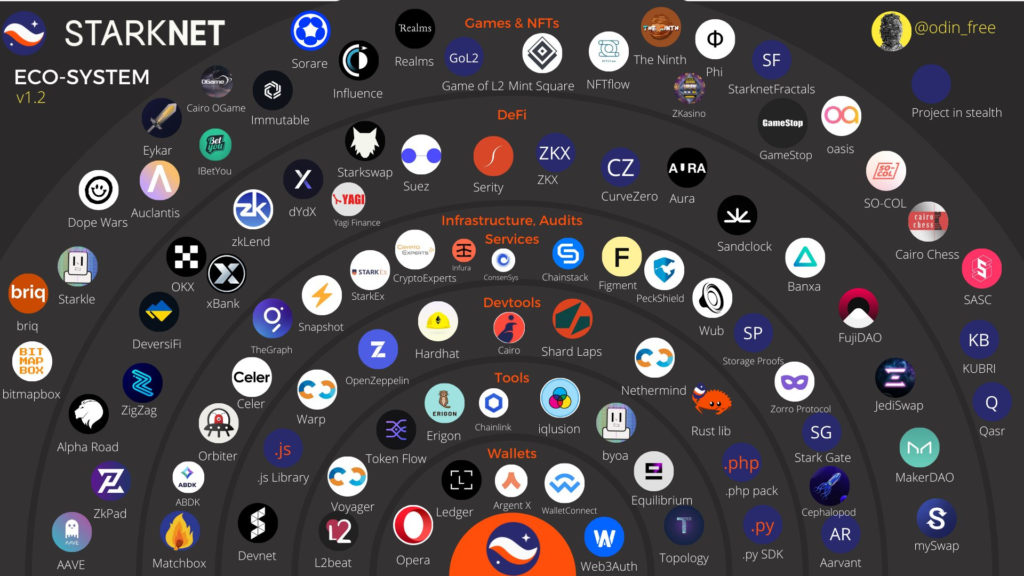
As of autumn 2022, more than 120 projects are live or in development on Starknet. The base infrastructure and core DeFi service types are in place, letting users and developers test the benefits of the new L2:
- Web3 wallets Argent X and Braavos, as well as MetaMask (with the Metamask Flask and Starknet Snap modules);
- Block explorers StarkScan and Voyager;
- Cross-chain bridges — the official StarkGate bridge and third-party services Orbiter Finance, Layerswap, Kubri and Suez;
- Decentralised exchanges (AMM DEXs) mySwap, JediSwap, 10KSwap, and a Uniswap fork launched in October 2022 by the team behind the Ethereum client Nethermind;
- Lending service xBank Finance;
- NFT marketplaces Aspect and Mintsquare;
NFT games Imperium Wars, Dope Wars, Frens Lends, Loot Realms and others.
How to get started with Starknet
Although Starknet remains in alpha, it is open to users. To start using it and access deployed DeFi applications:
- install the Argent X browser extension and register;
- open the StarkGate cross-chain bridge and transfer ETH from Ethereum or one of the supported L2s (Optimism, Arbitrum, etc.). This requires connecting both Argent X and MetaMask;
- connect Argent X to any available DeFi or NFT application and execute transactions, confirming them in the wallet and paying fees in ETH.
What are Starknet’s prospects?
As of October 2022, Starknet processes 3–6 million transactions a week, indicating high user activity.
By the end of 2022, StarkWare plans steps toward decentralising Starknet: software to run sequencers and verifiers will be made public. Financial incentives are expected for provers, sequencers and full-node operators, who would receive a share of transaction fees.
After STRK enters circulation, DAO-based coordination and governance mechanisms will be developed via DAO.
Further reading
Ethereum’s move to Proof-of-Stake (PoS): everything you need to know
What are sidechains and how do they work?
Aptos review: the next generation of blockchain platforms?
Рассылки ForkLog: держите руку на пульсе биткоин-индустрии!