


What is ZKsync?
What does ZKsync offer?
ZKsync is the first EVM-compatible layer-two solution (L2) based on ZK rollups, built on top of the Ethereum blockchain.
The implementation is based on zkEVM technology, designed to scale smart contracts by combining zero-knowledge proof (zero-knowledge proof, ZKP) with the capabilities of the Ethereum Virtual Machine (EVM).
This combination delivers fast, low-cost and private transactions while relying on L1 security. ZKsync’s specifications allow up to 2,000 TPS, and transaction costs can fall to 1/100 of base-layer fees, i.e., those on Ethereum.
Who developed ZKsync?
The solution was built by Matter Labs, founded in Berlin by Alexander Vlasov and Alex Gluchowski in 2018. According to official data, total funding for the ZKsync initiative reached $458m by the end of 2022. Investors included Placeholder, DragonFly Capital, 1kx, Hashed, Dekrypt Capital, Andreessen Horowitz (a16z), Blockchain Capital, as well as the investment arms of the Crypto.com, OKX and Bybit exchanges.
In June 2020 Matter Labs launched the first public version of ZKsync—1.0. The second version, 2.0, was opened to the public in late October 2022. In February 2023 the team carried out a rebrand: zkSync 2.0 was renamed ZKsync Era, and zkSync 1.0 became ZKsync Lite.
A key feature of the ZKsync Era launch was support for EVM-compatible smart contracts using ZK technology—zkEVM. As Matter Labs reports, the project received more than 150 applications to deploy on the network ahead of the 2.0 launch. Interest came from Chainlink, SushiSwap, Uniswap, Aave, Argent, 1inch, Gnosis and Curve.
How do ZKsync and Optimism differ?
There are two main kinds of rollup in the L2 market: Optimistic and ZKP. The key difference lies in how transactions are verified. In the first case, only transactions that someone challenges are checked; in ZKP, every operation is validated.
In practice this means that, to combat fraudulent transactions, verification in optimistic rollups can take several weeks. In zero-knowledge networks, by contrast, proof of the absence of “malicious” operations is near-instant.
This affects the speed of withdrawing assets to the Ethereum mainnet. In the first design the process can take about two weeks; in the second, up to three hours.
Optimistic networks include Arbitrum, Base and Optimism. ZKP-based projects include Starknet, Linea and ZKsync.
What makes ZKsync unique, and what are Hyperchains?
The base implementation of the ZKsync Era protocol (formerly 2.0) includes support for account abstraction. This can deliver a user experience quite unlike conventional blockchain networks.
By default, network account holders can pay fees in any token and create wallets without seed phrases. As stated on the ZKsync website, accounts can implement biometric verification and social recovery via relatives, friends or a third party. Users can also opt for Web2 profile sign-in, where applications configure access to the ZKsync network for clients who do not have ETH addresses.
Like the Optimism team, developing a distinctive ecosystem based on OP Stack technologies, ZKsync has its own global vision—Hyperchains.

Hyperchains are fractal instances of zkEVM, developed on the ZK Stack. In essence, these are identical copies of networks assembled modularly to suit developers’ needs and connected by L1–L2-style bridges.
Hyperchains make it possible to create L3 solutions, delegating part of operations to an L2 level built on ZKsync.
Will ZKsync have a native token?
Information about a native token appears in documents on the Matter Labs website. For example, in the description of mechanisms related to accounts, ZKsync’s own digital asset acts as a controller of account data availability.
Matter Labs CEO Alex Gluchowski also confirmed the need for a token as a tool for decentralising ZKsync. He said the need would arise once the network reaches the required stability metrics. By his estimates, this should happen in early to mid-2024.
How is the ZKsync ecosystem developing?
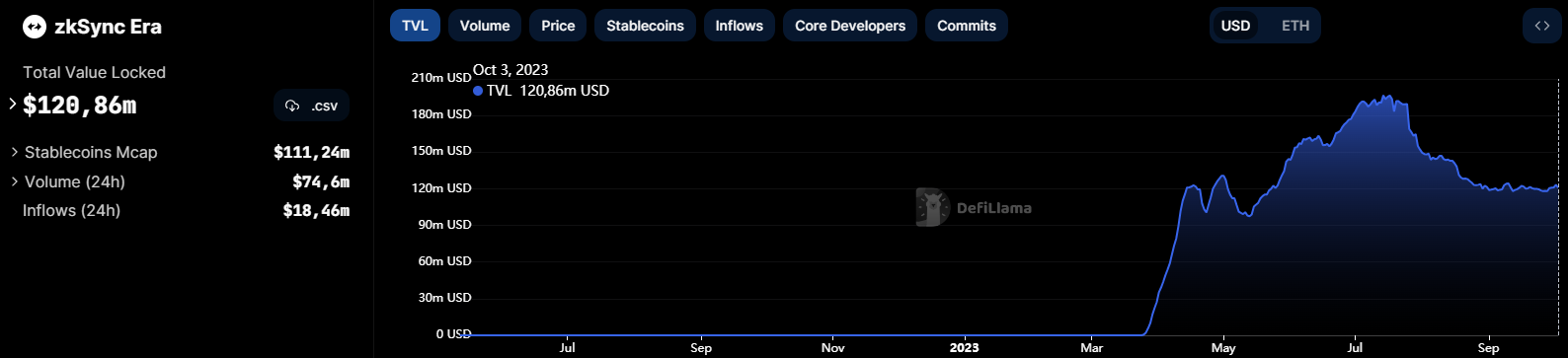
As of October 2023, total value locked (TVL) in ZKsync, according to DeFi Llama, stood at more than $120m across 79 DeFi applications.
In September 2023 ZKsync surpassed the Ethereum network by transactions per second. And the flagship DEX SyncSwap became the leader by the pace of attracting new users, crossing the 1m mark in September 2023 and overtaking Uniswap and PancakeSwap.
The ZKsync L2 outpaced Ethereum not only by transactions per second but also by aggregate volume. In September 2023 its users conducted 32.5m transfers versus 32.3m on the Ethereum mainnet.
In September 2023 the ZKsync team noted that nearly 120m transactions had been conducted in the ecosystem and 368,000 smart contracts had been created.