



What is Avalanche?
Avalanche is an open-source platform for launching decentralised applications and deploying public and private blockchains within a single, scalable ecosystem.
Avalanche comprises a Primary Network and an unlimited number of Subnets.
The Primary Network includes three blockchains:
- Platform Chain (P-Chain) stores metadata, coordinates validators and tracks subnets;
- Contract Chain (C-Chain) enables Ethereum-compatible smart contracts;
- Exchange Chain (X-Chain) provides tools for cross-subnet data exchange and for creating fungible tokens and NFTs.
Avalanche Subnets resemble Ethereum L2 solutions and parachains in Polkadot, but with fully isolated blockchain states.
Any Avalanche user can create a Subnet by paying a fee of 0.01 AVAX.
All Avalanche nodes must validate transactions on the Primary Network and may, optionally, validate other Subnets.
Subnet creators can set various parameters—run multiple blockchains and define their own validator requirements, such as mandatory KYC/AML.
Who created Avalanche, and when?
The first publication about Avalanche appeared on May 16, 2018, when an anonymous developer group, Team Rocket, posted the paper Snowflake to Avalanche: A Novel Metastable Consensus Protocol Family for Cryptocurrencies on the official IPFS website.
A day later Cornell University professor Emin Gün Sirer commented on the publication on Twitter:
“Yesterday someone posted this paper on IPFS and a few IRC channels. It describes a new family of consensus protocols that combines the advantages of Nakamoto consensus with the best classical protocols. A huge breakthrough.”
That year, Emin Gün Sirer, together with colleagues Kevin Sekniqi and Maofan Yin, founded Ava Labs, the lead developer of the Avalanche platform.
In 2019, Ava Labs and Team Rocket published an updated version of Snowflake to Avalanche titled Scalable and Probabilistic Leaderless BFT Consensus through Metastability. The company uploaded it alongside three white papers on the token, stablecoins and the Avalanche platform.
In 2020, Ava Labs raised $12m in a private token sale and $42m in a public sale.
The Avalanche mainnet launch took place on September 21, 2020.
Which consensus protocols does Avalanche use?
The Avalanche Platform Whitepaper describes a family of consensus protocols called Snow*, comprising three mechanisms: Avalanche, Snowman and Frosty.
To date, the team has implemented Snowman on P-Chain and C-Chain, and Avalanche on X-Chain. Frosty is in development.
The Avalanche protocol uses a directed acyclic graph (DAG), allowing the network to process transactions in parallel.
To determine transaction validity, validators query one another at random. No additional confirmations are required.
In Avalanche there are no blocks: the protocol operates with parent transactions—vertices. They allow validators to group transactions for voting. Confirmation proceeds stepwise across a series of rounds.
Snowman is built on Avalanche but orders transactions linearly and creates blocks instead of vertices. This suits smart contracts and increases throughput.
How does the Avalanche protocol work?
On the Avalanche Hub blog, an author under the pseudonym Seq explains confirmation or rejection of transactions using the example of nodes collectively choosing yellow or blue.
Nodes pick a colour, then query one another. If a node’s choice differs from the majority, it switches its decision.
A node picks yellow and sends queries to five random peers (circled in red). Most of them are blue, so the sender changes colour.


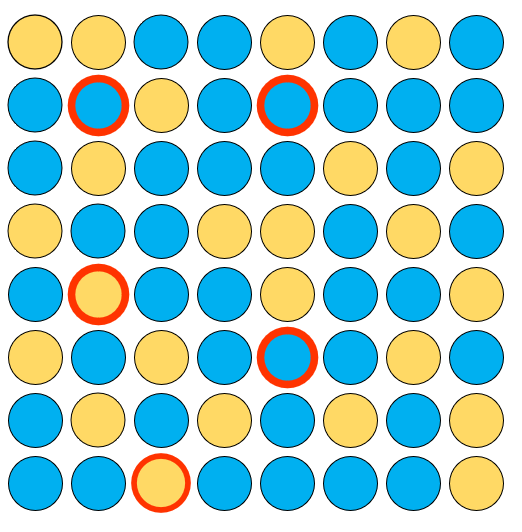
This interaction continues in stages until all nodes converge on one colour.



Response time is bounded, filtering out nodes that introduce excessive latency.
Nodes are sampled at random; however, the chance of participating in transaction checks rises with the amount of Avalanche tokens staked.
A more detailed description of Avalanche’s consensus appears in the project’s Russian-language blog, AVA Russia.
What is AVAX’s role in the ecosystem?
Avalanche (AVAX) is the platform’s native token with a 720m supply cap. The protocol burns all transaction fees, making AVAX a deflationary asset.
The token is used to:
How to become an Avalanche validator
Network validator requirements:
- stake: 2000 AVAX on P-Chain;
- hardware: 8-core CPU >= 2 GHz; RAM: 16 GB; 200 GB of free disk space;
- software: AvalancheGo by Ava Labs;
- operating system: Ubuntu >= 18.04 or macOS >= Catalina;
- internet connection: IPv4 or IPv6 with an open public port and bandwidth of at least 30 Mbps.
You can manage a node with the Avalanche Wallet web wallet. It also lets you connect a node or delegate funds to other validators.
A validator node installation guide is available in the project’s Russian-language blog, AVA Russia.
How to delegate funds in Avalanche Wallet
Tokens for staking must reside on P-Chain. If they are on C-Chain or X-Chain, open the Avalanche Wallet, go to the Earn tab and perform a cross-chain transaction.


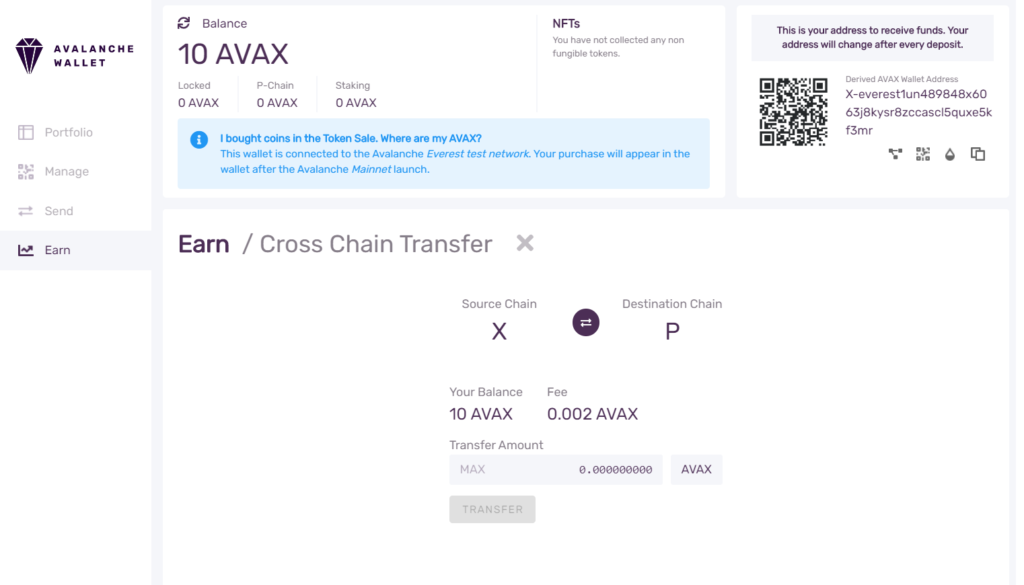
Ensure your node is synced with the Avalanche network. Then add it to the wallet—enter the node identifier in the Node ID field.


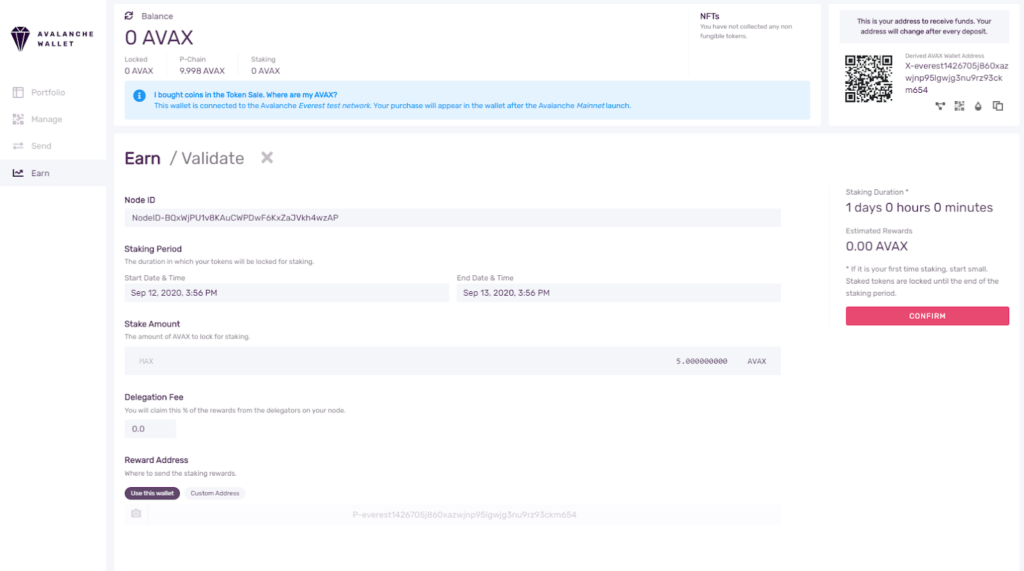
In the Delegate tab you can delegate funds to a third-party validator: select a Node ID, then specify the amount and staking period.


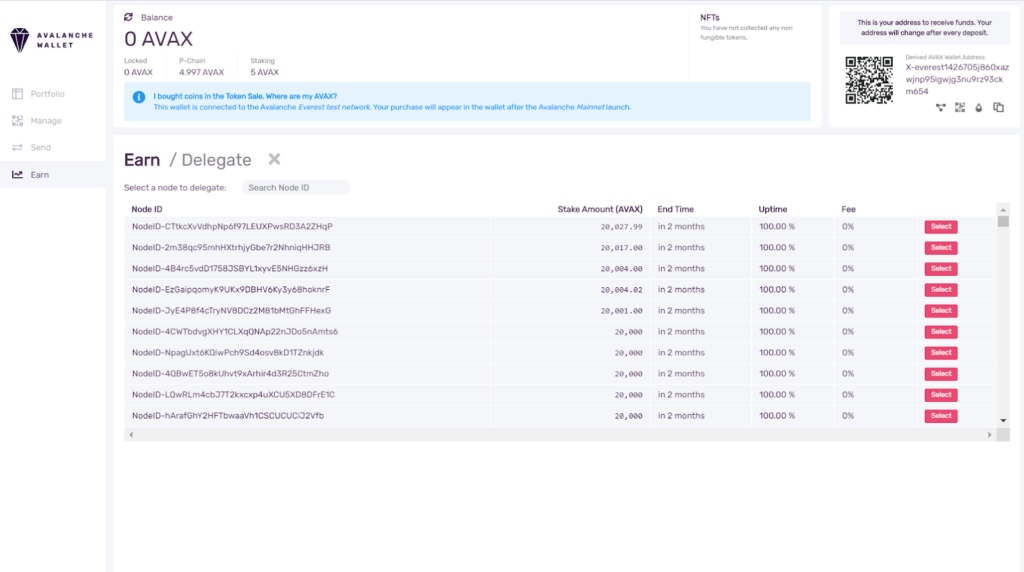
Remember: the delegation period must not exceed the value in the End Time field.
How to add Avalanche to MetaMask
Open wallet settings, select Networks and click Add network. Fill in:
- Network Name — Avalanche Network;
- New RPC URL — https://api.avax.network/ext/bc/C/rpc;
- Chain ID — 43114;
- Currency Symbol — AVAX;
- Block Explorer URL — https://snowtrace.io/.
Click Save. Avalanche support materials include a detailed guide to connecting MetaMask and an up-to-date list of supported wallets.
Alternatively, use Chainlist: click Connect Wallet, enter “Avalanche Mainnet” in the search bar and approve the addition in MetaMask.
How is Avalanche developing?
According to DeFi Llama at the start of November 2022, over $1.3bn is locked in Avalanche-based decentralised applications. The top three include lending platforms Aave and Benqi, as well as the DEX Trader Joe.
On mainnet launch day the Binance exchange added support for AVAX. The token now trades on Coinbase, Huobi, OKEx, Bitfinex and other exchanges.
In July 2021, the non-profit Avalanche Foundation, which oversees the ecosystem’s development, raised $230m in a private token sale.
In early November the Avalanche Foundation announced the $200m Blizzard fund to support innovation across the platform’s ecosystem. Backers include Polychain Capital, Three Arrows Capital, Dragonfly Capital and CMS Holdings.
On November 16, Ava Labs head Emin Gün Sirer announced a partnership with Deloitte. The parties will launch the Close As You Go cloud platform to help people affected by natural disasters.
On November 18, 21Shares announced the listing of an exchange-traded product (ETP) based on the Avalanche token. Since November 19 it has traded on Switzerland’s largest stock exchange, SIX Swiss Exchange.
On November 24, AVAX entered CoinMarketCap’s top ten by market capitalisation, exceeding $24bn.