




Peter Schiff, a noted crypto critic and gold advocate, said the financial architecture of Strategy, the largest public holder of bitcoin, is built on “fraud”.
MSTR’s business model relies on income-oriented funds buying its “high-yield” preferred shares. But those published yields will never actually be paid. Once fund managers realize this they’ll dump the preferreds & $MSTR won’t be able to issue any more, setting off a death spiral.
— Peter Schiff (@PeterSchiff) November 16, 2025
“MSTR’s business model entirely depends on funds buying its ‘high-yield’ preferred shares. But the stated yield will never actually be paid. Once managers realise this, they will dump the securities,” he wrote.
According to Schiff, this will trigger a “death spiral”: the company will lose the ability to raise financing through debt instruments.
Asked why Strategy might not pay dividends, the expert said:
“Payment of dividends is solely at the discretion of MSTR’s board of directors. The company has no obligation to declare them and faces no penalties if it does not. Unpaid dividends do not accrue—the right to receive them is lost irrevocably.”
Users disagreed, accusing him of spreading FUD.
In a separate post, Schiff invited Strategy founder Michael Saylor to debate during Blockchain Week in Dubai in December. He has yet to respond—so Helius Labs CEO Mert Mumtaz put himself forward instead:
“It seems pretty straightforward to me. I’d be happy to argue with you on any crypto topic. At stake: at least $10m in ZEC for the loser.”
Opinions split
A user posting as Cryptoguy noted that Strategy does not depend on preferreds to survive—the company issues them only to buy bitcoin, not to finance operations.
“Even if issuance slows, there will be no collapse—they will simply use less leverage. Calling this a ‘death spiral’ is a major exaggeration,” he stressed.
The crypto critic replied that, if it loses the ability to generate returns from digital gold, the firm will forfeit a key source of its market value. Cryptoguy countered that Strategy’s value lies in providing institutional access to bitcoin with leverage and high liquidity.
Crypto enthusiast Shagun Makin noted that in every cycle “someone declares MSTR a ticking time bomb”. Yet, he said, the company’s strategy has so far passed every test.
Some agreed with Schiff. Among them was Scott McClintic, a supporter of bitcoin and Zcash and the founder of the wagering project The Home of FAIR PLAY.
“I believe in BTC and ZEC, but Saylor’s strategy does not withstand scrutiny. You can’t call the scheme ‘raise capital, buy bitcoin, rise with it and lock in profits’ arbitrage. It’s a financial pyramid that feeds on itself. Liquidity providers are asking to fail. The model is unstable,” he said.
Strategy’s premium falls below 1
Schiff’s comments came amid an ongoing bitcoin correction and mNAV at Strategy falling below 1—for the first time since the start of the crypto-treasury boom. At the time of writing, the metric had recovered to 1.21.


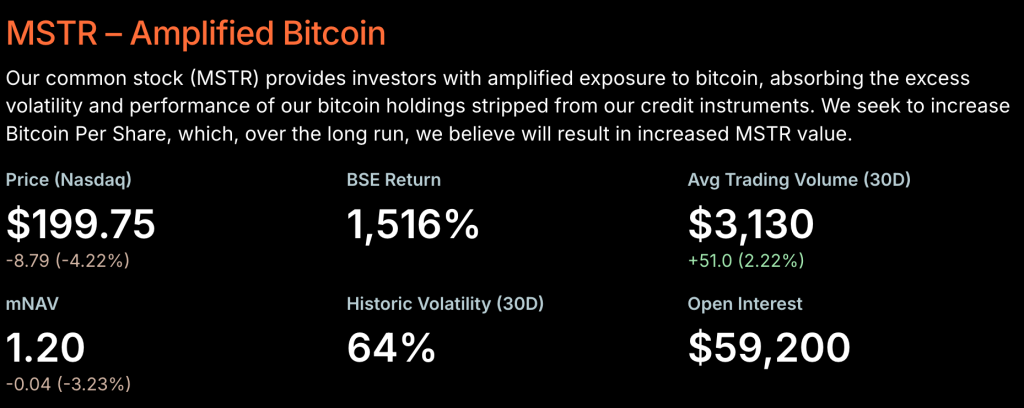
A lower reading means the firm’s market value is below the value of its bitcoin holdings net of liabilities. That points to a high share of debt financing.
The last time this happened was in early 2024.
Investors consider an mNAV of 2 or higher sustainable for a treasury company. Since July, Strategy’s shares have fallen by more than 50% and, at the time of writing, trade at about $199.


Strategy oversees 641,205 BTC worth over $61bn, according to BitBo.
Bitcoin trades around $95,300. According to CoinGecko, over the past 24 hours its price slipped 0.4%, and over the week—10.2%. Analysts explained the drop by panic among new investors.
In early November, Kynikos Associates closed a short position against Strategy’s shares. Its founder, James Chanos, attributed the move to the decline in the company’s mNAV.