


Proof‑of‑Event: NFT tickets and the future of Web3
NFT tickets have become a popular tool for running events, drawing Web3 users with rich features and perks from organisers. That, however, is only the tip of the iceberg. What this technology is really about—and the prospects it opens for business—is the subject of Vladimir Menaskop’s article.
Background
For more than a decade, a central strand of my work has been the search for new niches, vectors, segments, industries, markets and domains. Some things pass me by for ideological reasons—say, the hype around TON or the rise of meme-coins on Solana. Others I manage to spot early.
This piece is about one such find.
There is no more contentious, intriguing and consequential topic in Web 3.0 and Web3 than NFTs. Meme-coins and fast chains are hype that is already fading; DeFi is a steady business; GameFi remains niche. NFTs, by contrast, are everywhere—especially NFT 2.0.
One industry NFTs have touched is ticketing—more precisely, the business of staging events from meetups to large-scale conferences. A few examples:
- ETHDenver;
- TOKEN2049;
- Blockchain Life.
NFTs used as tickets mark the start of a broader tokenisation of the entire category. So let us examine several important trends.
By the numbers
First, a few numbers and facts:
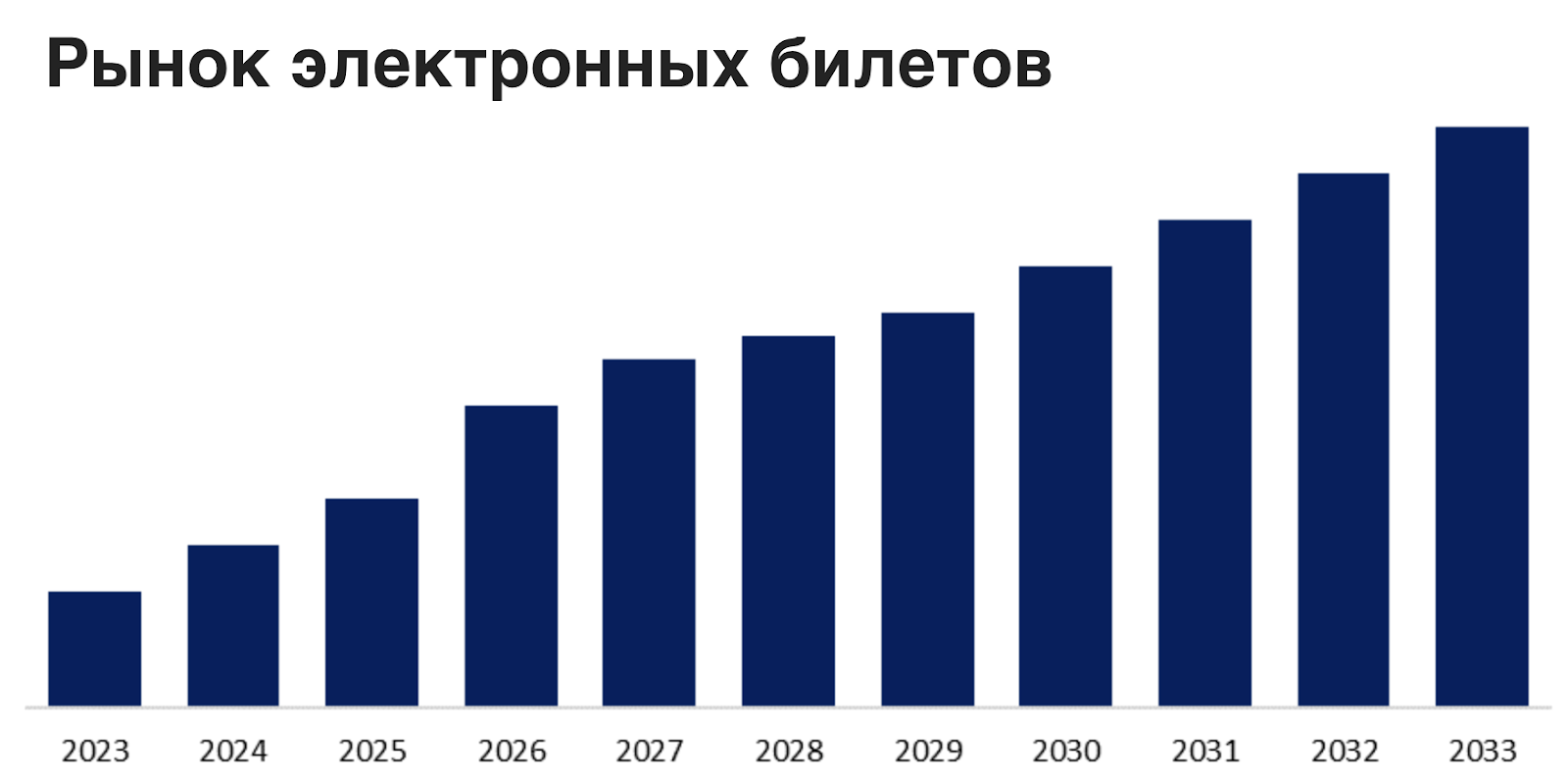
- ticketing revenue is forecast to reach $85.07 billion in 2024;
- the market’s compound annual growth rate is expected at 2.54%, taking it to $94.06 billion by 2028;
- the segment is set to grow by 4% in 2025;
- in 2024, ARPU will be $115.90;
- by 2028, 769 million people will be buying electronic tickets;
- user penetration in the category will be 9.5% in 2024.
Source: Spherical Insights.
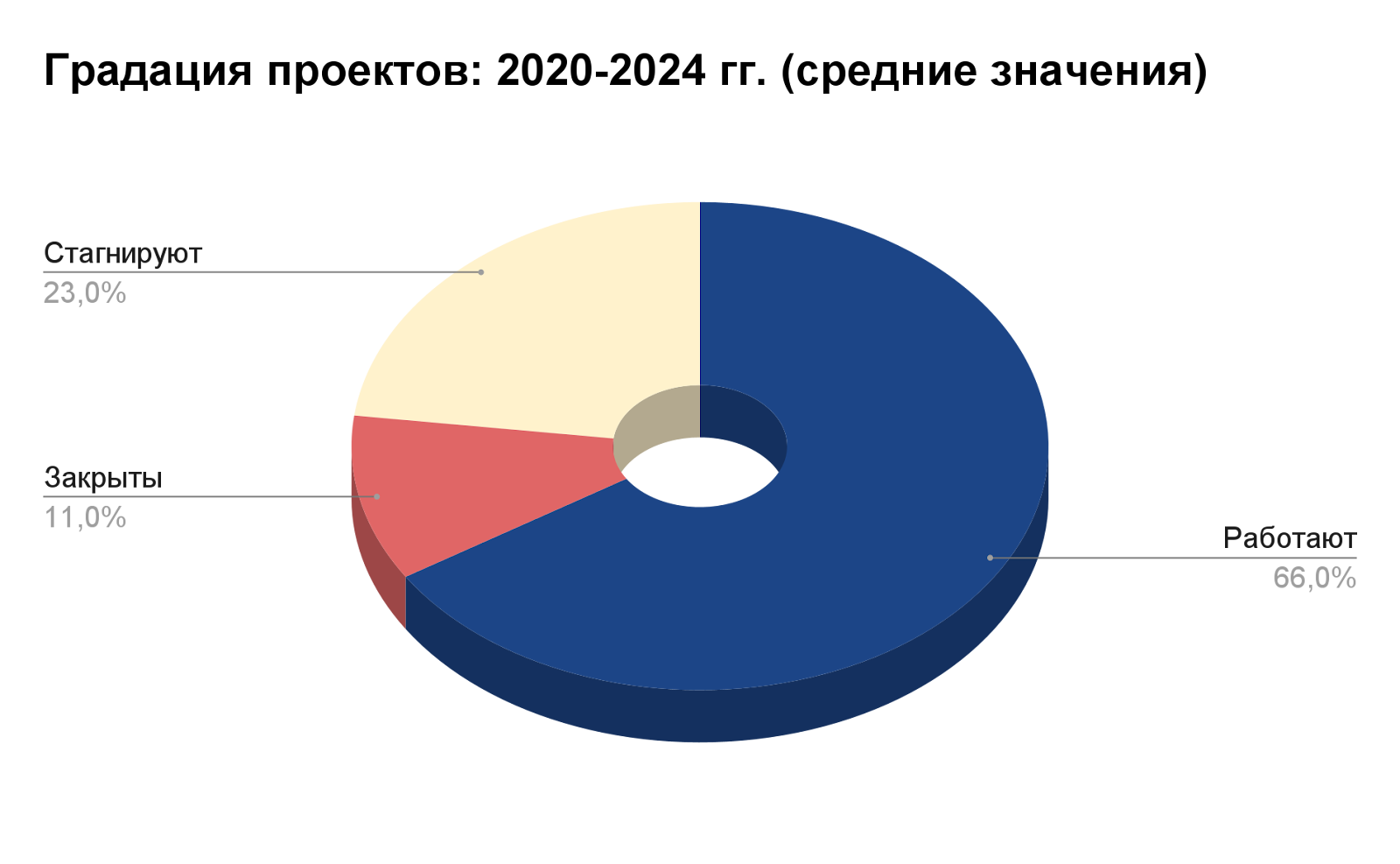
In the medium term, NFT tickets may claim only 1%–5% of the market—and that would be enough. Before you rush off to launch yet another ticketing service, consider the data I have gathered.
Source: Menaskop.
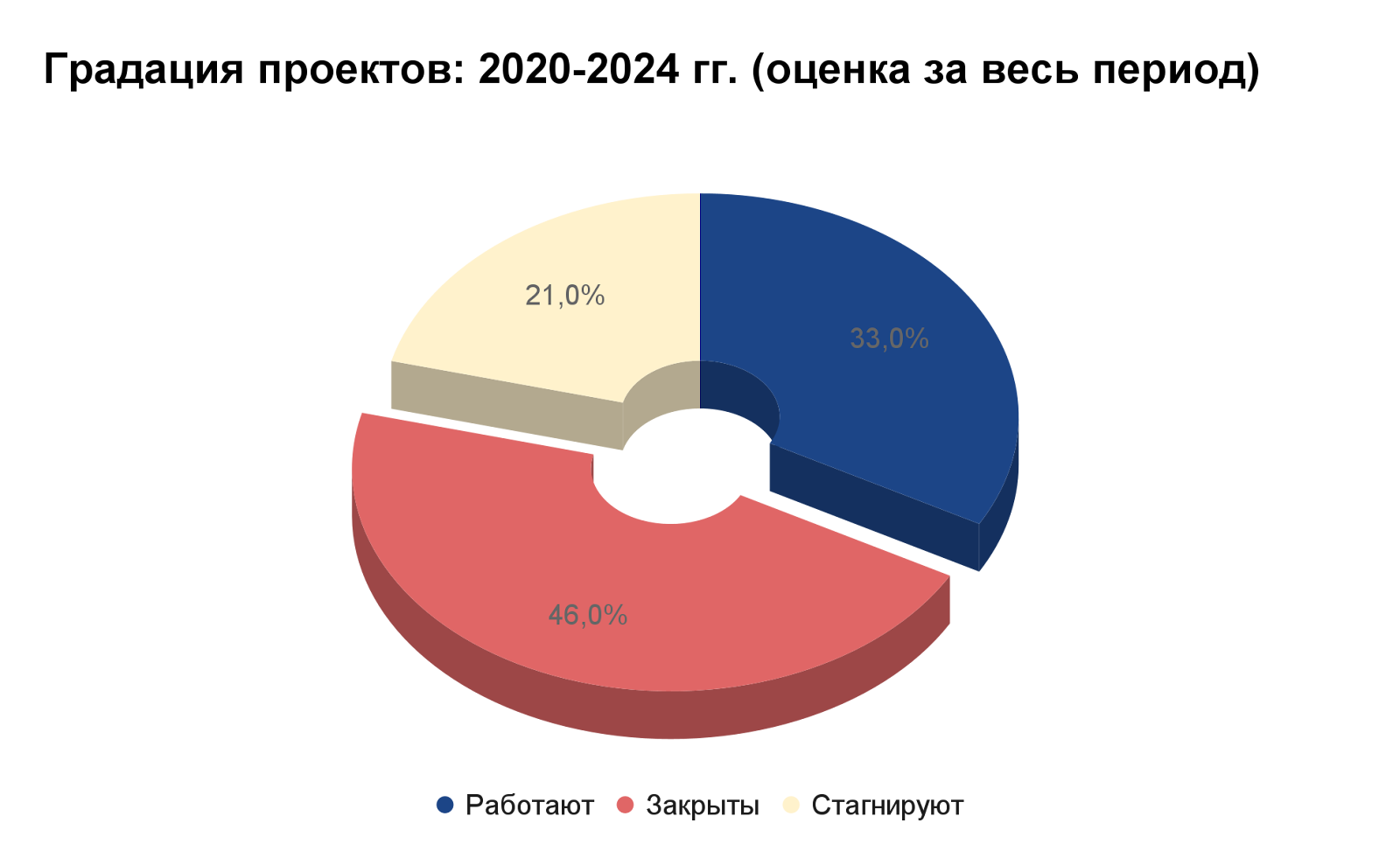
This is an approximate assessment. Pinpointing exact figures is hard because:
- many startups shut down before shipping a product;
- some projects stagnate for one to three years, then suddenly scale—say, after an IDO or an airdrop;
- companies often pivot—Cardinal, Collab, Debank and others come to mind.
Source: Menaskop.
In the first case, the metrics are derived as follows: take P1 (period one—2020 through 2021 inclusive), calculate the share still operating at year-end, the share closed and the share stagnating, and determine their proportions.
Then repeat for P2 (2021–2022), P3 (2022–2023) and P4 (2023–2024). For 2024, the figures are extrapolated from the first half—another source of adjustment.
In the second approach, we tally the entire period—2020 to 2024 (with extrapolation). The key point: projects shut down frequently, especially over the medium term.
See the spreadsheet for details. Many “dead” projects were removed and generalist companies added, to help explore adjacent markets.
Types of players
Some incumbents have bolted on NFT tickets as an experiment. Others were built from scratch on non-fungible tokens. In the latter camp, several focus not only on NFT tickets but also on access passes, certificates and the like (Collab, Unlock, MyShCh).
This is a low-margin business. Many projects, including fairly large ones, have closed for that reason. A notable casualty is Cardinal.so on Solana (the core lines live on, but NFT tickets were axed). Also worth noting: wicketevents.com, ticketmint.app, relictickets.com, dehidden.com and others.
Given the thin margins and relatively straightforward development, competition is fierce—and clear leaders are scarce.
NFT tickets also touch adjacent segments:
- crypto event calendars;
- NFT access services that can be repurposed for events;
- reputation apps (Gitcoin, Nomics);
- others.
Over the past three years I have analysed more than 150 projects. The most interesting today include:
- DeFy Tickets;
- MEGO Tickets;
- Getpass;
- Gated Pass;
- GET Control;
- GUTS Tickets;
- Moongate;
- MyShCh;
- NiftyKit;
- NFT Tickets;
- Oveit Pricing;
- Seatlab;
- Welook;
- YellowHeart.
Research can proceed from the general to the particular, or vice versa. This time I chose the former; profiling each service would take ages and still miss the underlying currents.
Trend one: simple, but not simpler
This is the clearest vector. Everyone talks about mass adoption; event management, however, is one of the hardest segments to execute.
Event formats have ossified over decades. Smart contracts and related stacks, meanwhile, impose constraints unfamiliar to consumers.
There is a third issue: the segment lacks standardised interfaces, and building them can take months or years.
Projects end up reinventing plenty: from email sign-in—recast as Web 2.5—to compliance with copyright when minting NFT tickets.
Several lines stand out:
- tickets can be minted via lazy minting and its variants, greatly simplifying crypto-event creation;
- NFT passes are increasingly paired with AI generators for text and images, speeding up workflows;
- services obsess over payments: integrating aggregators, building gateways and even custodial wallets—in short, lifting conversion;
- and NFTs are becoming programmable assets—NFT 2.0—so the mechanics expand almost without limit.
Simplifying the interface and pushing the back end out of sight is only the first trend.
Trend two: Proof‑of‑Event (PoE)
NFT tickets double as a record of participation—a Proof‑of‑Event. In that sense, Galxe, Layer3 and other online quest platforms converge with projects built to create and promote crypto-events.
Why? Because airdrops by Wormhole, LayerZero, zkSync and many others showed that transactional reputation is a boon, whereas quantitative ratings based on raw activity are often a bane.
What matters is what someone does—and that they are not a bot—not their name or address. Proof‑of‑Humanity (PoH) helps, but does not solve everything.
Here is the key, if not obvious, conclusion.
Services focused on accesses, on proving “humanity”, on selling tickets, on-chain certification, running quests and building guilds are merging into a continuum—where Proof‑of‑Event becomes a basic, if not the only, way to separate signal from noise.
Together, these technologies enable a simple algorithm:
- first, establish whether a wallet/account is active in an app, service, protocol or network;
- then check whether it can be identified via PoH, PoE and other mechanics.
That brings us to a decentralised triad—the 3P: Proof‑of‑Humanity, Proof‑of‑Event, Proof‑of‑DeFi. And there is more.
Trend three: multichain, or bust
In 2024, single‑chain plays are out of favour: even Bitcoin now boasts L2s, with bridges into the EVM world. Cardano, Algorand and others, by contrast, seem stuck.
Let a hundred flowers bloom, but the lesson from NFT tickets is clear: connecting only Ethereum or only Arbitrum is not enough.
Blast, for instance, bet on apps fully native to its L2. Within months, beyond the native bridge, many others appeared—and with them a host of multichain apps from Uniswap and Wassabi to Element and more.
Cross‑chain tickets are thus not a mere LayerZero offshoot but a necessity born of relentless product improvement in services and specific dapps. This works only if we accept that LayerZero’s daily‑transaction plunge of 97% stems from liquidity centralisation—and the lack of clear rules to unify the 3P.
The war on Sybils, now declared by almost everyone, is a blunt and not always correct instrument (zkSync’s experience suggests as much). The 3P approach is more promising and does not violate Web 3.0/Web3’s core tenets: decentralisation, anonymity, openness.
Trend four: tickets are not tickets
NFT and NFT 2.0 are the tip of the iceberg—and the iceberg itself. Why:
- NFT 2.0 encompasses far more standards than NFT—and not only ERC‑404;
- NFT 2.0 safely includes SFT, as they are also a subclass of programmable assets;
- NFT 2.0 may appear as wrapped (wNFT), dynamic (dNFT), collective (cNFT), programmed (xNFT) and more—and can combine these forms in myriad ways;
- in the end, NFT 2.0 enable not just tickets but gifts, certificates, single‑use passes and much else.
When we talk about NFT tickets, we really mean the full range of programmable‑asset subtypes—and many mechanics yet to be built.
Already, you can mint an NFT that, after a set period and a specific user action, turns into a wNFT and later an SBT—proving you attended an event, took an action and received tokens. No one will know who you are. To everyone else, you will be the account of a living human on one or several blockchains.
All this without intermediaries: just decentralisation and you. The excitement may feel premature, but the implications are real—for DeFi, GameFi, DeSoc and more.
Conclusions
Every article should end with conclusions. I wondered what truly matters here—NFT tickets hardly sound revolutionary. It turns out the picture is richer: quest services (Galxe, Layer3), guilds (Guild.xyz), PoH services (Civic, Nomics, Gitcoin) and NFT tickets are coalescing into a single trend—transactional reputation.
For me this is doubly significant: first, ideas discussed seven or eight years ago have become reality; second, we are witnessing the rise of Proof‑of‑Event—across events, airdrops, DeFi, GameFi and many other sectors, segments and niches.
The second conclusion is broader still: meme‑coins and tokens, Uniswap forks across networks, replicable oracles and similar pursuits are the formation of business models in Web3.
If the era of ICOs or early mining was about high risk and startups, then today mining is a business model—just as communities around meme‑coins are, not the pump‑and‑dump kind but those building ecosystems: Notcoin, Shiba, Doge.
It may sound odd, even absurd, but the numbers do not lie. We have found ourselves in a future where each of us has a semi‑autonomous (and, in time, fully autonomous) avatar capable of earning real income: be it a Discord role, DYM/ALT/EIGEN accruals to stakers, or the weaving of decentralised social networks into endless constellations of protocols, dapps and direct P2P chats.
Рассылки ForkLog: держите руку на пульсе биткоин-индустрии!