


RaaS, ready to roll: leading turnkey rollup platforms
The Web3 market hosts thousands of dapps running across hundreds of blockchains. GameFi and DeSoc users need fast, reliable and low-cost interactions, while developers want simple tools to build, tailor and scale such applications.
This article examines Rollup-as-a-Service (RaaS) — platforms that offer customised rollups for specific tasks, looks at where they fit, and reviews established providers.
Where to deploy dapps
All blockchains grapple with scalability, constrained by throughput and high transaction costs. Second- (L2) and third-layer (L3) solutions help by moving computation off the base layer (L1), easing load on the main network and improving overall performance.
Developers have four main options for hosting and operating dapps:
- L1. The now-classic approach — deploying atop networks such as Ethereum — underpinned popular projects like Aave and Uniswap in their early days. The key advantages are security and the marketing pull of a large-chain ecosystem. The drawbacks include the high cost of deployment and maintaining smart contracts. In addition, every dapp shares blockspace with many others, creating scalability bottlenecks, weaker performance and sharp fee spikes at peak times.
- L2. In 2024 Ethereum’s Dencun upgrade, including EIP-4844 and BLOB activation, cut rollup transaction costs by nearly tenfold. On popular L2s such as Arbitrum One and OP Mainnet, fees fell below $0.10, opening new prospects for dapp design. As rollups, sidechains, validiums and other L2s proliferated, they too met scalability challenges for certain workloads. Social networks and gaming platforms, for instance, demand high parallel throughput and thus bespoke network architecture. Moreover, general-purpose L2s are built for broad use cases and do not allow fine-tuning across the axes of security, privacy or speed.
- Customisable solutions: appchains and L3. Appchains sit atop any layer and are designed for applications. Cosmos is a prominent champion of customisation via IBC. In Cosmos Hub, more than 90 different “zones” operate, including Sei, Injective and Kava. In the relatively new L3 stack, solutions such as Degen Chain and Xai target specific social and gaming needs, trading off speed and low costs against security.
- Custom rollup. At the intersection of the previous three options sits a newer approach: running an application on its own, unique rollup. This emerged with modular blockchains like Celestia and rising interoperability. Blending high reliability with design flexibility gives dapp developers a handy instrument.
The leaders in scalability have built frameworks for easily spinning up rollups. With OP Stack, Arbitrum Orbit and ZK Stack, developers can build on a ready base. RaaS providers simplify things further, offering step-by-step deployment and configuration.
Pros and cons of RaaS
Building and maintaining rollups typically requires significant resources, technical expertise and time. RaaS lets developers focus on dapp design and business operations while the infrastructure is delivered as a service. The approach offers these advantages:
- brings additional audiences of developers and business startups to Web3;
- networks can be customised to specific needs: security measures, throughput, transaction fees;
- component integration. The modular nature of RaaS allows combining different elements — data availability (DA), consensus and execution;
- support for third-party tools such as block explorers and wallets enhances functionality and usability;
- monitoring and maintenance. RaaS can track performance and security, helping ensure optimal operation;
- help with scaling a startup. RaaS providers can rapidly expand rollup resources, manage traffic and transaction volumes, and optimise speed and efficiency.
Drawbacks include:
- centralisation risks. RaaS providers deploy and run infrastructure on developers’ behalf. A startup is forced to delegate a sometimes critical share of its operations, increasing dependency. There are also persistent risks of censorship or unilateral changes, which can hurt a company’s reputation;
- liquidity issues. Rollups launched via RaaS may initially have thin liquidity compared with well-known L1s or L2s. That complicates moving assets between networks via cross-chain bridges and harms user experience.
The rollup menu
Providers offer similar toolkits, differing mainly in extra configurable services. The analytics platform L2BEAT lets you aggregate by a specific RaaS platform. Here are the main options.
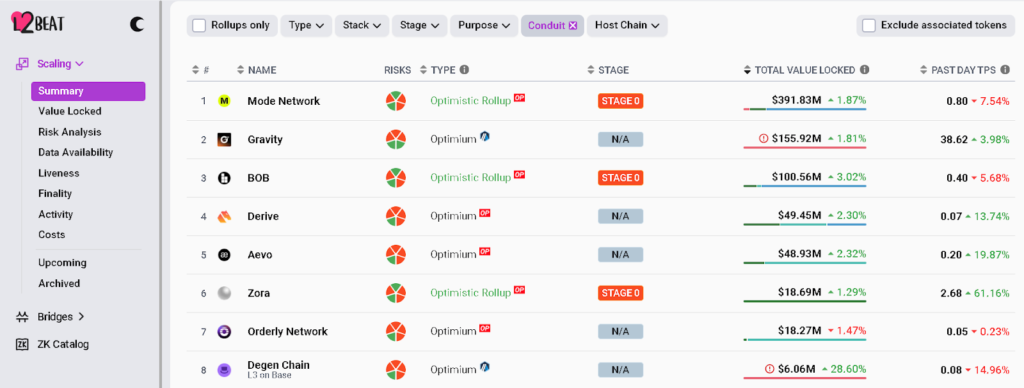
Conduit. Its mainnet, launched in March 2023, lets developers run their own optimistic rollups. The RaaS supports two frameworks: OP Stack and Arbitrum Orbit.
Services include a block explorer, transaction tracer, auto-scaling RPCs, logs and monitoring. Integrations are part of rollup management, allowing partners to connect to other infrastructure projects — for example, configure account abstraction (AA) or add price oracles. To simplify access, Conduit Marketplace was launched in late August 2024.
In October 2023 the team, together with Uniswap Foundation, announced an OP Stack–based rollup meant as a sandbox for Uniswap v4 developers. On 10 October 2024 the popular DEX unveiled its L2 — Unichain — within the Superchain.
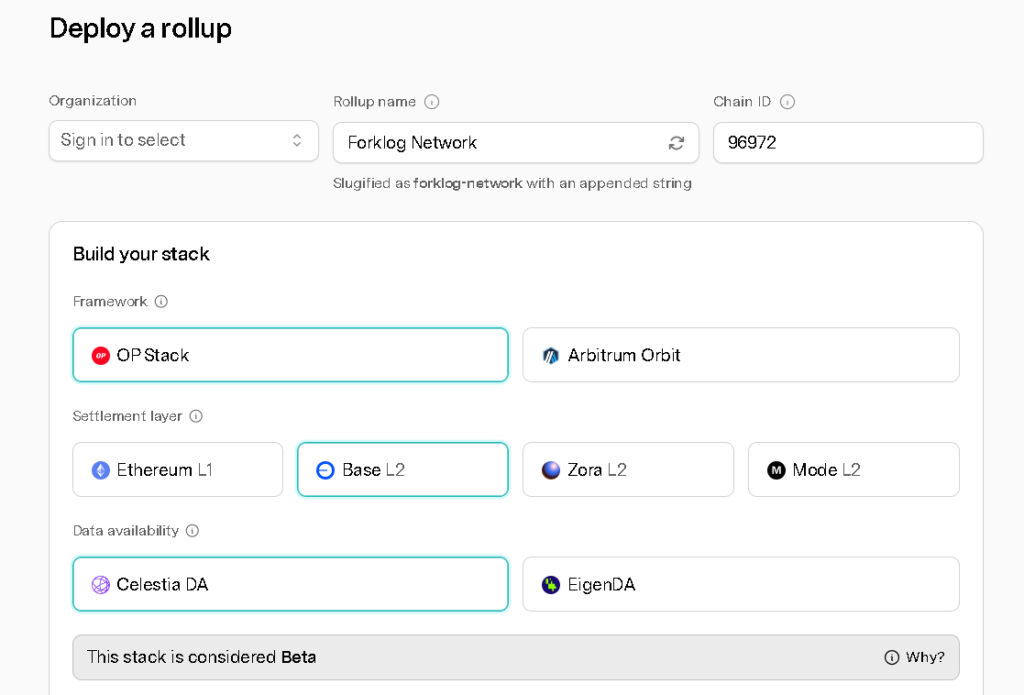
In February 2024 Conduit introduced an application for launching L3 solutions. Any L2 or L3 network can be spun up in about 15 minutes, depending on settings. The first step is to choose the rollup’s name, framework, execution layer and DA.
In a test run to create a third-layer network, ForkLog Network, we opted for OP Stack on top of the Base execution layer with Celestia DA. The calculator estimated a one-off deployment fee of ~0.239 ETH, while a testnet would be free.
In Ethereum’s economic model, rollups as part of the ecosystem earn revenue in ETH. Conduit charges a 5%–10% fee on profits. When choosing Arbitrum Orbit, an additional 10% goes to the Arbitrum DAO.
Regardless of settings, a testnet costs $50 a month and a mainnet $3,000 a month.
In June 2024 Conduit raised $37 million in a Series A led by Paradigm and Haum Ventures. The provider’s portfolio includes Zora, Mode Network, L1 Gravity by Galxe, BOB for scaling Bitcoin, Aevo, Orderly Network and Degen Chain.
The latter — an L3 with the DEGEN token — blamed block-production outages and users’ loss of funds on poor performance by third-party providers. After one such major incident, an L2BEAT researcher found that all of the provider’s networks depend on a single multisig wallet. If it were compromised, every solution built with this RaaS would be at risk.
AltLayer. A RaaS platform that lets developers launch optimistic and ZK rollups, offering interoperability with various virtual machines (VMs) used in the Cosmos SDK. The team plans to add Solana’s VM and the Move VM from Sui and Aptos. Unlike Conduit, AltLayer additionally supports Polygon CDK and ZK Stack.
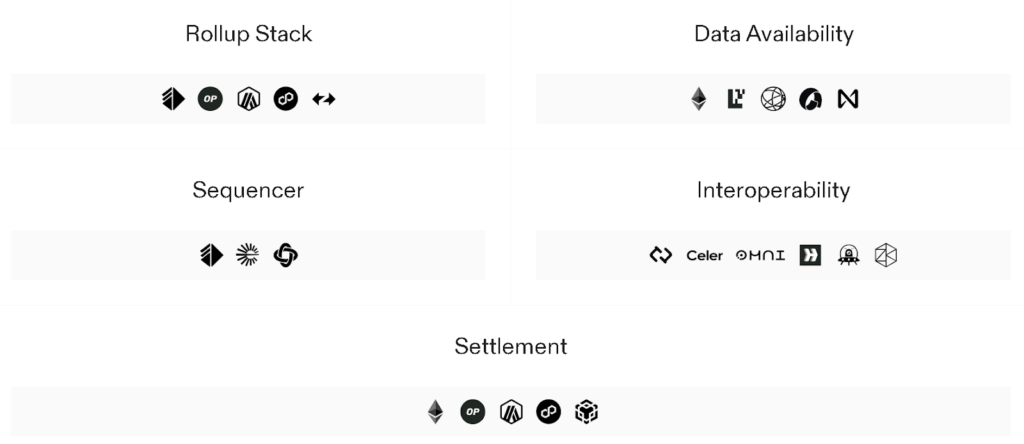
Clients get a broad choice of DA. Beyond Celestia and EigenLayer, Avail, Near and Alt DA can be used to tailor a rollup.
EigenLayer offers restaking and AVS-as-a-Service. AltLayer’s core innovation is Restaked Rollups — essentially a set of three vertically integrated AVSs, created on demand. They provide state-correctness verification, faster finality and decentralised sequencing.
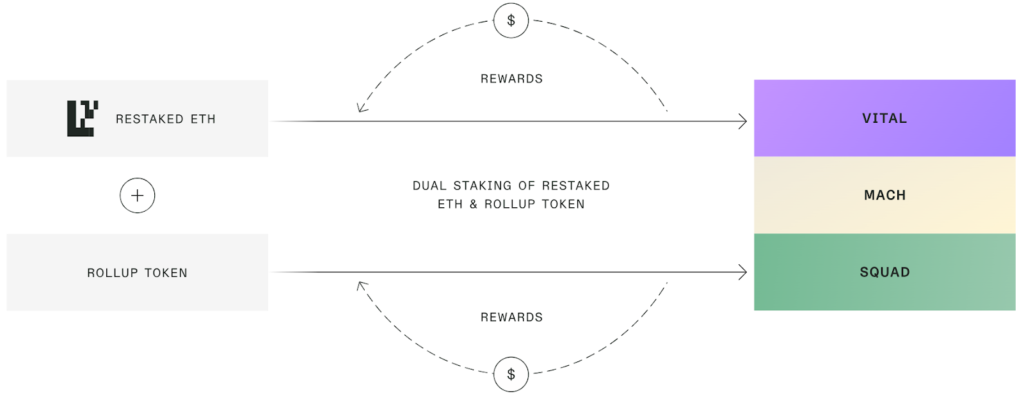
In January 2024 an airdrop of the ALT token took place; the following month AltLayer raised $14.4 million from Polychain Capital and Hack VC.
On 15 May 2024, with AltLayer and an OP Plasma implementation, the developers launched the Cyber L2 mainnet for DeSoc.
Caldera. A developer platform for building Caldera Chains — networks based on optimistic and ZK rollups. The screenshot shows four types of base frameworks.
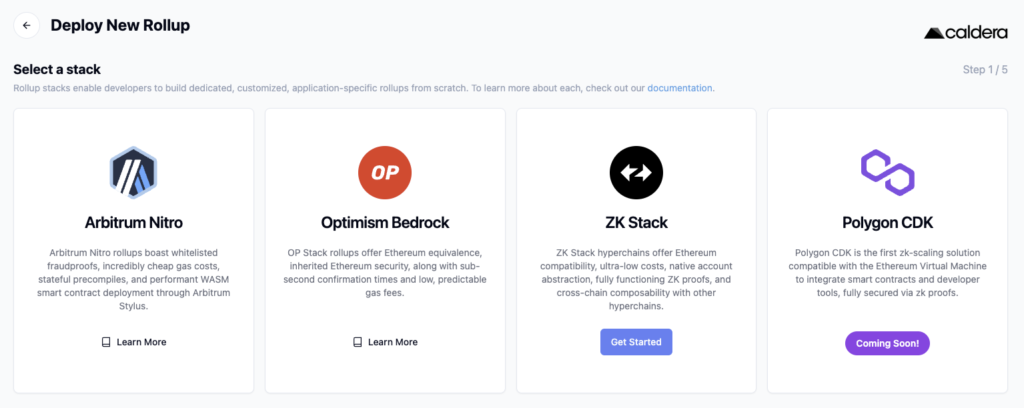
Caldera positions itself as a universal turnkey rollup platform — Metalayer. It provides developers with all the necessary tools, resources and even a white-label documentation feature — Whitelabel Docs.
Caldera also lets teams configure gas-token usage. This makes it possible to remove fees, useful for some dapps such as Web3 games. In addition, an early-access-to-EIPs feature is in development — allowing startup teams to use improvements before they land on Ethereum mainnet.
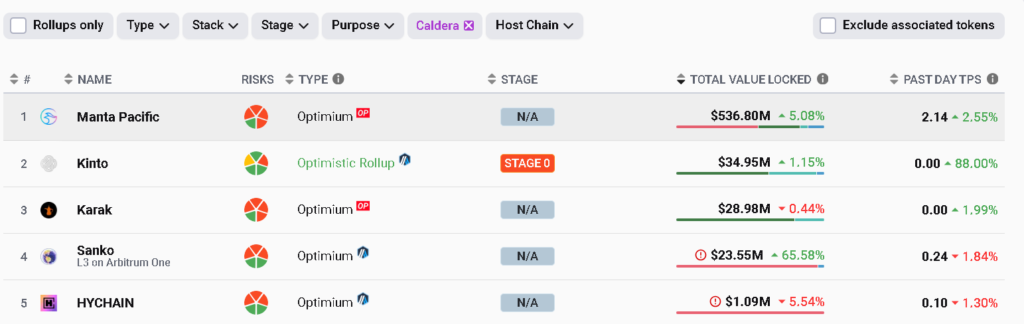
Caldera has powered the L2 Manta Pacific and Sanko, an L3 gaming solution. In March 2024, with support from the RaaS provider, the Cosmos-based mainnet for the inEVM L2 went live.
In July 2024 Caldera closed a $15 million Series A.
The round was led by Peter Thiel’s Founders Fund. The proceeds will go towards building Metalayer to unify the second- and third-layer ecosystem.
Gelato. Founded in 2019, the platform initially helped developers create gasless, automated smart contracts capable of off-chain computation. In September 2023 Gelato completed its transition to a RaaS.
The team now provides infrastructure services for customising networks. The project’s main focus is ZK rollups and AA.
zkRaaS enables the creation of ZK rollups using Polygon CDK. The first client in this stack was Astar zkEVM. The platform also supports OP Stack and Arbitrum Orbit.
The Gelato team has been active in advancing AA. In March 2023, staff at Safe (formerly Gnosis Safe), a platform for managing digital assets, released an SDK. The toolkit, Safe{Core}, enables AA as an alternative to traditional wallets with private/public keys. It was built in collaboration with payments giant Stripe, Gelato and Web3Auth.
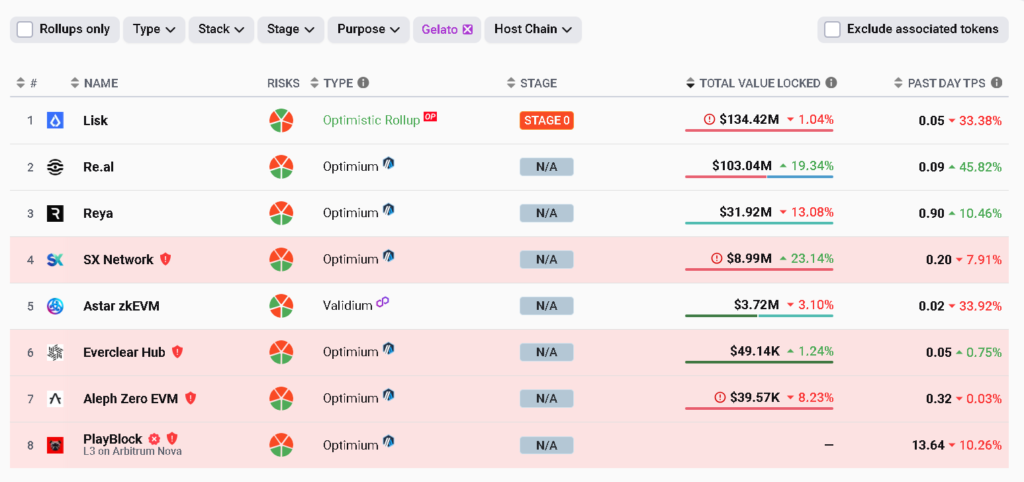
Clients of the RaaS provider include Lisk, which switched from its own L1 blockchain to a custom L2; the RWA platform Re.al; and the on-chain trading service Reya.
To support the decentralisation of its economic model Gelato issued the GEL token. According to CoinGecko, as of 20 October 2024 its market capitalisation exceeds $30 million.
In March 2024 the infrastructure crowd also took note of Espresso Systems. A Series B round closed at $28 million, led by a16z with participation from RaaS platforms Caldera, Lumoz and Eclipse.
In late 2023 the Web3 infrastructure provider Ankr unveiled a RaaS for ZKsync Hyperchains (L3). The project specialises in scaling Bitcoin and offers infrastructure for rollups built on the Babylon Bitcoin Layer protocol. Another Bitcoin L2, Bison Labs, is working on RaaS solutions atop the first cryptocurrency.
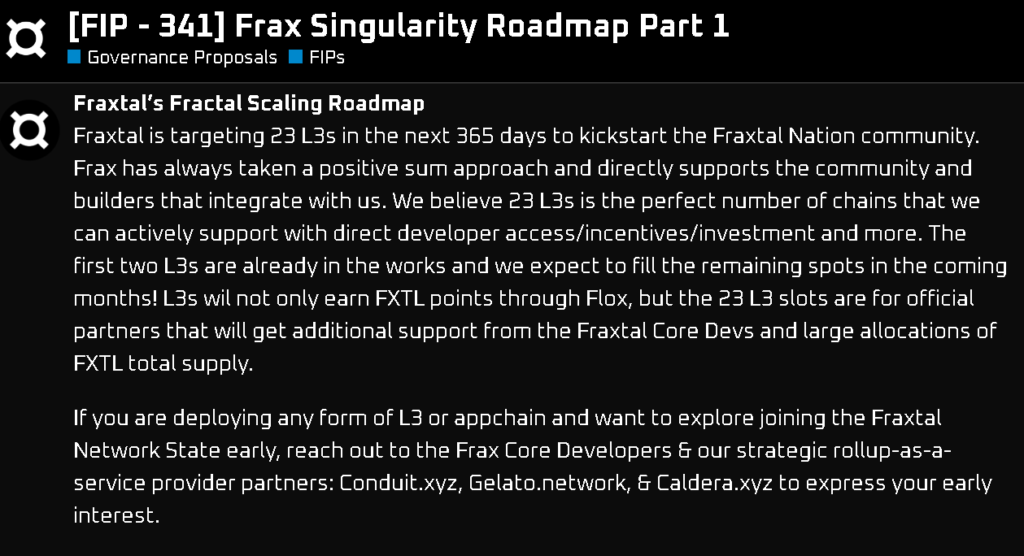
Frax Finance founder Sam Kazemian, in the updated “Road to Singularity” roadmap, referred to strategic RaaS partners who will apparently help ship 23 L3s by March 2025.
Conclusions
Rollup-as-a-Service is a powerful instrument that lowers the barrier to scalable blockchain solutions and opens new doors for developers and businesses. Engineers can focus on building innovative applications without the headaches of standing up and maintaining their own infrastructure.
RaaS congregates almost every part of the industry around it. Yet providers wield substantial power: they can put a blockchain into maintenance mode or fail to uphold an adequate security standard.
Text: Sergey Golubenko
Рассылки ForkLog: держите руку на пульсе биткоин-индустрии!