




- The SEC has postponed its decision on the ETH-ETF from Invesco and Galaxy to July 5.
- Inflows into U.S. Bitcoin spot ETFs continued for the second consecutive day.
- Hong Kong’s BTC-ETF recorded its first net outflow.
The U.S. Securities and Exchange Commission (SEC) has extended the review period for the proposed spot Ethereum ETF by Invesco and Galaxy. This information is available on the agency’s website.
The next deadline is July 5, 2024.
“The Commission finds it appropriate to designate a longer period within which to take action on the proposed rule change. This is necessary to allow time for consideration of the proposed rule change and the issues raised therein,” noted representatives of the agency.
On April 23, the SEC postponed its decision on Franklin Templeton’s spot Ethereum ETF, setting a deadline of June 11. Prior to this, the regulator extended the review period for a similar application from BlackRock.
In May, the final deadline for proposals from VanEck and Grayscale will arrive.
In April, experts from Standard Chartered joined the skeptics doubting the approval of spot ETH-ETFs by this deadline. Analysts cited the lack of constructive dialogue between the Commission and issuers.
Summary of BTC-ETF
According to SoSoValue, on May 6, inflows into Bitcoin spot ETFs continued for the second day in a row, totaling $217 million.
According to SoSoValue, total net inflows into Bitcoin spot ETFs on May 6 were $217 million. Grayscale ETF GBTC saw a single-day net inflow of $3.937 million. Fidelity ETF FBTC had a single-day net inflow of $99.1936 million, Ark Invest and 21Shares ETF ARKB had a single-day net… pic.twitter.com/1OrHFH4Vpz
— Wu Blockchain (@WuBlockchain) May 7, 2024
Positive momentum also resumed in BlackRock’s IBIT ($22 million).
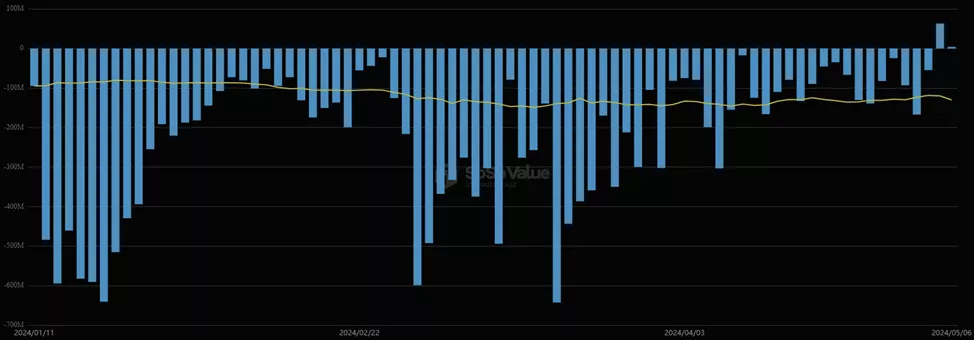
The overall trend was supported by Grayscale’s GBTC ($3.94 million). The previous day, investors had poured $63 million into this exchange-traded fund. Since the approval of the ETF on January 10, negative dynamics had been observed for 78 days.
Overall, during the entire period under review, the net outflow from GBTC amounted to $17 billion. AUM fell to 292,217 BTC ($18.4 billion).


Net Outflow in Hong Kong
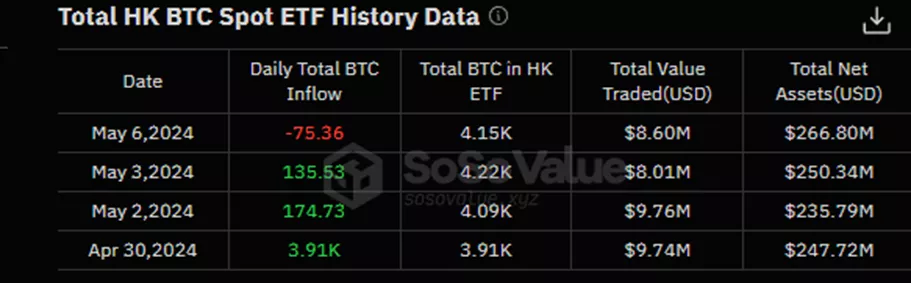
Hong Kong recorded its first net outflow since the start of trading on April 30 (75.36 BTC). Investors withdrew this amount from the ETF by ChinaAMC, while other products showed zero dynamics.
Thanks to the positive market conditions, AUM rose to $266.8 million.

The combined inflow into spot BTC and ETH ETFs on the first day after launch was approximately $292 million.
We just put out note with final data (which doesn’t come in as fast as US). In short, HK saw $292m in assets on Day One (we predicted $1b in two years so way ahead of schedule but corrections can derail trajectories as we seeing in US). Ether ETFs grabbed 15% of pie and size… https://t.co/RT8SvMvEuA
— Eric Balchunas (@EricBalchunas) May 2, 2024
The provided statistics do not reflect the physical acquisition of exchange-traded funds.
Unlike the approved Bitcoin ETFs in the U.S., their counterparts in Hong Kong have a subscription and redemption mechanism in kind. This allows for the exchange of underlying assets for ETF shares and vice versa, whereas American counterparts operate on a cash redemption model.
On May 1, the outflow from spot Bitcoin ETFs reached its highest level since the registration of the products — $563.8 million.
Later, Robert Mitchnick, head of digital assets at BlackRock, predicted a new wave of inflows into these instruments due to institutional investor participation.
Previously, Bernstein described the slowdown in inflows into Bitcoin-based exchange-traded funds as temporary.