



SEC Commissioner SEC Hester Peirce urged the crypto industry to temper expectations regarding the “innovation exemption” for trading tokenized stocks. According to her, the regulator does not plan to permit the issuance of synthetic assets.
I appreciate the interest in—but not the hyperbole about—the contemplated innovation exemption for the onchain trading of tokenized NMS stock. Keep in mind: I’ve always expected that it’d be limited in scope & would facilitate trading only of digital representations of the same…
— Hester Peirce (@HesterPeirce) May 21, 2026
Peirce’s statement followed a Bloomberg report indicating that the Commission is preparing rules for stock tokenization without issuer consent. According to the agency, the SEC discussed guidelines for trading RWA securities with “hundreds of market participants.”
Peirce clarified that the relaxations will apply only to digital copies of stocks already traded on the secondary market. Tokens must confer the same rights as regular shares, including voting and dividends, she emphasized.
Securitize CEO Carlos Domingo supported this stance. In his view, issuing tokens by third parties without issuer involvement fragments the market and creates risks.
This is good, we want to do on-chain trading, but for the right assets, and not to help proliferate those derivatives that are fragmenting the market and introducing additional risks. Tokenization is needed to solve problems and eliminate intermediaries, not to add new additional… https://t.co/vNTfC5vOoF
— Carlos Domingo (@carlosdomingo) May 22, 2026
Robert Leshner, CEO of the Superstate platform, agreed, asserting that a strict approach will maintain the standards of the American financial market during the integration of DeFi.
The SEC has been hard at work crafting an innovation exemption that will bring securities into the tokenization & DeFi era, without compromising the standards that make the USA the center of capital markets.
More innovation, done well, soon 👏 https://t.co/x1nNUMM9gF
— Robert Leshner (@rleshner) May 21, 2026
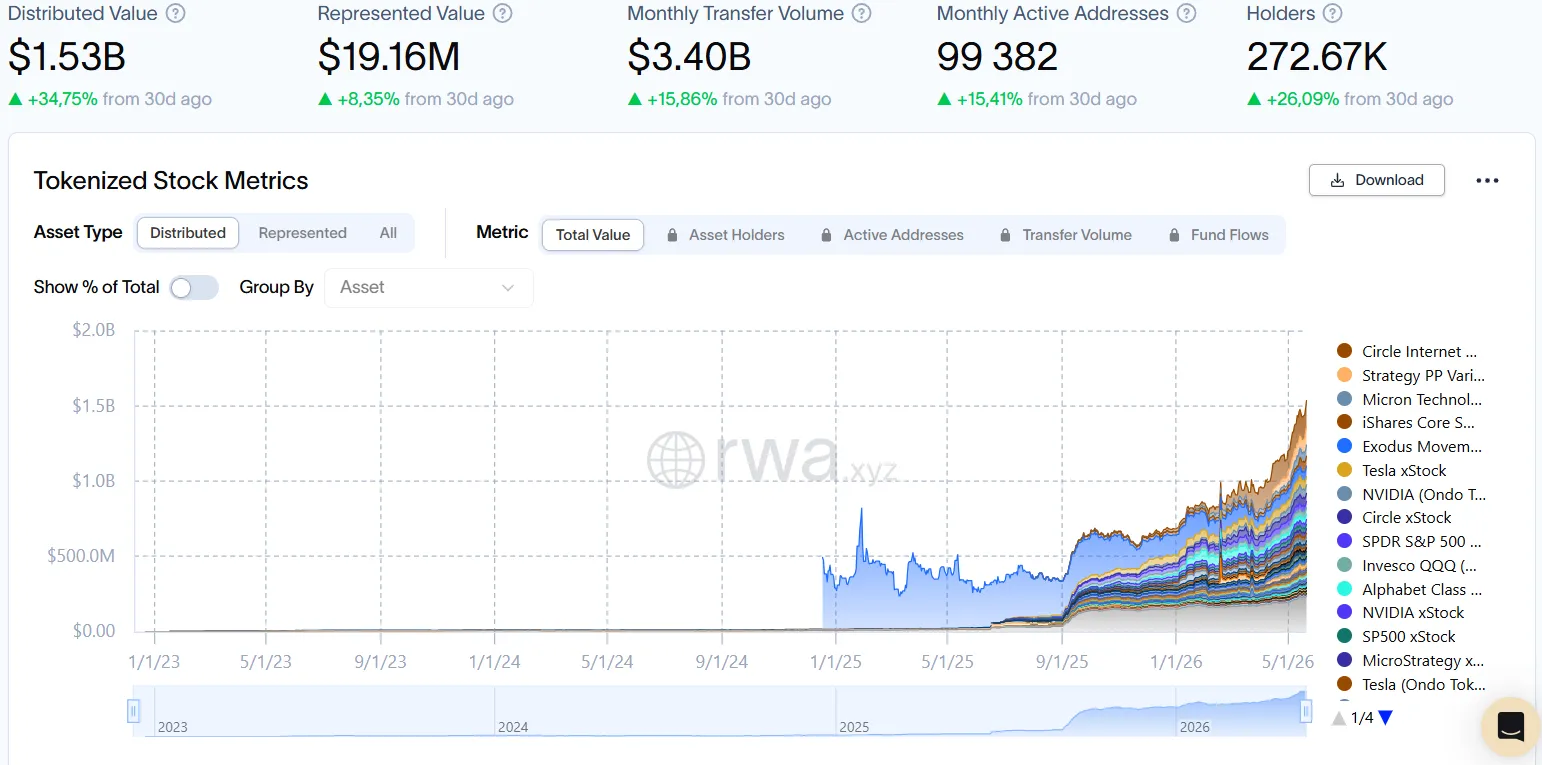
According to RWA.xyz, stocks worth $1.53 billion have been issued, including shares of Circle, Strategy, and Google. The sector is growing more slowly than analysts’ forecasts, which anticipated trillion-dollar turnovers by 2030.


RWA Risks
The Bloomberg publication also drew a response from Ryan Yoon, head of research at Tiger Research, who warned of liquidity fragmentation risks due to stock tokenization without issuer consent.
— Tiger Research (@tiger_research_) May 22, 2026
According to the expert, capital will begin to move from centralized platforms to various blockchain networks. This will dilute trading volumes currently concentrated on the NYSE or Nasdaq.
“Traditional finance sees a serious threat in the breakdown of consolidated liquidity,” Yoon stated.
Market fragmentation will lead to price discrepancies across platforms and slippage in large transactions. Tiger Research believes this will reduce overall market efficiency.
The second issue will be profit outflow. When tokenized stocks are traded on numerous decentralized platforms, exchange revenues go offshore. This undermines the country’s financial competitiveness.
FG Nexus’s head of digital assets, Maja Vujnic, added that dividing the market into “isolated pools” will create pricing errors. There will also be a risk of “shadow short selling” due to a lack of local buyers to stabilize prices.
Proponents of tokenization point to its advantages:
- instant settlements;
- fractional asset ownership;
- low fees;
- 24/7 trading.
Siebert Financial analyst Brian Witten believes that the SEC’s decision will accelerate the financial system’s transition to blockchain. He predicts that some capital will eventually flow into Bitcoin and Hyperliquid networks.
In May, it was revealed that the Bank of England will focus its future strategy on RWA to modernize the country’s economic sector.