



Silicon Tanks: Evgeny Morozov, prophet of digital scepticism
While Silicon Valley promised peace, fellowship and democracy via apps, the Belarusian scholar Evgeny Morozov warned that technology is not magic but a tool of power. A decade ago he was branded an alarmist; today his books are read as manuals for the digital world.
Why Morozov’s critique of “solutionism” and “internet-centrism” feels timelier than ever in an age of total data control and AI hype—read in a new instalment of Silicon Tanks from ForkLog.
Who is Evgeny Morozov?
Evgeny Morozov is a Belarusian-born researcher, writer and public intellectual. He is one of Silicon Valley’s most prominent and consistent critics. After studying in the United States and working at Stanford University, Morozov published two books that set the course of his thinking and helped found modern techno-scepticism.
Unlike many theorists, he does not simply criticise technology; he analyses its political and economic underpinnings. Morozov looks at Facebook, Amazon or Uber not as services but as powerful institutions reshaping society. In a piece for The Guardian he examines so-called “platform capitalism”—the economic model promoted by tech giants.
In his view, the impulse of these companies to call themselves “platforms” is less an innovation than a crafty move to dodge traditional regulation, taxes and responsibility. They do not make goods or provide services directly; they merely connect suppliers with consumers. That lets them command vast market valuations with minimal assets and headcount.
The core idea of the article is that the real power of “platforms” lies not in the core service but in control of the periphery: payments, identity verification, location data and algorithms. Those auxiliary elements have become central—and whoever owns them sets the rules for the entire industry.
“The world of ‘platform capitalism’, for all its intoxicating rhetoric, is not that different from its predecessor. The only thing that has changed is who pockets the money.”
“The Net Delusion”: how the internet failed to bring democracy
Morozov’s first breakthrough was The Net Delusion: The Dark Side of Internet Freedom (2011). In it he took aim at “cyber-utopianism”—the naive belief that the internet and social networks automatically spread democracy and liberate people from authoritarian regimes. He argues that the reality is far more complex—and darker.
His main point is that the same technologies activists use to organise protests are used even more effectively by dictatorships for their own ends. Authoritarian regimes have learned to deploy the internet for mass surveillance of citizens, identifying dissenters, spreading pro-government propaganda and manipulating public opinion. In his view, the internet has become a tool for consolidating power, not undermining it.
“The West’s obsession with the internet’s emancipatory power rests on a profoundly mistaken understanding of how authoritarian regimes work.”
He also introduced the notion of “slacktivism”, criticising the idea that online activity—likes, reposts or signing petitions—constitutes full-blooded political struggle. Such gestures create an illusion of participation without real risk or effort, distracting from more difficult and effective forms of real-world protest.
“Authoritarian governments will not fall because of a few sarcastic tweets.”
Morozov’s book urges a sober, critical look at the role of technology in politics. The internet, he shows, is merely a tool; its impact depends entirely on the social and political context in which it is used.
“To credit the internet with establishing democracy is like thanking the blacksmith for the sword’s ability to kill.”
A critique of “solutionism”: when a hammer sees only nails
His second landmark book, To Save Everything, Click Here: The Folly of Technological Solutionism (2013), targets Silicon Valley’s ideology. Morozov introduces the term “solutionism”.
Solutionism is the belief that any complex social, political or cultural problem can be solved with a simple, elegant technological fix—usually an app, a platform or an algorithm.
- Obesity? Here’s a calorie-counting app. It ignores economic causes, access to healthy food and psychological factors.
- Inefficient government? Let’s build a “smart city” with sensors everywhere. That may ease congestion, but it creates pervasive surveillance and hands control of urban infrastructure to private IT corporations.
- Political apathy? Create an online voting platform. It simplifies the process but does not fix the lack of trust in political institutions or improve the quality of debate.
For Morozov, solutionism is dangerous because it offers simple answers to complex questions. It makes us forget context and focus on what can be measured and optimised, ignoring the rest. Instead of reforming flawed institutions—courts, parliaments, health systems—solutionists propose a technological crutch that merely masks the problem, and sometimes worsens it.
The book urges readers to be more sceptical of technological “panaceas” and to remember that many crucial human and social questions are not engineering tasks; they require political debate, moral choice and compromise.
“The greatest sin of solutionists is their intellectual blindness—their inability to see the world as messy, complex and unpredictable. They want to believe that if they have a hammer (in the form of technology), then every problem is a nail.”
From critique to action: The Syllabus
In recent years Morozov has moved from pure critique to building an alternative. His new project—The Syllabus—is a media platform that tries to fix the information flow imposed by social-media algorithms.
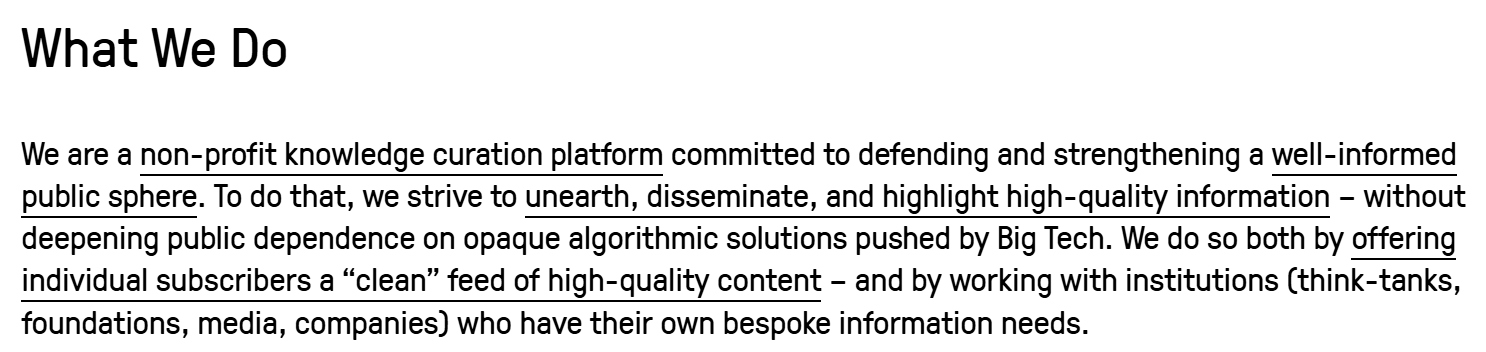
Today’s feeds surface what triggers a fleeting emotional response, not what truly matters for understanding the world. The Syllabus works differently. It uses technology to analyse thousands of sources (academic articles, lectures, podcasts, videos), but human experts make the final selection and curate the content.
The aim is to give users not fragments of news but deep, contextualised content on the most important themes: from climate change and international politics to the future of artificial intelligence. In essence, it is an attempt to build a healthy information diet to counter the digital fast food served by tech giants.
Key ideas and goals:
- fighting superficial content—offers a “healthy information diet” composed of difficult but important material;
- providing context—not just links, but help in understanding why a given item matters;
- interdisciplinarity—building bridges between technology, politics, sociology, economics and culture;
- creating an alternative—an attempt to build infrastructure for serious intellectual work in an era when attention has become the prime commodity.
The Syllabus targets researchers, scholars, journalists, analysts, policymakers, students and anyone who wants not merely to consume news but to understand global processes in depth. It is a paid service, underlining its independence from the advertising model that lives on clickbait.
Morozov and the crypto industry: common enemies, different paths?
At first glance, Morozov’s ideas should resonate with the crypto community. Like advocates of decentralisation, he criticises the monopolies of Google and Meta, opposes “walled gardens” and condemns surveillance capitalism. They share a common foe: the centralised power of tech giants.
Yet Morozov is deeply sceptical of cryptocurrencies and blockchain. In his articles and talks he often brackets them with other forms of techno-solutionism. The belief that blockchain can “fix” trust, corruption or inefficient bureaucracy, he argues, repeats the error made by early internet adherents.
The Syllabus hosts an entire section devoted to cryptocurrencies, whose description includes Morozov’s statement that public debate about digital currencies is intellectually poor and one-sided. On one side are critics who too superficially label everything a scam. On the other—and this worries him more—are the “true believers”, mostly venture capitalists, who shape public opinion in their own interests.
To address this, Morozov launched The Crypto Syllabus. Its goal is to provide intellectual resources to help journalists, scholars and curious readers analyse crypto phenomena (from blockchain to NFTs) critically and in depth.
Morozov argues that crypto should not be discussed in isolation from the wider context: the history of finance, geopolitics and the relationship between Silicon Valley and Wall Street. For now, he believes, the cryptosphere is largely “a set of solutions in search of problems”.
He is also sceptical of the “crypto left”, urging its proponents to prove why their decentralised fixes are more effective against global capitalism than other political strategies, such as democratising central banks.
What next?
Morozov’s work is as relevant as ever. Amid the rise of AI, his warnings about “black boxes” making decisions for us sound especially ominous. His critique of solutionism prompts a question: are we trying to “solve” human creativity with ChatGPT, and decision-making with algorithms whose logic we do not fully understand?
Morozov offers no easy answers and does not lapse into Luddism. He calls for sobriety—forcing us to ask uncomfortable questions: who benefits from this technology? What problem does it truly solve, and which does it create? And are we trying to mend a broken world by simply clicking “Save everything”? In an age when technology promises us everything, the ability to ask the right questions is the most valuable asset.
Рассылки ForkLog: держите руку на пульсе биткоин-индустрии!