


Silicon Tanks: How French Theorists Predicted the World of Web3
French theory that anticipated blockchains, NFTs, metaverses and the Web3 panopticon.
Post-war French philosophy can look like an elaborate parlour game, detached from reality. In truth, thinkers such as Gilles Deleuze, Michel Foucault and Jean Baudrillard sought to explain the new forms of relation forged between the individual, the state and the media.
Read retrospectively, their work anticipates today’s internet, algorithmic feeds and blockchains, and offers tools to analyse decentralisation, metaverses and digital control.
ForkLog examines how the ideas of 20th-century French theorists illuminate the current state of Web3.
Deleuze and Guattari: Rhizome vs. Tree
In 1980 the philosopher Gilles Deleuze and the psychoanalyst Félix Guattari published A Thousand Plateaus. They opposed two societal and informational structures: the arborescent (hierarchical) and the rhizomatic (networked).
The “arborescent” model has a root, a trunk and branches—a strict hierarchy. Centralised servers, corporations like Google or Amazon, and banking systems fit this design. Data flow from administrator to user. The vulnerability is obvious: a blow to the root (the server) fells the entire structure.
The rhizome (a mycelium) is different. It has no centre, beginning or end. Any point can connect to any other. Break one link and the system reconfigures and keeps working.
Blockchain Is the Ultimate Rhizome
Bitcoin’s architecture bears rhizomatic traits. In a peer-to-peer (P2P) network, where every node is equal, there is no single centre of control. The absence of a “main server” makes it resilient to censorship and attack.
Yet many modern crypto projects are faulted for “betraying the rhizome”. The use of centralised gateways (such as Infura for Ethereum), stablecoins with address blacklists (USDT, USDC) and CEX nudges the industry back towards hierarchy.
Deleuze and Guattari warned: a rhizome can freeze into a tree if nodes of power emerge. That is precisely what current debates on DeFi regulation reveal.
The rise of DAOs is an attempt to restore rhizomatic governance by dismantling corporate verticals.
Baudrillard: How the Hyperreal Consumed Reality
Jean Baudrillard did not live to see DeFi and NFTs, yet he described their mechanics long before Bitcoin’s genesis block. His 1981 book Simulacra and Simulation inspired the creators of The Matrix, but reality proved more complex than cinema.
From Symbol to Signal
Baudrillard’s central concept is the simulacrum: a copy with no original in reality. He outlined four stages in the evolution of the sign, which can be mapped onto finance as follows:
- The sign reflects a basic reality (a gold coin has the value of its metal).
- The sign masks and distorts reality (paper money partially backed by gold).
- The sign masks the absence of reality (fiat money printed by central banks without backing).
- The sign bears no relation to reality and is a pure simulacrum (cryptocurrencies).
Baudrillard argued that in postmodernity the map precedes the territory; signs produce reality rather than the reverse. In blockchain terms, code is primary. A Smart contract does not describe a deal; it creates it. Bitcoin became a near-perfect simulacrum: an asset that does not represent dollars or gold, but refers only to itself and to the network’s computational difficulty.
For a crypto investor this clarifies volatility: markets fall not because factories fail but because a narrative collapses.
NFTs, Metaverses, AI
The internet is a factory of simulacra, and NFTs are a case in point. By buying a picture of a monkey, a user acquires neither the object nor the copyright, but a registry entry pointing to another record. It is a sign referring to a sign. Value is formed solely by community belief, with no tether to a physical asset or to labour in the classical sense.
Metaverses embody Baudrillard’s “hyperreality”: a milieu in which simulation becomes more real than the physical world. Users spend real money on digital clothes for avatars. Thus the map (the digital) supplants the territory (the physical).
Generative AI produces content without a human author and without roots in lived experience. The internet fills with texts and images that look authentic but lack a subject behind them. The information space collapses in on itself: truth and fabrication grow ever harder to tell apart.
Foucault: Panopticon Transparent Society
Michel Foucault studied the nature of power and control. In Discipline and Punish (1975) he turned to the panopticon—an “ideal prison” proposed in the late 18th century by the utilitarian philosopher Jeremy Bentham.
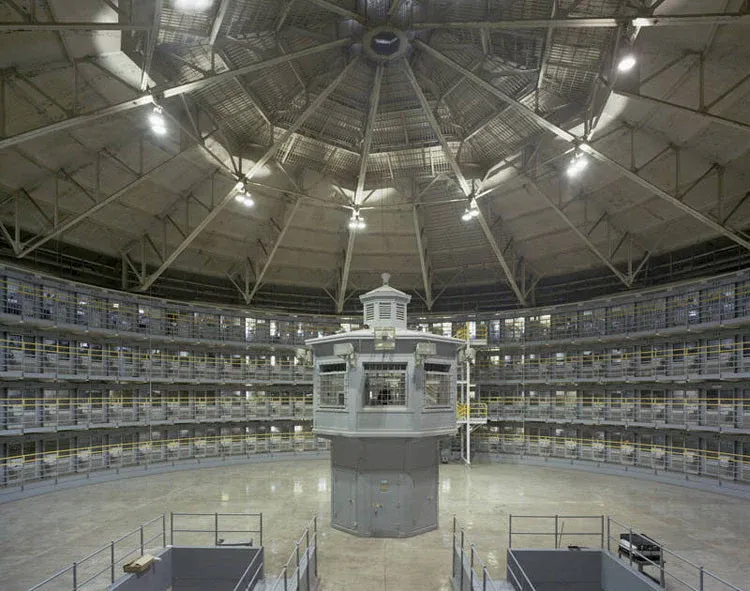
In a panopticon the guard stands at the centre and the cells are arranged around it. Prisoners cannot see the watcher, but know they may be observed at any moment. That knowledge compels continuous self-discipline: power becomes automatic and bodiless.
The internet has become a global panopticon. Social networks, trackers and cookies collect data incessantly. A user never knows when an algorithm is scrutinising their behaviour and so is pushed—consciously or not—to adjust it. The introduction of KYC and AML procedures on crypto exchanges extends the panopticon into finance.
Blockchain as a Tool of Surveillance
Blockchain’s paradox is its duality. On the one hand, it is a tool of freedom (no one can block a Bitcoin transaction). On the other, a public ledger is a dream for a state overseer. All transactions are recorded forever; analytics firms label wallets, making financial life transparent.
With CBDCs, the state can not only watch money move in real time but also program it—for instance, banning certain purchases or setting an expiry date.
The answer is zero-knowledge cryptography (ZK): technology that lets one prove a statement (for example, “I have funds”) without revealing the data. It is a technical bid to breach the panopticon’s walls.
Virilio: Dromology and the Inevitability of the Accident
Speed and the accident sit at the core of Paul Virilio’s philosophy. Technologies not only extend human capacities; they also create new kinds of catastrophe:
“By inventing the ship, you invent the shipwreck. By inventing the plane, you invent the plane crash.”
The Speed of Light and Algorithmic Trading
In the essay Speed and Politics (1977) Virilio introduced “dromology” to describe how modern society is organised. Absolute power, he argued, depends directly on the velocity of data transmission.
High-frequency trading (HFT) and MEV bots in blockchains exploit microseconds. Humans are cut out of decision-making because they cannot react that fast. Power shifts to algorithms.
Integral Accident
Virilio also described the “integral accident”: a catastrophe that occurs everywhere at once thanks to global connectedness.
The collapse of the Terra ecosystem is an example. Panic and cascading liquidations spread instantly, crashing markets worldwide within minutes. Smart contracts execute code automatically and at once, leaving no time to correct mistakes.
Traditional finance has circuit-breakers; DeFi runs in real time, 24/7. In Virilio’s terms, we are building a system whose accident will be global and instantaneous.
Debord: The Society of the Spectacle and the Tokenization of Attention
In 1967 Guy Debord published The Society of the Spectacle. His core thesis: “All that once was directly lived has become mere representation.” Being yielded to having, and having to appearing.
Attention Economy
Online, the commodity is not content but the user’s attention. Social networks turn life into an endless performance for social capital (likes). Cryptocurrencies monetised the process.
Governance tokens, POAP and NFT avatars are instruments of the “society of the spectacle”. People buy costly JPEGs less for art than to parade status in digital communities. Speculative value often rests purely on hype and visuals, detached from technological utility.
For Debord, the spectacle is not a collection of images but social relations among people mediated by images. In Web3, those relations are mediated by tokens.
Bruno Latour’s Actor–Network Theory
Though Bruno Latour was first and foremost a sociologist, his ideas are critical to understanding smart contracts. In actor–network theory (ANT) there is no hard line between humans and objects: both are actants—actors in their own right.
Code as an Actor
In traditional law the subject is a person. On Ethereum, a smart contract acts autonomously. It holds funds, makes decisions and executes transactions without an operator. Code becomes a full-fledged actor in the network.
The 2016 hack of The DAO produced a philosophical and legal conundrum: the hacker merely exploited the code’s possibilities. From Latour’s perspective, code, the hacker and the Ethereum community (which opted for a hard fork) are equivalent agents, shaping reality through interaction. Technology ceases to be a neutral tool; it dictates the rules of the game.
Lyotard: The End of Grand Narratives
In The Postmodern Condition (1979) Jean-François Lyotard proclaimed the death of “metanarratives”—sweeping ideologies that explain everything (religion, communism, progress). They give way to local language games and small narratives.
Bitcoin as a Rejection of the State Narrative
The first cryptocurrency emerged amid a crisis of trust in the financial metanarrative. Digital assets offer a multitude of “small narratives”: each blockchain has its own philosophy, community and rules of consensus. There is no single truth—only agreement within a given network.
Yet new metanarratives are taking shape: “Web3 will save the world”, “Bitcoin is digital gold”. Lyotard warned against faith in universal salvations.
Synthesis: The Future Through the Lens of French Theory
Reading these thinkers suggests several trajectories for technology:
- The fight over structure: the conflict between the rhizome (DeFi) and the tree (CEX and corporations) will intensify. Technology gravitates to decentralisation; states and capital to capturing the nodes.
- Hyperreality wins: advances in AI and metaverses will render the line between original and copy moot. “Is it true or a deepfake?” will matter less than a piece of content’s impact.
- The end of privacy: the panopticon is being perfected. Cryptography is the only refuge. Confidentiality shifts from a right to a privilege that demands technical know-how.
- Speed as threat: higher blockchain throughput and faster trading raise the risk of instant, systemic crashes. Safety requires slowing down—a logic markets resist.
French thinkers showed that technology is not neutral. The internet, conceived as a space of freedom, contains the genes of control and simulation. Developers and users need these concepts not for academic sport but for deliberate engagement with digital reality—or risk dissolving into code, reduced to terminals for the circulation of data.
Рассылки ForkLog: держите руку на пульсе биткоин-индустрии!