


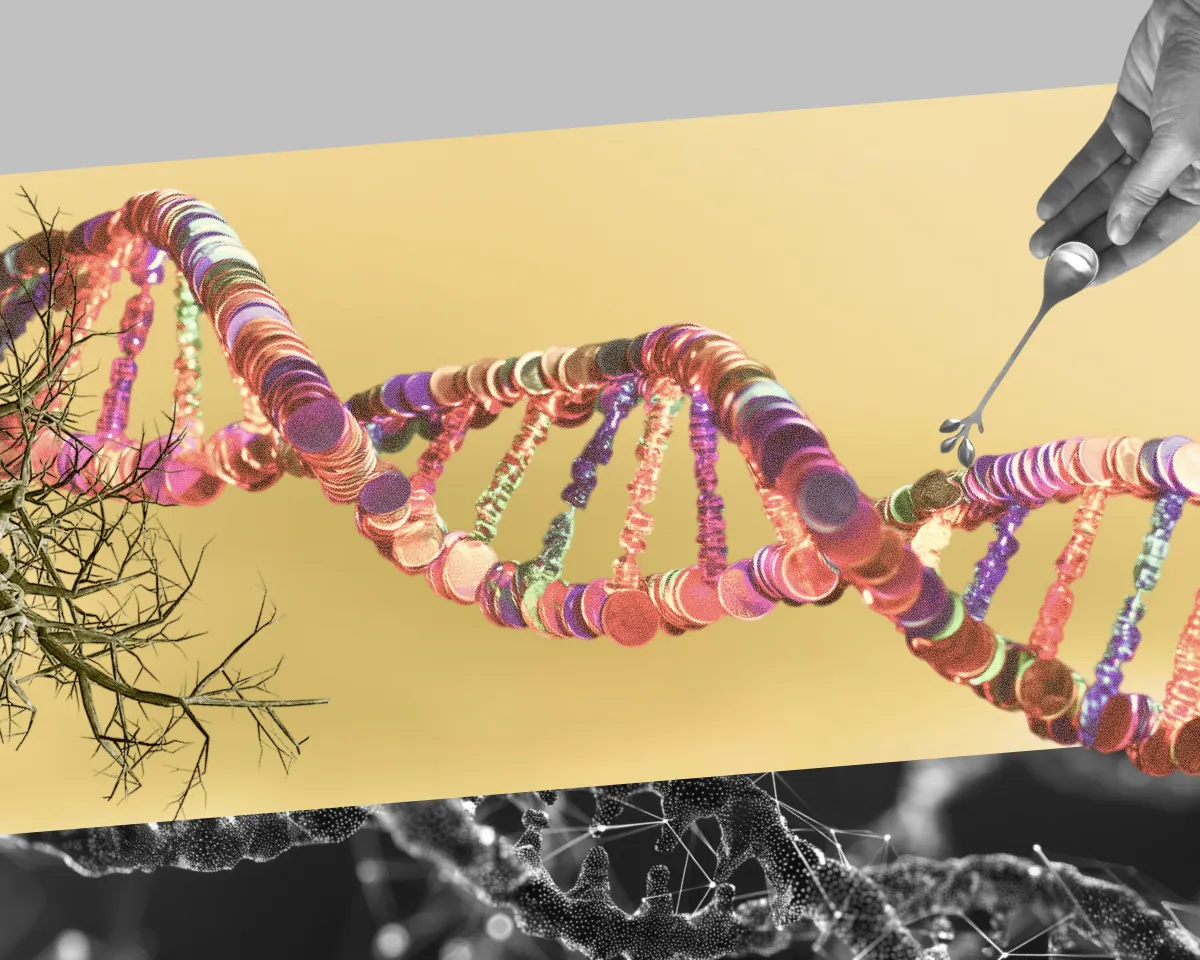
Staking Your Body
On the biopolitics of the Web3 era.
The rise of artificial intelligence has put traditional online verification under strain. Text passwords, CAPTCHA and facial-recognition algorithms no longer guarantee a user’s uniqueness. The digital realm now demands a cryptographic proof of humanness. The Web3 industry is moving to a new tier of identification, turning the physical body into a universal access instrument. The iris, palm-vein patterns, heartbeat and genetic code are becoming the primary keys to the new economy.
ForkLog examines how the philosophical concept of biopolitics is taking shape in blockchain networks, why metaverses want users’ biological data and what risks lurk in trading one’s own genome.
‘Bare life’ in Web3
The modern idea of biopolitics was formulated in the mid-1970s by Michel Foucault. The French philosopher showed that as the modern state emerged, power turned to governing population and economy through medicine, hygiene and demography. The human body became an object of political regulation via disciplinary institutions (schools, hospitals, prisons), statistics and mechanisms to control the quality and duration of life.
Foucault’s observations were later radicalised by the Italian political philosopher Giorgio Agamben. In Homo Sacer: Sovereign Power and Bare Life (1995) he introduced the term “bare life” (nuda vita): a condition in which a person is stripped of political subjecthood and treated purely as a biological organism.
Web3 can be seen as the basis for a new economic infrastructure in which the state’s and capital’s monopoly over identity cedes to decentralised protocols. Here, blockchain networks forge their own biopolitics: the physical body is no longer merely a vessel for the mind; the organism becomes a generator of data.
Today’s technologies are turning “bare life” into “digitised life”. A unique DNA nucleotide sequence or an unrepeatable iris pattern becomes the foundation of social capital. In future, protocols may require users to prove biological reality in exchange for access to financial services, governance and capital allocation.
From iris to DNA: the evolution of biometric networks
The crypto industry’s mass encounter with biometrics began with projects like World (formerly known as Worldcoin). Its developers built an orb specifically to scan the iris: by providing a biometric imprint, participants receive WLD tokens and a World ID digital passport. The launch ignited a debate over the ethics of swapping unique biological markers for financial assets. Even so, the idea of universal basic income (UBI) financed by protocol tokenomics duly attracted millions of users.
World’s early lead in Proof-of-Personhood proved short-lived. New protocols changed how data are gathered. Hardware constraints are giving way to mobile technologies.
The Humanity Protocol deployed a network on Polygon that uses palm biometrics (including vein scanning) via smartphones or dedicated devices. It does not require orb-level specialised hardware, dramatically accelerating network scaling.
The TON ecosystem integrated HumanCode’s solutions. Telegram users can verify identity by scanning a palm directly from mini-apps. Developers rely on cryptographic protection of biometric vectors inside the phone using Secure Enclave standards (available to iOS users).
Progress in the sector is pushing towards deeper data. Startups are laying the groundwork for DNA collection. Projects at the intersection of blockchain and decentralised science (DeSci) are emerging. Platforms such as GenomesDAO offer to sequence a genome and encrypt the results. The genome’s owner can sell time-limited access to genetic markers to pharmaceutical companies without revealing a direct link to identity.
These trends point to a single economic model of total biometric coverage. It is plausible that, to receive enhanced UBI payouts in future metaverses, users will need to provide a comprehensive biological profile. If base-level payouts can be unlocked with a simple face scan, the mid-tier may require wearables streaming heart rate and sleep phases. The highest level of passive income would be reserved for fully verified donors of genetic code.
The ‘oracle of flesh’ problem
A blockchain is an isolated system. Smart contracts cannot fetch off-chain information on their own. Oracles—gateways delivering price feeds or match results—solve this. It is here that the bridge between the physical and digital worlds becomes fraught: the so‑called oracle of flesh.
Sending raw biological data to corporate servers or public blockchains carries critical risks. A compromised password can be replaced; a stolen iris pattern or decrypted genome cannot. Biometrics can only guard access to a key; they are not the key itself, since a private key is a strictly cryptographic object. Even so, compromising the biological data used to access that object can mean the irrevocable loss of digital identity.
Zero-knowledge proofs (ZKP) and fully homomorphic encryption (FHE) offer privacy-preserving tools. ZKPs let one prove a fact without revealing auxiliary information. But they do not, by themselves, solve the “reality of the body” problem: they prove only that a computation was correct, not that someone is alive. Recognising a human remains a hardware task—for sensors and specialised scanners.
Next-generation verification works as a chain: hardware attests to the presence of a unique living person; then the device mathematically proves to the protocol that the data were collected correctly. The blockchain receives only a cryptographic certificate (a ZK proof). Raw iris or DNA data stay on the user’s device or are destroyed immediately after the hash is generated.
FHE takes security a step further. It lets external algorithms and neural networks analyse genetic sequences or medical indicators while the data remain encrypted. A protocol can test a genome’s suitability for a medical study without seeing the underlying nucleotide sequence.
In this way, robust hardware plus cryptography yields a full‑fledged “oracle of flesh” that confirms bodily reality while keeping it in a permanent cryptographic shadow.
A market for biometric derivatives
Tokenisation of biological parameters opens the door to new financial instruments. Genetic data already carry high commercial value for research institutes, biotech firms and insurers, but today most trading happens outside Web3. Putting such data on-chain remains largely conceptual. While there is no mass market yet, the growth of niche initiatives at the nexus of blockchain and genomics could, in time, form a primary digital market for genetic capital.
In this futurist vision, users could monetise physical characteristics directly. In theory, the holder of a rare mutation (say, innate immunity to certain viruses) could grant labs access to their data. Web3 proponents posit that blockchains could automate regular payouts via smart contracts, yet implementation faces serious hurdles. Tying a specific medical breakthrough to an individual genome is legally and methodologically difficult; for now, pharma firms avoid per‑access royalties and stick to one‑off compensation or clinical‑trial payments.
Even so, a secondary market could hypothetically produce biometric derivatives. Research pools might issue tokens whose yield is backed by future medical discoveries based on the genetic material of a given user cohort. In time, futures on access to DNA from particular demographic groups could emerge.
It is conceivable that metaverse economies will partly rest on verified biological diversity. In one scenario, liquidity migrates from traditional assets into data on human physiology, and biometric staking becomes a new form of passive income. In that paradigm, locking ZK certificates of one’s DNA in a smart contract could, in principle, generate returns funded by demand from research corporations.
The ethical crisis of genome tokenisation
Trading biometric data upends conventional ideas of privacy. DNA monetisation raises the thorniest issues.
Genetic information is not strictly individual. DNA contains precise data about biological parents, siblings and children. Listing one’s genome on a decentralised marketplace automatically compromises the medical privacy of the entire family. A single decision to sell a genetic profile for UBI can expose information about predispositions to genetic diseases across dozens of relatives.
The collective nature of DNA clashes with the individualism of crypto‑economics. Smart contracts have no mechanism to obtain consent from all carriers of similar genetic markers.
There is a risk of genetic inequality. Metaverse algorithms and decentralised insurance protocols could discriminate on the basis of encrypted on‑chain data. Approval for a loan in a DeFi protocol or the pricing of health insurance could hinge on disease probabilities encoded in a tokenised genome.
Swapping biometrics for a basic income creates economic coercion. Users hand protocols the keys to their physical existence not only out of need, but also lured by quick monetisation, social trends or a poor grasp of long‑term risks. A technology built to resist corporate diktat risks creating a new dependency: the right to join the digital economy is bought at the price of total de‑anonymisation of the body.
Embedding biopolitics into Web3’s architecture would complete the fusion of physical and digital worlds. The body ceases to be external to the network. Blockchain turns physiology into liquidity, and human life into a set of cryptographic proofs. Using DNA as a biometric identifier may complicate Sybil attacks, but it does not solve the problem: critical vulnerabilities persist in the form of template compromise and data cloning. The deeper flaw lies elsewhere—this approach imperils a basic right not to be indexed by an algorithm.
Рассылки ForkLog: держите руку на пульсе биткоин-индустрии!