


Sui: an ambitious blockchain and cryptocurrency from Meta alumni
Key points
- Sui is a high-performance layer-1 (L1) blockchain being developed by Mysten Labs to serve latency-sensitive decentralised applications.
- Like Aptos, Sui leverages work from Diem, Meta’s aborted blockchain platform. In particular, Sui’s code uses a modified version of Move, the language created for Diem.
- The Sui network’s operation and security are provided by a Proof-of-Stake mechanism with staking and delegation.
- Sui’s consensus employs the Narwhal and Bullshark protocols, which enable parallel execution and give the network strong scaling potential.
- As of October 2022, Sui runs on a test network.
Who is building and funding the project
Sui is being developed by Mysten Labs, founded in September 2021 in California by former senior managers and engineers from Novi Research, a Meta division that worked on the Diem blockchain and the Move programming language. Mysten Labs’ co-founder and chief executive is Evan Cheng, formerly director of research and development at Novi Research.
The team publicly unveiled the project on March 22nd 2022, having started work in autumn 2021.
As of October 2022 the startup had completed two funding rounds. An early-2022 series A of $36m was led by Andreessen Horowitz; a subsequent series B raised $300m, valuing Mysten Labs at $2bn.
The Sui testnet was launched in August 2022.
Sui’s features and advantages
The developers pitch Sui as a general-purpose network with high throughput, fast and cheap transactions, and a user-friendly interface for Web3. Mysten Labs aims to build a platform for high-performance decentralised applications.
Sui’s architecture is detailed in the whitepaper and technical documentation. A distinctive feature is the use of Sui Move, the project’s own programming language—a modified version of Move created for Diem. Whereas many blockchains use accounts as the basic storage unit, Sui uses objects that are created and managed by smart contracts. An object can represent any asset type and has a unique identifier, an owner and a property indicating whether it is mutable or immutable.
The Sui blockchain maintains a causal history for each object from its creation. If objects’ histories do not intersect, transactions involving them can be processed in any order—or in parallel. Thanks to this, Sui can handle batches of transactions in parallel without risking double-spending.
This design enables horizontal scaling of throughput, with overall performance limited only by the number of nodes processing transactions. In tests, Sui reached more than 120,000 transactions per second with average latency of about two seconds.
How Sui works
Sui uses the Proof-of-Stake (PoS) consensus model. Transactions are processed by sets of validators, with membership rotating each epoch (24 hours) from among active full nodes. As of late October 2022 the testnet has four validators and more than 3,600 active nodes.
How a transaction is handled depends on whether it touches a single-owner object (any asset type) or a “shared object” (for instance, public smart contracts).
Transfers of coins, NFT issuance and voting belong to the first category. Such transactions follow a simplified Fast Pay procedure based on Byzantine Consistent Broadcast. It comprises four stages:
- The transaction is sent to a node, which “broadcasts” it to validators;
- Validators vote to approve the transaction and return the result to the sender;
- The sender creates a certificate containing signatures from at least two-thirds of validators;
- The certificate is distributed to validators, who confirm it. The transaction is then included in the blockchain.
This process avoids validator-to-validator consensus, substantially reducing processing time.
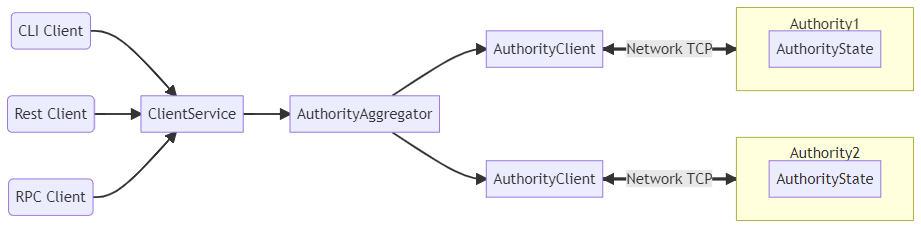
By contrast, transactions involving shared objects add a consensus stage using the Sui Consensus Engine. It has two components:
- Narwhal, a high-throughput mempool (“waiting room” for unconfirmed transactions) that ensures synchronisation and data availability for validators;
- Bullshark (or the older solution Tusk), a consensus protocol combining a directed acyclic graph with Byzantine Fault Tolerance. Bullshark’s novelty is that it reaches consensus without validators needing to exchange information.
This delivers not only high throughput but also fault tolerance: even a large number of faulty validators does not drag down performance, unlike in some existing PoS blockchains.
Tokenomics and functions of the Sui cryptocurrency
No timetable has been set for the mainnet and the launch of the native SUI coin. The team has, however, outlined the project’s tokenomics. The maximum supply will be 10bn coins. Each SUI will be divisible into a billion units called MIST.
At mainnet launch only a portion of SUI will circulate; the remainder will be allocated to the Mysten Labs team, investors, community participants, validator rewards and other purposes. A significant share will go to the Sui Foundation—independent of Mysten Labs—which will fund hackathons, conferences, application development and developer teams.
SUI is expected to have several uses:
- validator staking;
- delegated staking to validators (for ordinary coin holders);
- payment of transaction fees;
- a medium of exchange, settlement and store of value within the Sui ecosystem;
- on-chain governance of the Sui blockchain.
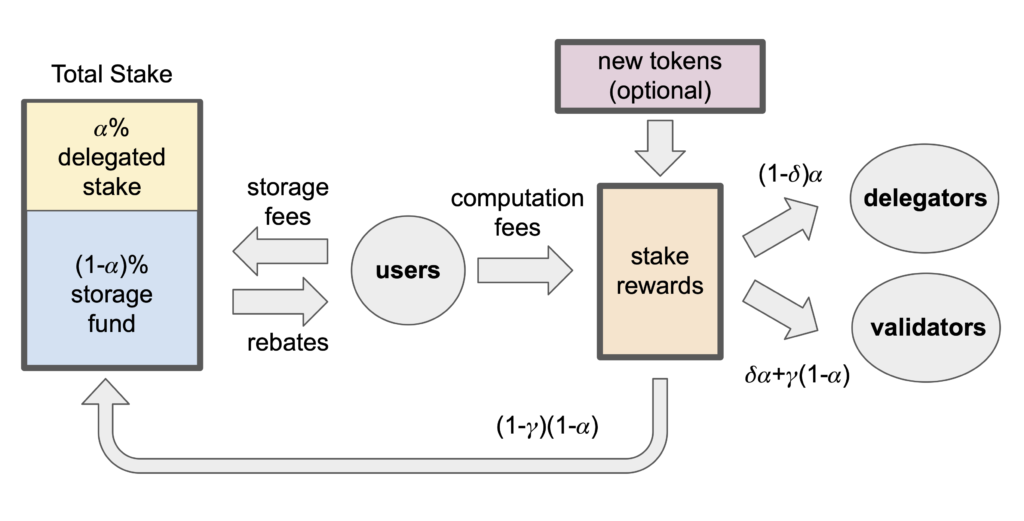
Each validator has a stake of SUI delegated by token holders. Delegated coins are locked for the entire epoch and earn a share of staking rewards when the epoch closes. Holders can therefore withdraw their SUI or switch delegates only at epoch boundaries. It is already known that the Sui team will reward full-node operators, developers and active testnet participants. In particular, after Sui launches on mainnet, node operators will receive 2,000 SUI each, locked from sale for one year.
How the Sui ecosystem is developing
The team has already launched basic infrastructure for interacting with the Sui testnet. In August 2022 it rolled out the Sui Explorer, which displays detailed information on blocks, addresses and transactions.
The Sui Wallet is also available as a Google Chrome extension. It lets users create new addresses and restore existing ones via a seed phrase, view and manage all asset types, including NFTs, and interact with decentralised applications. The wallet can be topped up with test SUI via a faucet, for example on the NFT marketplace BlueMove.
Third-party teams are building more than 60 projects on Sui. Among them:
- decentralised exchanges Suiswap, MovEx;
- DeFi services Cetus, Porto Labs, Kxfinance, Leizd Protocol;
- cross-chain bridges WormHole and Axelar Network;
- domain-name services Sui Name Service, Suins;
- social platforms ComingChat, AskMeX, Peeranha;
- NFT marketplaces Blue Move, Sui Art, Sui Gallery;
- NFT collections Sui Punks, Sui Birds, Sui Droplets;
- games Trial Xtrem, F1 Dog, Netmarble.
Prospects
In July 2022, during a Q&A session, Alonso de Gortari of Mysten Labs said the company plans a public token sale, with the mainnet and SUI launch targeted for year-end. Since then the team has made no further announcements or comments on the subject.
The newly established non-profit Sui Foundation has announced a grants programme for developers in the Sui ecosystem. Teams building applications across a wide range of use cases—from social networks and games to payments, finance and legal services—can receive $10,000–$100,000.
Promised rewards for early testnet node operators, and the large number of Sui-based projects without their own tokens, have already stirred up airdrop hunters. The odds of ordinary testnet users receiving rewards remain unclear.
Further reading
What is the StarkNet cryptocurrency and blockchain?
Alien Worlds: a comprehensive review of the popular blockchain game
The Brave web browser and the BAT cryptocurrency: an in-depth review
IPFS instead of HTTP—is this the future of the decentralised internet?
What is Chiliz (CHZ)? All about the leading cryptocurrency for sports fans
Рассылки ForkLog: держите руку на пульсе биткоин-индустрии!