




Signed in July, the GENIUS Act will spur a mass shift of deposits from traditional banks into higher-yielding stablecoins, according to Multicoin Capital co-founder Tushar Jain.
The Genius Bill is the beginning of the end for banks’ ability to rip off their retail depositors with minimal interest. Post Genius Bill I expect the big tech giants with mega distribution (Meta, Google, Apple, etc) to start competing with banks for retail deposits.
The tech… https://t.co/SCtHrgNeLI
— Tushar Jain (@TusharJain_) October 4, 2025
“[The bill] will put an end to lenders paying minimal interest to retail depositors while keeping the profits for themselves,” he noted.
Stripe CEO Patrick Collison said the average interest rate on savings accounts is 0.40% in the US and 0.25% in Europe.
Good post on evolving stablecoin market structure. I would extend it further: yes, I think that stablecoin issuers are going to have to share yield with others, but this is just one instance. Everyone is going to have to share yield. Today, the average interest on US savings… https://t.co/yjjLOzxoOk
— Patrick Collison (@patrickc) October 3, 2025
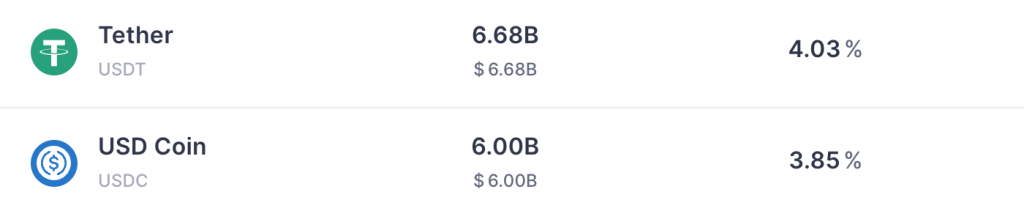
By comparison, yields on USDT by Tether and USDC by Circle on Aave reach 4.03% and 3.85%, respectively.


Jain argues that once the bill is fully enacted, technology giants such as Meta, Google and Apple will wade into competition for deposits. These firms, he said, can offer higher yields on stablecoins along with a better user experience for instant settlement and round-the-clock payments than traditional banks.
Banks seek protection
The Multicoin Capital co-founder also stressed that lending groups are already trying to shield themselves from the effects of the GENIUS Act. He pointed to an official letter from America’s largest banking associations to Congress in August.
It noted a significant loophole in the current draft: the direct ban on the payment of interest by stablecoin issuers does not extend to crypto exchanges and affiliated companies. That creates room to circumvent the law via partnership programmes under which platforms pay rewards to stablecoin holders.
Banking groups worry that widespread yield-bearing stablecoins could undermine a system that relies on attracting deposits via high-yield savings products to fund loans.
Citing an April report by the US Treasury, the Bank Policy Institute warned of potential deposit outflows of $6.6trn. The authors said this could raise borrowing costs for businesses and households.
“A reduction in credit supply will lead to higher loan rates, lower lending volumes and greater financial burdens on businesses and households,” the letter said.
Bankers insist on aligning regulation with standards applied to traditional financial institutions, citing the need for a level playing field.
Stablecoin risks extend beyond the US
The growing popularity of stablecoins could trigger a mass outflow of deposits from banks in emerging economies, analysts at Standard Chartered said, according to CoinDesk.
They estimate that over three years more than $1trn could be pulled from traditional instruments.
Adoption is most active in countries with volatile currencies — Egypt, Pakistan, Bangladesh and Sri Lanka — where locals see stablecoins as a protective asset.
“Indeed, the future growth of stablecoin usage for saving will broaden from a small number of wallets with large balances to a large number of wallets with relatively small balances. Over time, these holdings will become significant; growth is likely to come from emerging markets where demand for a liquid, 24/7, reliable alternative to local banks is higher,” the analysts stressed.
Standard Chartered forecasts the global market for dollar-pegged coins to reach $2trn by 2028, with two-thirds of demand coming from emerging markets.
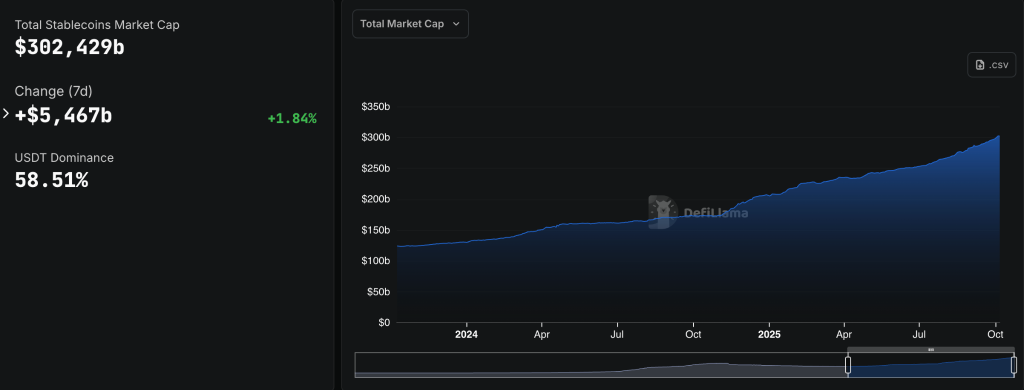
On September 29 the market capitalisation of the stablecoin sector topped $300bn for the first time. At the time of writing, it stands at $302.4bn. Over the past quarter, supply surged by a record $45bn.


Earlier, Tether co-founder Reeve Collins said that by 2030 all fiat money will turn into stablecoins.