



Vitalik Buterin outlines timelines for addressing Ethereum centralization issue
Centralization of nodes is one of Ethereum’s key problems, but an ideal solution could emerge in 10–20 years. Such timelines were outlined by Ethereum co-founder Vitalik Buterin, Cointelegraph reports.
According to him, the solution lies in cheaper and simpler maintenance of nodes.
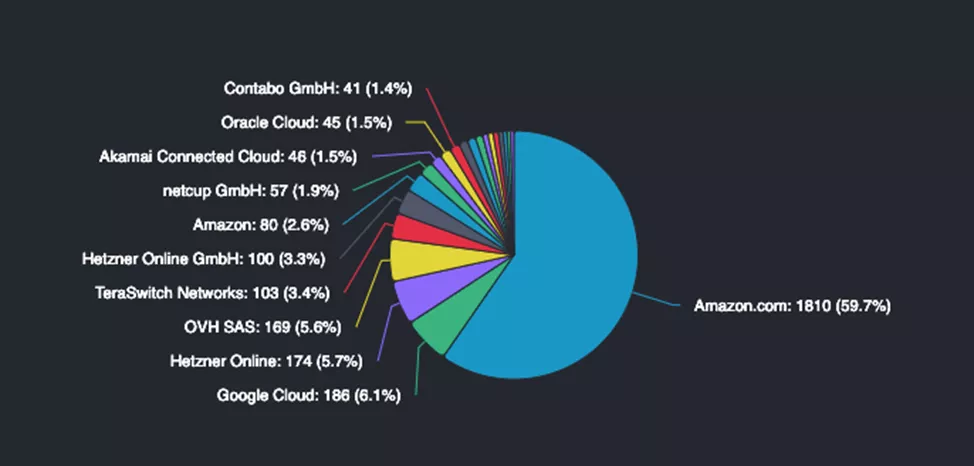
According to Ethernodes, 59.7% of the 5,901 active nodes in the blockchain of the second-largest cryptocurrency by market cap operate on Amazon Web Services. Another 6.1% rely on Google Cloud, 5.7% on Hetzner Online.
According to analysts, such a ratio makes Ethereum vulnerable to a centralized point of failure.
Speaking at Korea Blockchain Week, Buterin outlined six key challenges that must be addressed to solve the centralization problem.
The node problem is a “big part of the puzzle” for ensuring Ethereum’s long-term decentralization, he stressed. For the latter, he added, statelessness (an unfixed state) technology is needed.
“Today, running a node requires hundreds of gigabytes of data. With statelessness clients, you will be able to do this almost from scratch“, explained the Ethereum co-founder.
The concept implies eliminating dependence on centralized service providers to verify activity in the network.
According to Ethereum Foundation, true decentralization is not possible until node operators can run software on modest and inexpensive hardware. Statelessness is a key component of the project’s roadmap with deployment in the The Verge and The Purge stages.
Buterin doubted the possibility of overcoming purely technical constraints in the near term. He suggested it would happen in 10 or even 20 years.
In addition to achieving statelessness, additional requirements to reduce centralization will include:
- documentation simplification;
- reducing barriers to decentralized staking;
- ensuring greater security and usability.
The Ethereum co-founder acknowledged that achieving higher levels of scalability is a more pressing task at present than reducing decentralization.
In June, Buterin published a roadmap, in which he highlighted the main directions for the blockchain’s sustainable development — L2-scaling, wallet security enhancements and data privacy.
In the previous version of the document, the Ethereum co-founder placed emphasis on scaling via zk-Rollups.
Рассылки ForkLog: держите руку на пульсе биткоин-индустрии!