




Leaders of Ripple and Ava Labs were accused of pressuring projects through lawsuits, MakerDAO co-founder proposed decoupling DAI from the dollar, IOHK named the exact activation date for Vasil on the Cardano network, and other events from the past week.
Bitcoin ends the week below $20,000
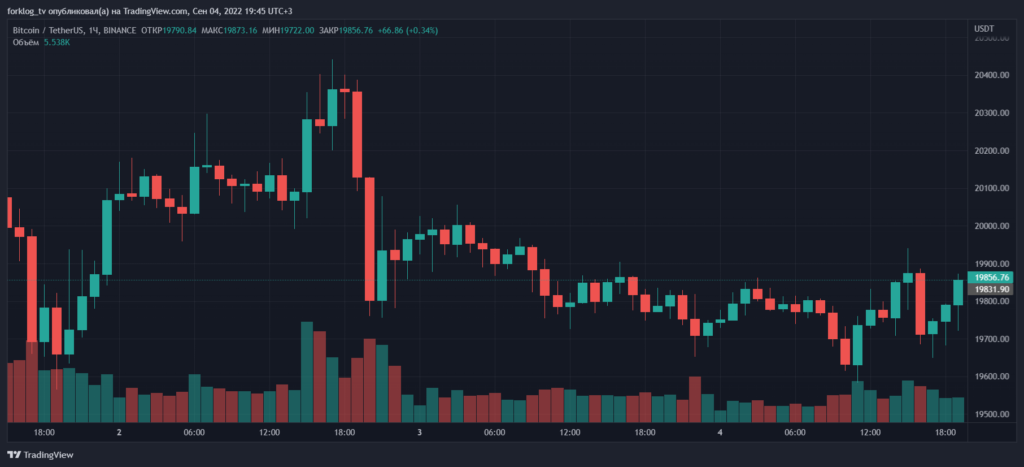
Over the week, the price of the first cryptocurrency tested the $20,000 mark several times but could not sustain above that level. At the time of writing, the asset was trading near $19,850.


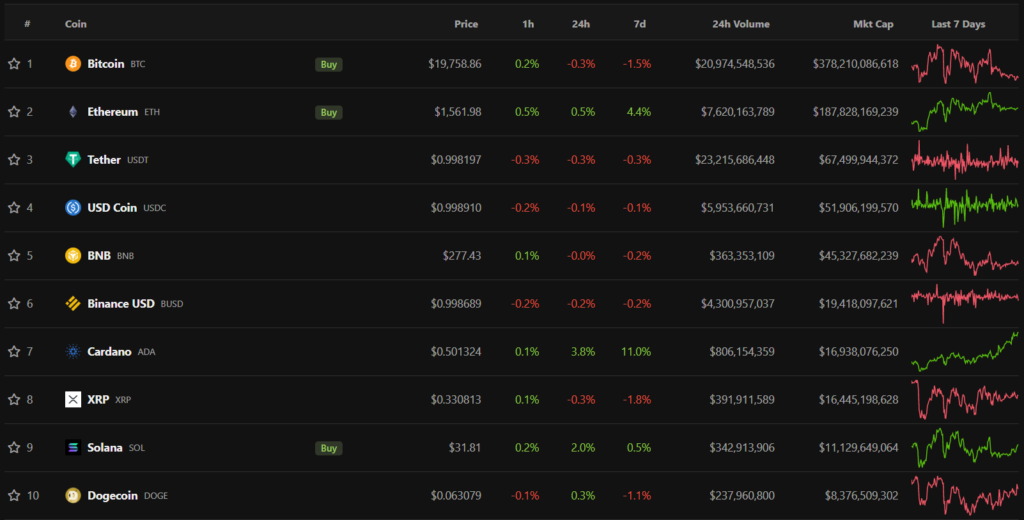
Most assets in the top 10 by market cap closed the week in the red. The exceptions were Cardano (+11%), Ethereum (+4.4%), and Solana (+0.5%).


Total cryptocurrency market capitalization stood at $1.01 trillion. Bitcoin’s dominance index fell to 37.1%.
Ripple and Ava Labs executives accused of unfair competition
CryptoLeaks published a series of videos in which Kyle Roche of the U.S. firm Roche Freedman alleged a collusion with Ava Labs CEO Emin Gün Sirer to pressure competitors in exchange for AVAX tokens and shares in the crypto company. The lawsuits were allegedly used for this purpose.
In the videos also mentioned the head of Ripple, Brad Garlinghouse. Both executives denied the allegations, calling them nonsense.
Later Roche stated that the videos were taken out of context and edited. According to him, the recordings were made during a meeting with Norwegian investor Kristen Ager-Hansen, who acted to discredit him at the request of the founder of Dfinity, Dominic Williams. The latter allegedly is a party to a high-profile securities fraud and insider trading case initiated by Roche Freedman.
The founder of the law firm declined to participate in lawsuits against Tether, Bitfinex, Tron and HDR Global Trading.
MakerDAO co-founder proposed to decouple DAI from the dollar
Rune Christensen, co-founder of the DeFi platform MakerDAO, spoke as concerns grew about potential sanctions-compliant asset freezes by the issuer of the stablecoin USDC, Circle.
believes that it is prudent to significantly reduce the amount of risk-weighted assets (RWAs), since Maker cannot blacklist and cannot ensure compliance. In this way he allowed DAI to float freely away from the USD and proposed several tools that could compensate users’ losses.
Mining pools and protocols clarified the mechanism after The Merge
From September 3, the Bitmain-affiliated mining pool AntPool will stop supporting Ethereum in light of the upcoming transition to the Proof-of-Stake (PoS) consensus algorithm. The service recommended users to add their ETH wallet address to their account by that date to receive mined coins.
The Ethermine mining pool, the largest in the Ethereum network, launched a staking service for the second-largest cryptocurrency as an alternative to the end of the PoW mining phase. The minimum investment is 0.1 ETH.
Binance will suspend deposits and withdrawals of Ethereum and ERC-20 tokens during The Merge. The tentative times are September 6 at 14:00 (Kyiv/Moscow time) and September 15 at 03:00 (Kyiv/Moscow time).
OpenSea said it would support only tokens based on the PoS algorithm.
What to discuss with friends
- Crypto.com accidentally transferred $10.5 million to a user instead of $100.
- In Ukraine authorities uncovered a fraudulent bitcoin investment scheme. Media identified the owner of a crypto wallet blocked for donations to the war.
- The Wolf of Wall Street criticized high-risk cryptocurrencies, comparing them to “junk stocks” on which he made a fortune.
- Vitalik Buterin announced the book “Proof of Stake” — a collection of his personal notes over ten years.
Experts linked the movement of 10 000 BTC to Mt. Gox
On August 29, for the first time since 2013, 10 000 BTC moved. According to the Telegram channel GFiS, in each of the transaction chains linked to both withdrawals, the same wallet appeared, which had received 134 000 BTC from Mt. Gox during the 2011 cyberattack on the exchange. The attackers are suspected to include the founders of the later BTC-e platform and its successor WEX.
Elliptic: Tornado Cash was a key service for NFT scammers
Elliptic found that the Tornado Cash mixing service was the source of $137.6 million in crypto assets processed by NFT marketplaces. It helped launder 52% of proceeds from illicit NFT operations.
At the same time, Immunefi experts found that the value of 143 tokens from the NFT collection Bored Ape Yacht Club, which the OpenSea marketplace labelled as suspicious activity, amounts to $13.58 million.
FBI names popular vectors of attacks on the DeFi sector
FBI issued a warning about the most common vulnerabilities used by cybercriminals to attack DeFi platforms. Among them:
- flash loans;
- vulnerability in cross-chain bridges;
- price manipulation by exploiting a range of vulnerabilities, including the use of a single-price oracle.
The agency recommended thorough review of platforms, protocols and smart contracts for independent auditing, and assessing potential investment risks in the DeFi sector.
Experts uncovered a hidden mining campaign affecting 11 countries
The Nitrokod hidden mining campaign allegedly infected thousands of computers in 11 countries with malware, Check Point Research found. The attackers injected utilities into free apps based on popular services like Google Translate or YouTube Music.
OptiFi DeFi project lost $661 000 in a failed update, and Compound froze assets of the cETH pool
The Solana-based DeFi protocol OptiFi accidentally shut down its mainnet and blocked users’ USDC funds totaling $661 000. The developers promised to reimburse all funds to the affected users — 95% of the amount was provided by a project employee.
Compound temporarily froze operations with the cETH lending pool due to an error in the protocol update — the price oracle stopped providing up-to-date quotes. Because of the voting mechanism, the decision can only be reversed after a week.
The team said there are no risks to users’ funds. The protocol still allows adding collateral, including Ethereum.
The Fed names DeFi as a potential threat to financial stability
As the cryptocurrency market cap grows, the DeFi sector could pose long-term risks to financial stability. This was stated by researchers at the Federal Reserve’s research group. Fed.
According to analysts, the threat stems from a lack of clear regulation for decentralized applications. They stressed that the sector has not yet become “systemically important,” but authorities should pay it more attention.
The Fed also published a separate study on the impact of digital assets on financial stability. They noted the need for stricter oversight of crypto firms that handle client funds.
IOHK sets the exact activation date for Vasil on the Cardano network
IOHK developers announced the activation date for the Vasil hard fork on the Cardano mainnet — September 22.
Vasil is Cardano’s largest update, which is expected to increase network throughput, reduce transaction costs, and enhance security.
The hard fork will also add new features to the Plutus platform for developers.
The team expects a smooth technical transition with no outages or interruptions in block production. Users do not need to take any action.
Also on ForkLog:
- Changpeng Zhao denied any link between Binance and Chinese authorities.
- Vitalik Buterin described the current bear market as expected.
- SudoSwap will conduct an airdrop of the SUDO governance token.
- Unknown individuals hacked the KyberSwap DEX at the frontend level
What else to read and watch?
In a new exclusive ForkLog piece, they found the share of Bitcoin in the global energy consumption structure and its long-term growth prospects.
In educational cards they collected everything a typical user should know before The Merge upgrade in the Ethereum network. They also talked about the Tron cryptocurrency, Michael Saylor, the Proof-of-Work algorithm, and the Ethereum Virtual Machine.
In the traditional digest, they gathered the main events of the week in the field of artificial intelligence.
The crypto industry is attracting more institutional players. This is evidenced by new investments in infrastructure and growing attention to Bitcoin as an asset class. The most important events of the last weeks are in ForkLog’s обзор.
In a new informative issue, ForkLog explained the features of Layer-2 protocols — why such solutions were launched and how they work.

Read ForkLog’s Bitcoin news in our Telegram — cryptocurrency news, prices and analysis.