



Week in review: a record hack, altseason’s onset and shifts at the SEC
The crypto exchange Bybit lost an industry-record $1.5bn in a hack; researchers tallied investors’ average profits in 2024; the SEC is halting lawsuits against crypto firms; and other highlights of the week.
Bull-market jitters
Bitcoin opened the week at $96,500. By Tuesday the price had slipped to a local low around $93,500.
On Friday the first cryptocurrency approached $100,000, but at $99,500 the trend reversed and within hours the price fell to $95,500.

At the time of writing the first cryptocurrency trades at $95,500, a net weekly decline of 2.28%.
According to CryptoQuant CEO Ki Young Ju, bitcoin’s bull phase will continue even if the price falls 30% from the peak—to about $77,000.
“I don’t think that we will enter a bear market this year. We are still in a bull cycle. The price will ultimately go up, but the [swings] range looks wide,” the expert noted.
In his view, entry points are:
- for custodial wallets of spot ETFs or “new whales” — ~ $89,000;
- based on traders’ deposits at Binance — ~ $59,000;
- for large miners’ balances — ~ $57,000.
A breach of the breakeven level for the latter category has historically confirmed a shift to a bear market. That occurred in November 2018, March 2020 and May 2022, the CryptoQuant head emphasised.
According to JPMorgan analysts, the weakening institutional demand for bitcoin and Ethereum futures on the CME serves as a bearish signal in the near term.
They noted a 15% drop in the aggregate market capitalisation of digital assets from the record $3.72trn in December.
As a result, futures on the two largest cryptocurrencies are close to backwardation—as in June and July last year. The more typical state is contango, when derivatives trade at a premium to spot.
This metric, often above 10% annualised, is driven by the high “risk-free” rate in crypto markets, where USD lending typically runs at 5–10% per year, the specialists explained.
They cited a lack of positive catalysts and fading price momentum.
Some institutional investors are taking profits to move to the sidelines, as U.S. crypto-related policy initiatives are unlikely before the second half of the year.
Momentum-oriented funds are also trimming longs as signals weaken. In Ethereum the indicator has already turned negative.
At the time of writing the second-largest cryptocurrency trades at $2,780, having started the week at $2,660. The price has gained about 3.37%.
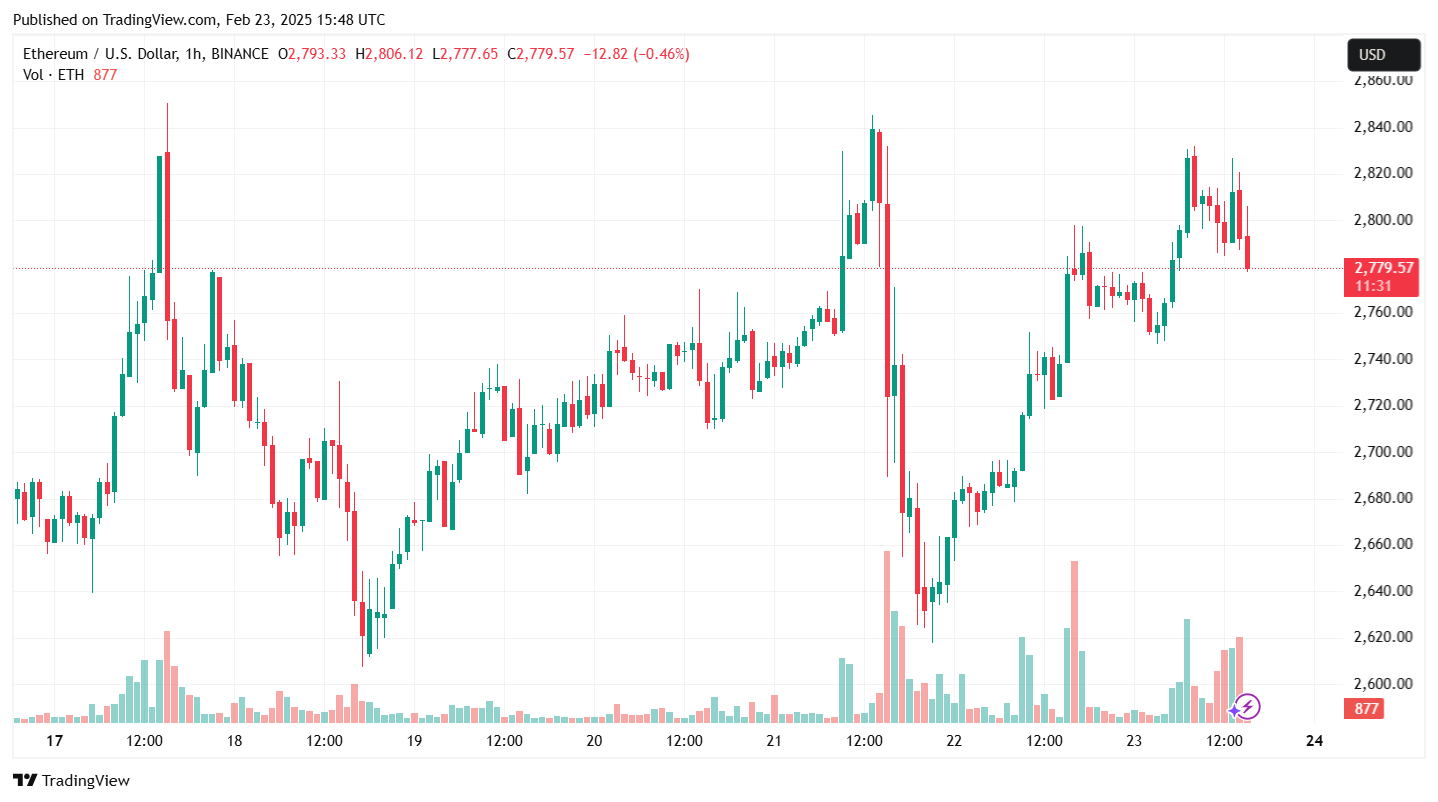
One of the most notable drivers for Ethereum and the wider crypto market this week was the industry’s largest heist—the Bybit hack involving the theft of half a million ETH.
All top‑10 assets by market capitalisation fell on the back of the incident. By week’s end only Ethereum showed positive dynamics.
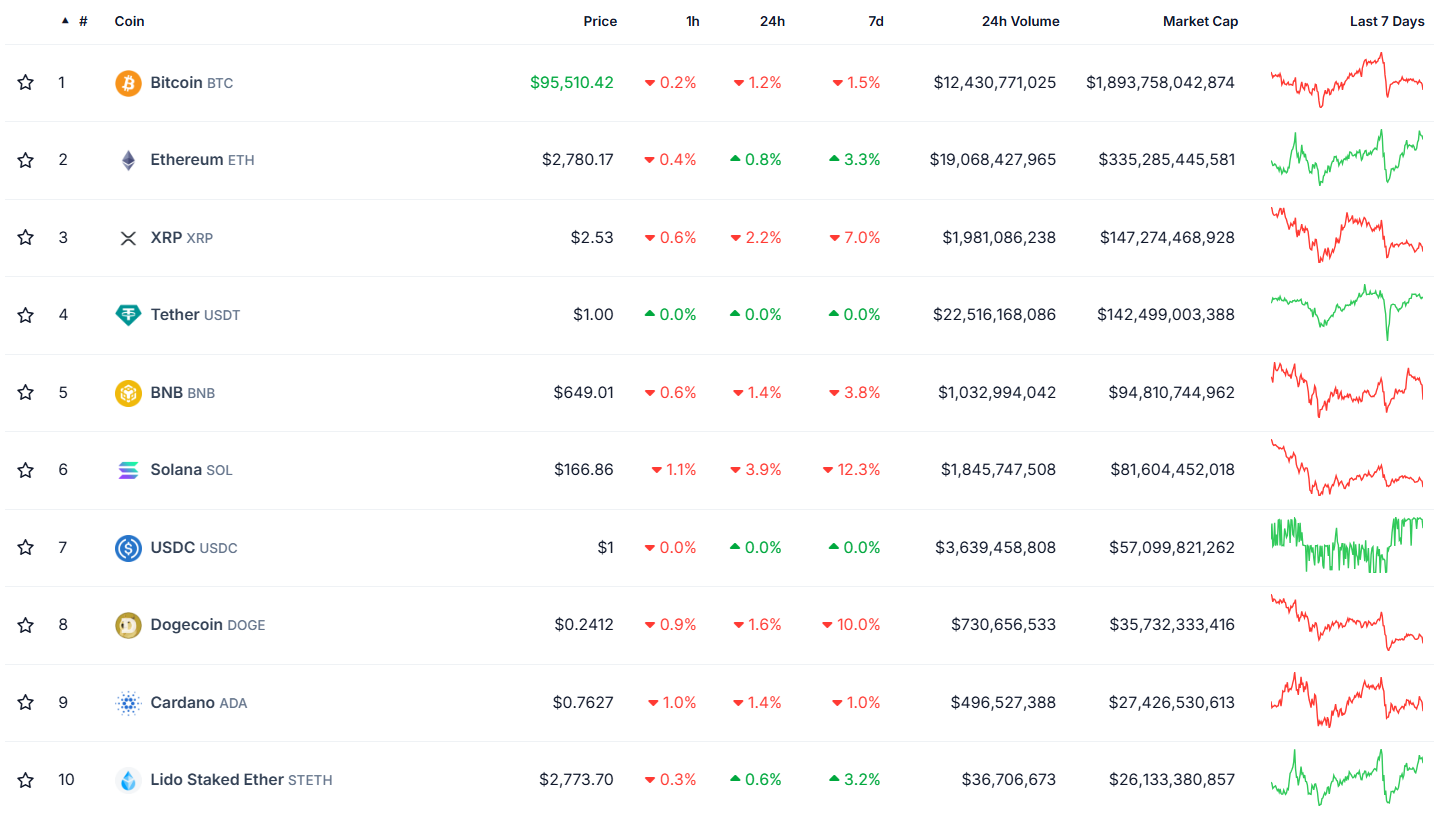
Over the past seven days SOL fell 12.3%, DOGE 10%, and XRP 7%.
The biggest hack on record
On February 21 hackers drained 499,395 ETH (about $1.46bn at the time) from a Bybit exchange wallet. The suspicious outflows were first reported by ZachXBT, followed by the platform’s official confirmation of the hack.
Bybit detected unauthorized activity involving one of our ETH cold wallets. The incident occurred when our ETH multisig cold wallet executed a transfer to our warm wallet. Unfortunately, this transaction was manipulated through a sophisticated attack that masked the signing…
— Bybit (@Bybit_Official) February 21, 2025
According to the exchange, the incident occurred during a transfer of ETH from a cold multisig vault to a warm wallet.
The attackers spoofed the transaction-signing interface so that all participants saw the correct address. At the same time the smart-contract logic was altered, the hackers gained control of the ETH wallet and withdrew all funds.
Later, on-chain data platform Arkham Intelligence reported that the North Korean Lazarus Group was involved.
The founder of the AML service BitOK and crypto investor Dmitry Machikhin told ForkLog the stolen crypto is being actively moved out of Ethereum to other blockchains.
Chinese crypto entrepreneurs are supporting liquidity by actively transferring ETH to the affected platform. In particular, Huobi co-founder Du Jun deposited 10,000 ETH and promised not to withdraw it for a month. The co-founders of Conflux and Mask Network also said they had deposited ether to the exchange’s cold wallets.
Bybit representatives said information about the incident “has been forwarded to the relevant authorities.” Cooperation with on-chain analytics providers helped identify and isolate related addresses, limiting the attackers’ ability “to off-ramp ETH through legitimate markets.”
Bitget chief Gracy Chen said the losses are equivalent to Bybit’s annual profit ($1.5bn). Client funds are fully safe, she added, so there is no reason to panic. Chen also clarified that the assets transferred belong to Bitget itself, not to users.
According to analysis by Taproot Wizards co-founder Eric Wall, the North Korean hackers will likely convert all ERC‑20 tokens into ETH, then swap the ether into bitcoin, and gradually off‑ramp into yuan via Asian exchanges. The proceeds may finance North Korea’s nuclear and missile programmes.
At the time of writing the attackers have already swapped 37,900 ETH (about $106m) into bitcoin and other assets via Chainflip, THORChain, LiFi, DLN and eXch. The hackers’ address still holds 461,491 ETH of the 499,395 ETH stolen.
Debate over an Ethereum “rollback”
Amid the Bybit hack, community members including bitcoin maximalist Samson Mow and BitMEX co-founder Arthur Hayes broached a “rollback” of Ethereum’s state to return the stolen funds. Several experts criticised the idea.
Developer Tim Beiko stressed there were no technical problems with the Ethereum protocol or the multisig application used by exchange staff. The issue was misrepresentation of transaction data in the compromised interface.
The funds quickly dispersed across Ethereum’s complex ecosystem. A “rollback” would entail cancelling numerous legitimate operations, some of which are tied to actions outside Ethereum. Moreover, the off-chain components of those transactions would not be affected, he added.
Yuga Labs vice-president known as Quit emphasised that the damage from cancelling part of the blockchain’s history would exceed the amount stolen. He noted that many ordinary users would lose money and the accounting systems of large players such as Circle and Tether would collapse.
“It might be cheaper to just send a strike team to the DPRK to try to get the funds back. Or ask very politely, I don’t even know,” wrote Quit.
What to discuss with friends?
- About 80% of crypto investors bought “presidential memecoins” — a study.
- Media: Kanye West plans to launch the Swasticoin token.
- Jack Dorsey was named as bitcoin’s creator, Satoshi Nakamoto.
- SBF attributed the FTX collapse to a liquidity crisis and asked for a pardon.
Altseason is here, but not for everyone
Altseason has begun, believes CryptoQuant founder and CEO Ki Young Ju, though fierce competition between projects should be expected.
Alt season has begun.
No direct BTC-to-alt rotation, but stablecoin holders are favoring alts. Alt volume is 2.7x BTC. BTC Dominance no longer defines alt season—trading volume does.
It’s a very selective alt season tho. DYOR. pic.twitter.com/7lSffDuuM8
— Ki Young Ju (@ki_young_ju) February 21, 2025
He suggested focusing on trading volumes instead of standard bitcoin dominance. By his count, altcoin turnover is 2.7 times bitcoin’s.
“In this season only a few coins are gaining traction. In the absence of fresh liquidity this looks like PvP over a fixed pie. Trading volumes show the battles are getting fiercer,” the CryptoQuant head explained.
He also recalled that back in December last year he explained the divergence by institutional demand for BTC ETFs.
These market participants do not intend to swap the first cryptocurrency for other assets and, for the most part, operate outside centralised exchanges.
MN Trading founder Michaël van de Poppe considers that “good weeks” are coming for altcoins. He pointed to the ETH/BTC pair breaking above 0.029 and forming a positive trend.

In his opinion, above 0.028 the returns of assets in Ethereum’s ecosystem will improve. At the time of writing the ETH/BTC rate stands at 0.0293.
Changes at the SEC
The SEC restructured its crypto assets and cyber unit.
Under the new name “Cybersecurity and Emerging Technologies Unit” (CETU) it will combat internet crime and protect retail investors from fraud in areas of new technologies. The 30-person structure is headed by Laura D’Allaird.
According to the statement, CETU will counter securities-related misconduct in several priority areas:
- fraud leveraging new technologies such as AI, blockchain and cryptoassets;
- use of social networks, the darknet or fake websites to run scams;
- hacks aimed at obtaining material non-public information;
- takeovers of retail brokerage accounts;
- compliance by regulated entities with security rules and norms, and disclosure of relevant information.
In addition, this week the Commission gave preliminary consent to halt its court case against Coinbase.
SEC staff have agreed to dismiss their case against us (pending Commission approval).
But this isn’t the end.
It’s the beginning.
And if there were ever a time to build—that time is now.Thank you to everyone who stood with us, and stood with crypto. pic.twitter.com/gjokUZPotz
— Coinbase ?️ (@coinbase) February 21, 2025
According to the exchange’s co-founder and CEO Brian Armstrong, ending the action will send a positive signal about the direction of U.S. crypto regulation and create a domino effect for other SEC cases against crypto companies.
On February 19 the American exchange Binance.US resumed U.S. dollar deposits and withdrawals after almost 18 months of restrictions. The platform had suspended dollar operations in the summer of 2023 following an SEC lawsuit. Last week the Commission agreed to pause the proceedings.
Analysts assessed crypto investors’ 2024 profits
The average realised profit of digital-asset holders in 2024 was $5,482 versus $888 in the previous 12 months, according to a report by tax platform CoinLedger.
The biggest unrealised gains came from bitcoin, Hyperliquid, SuperVerse, Shiba Inu and Render. The largest losses were tied to Ethereum, Cardano, Polkadot, Cosmos and Cronos.
Bitcoin remains the most popular asset among HODLers for the second year in a row. Ethereum, XRP and Cardano follow.
Binance lost the lead in user data imports, yielding to Coinbase. Crypto.com slipped to third place. Kraken ranked fourth.
Despite the suspension of U.S. dollar deposits and withdrawals at Binance.US, in 2024 it remained in the service’s top five. Next came Robinhood and KuCoin.
Also on ForkLog:
- Javier Milei said he merely shared information about LIBRA.
- SafeMoon’s CTO pleaded guilty to $200m crypto fraud.
- The Fed vice-chair denied accusations of debanking the crypto industry in the U.S.
- In Russia, authorities announced the date for banks to connect to a crypto-transaction analysis service.
What else to read?
In a new piece we explain the fee switch—a revenue-redistribution mechanism that pays dividends to DeFi-token holders.
We examined whether cryptocurrency can truly Become a tool of economic independence or is merely a new form of digital colonialism.
We sorted through rumours, speculation and confirmed facts about an allegedly secret group making money on hyped memecoins.
In our regular digest we collected the week’s main events in cybersecurity.
Рассылки ForkLog: держите руку на пульсе биткоин-индустрии!