




The Bank of Russia defined eight criteria that would enable banks to identify cards and electronic wallets used by the shadow economy. The regulator also targeted cryptocurrency exchangers, as well as illegal online casinos, financial pyramids and illicit forex dealers.
Bitcoin up nearly 6%, Ethereum up 3%
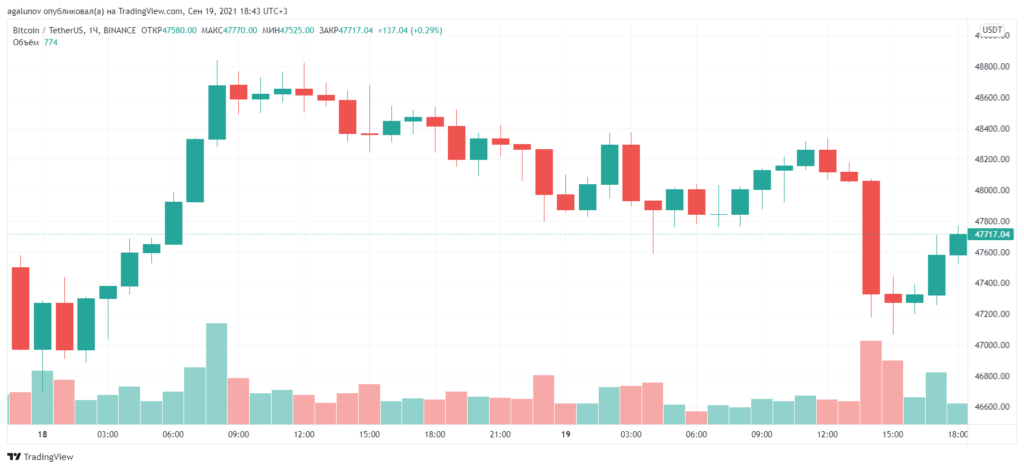
During the week, Bitcoin traded in a wide range of $44,000-$48,800, rising 5.7%, according to CoinGecko. At the time of writing, the price of digital gold stood at $47,700.


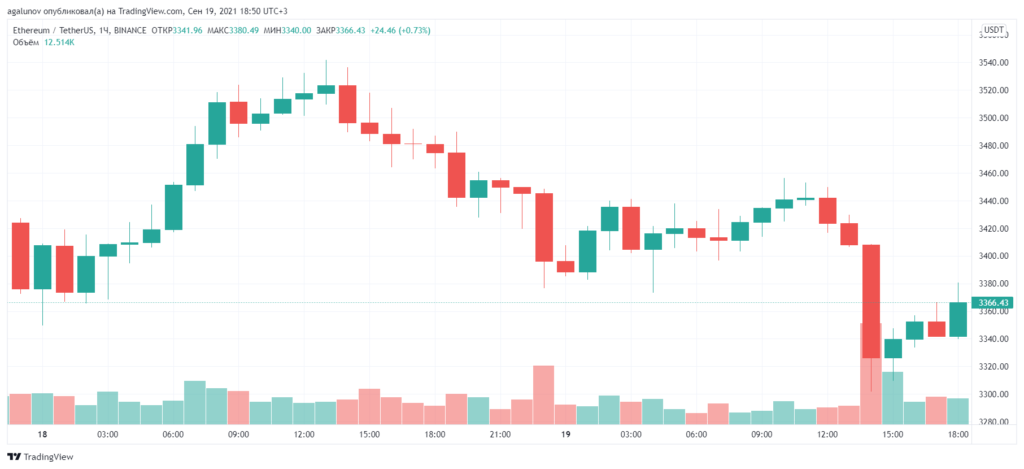
Ethereum rose 3%, climbing above $3,600 on September 16. As of writing, the asset traded around $3,300.
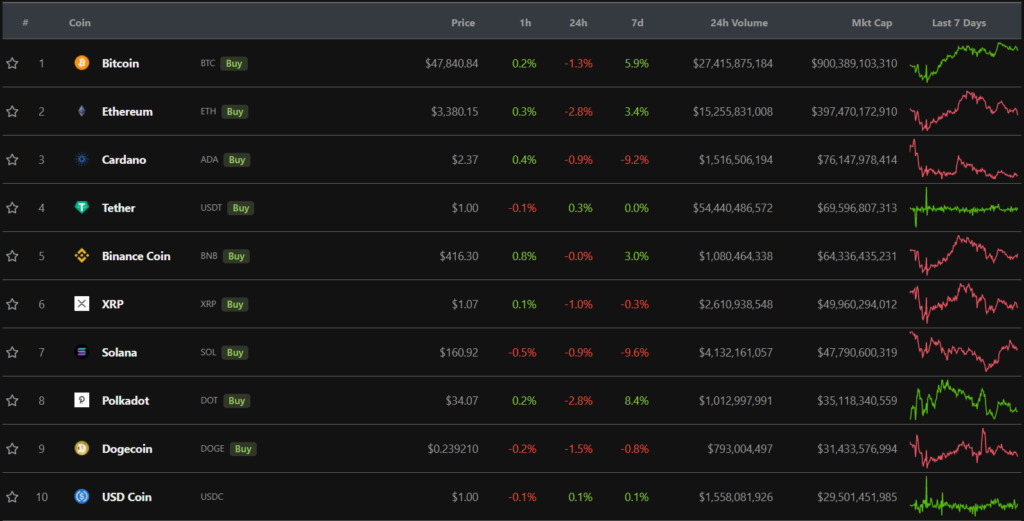
Among top-10 assets by market cap, the strongest weekly mover was Gala Games’ token GALA (+8.4%), while Solana (-9.6%) led the losses.


According to Messari, the week’s biggest gainer was Gala Games’ token GALA, up 456% to $0.118 with a market capitalization of $862 million.


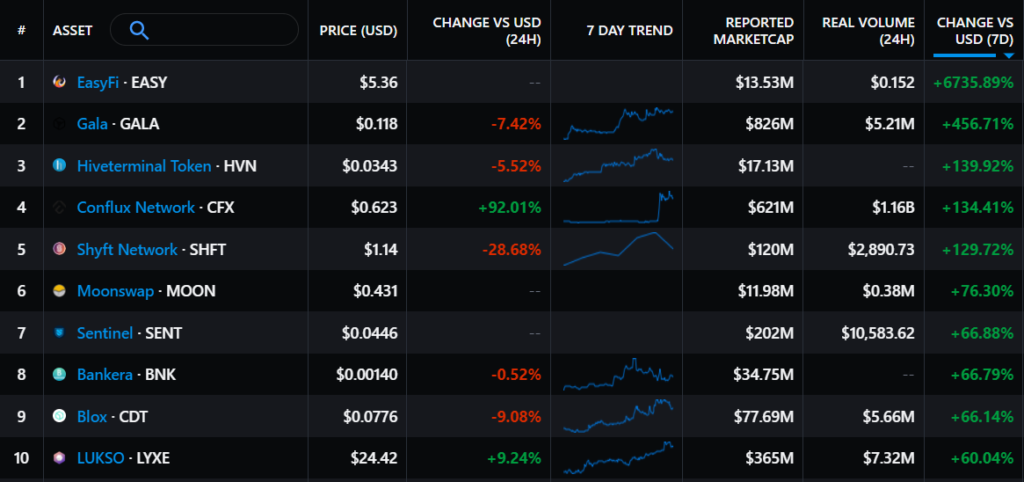
The biggest weekly drop belonged to Harmony’s ONE token, down 26%, with a market cap of $1.68 billion.


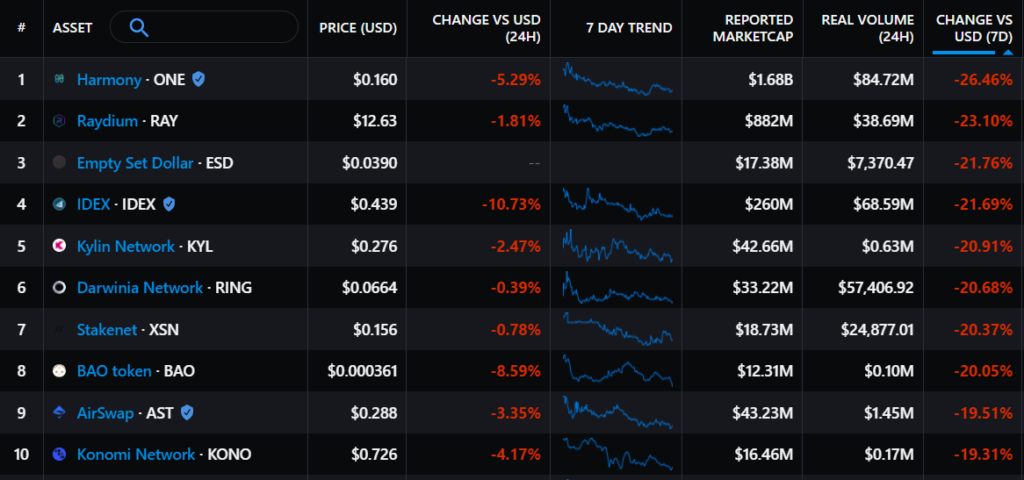
The cryptocurrency market’s total capitalization stood at $2.22 trillion. Bitcoin’s dominance index slipped to 40.5%.
Bank of Russia Tightens Crackdown on Cryptocurrencies
The Bank of Russia defined eight criteria that would allow banks to identify cards and electronic wallets used by shadow economy operators. The regulator also proposed to slow bank payments to Bitcoin exchanges. First Deputy Chairman of the Bank of Russia Sergey Shvetsov clarified that the central bank is considering legislative changes to “more clearly prohibit” the use of cryptocurrency and to introduce administrative and criminal liability.
One day later the BoR opposed access by non-qualified investors to Bitcoin, noting that digital currencies exhibit features of a financial pyramid. Analysts believe the regulator’s announced prohibitions will hit Bitcoin exchangers and miners.
Walmart Denies News of Litecoin Collaboration
On September 13, GlobeNewswire published a press release purportedly from Walmart stating the retailer would add a Litecoin (LTC) payment option. The coin jumped about 35% immediately, lifting the market higher. However, the community questioned the report’s credibility — the domain from which the release originated had been registered roughly a month earlier.
Confidence in the story was boosted by the Litecoin Foundation itself. The organisation’s official account retweeted the post, but after the retraction Walmart removed it. LTC, like the rest of the market, began to fall rapidly.
Later, Litecoin founder Charlie Lee admitted that the organisation had bungled. He said anyone could add Litecoin support without prior approval, so he himself thought it was true.
Solana Block Produces 16-Hour Outage; Arbitrum Also Encounters Technical Difficulties
On September 14, a technical outage occurred in Solana’s beta mainnet — the blockchain stopped producing new blocks. Developers found that spam transactions exhausted the network’s resources. Project founder Anatoly Yakovenko urged validators to prepare for a restart.
More than 16 hours later, validators successfully completed the restart of the mainnet beta after updating the node software to version 1.6.25. The incident did not have a notable impact on SOL’s price.
That same evening, Ethereum scaling protocol Arbitrum also faced issues. A 45‑minute outage occurred due to a bug in the Sequencer contract. During this period the network did not process transactions, but developers quickly fixed the issue.
Bitcoin Core 22.0 Released with Taproot Support
The Bitcoin developers unveiled a new software release for Bitcoin Core 22.0. It includes support for the forthcoming major Taproot upgrade scheduled for November 2021.
Cardano Developers Add Smart Contracts to Mainnet
On September 13, developers of the third-largest cryptocurrency Cardano (ADA) activated the Alonzo upgrade, enabling Plutus smart contracts to run on the mainnet. The vast majority (99%) of contracts remain inactive, with a temporary locking status.
Binance Abandons Decentralised Model; CFTC to Review
According to Binance chief Changpeng Zhao, the Bitcoin exchange is transforming into a licensed entity with a centralized business. Regulatory troubles pushed the move.
Spurred by regulators, Bloomberg reported on plans for the CFTC to examine Binance for insider trading and market manipulation. An agency source said the regulator suspects the company of conducting proprietary trades based on customer orders prior to execution. No charges have been filed yet.
Coinbase Places $2 Billion in Debt Market
On September 13, Coinbase, the largest U.S. cryptocurrency exchange, announced a private placement of two callable bonds due 2028 and 2031, with a total face value of $1.5 billion. A day later the company raised the target to $2 billion “in light of strong market demand”.
Each issue will now be worth $1 billion. The 2028 maturity bonds carry a coupon of 3.375%, while the 2031 notes pay 3.625%.
This week Coinbase also filed to register as a futures intermediary and signed a software contract with ICE.
Ripple to Provide SEC with Internal Records
The fintech company Ripple will provide the SEC with internal audio and video recordings — covering meetings dating back to Q4 2014.
Media also found out the reason for the SEC’s divergent approach to Ethereum and XRP.
Shiba Floki Surges 1,300% on Elon Musk’s Tweet; Shiba Inu Rises on Coinbase Listing
Earlier in the week, Elon Musk boasted a photo of his Shiba Inu puppy named Floki, which spurred a rally in several meme tokens. Within three hours of the tweet, Shiba Floki jumped 1,309% and Floki Inu 139%.
At week’s end, Coinbase conducted a listing of the meme token Shiba Inu (SHIB). SHIB reacted with a near 40% gain.
Bitcoin’s Legal Tender Status Sparks Protests in San Salvador
Residents of San Salvador took to the streets on September 15, the country’s bicentennial, to protest the legalisation of Bitcoin and President Nayib Bukele’s recent consolidation measures.
Some protesters wore shirts reading “No to Bitcoin.” Radical demonstrators set alight one of the ATMs offering conversion to digital gold.
On the eve of this, Bukele announced that the Chivo wallet user base had reached 500,000, or roughly 7% of the population. He acknowledged there were technical difficulties implementing Bitcoin payments due to tight launch timelines and said the government will exempt foreign investors from capital gains tax and the withholding tax on Bitcoin transactions.
U.S. Infrastructure Bill Raises Crypto Reporting Clarity
The modification to Section 6050I of the U.S. Internal Revenue Code will require recipients of digital assets above $10,000 to verify the sender’s personal information. Similar rules already apply to fiat transfers.
Earlier media reported on Democrats’ plans in Congress to close tax loopholes in crypto reporting. The infrastructure plan proposed amendments extending the wash-sale rule to cryptocurrency trades. However, the document remained unchanged.
Also this week in Congress, SEC Chair Gary Gensler testified. With Senator Elizabeth Warren they hinted at forthcoming regulation of crypto exchanges, pointing to the recent Bitcoin slump following exchange outages and rising Ethereum network activity.
Fake Bitcoin Giveaway Tied to Apple Event
Hackers exploited the Apple event hype to run a fake cryptocurrency giveaway using the classic “get double what you send” scheme.
During the stream, the scammers also displayed a message claiming Apple would buy 100,000 BTC. At one point the stream trended on YouTube, drawing 165,000 viewers.
Earlier this week Apple blocked the mobile wallet Gnosis Safe’s update due to the feature storing third‑party NFT.
Laos Legalises Mining and Crypto Trading
The authorities in Laos approved mining and trading of Bitcoin, Ethereum and Litecoin for six companies. The decision comes a month after the central bank warned of crypto-related risks.
A number of analysts described the move as sensible given the country’s excess hydroelectric capacity and China’s crackdown on miners.
Ray Dalio: Regulators Will Kill Bitcoin if It Succeeds



Interactive Brokers Begins Trading Cryptocurrencies
The brokerage Interactive Brokers, in partnership with Paxos opened to U.S. clients access to Bitcoin, Ethereum, Litecoin and Bitcoin Cash. Fees will range from 0.12% to 0.18% of trade value depending on monthly volume.
Google Cloud Teams with Dapper Labs to Support Flow
The Google Cloud platform has begun collaborating with Canadian startup Dapper Labs, the creator of the NFT project NBA Top Shot and the Flow blockchain. Google Cloud will provide the infrastructure to scale Flow-based applications.
This week Dapper Labs led a $5 million seed round for the music NFT platform RCRDSHP.
FTX Cup #1 Trader Tournament Starts on September 25
The prize pool for FTX Cup #1 stands at $54,800 across three categories: trading volume, trader strength and additional categories. To participate, you must complete KYC1 verification, create a sub-account named “TradeLink” and deposit at least $200.
The tournament runs until October 25. Registration deadline is October 24, here.
Ernst & Young Integrates Polygon Protocol to Scale Ethereum Solutions
The Big Four auditor EY added Polygon protocol and framework support to its Ethereum-based solutions, reflecting the firm’s shift to scaling capabilities for the second-largest cryptocurrency.
The integration will help the firm increase transaction volumes, delivering “predictable costs and settlement times” for corporate Ethereum-based solutions. The auditor will also be able to move transactions from the Polygon sidechain to the public Ethereum network.
40 of 60 Bitcoin Exchanges to Close in South Korea
On September 24, roughly 40 of the 60 cryptocurrency exchange operators in South Korea will cease operations for failing to meet local regulator requirements. The rules include KYC procedures in cooperation with partner banks.
Also on ForkLog:
- NFT marketplace OpenSea fired a staffer accused of insider trading.
- Official damages in the Finiko pyramid case exceeded 1 billion rubles.
- In Budapest they opened a statue of Satoshi Nakamoto.
- Charles Hoskinson warned of bubbles forming in DeFi and NFT markets.
What to Read and Watch Next
In 2021, non-fungible tokens became one of the hottest topics in the crypto industry. Some argue the technology could exacerbate existing problems in the art market, long dubbed the “perfect venue for money laundering.” ForkLog has looked into whether these fears are justified.
In traditional digests, we present the week’s main stories in cybersecurity and artificial intelligence .
For the most significant DeFi news, refer to our “DeFi Herald”.
On September 13, in a ForkLog live broadcast, we discussed crypto prospects and Ukraine’s Law on Virtual Assets, with guests Deputy Minister of Digital Transformation of Ukraine for IT development Alexander Bornyakov and trader Vladimir Koen.

Subscribe to ForkLog’s updates on VK.